



Françoise-marie De Bourbon - Studio Of Pierre Gobert (1662–1744), Late 17th Century
Artist: Atelier De Pierre Gobert (fontainebleau, 1662-paris, 1744)
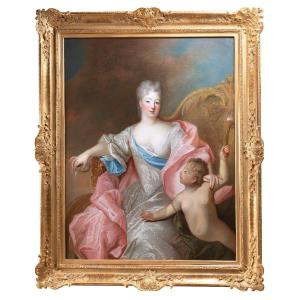
Françoise-Marie de Bourbon, Duchess of Orléans, as Flora
Studio of Pierre Gobert (1662–1744)
French School, late 17th century, circa 1695
Oil on canvas
Dimensions: h. 65 cm × w. 52 cm
17th century French finely carved giltwood frame with floral corners
Framed dimensions: h. 84 cm × w. 70 cm
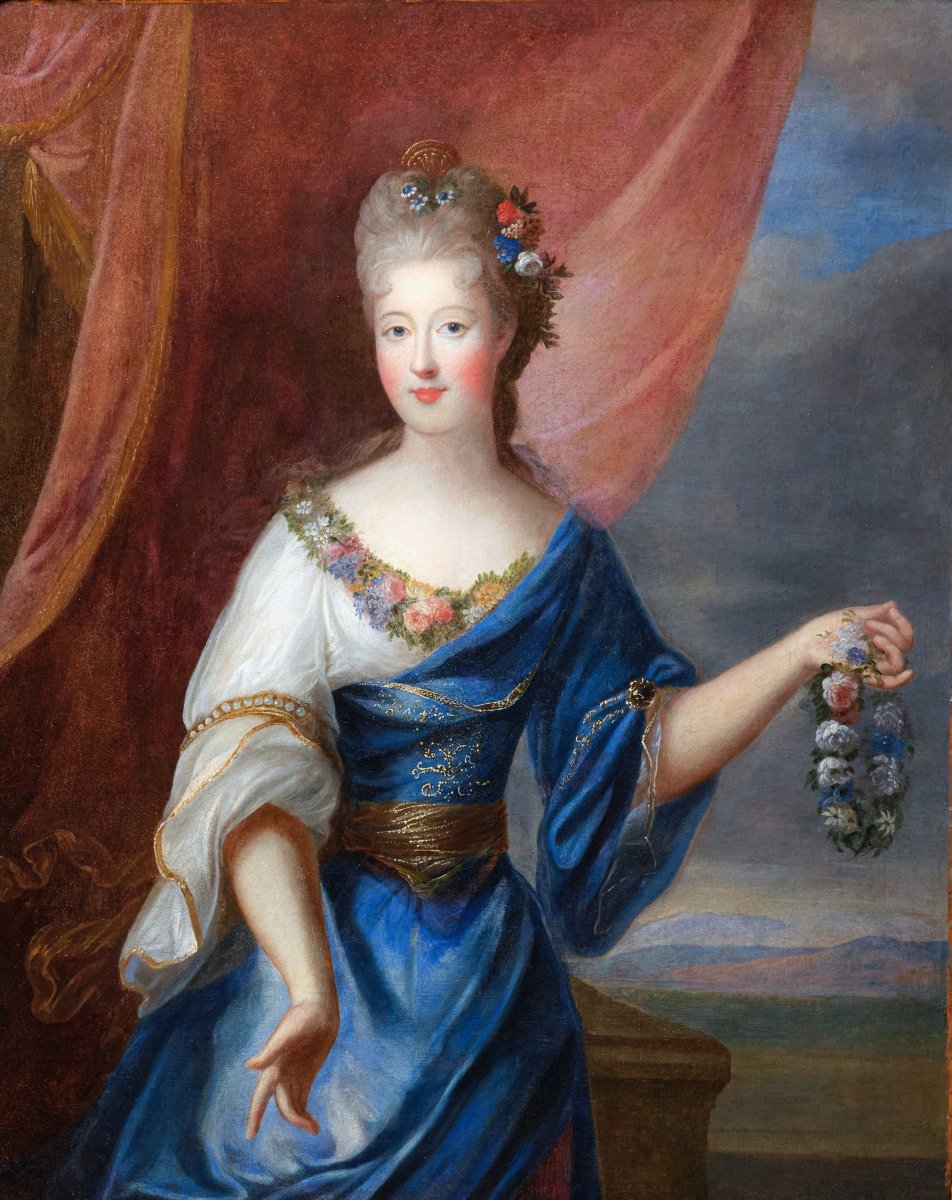
A charming portrait of Françoise-Marie de Bourbon, Duchess of Orléans, depicted as Flora, goddess of flowers and spring.
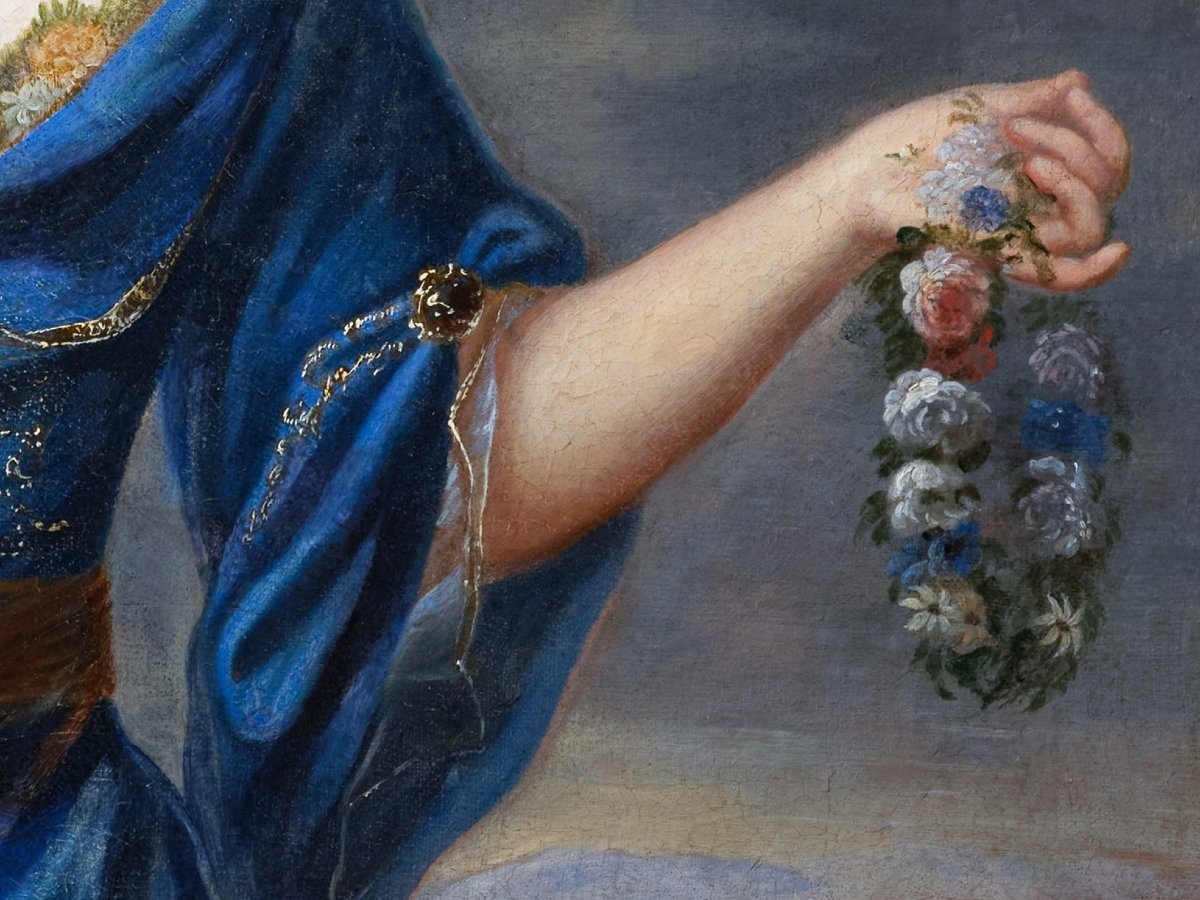
The princess is portrayed half-length, her body slightly turned and her face almost frontal, before a sweeping crimson curtain opening onto a landscape of distant hills. She regards the viewer with gentle assurance. Her raised left hand holds a garland of flowers, while her right hand opens in a graceful gesture, its fingers delicately extended.
Her elongated face, with its porcelain complexion, has full cheeks that taper towards a small chin. Light blue eyes, a straight nose and a small mouth with vermilion lips compose a serene countenance enlivened by a discreet smile. The rosy cheeks lend warmth and freshness to the pale flesh tones.
Her powdered hair is arranged high in the Fontanges style, with long, loose locks falling over her shoulders and down the nape of her neck. Two curled locks frame her forehead and soften the oval of her face. A gold diadem crowns the coiffure, which is adorned with small white, blue and red flowers interspersed with foliage, complementing the sitter’s guise as Flora.
The princess wears a low-cut white chemise, its ample sleeves gathered with pearl ornaments and edged with gold braid. A floral garland borders the neckline, setting off her décolletage. Her blue gown envelops her torso and falls in broad folds around her figure; embellished with gold motifs and borders, it is gathered at the waist by a wide golden-brown sash and secured near the shoulder with a garnet-set clasp.
This magnificent blue gown, with its sumptuous folds and luminous highlights, lends the composition all its splendour.
Flowers provide the unifying thread throughout the composition. Arranged in the hair, along the neckline and in the garland held in her hand, they merge the sitter’s adornments with the attributes of Flora. Their pink, white and blue hues echo the colours of her complexion and garments, poetically evoking beauty and the abundance of spring.
Far removed from strictly ceremonial court dress, the flowing sleeves, golden sash and freely arranged drapery form a fanciful costume inspired by classical antiquity. The mythological guise thus combines the distinction of the princely sitter with a freer expression of grace. The crimson curtain accentuates the pale flesh tones and the depth of the blue, while the opening onto the landscape lends spaciousness to the composition.
Pierre Gobert (1662–1744)
Admitted to the Royal Academy of Painting and Sculpture in 1701, Pierre Gobert worked for the courts of France and Lorraine, as well as for the Orléans, Condé and Conti families.
The present painting exemplifies the elegant pictorial language associated with his workshop: softly rendered features, composed poses, delicate gestures and a taste for fanciful costume. The portrayal as Flora, the richness of the fabrics and the delicacy of the floral adornments combine to create a refined image of the sitter, in which princely dignity meets the poetry of mythological portraiture.
Françoise-Marie de Bourbon (1677–1749), known as the second Mademoiselle de Blois, was the daughter of Louis XIV and Madame de Montespan. She married Philippe d’Orléans, the future Regent of France.
9 500 €
Period: 17th century
Style: Louis 14th, Regency
Condition: Excellent condition
Material: Oil painting
Width: l. 70 cm
Height: h. 84 cm
Reference (ID): 1848279
Availability: In stock
Print