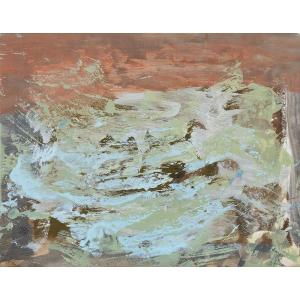
Paul Guigou (1834–1871) - Washhouse In Cassis
Washhouse in Cassis
Painting, oil on canvas, signed lower right
16 x 22 cm
Origins and Early Calling: From the Vaucluse Countryside to Painting
Born in 1834 in Villars, in the heart of the Apt region, Paul Guigou grew up in a family of wealthy landowners. Destined to pursue a career as a notary in accordance with family tradition, he attended the middle school in Apt and then worked as a notary’s clerk in Marseille beginning in 1854. However, his irrepressible passion for the visual arts quickly took precedence over law.
In Marseille, Guigou began painting as a self-taught artist before attending the studio of Émile Loubon, a leading figure of the Provençal landscape school. Loubon instilled in him a decisive taste for painting from life, far removed from the academic conventions of the studio. Dazzled by the boldness of the southern landscapes, Guigou permanently abandoned his notary practice around 1862 to devote himself entirely to painting and moved to Paris to test his vision against the capital’s innovative artistic movements.
The Parisian Avant-Garde and Faithfulness to the Provençal LandscapeIn Paris, Guigou joined the circle of artists breaking with the official art establishment. He was a regular at the Café Guerbois, a hub of intellectual exchange where the future Impressionists—Édouard Manet, Claude Monet, Frédéric Bazille, and Camille Pissarro—gathered. Yet, unlike his contemporaries, who were fascinated by the mists of the Forest of Fontainebleau or the banks of the Seine, Guigou remained unwaveringly attached to his native land.
Every summer, he returned to the Midi to paint the arid landscapes of the Vaucluse, the banks of the Durance, and the environs of Marseille:
Geometry and minerality: his compositions are characterized by vast, unobstructed horizons, straight, white roads blanched by the sun, and flanked by limestone hills and steep cliffs.
Uncompromising realism: far from picturesque exoticism or an idealized rural idyll, he painted a harsh, rugged, and silent Provence, punctuated by washerwomen at work, peasants bent under the strain of labor, or solitary horse-drawn carts.
A harsh, crystalline light: Guigou is the painter of great clarity. His palette, dominated by ochres, Sienna earth tones, intense azure blues, and dazzling chalky whites, conveys with unparalleled authenticity the bite of the sun and the sweeping force of the mistral.
Stylistically, Guigou’s work anticipates the breakthroughs of modernity. Frequently using horizontally elongated formats (panoramic formats), he stretches the space to better contrast the mineral mass of the earth with the immensity of the pure sky.
His brushwork is bold, dense, and block-like, often applied with a palette knife or in broad, vigorous swaths of color. This economy of means, combined with remarkable constructive rigor, places him alongside a young Paul Cézanne—whom he knew at the time—among the precursors of a formal renewal of the modern landscape.
A Cut-Short Career and Posthumous RecognitionDespite regularly submitting works to the Paris Salons beginning in 1863, Paul Guigou struggled to make a living from his art during his lifetime, facing the indifference of a public accustomed to the muted tones of northern landscapes. To support himself, he taught drawing and worked as an art critic.
In December 1871, just as he was finally beginning to receive praise from discerning critics such as Théophile Gautier, Paul Guigou was suddenly struck down in Paris by a stroke, at the age of only 37.
Rescued from obscurity at the end of the 19th century thanks to the discerning eye of visionary dealers and savvy collectors, Paul Guigou is today celebrated as the greatest master of 19th-century Provençal landscape painting. His major works are housed in the most prestigious international museums, notably the Musée d’Orsay in Paris, the Musée des Beaux-Arts and the Musée Cantini in Marseille, as well as the Palais des Beaux-Arts in Lille.
Discover more works by this artist on the gallery’s website: https://www.galeriepentcheff.co.uk/en/peintre-paul-guigou
Period: 19th century
Style: Modern Art
Condition: Good condition
Material: Oil painting
Length: 16 cm
Width: 22 cm
Reference (ID): 1847664
Availability: In stock