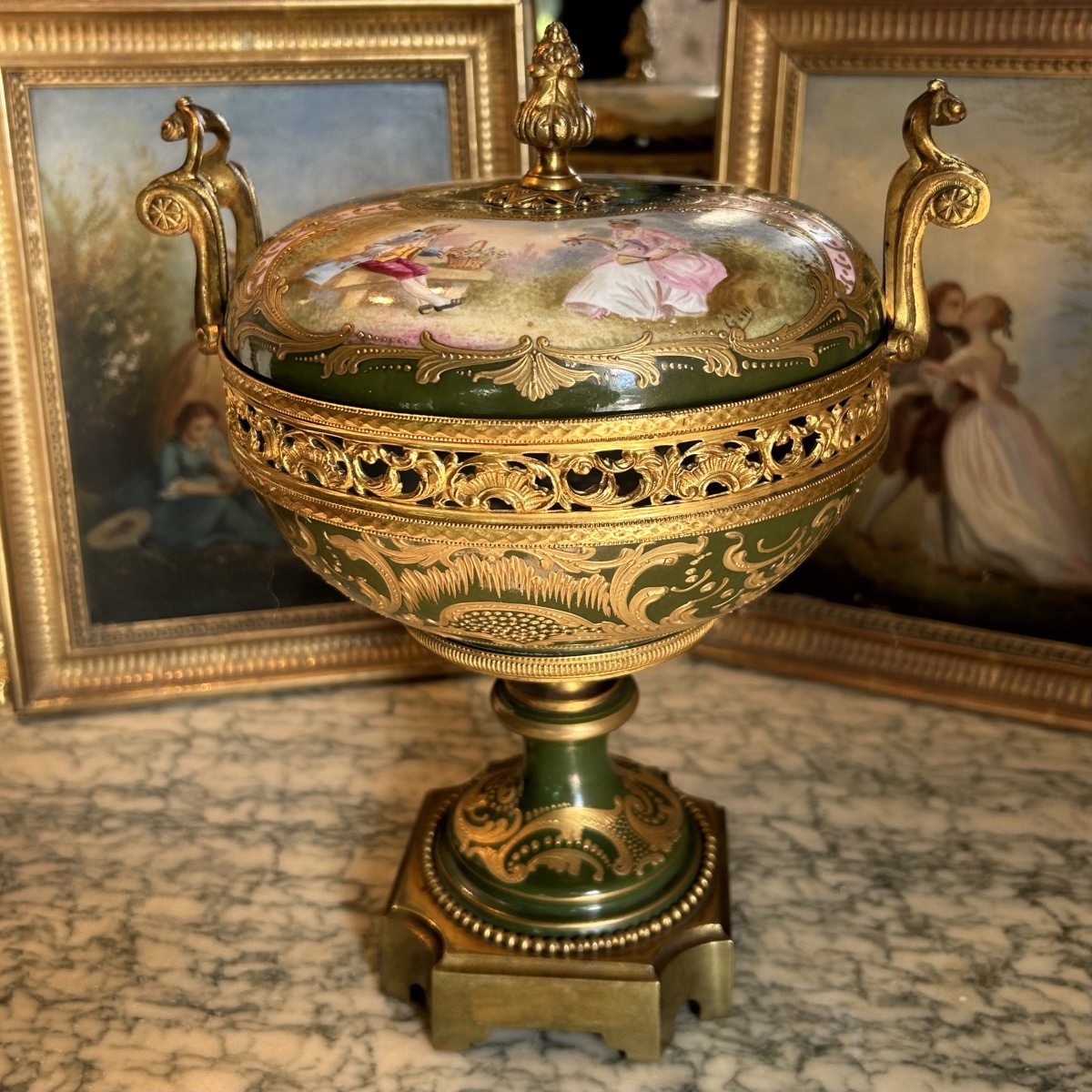


Porcelain Candy Dish, Sèvres Style—tuileries Palace, 19th Century
Artist: Manufacture Sèvres - Château Des Tuileries
Sèvres-style porcelain candy dish with an Empire-green base embellished with gilded motifs and hand-painted decorations in cartouches (or reserved areas) depicting a romantic scene on one side and a lakeside landscape on the other. Gilded bronze mount on a pedestal base with high-quality ornamentation, ornate handles, and a lid featuring a fruit-shaped bronze knob.
*The candy dish reflects the artistic trends of the Second Empire era, which was characterized by the so-called “eclectic” style a reinterpretation of the splendor of the past (notably the Louis XV and Marie-Antoinette styles, highly prized by Empress Eugénie). During the Second Empire, candy boxes served several key roles in society : A symbol of refinement and social prestige : Displayed on living room tables, sideboards, or mantelpieces in bourgeois and aristocratic homes, they attested to their owners’ financial prosperity and good taste. A reception accessory : They were used during visits, tea parties, and social gatherings to offer sweets to guests. A decorative element : Richly hand-painted and often adorned with gilding, floral motifs, or portraits, they reflected the eclectic and opulent taste of the Napoleon III style. A customary gift : They also served as refined gifts presented on special occasions or within high-society circles.
On this piece, three marks appear on the underside of the lid:
Manufacturer’s mark: “SVLP40”
Decoration mark: “Sèvres 1844”
A red stamp reading “Château des Tuileries” surmounted by a crown. In the 19th century (during the Second Empire), this red-ink stamp was affixed to pieces from official tableware sets. While some pieces bear a stamp mentioning the “Château des Tuileries,” this is an inventory or ownership stamp applied to tableware intended for that palace (which was often shared or loaned among various official residences), and does not indicate a place of production.
Period: Napoleon III
Condition: In perfect condition / Dimensions: H.27 x W.21 x D.17 cm
3 500 €
Period: 19th century
Style: Napoleon 3rd
Condition: Perfect condition
Material: Porcelain
Width: 21 cm
Height: 27 cm
Depth: 17 cm
Reference (ID): 1846168
Availability: In stock
Print