THIS OBJECT WAS SOLD
Brussels 1831–1868, Guild Staff Wreath, Solid Silver, Saint Nicholas
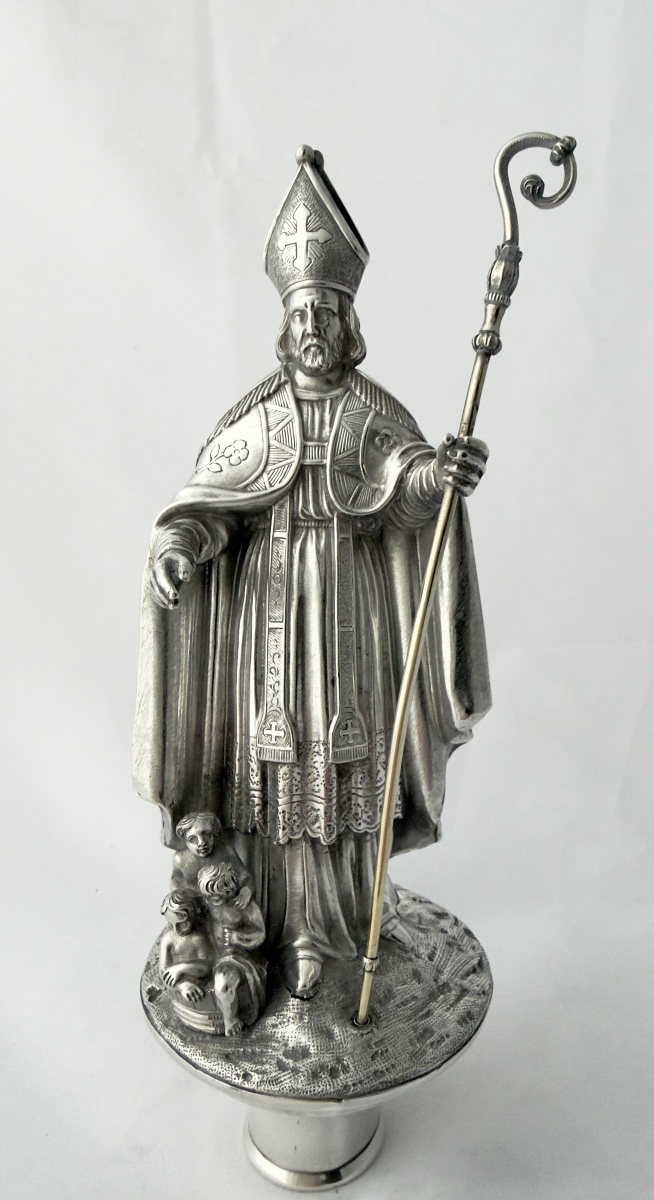
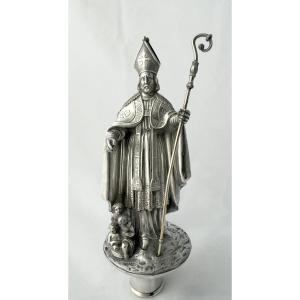


Silver Processional Staff Finial Representing Saint-Nicolas
Belgium, Brussels Assay Office, 1831–1868
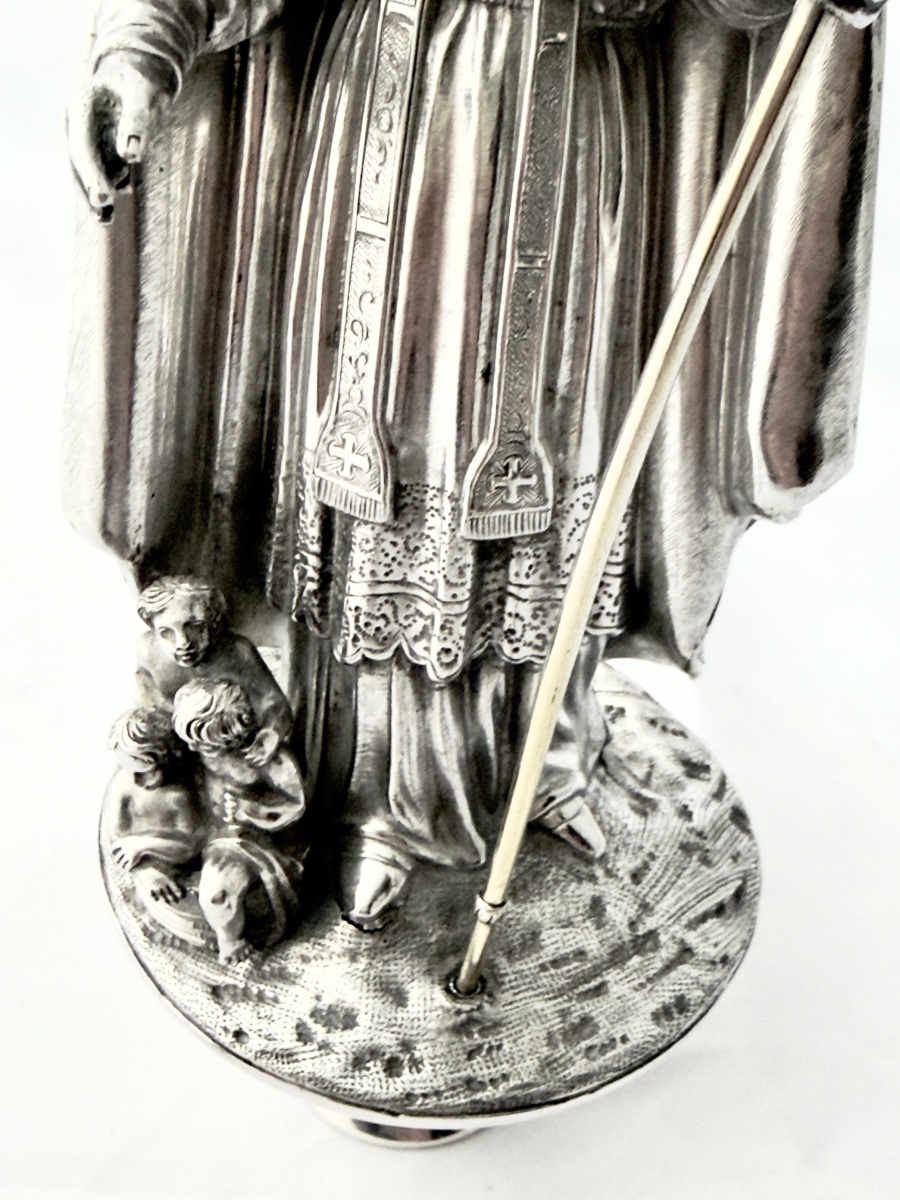
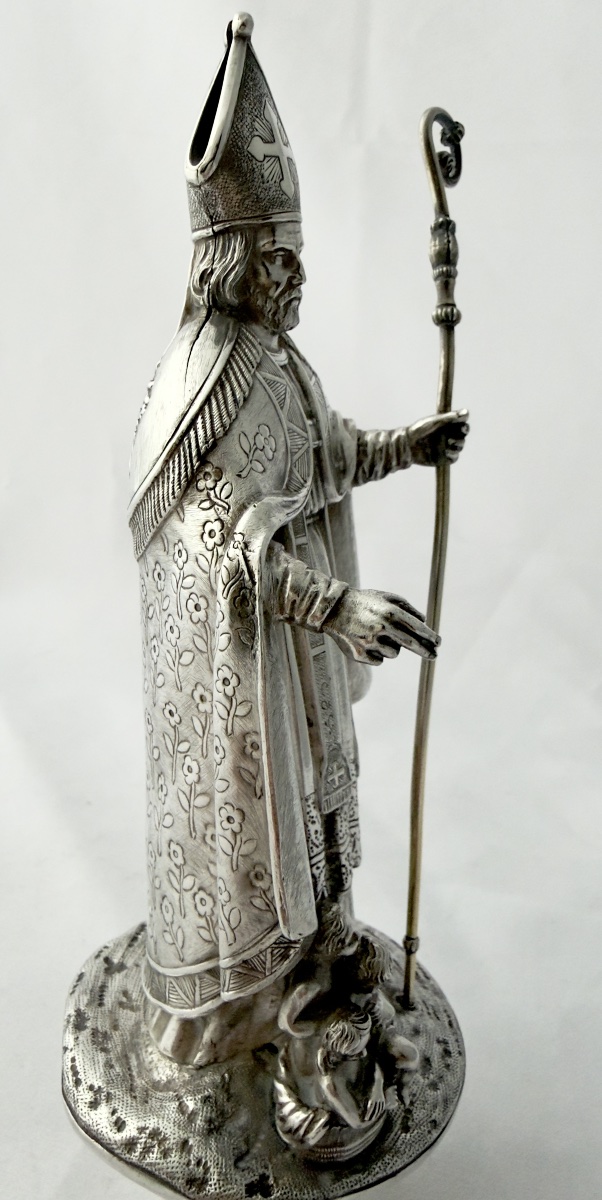
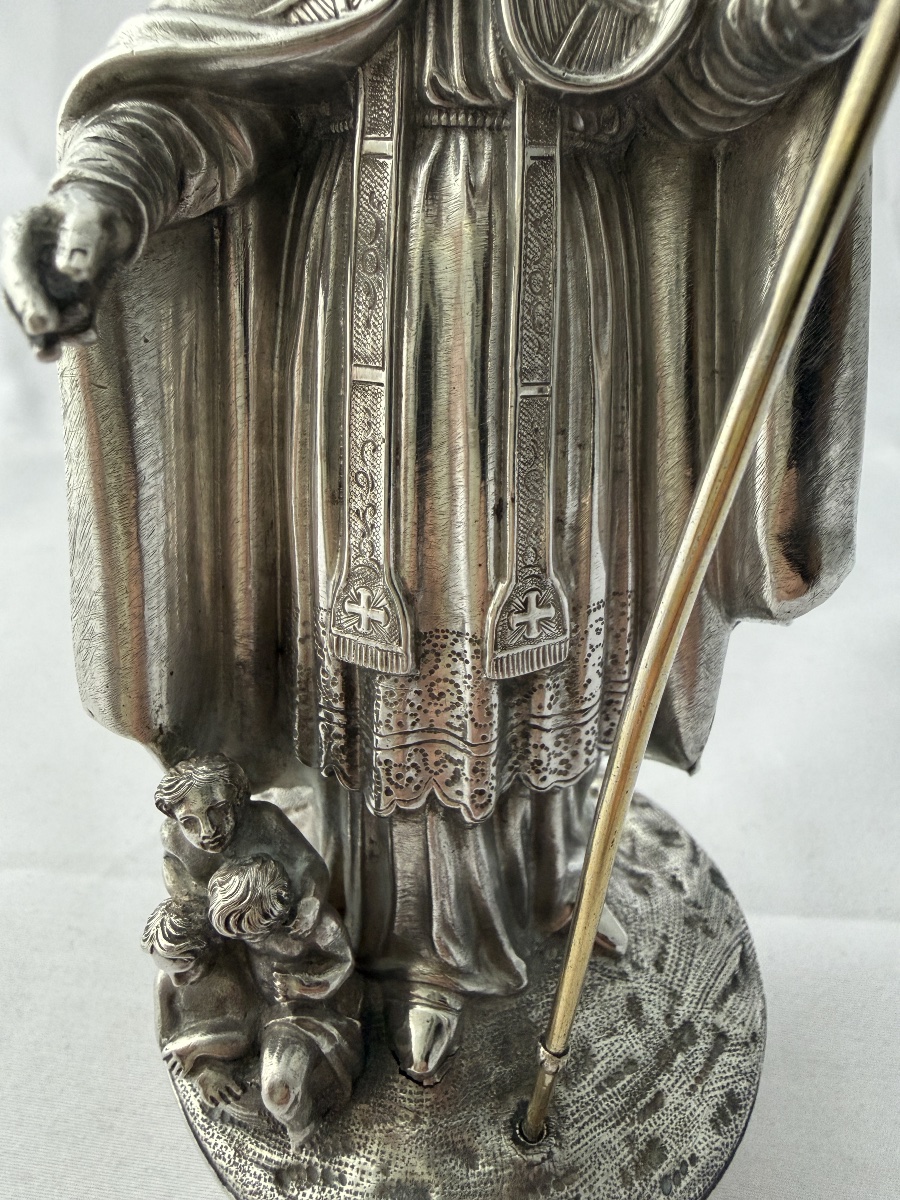
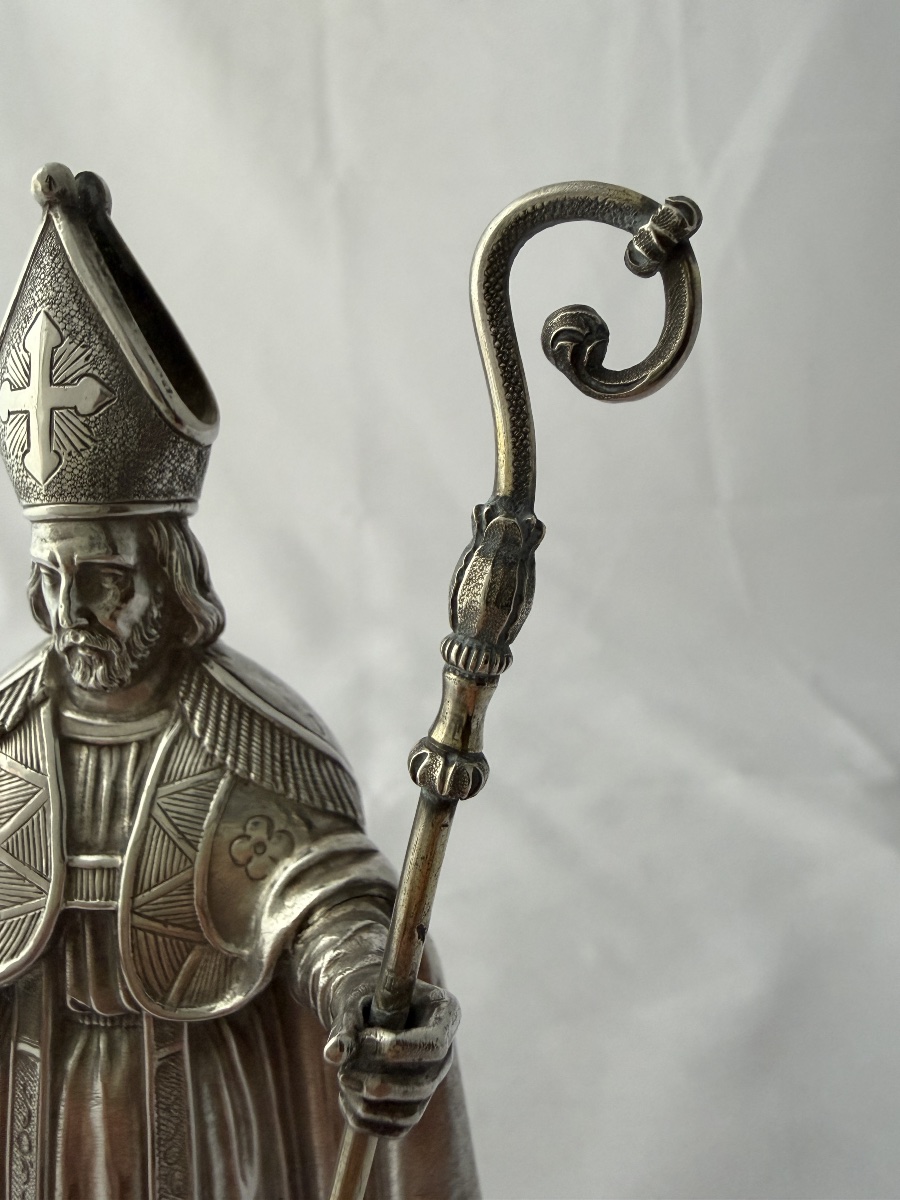
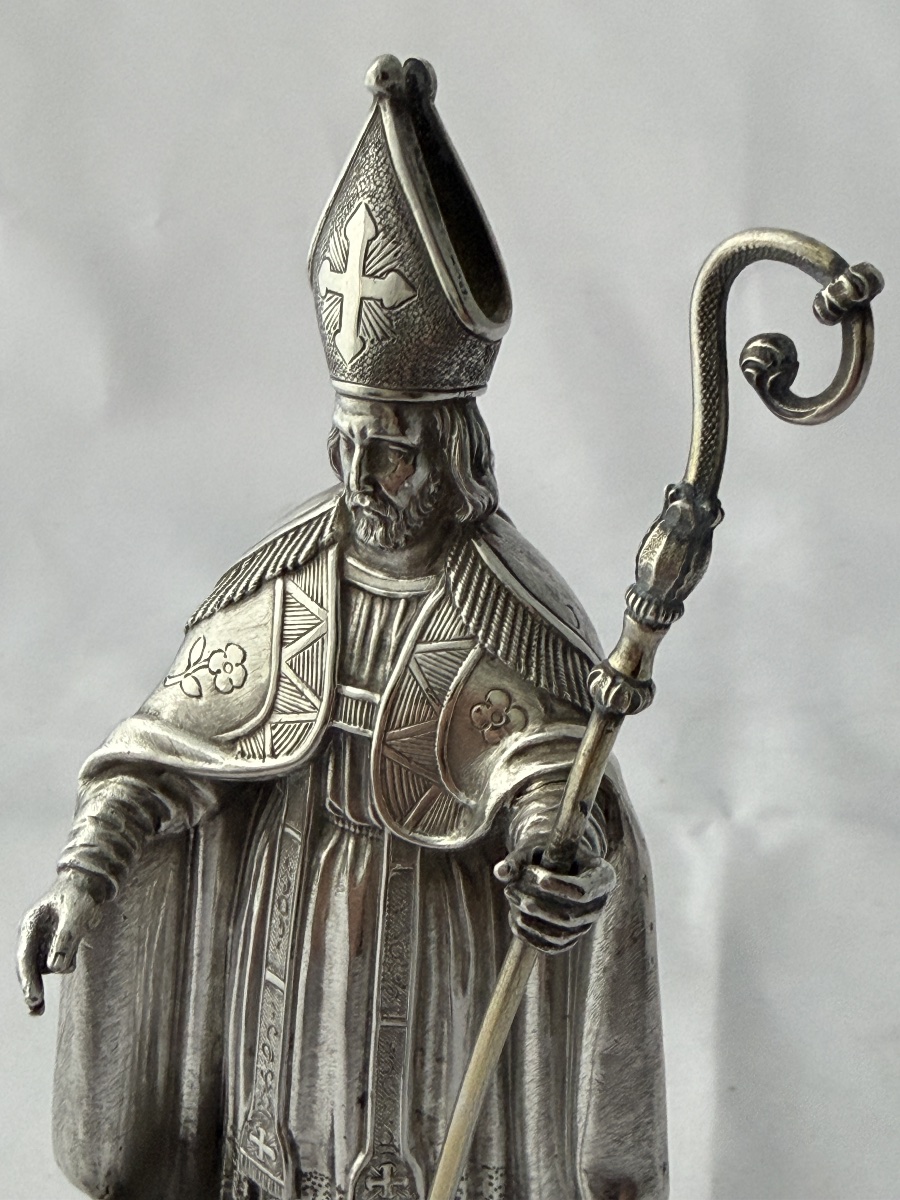
This solid silver staff finial depicts Saint-Nicolas standing in episcopal vestments. The saint holds a long crozier with a scrolled head in his left hand and extends his right hand in blessing. At his feet, three children gathered in a tub provide his immediately recognisable attributes. They recall the medieval legend according to which Saint-Nicolas restored to life three children who had been killed by a butcher and placed in a salting tub.
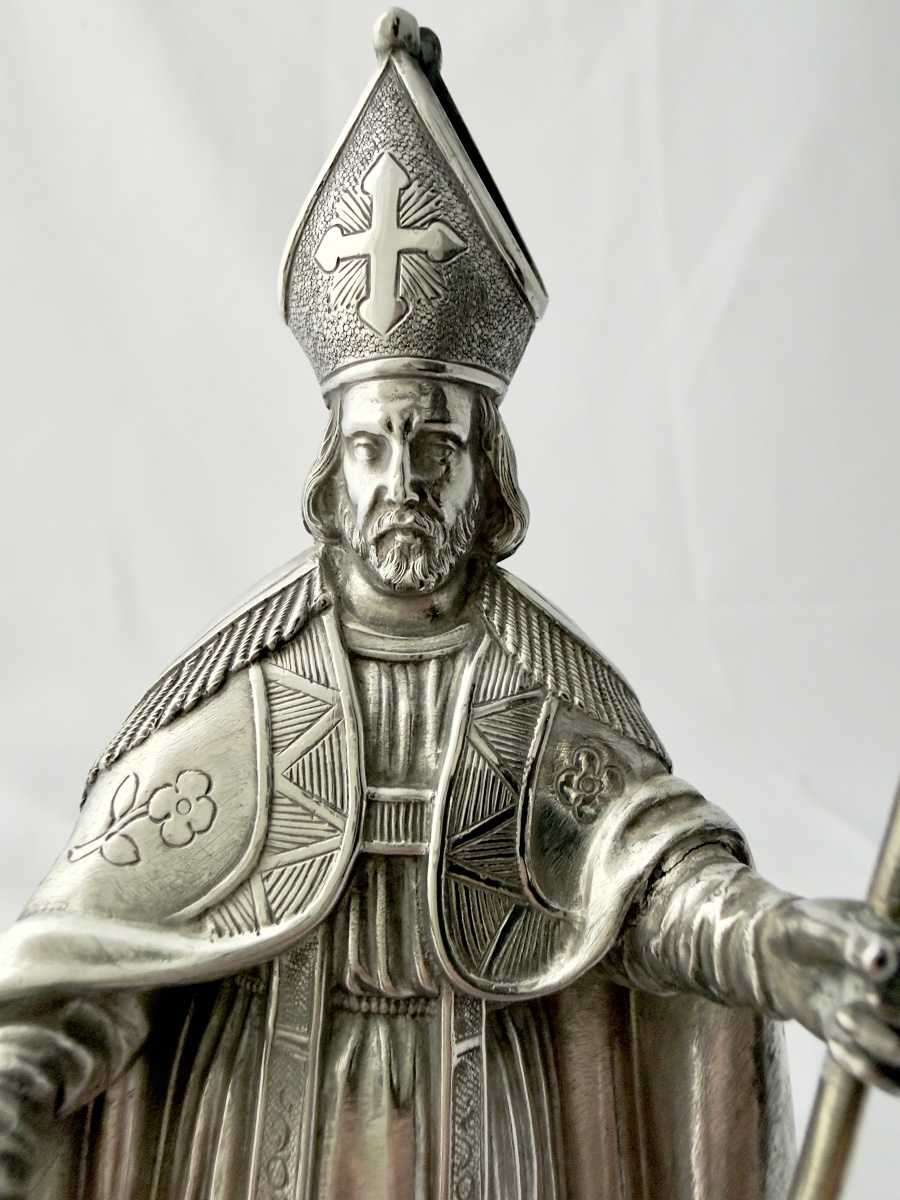
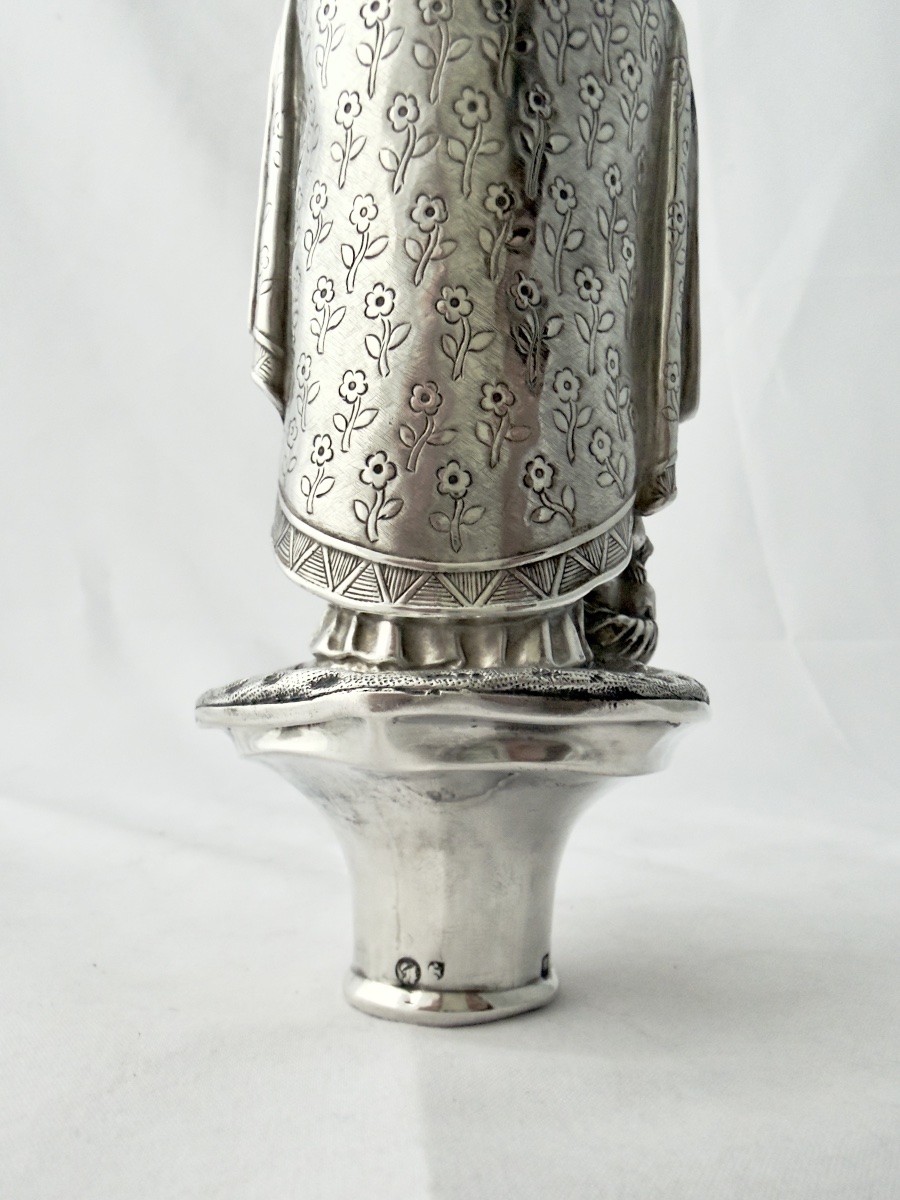
His bearded face, framed by wavy hair, is crowned by a tall mitre decorated with a radiant cross against a matted ground. The vestments display particularly careful decoration: long vertical folds, a border imitating lace, and a stole engraved with scrolling foliage and terminating in crosses. A broad cope envelops the figure. Its decoration combines scattered flowers on leafy stems, bands of hatched triangular motifs, and a fringed border.
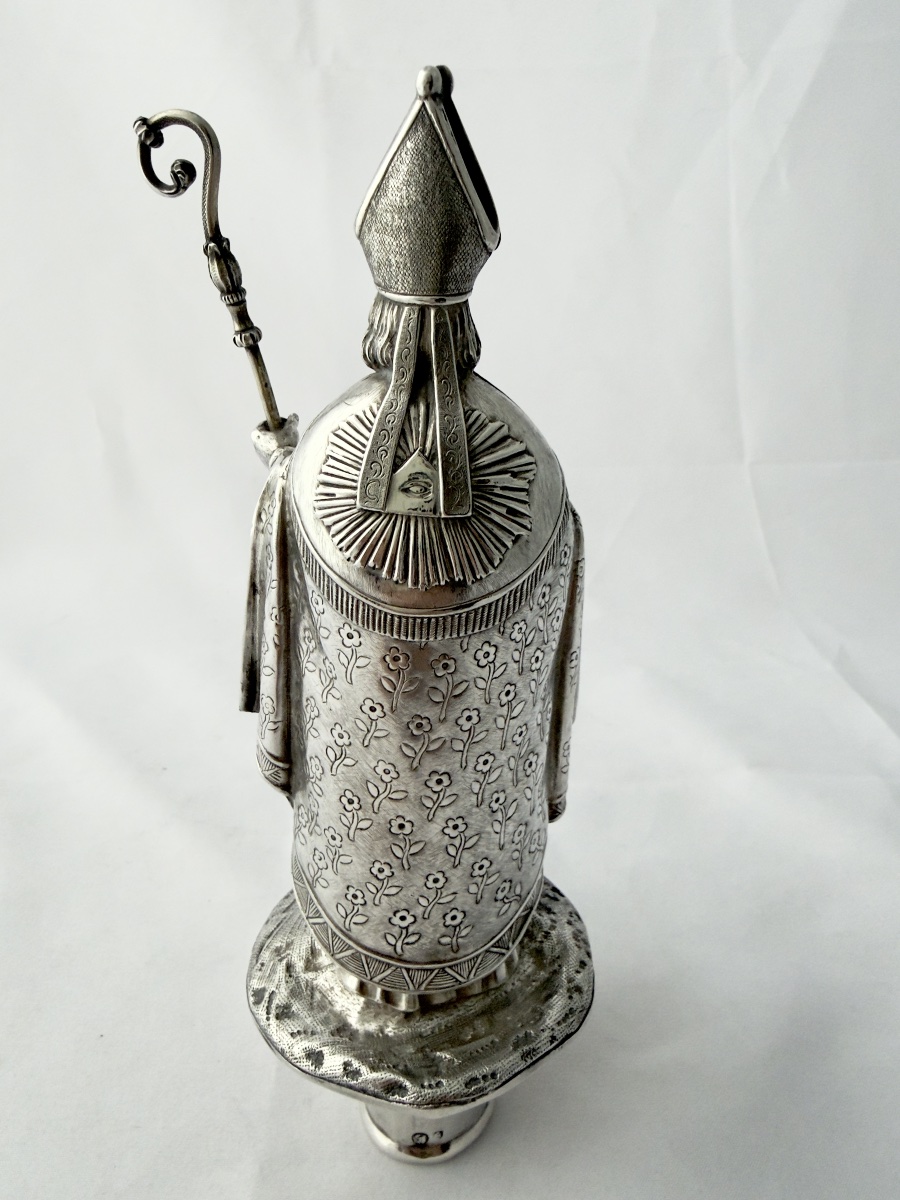
The reverse receives the same decorative attention. Beneath the two lappets of the mitre appears an eye within a radiant triangle, symbolising Divine Providence. The care devoted to every side is appropriate to an object intended to be viewed during a procession. The figure stands on a circular base with an uneven relief and stippled surface suggesting natural ground. Beneath this base, a flared socket allowed the finial to be mounted on a staff.
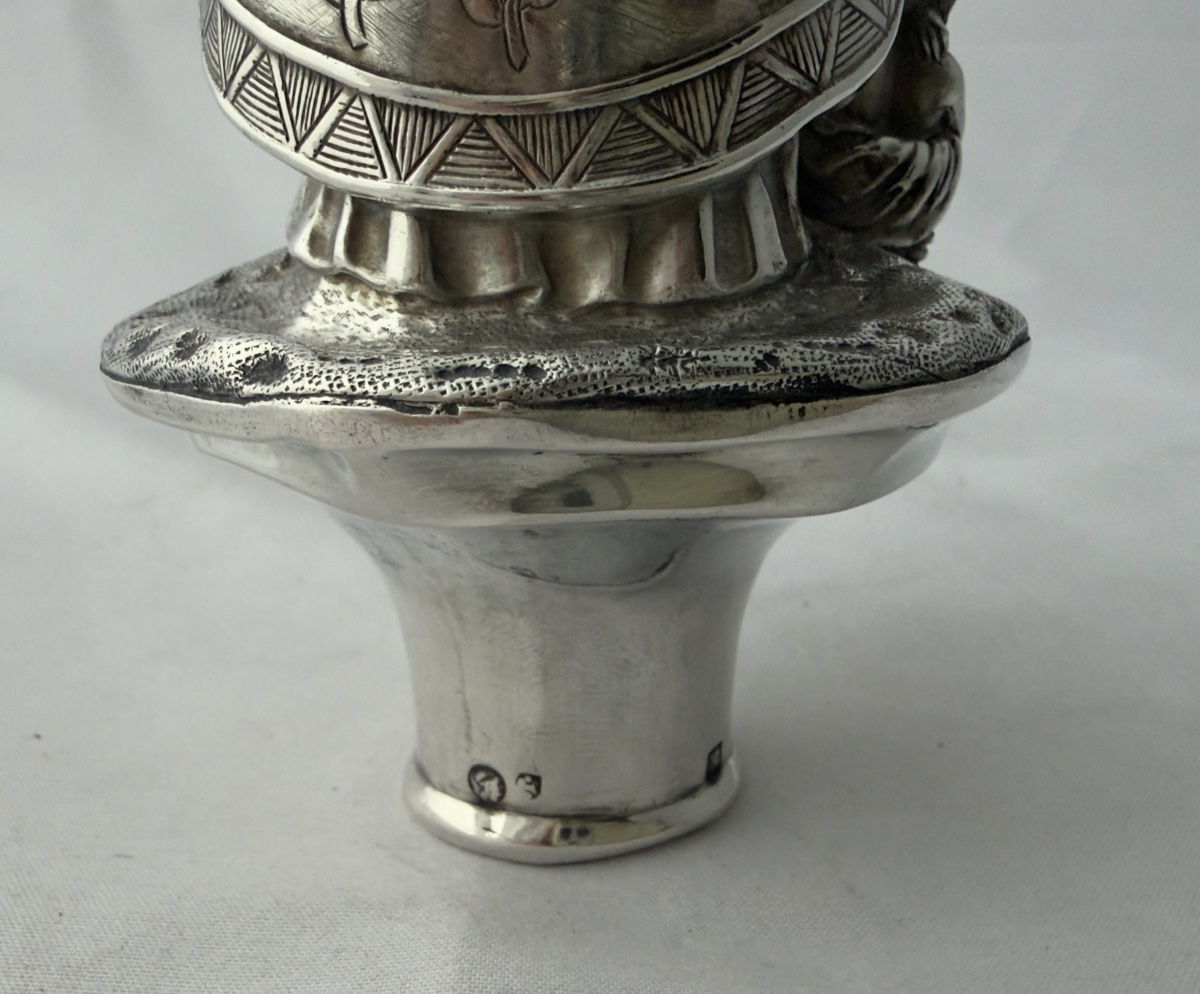
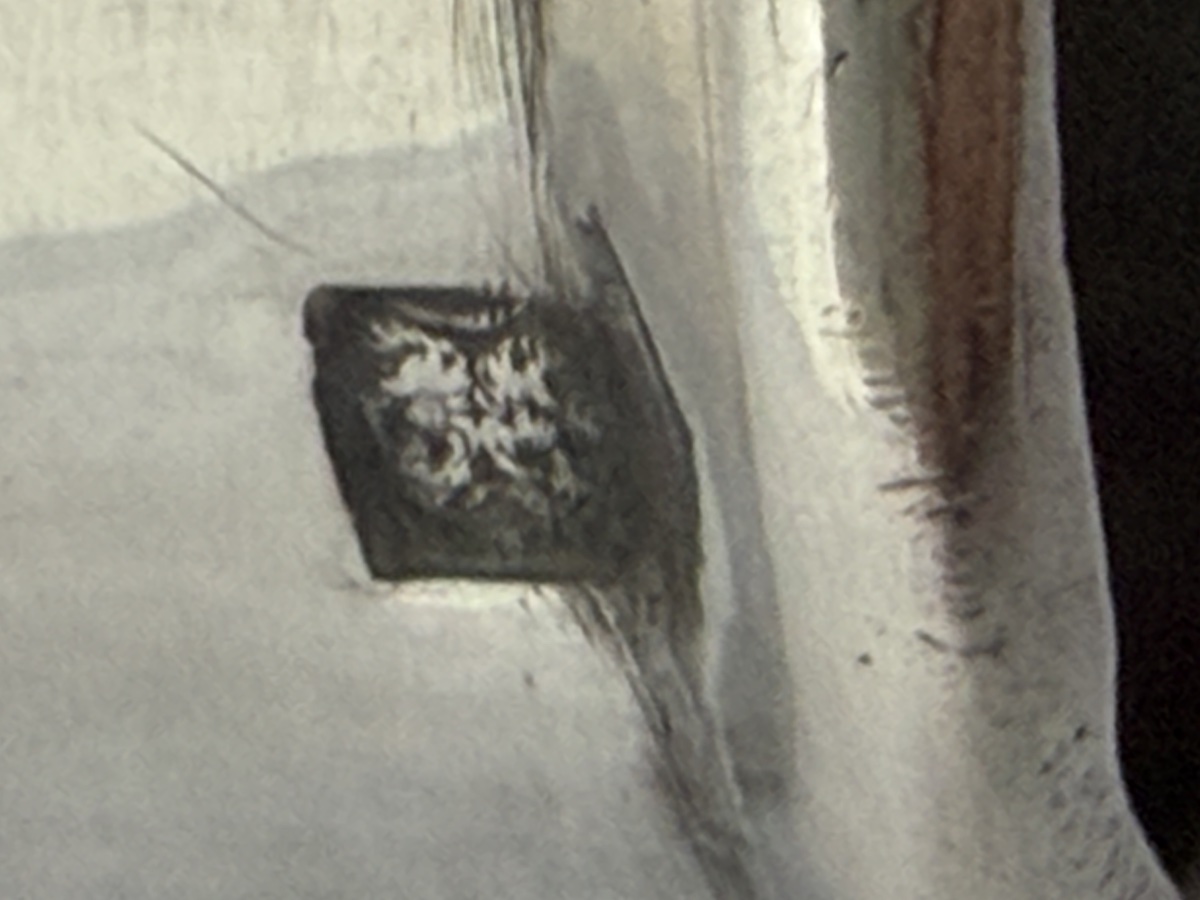
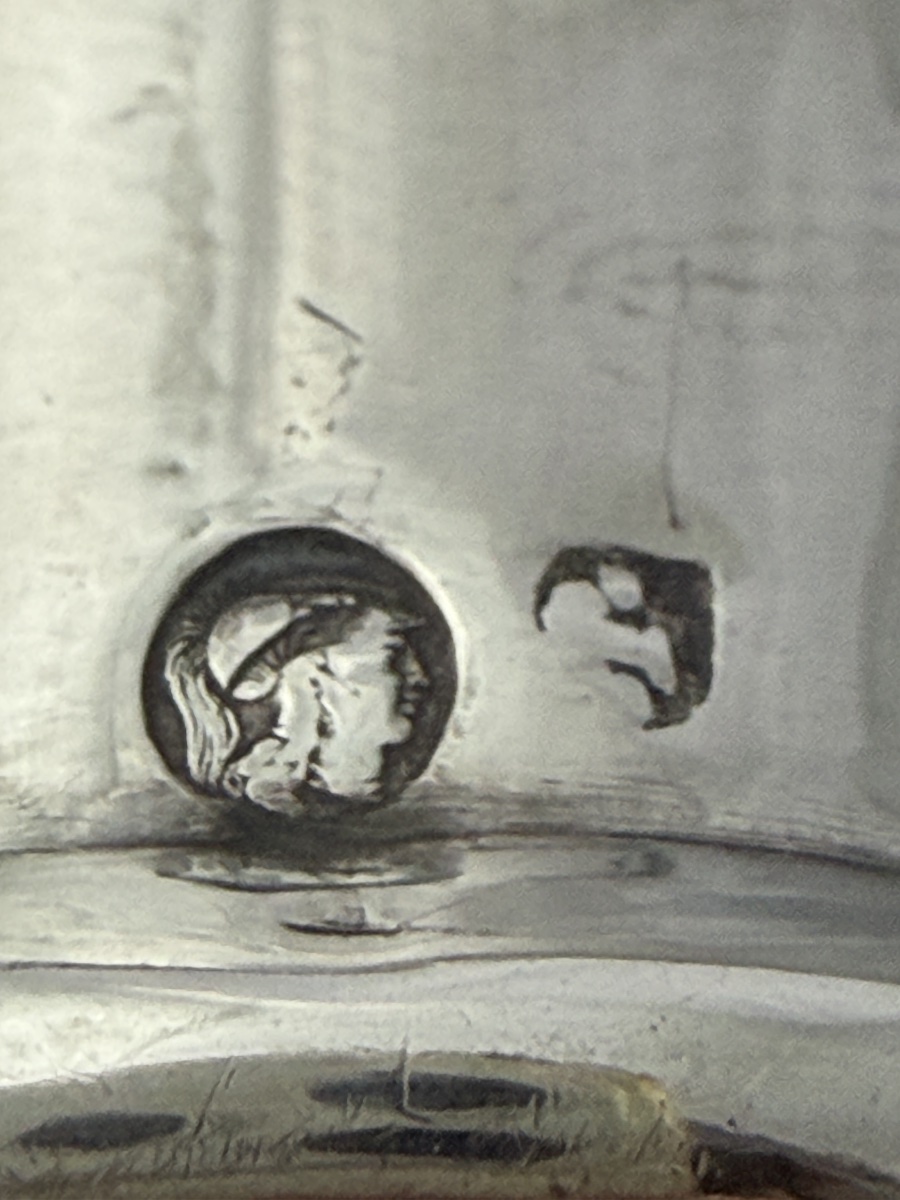
The socket bears the Belgian standard and guarantee marks used between 1831 and 1868: the double-faced Janus mark, corresponding to the second silver standard of 800 parts per thousand, and the helmeted head of Minerva bearing the letter of the Brussels Assay Office. A less clearly struck maker’s mark reveals a capital T accompanied by two pellets. Its legibility does not permit a secure identification of the silversmith. (silvercollection.it)
This object formed the finial of a confraternity staff. Such staffs served as emblems of a religious community, a devotional association, or a trade confraternity placed under the protection of a patron saint. Depending on local custom, they were carried by the president, dean, or another office-holder, ahead of the association’s representatives during ceremonies and processions, both within the church and through the streets of the parish. They expressed the dignity of their bearer and the collective identity of the group.
Saint-Nicolas was Bishop of Myra in Lycia, in present-day Turkey, during the fourth century. Few facts about his life are securely established; Christian traditions chiefly emphasise his generosity towards the poor, his assistance to those unjustly condemned, and his protection of travellers. Already established in the Christian East, his cult expanded considerably in Western Europe following the transfer of his relics to Bari in 1087. From the twelfth century onwards, he became one of the most popular saints in Christendom. Devotion to him took root in the Low Countries, France—particularly Lorraine—the German-speaking regions, Italy, and Spain, where he is often called San Nicolás de Bari. In the Low Countries, his feast on 6 December has retained exceptional importance, particularly among children and schoolchildren. (nominis.cef.fr, res.friportail.ch, culturadearagon.es, cipar.be)
In Brussels, the antiquity of this devotion is illustrated by the Church of Saint-Nicolas on Rue au Beurre, the closest church to the Grand-Place. Its origins date to around 1125, almost nine centuries ago. Founded in the heart of the trading quarter, close to the markets and the former harbour on the River Senne, this sanctuary bears witness to the importance of Saint-Nicolas’s patronage of merchants and boatmen in Brussels tradition. (collections.heritage.brussels, monument.heritage.brussels)
When considering the possible original use of this Belgian staff finial from the mid-nineteenth century, several historical regional patronages deserve attention: those of boatmen and mariners, merchants and certain groups of mercers, as well as lawyers, particularly in Mons. This last connection is especially relevant to a staff carried by an office-holder: the tradition of the staff of Saint-Nicolas borne by the representative of a lawyers’ confraternity gave rise to the title bâtonnier, used for the head of a bar association. His patronage of boatmen is also illustrated by early silver objects preserved in Namur. (rw.be, barreaudemons.be, collections-museedesartsanciens.be, collections.heritage.brussels)
A confraternity of butchers or coopers may also be considered, as these trades numbered Saint-Nicolas among their protectors according to local traditions. These connections do not, however, identify the precise association to which this finial belonged. A parish confraternity devoted to Saint-Nicolas, whose members shared no professional affiliation, remains equally possible. The three children in their tub are the saint’s customary attribute and do not, by themselves, identify a particular trade. (cipar.be)
Explore similar pieces and discover your ideal find:
Serveware