

Robert Dessales-quentin (1885–1958) La Roque Gageac, Dordogne
Artist: Robert Dessales-quentin
Robert DESSALES-QUENTIN
(Brantôme 1885–1958)
La Roque Gageac
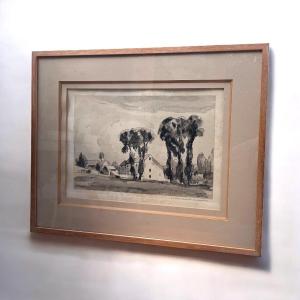
Watercolor with gouache
H. 68 cm; W. 48 cm
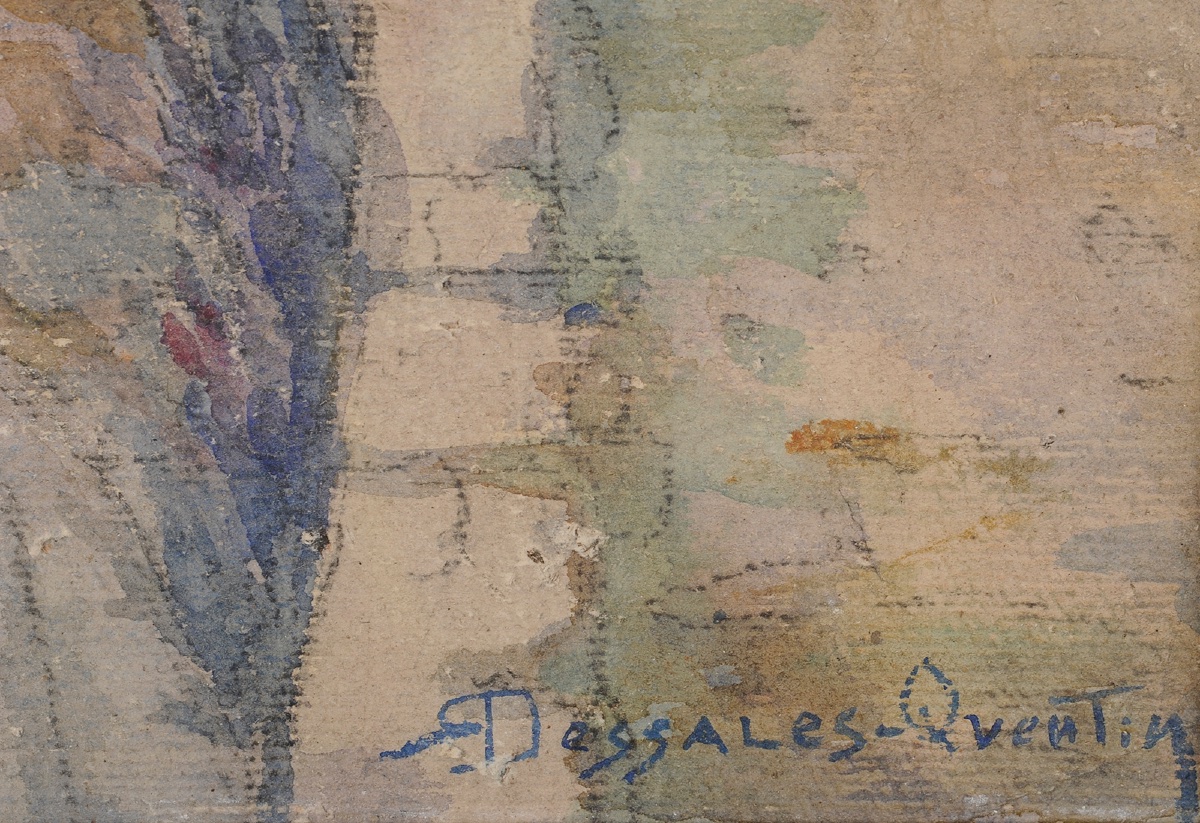
Signed lower right
Robert Dessales-Quentin was born in one of the most beautiful villages in France: Brantôme, nicknamed the “Venice of the Périgord,” as it lies on the banks of the Dronne, a river that serves as a natural defense by encircling the town. This small town in northern Périgord was the artist’s playground throughout his life. At the age of four, he completely lost his hearing as a result of treatment that was unsuitable for his then-unknown intolerance to quinine. His father, a notary in Brantôme, decided to send him quickly to Paris, where he would study at the National Institute for the Deaf and Mute. Aware of his artistic inclinations, his parents enrolled him at the Académie Jullian, in the studio of the famous Jean-Paul Laurens. A man of taste and deeply attached to his homeland, Dessales-Quentin naturally gravitated toward landscapes rather than history painting, for which his studies had prepared him.
He soon returned to the Périgord region and found his calling in depicting the local heritage. Castles, stately homes, churches, and cityscapes were exhibited as early as 1909 at the Salon des Artistes Français in Paris. He felt most at home working in watercolor, even earning a Grand Honorable Mention at the Salon in 1928—a rare achievement for this medium. In oil painting, he went through several different periods and styles, notably a period that could be called “wisteria,” due to the recurring presence of this plant in his paintings between the two world wars.
A drawing teacher for over fifteen years at the prestigious Institution Saint-Joseph in Périgueux and in his studio on Rue du Plantier, he was nicknamed by his students the “brilliant left-hander.” It was in this very studio that Dessales-Quentin welcomed the “whole of Périgord” each year for a highly anticipated exhibition of his works.
Though familiar with the old stone buildings of the Périgord, he did not neglect “other places.” Corrèze would become a place he frequently visited, as would the Basque Country—both the French and Spanish sides.
He exhibited his works in numerous French cities, traces of which we find very regularly through the well-known labels on the backs of his watercolors and their original frames.
This very large watercolor on heavily textured paper was painted in the small square of La Roque-Gageac, just below the Tarde family manor. The view depicted here overlooks the first row of houses along the harbor. In the background of the composition, rising slightly above the vegetation on the hill to the left, stands the fortress of Castelnaud, a small white speck here. Dessales-Quentin used this view on several occasions to illustrate the village, from a less touristy angle than the views of the lower street.
750 €
Period: 20th century
Style: Modern Art
Condition: Perfect condition
Material: Water color
Length: 68 cm hors cadre
Width: 48 cm hors cadre
Reference (ID): 1841379
Availability: In stock
Print