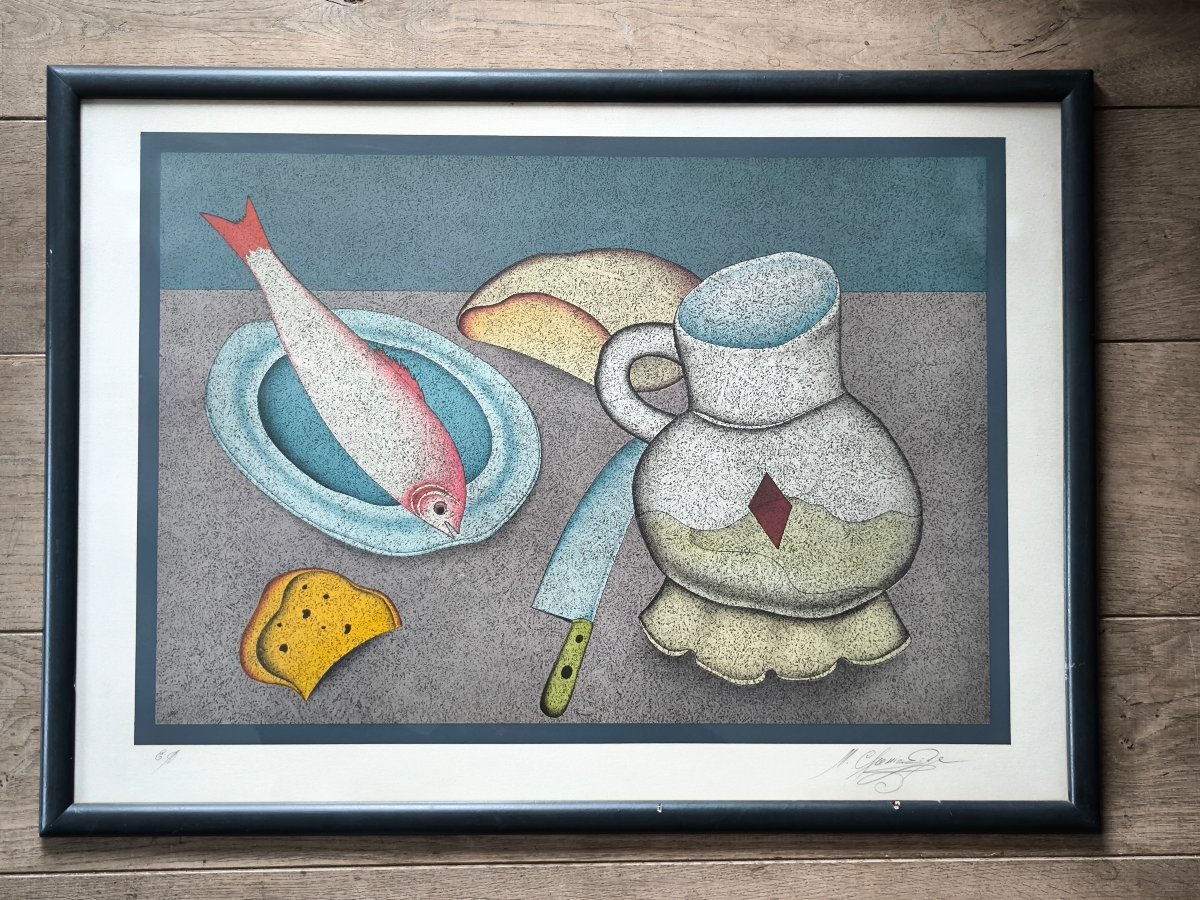
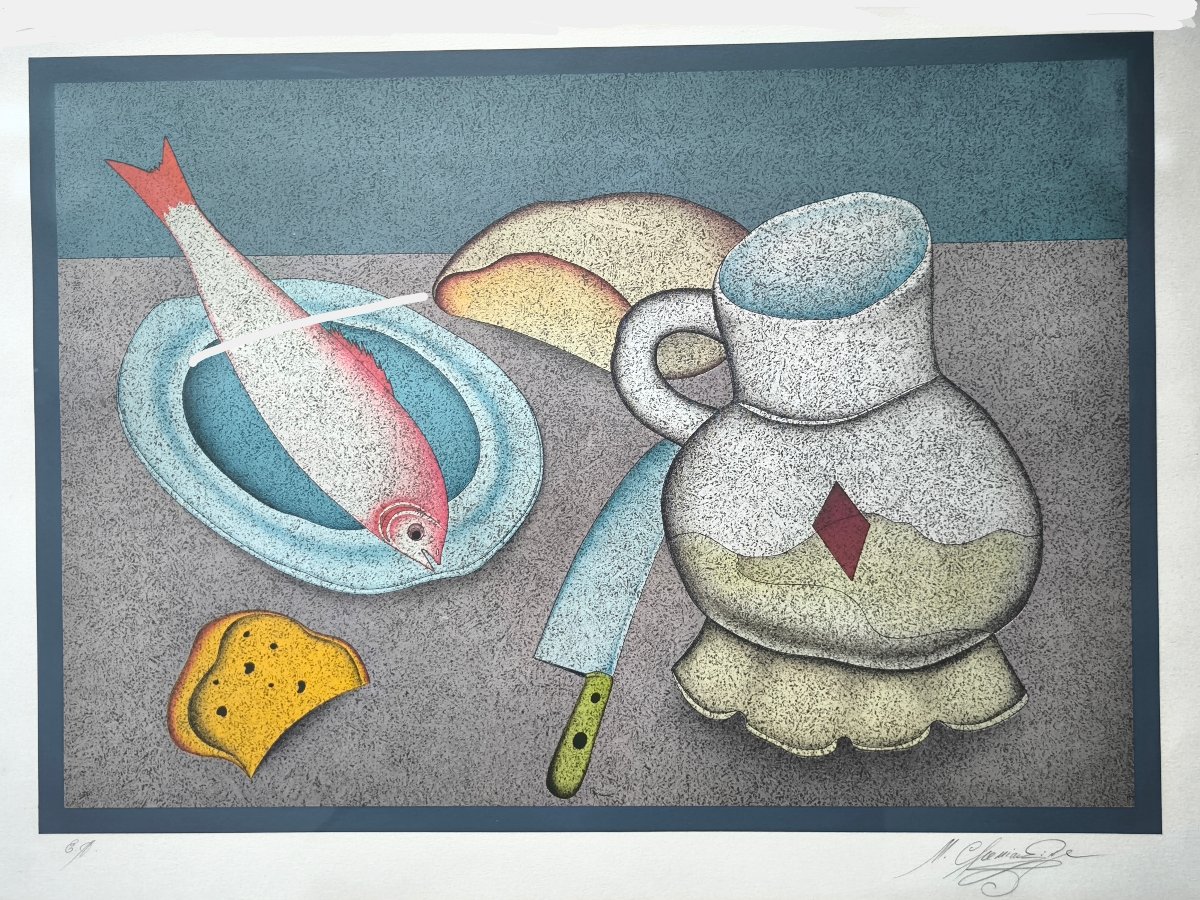
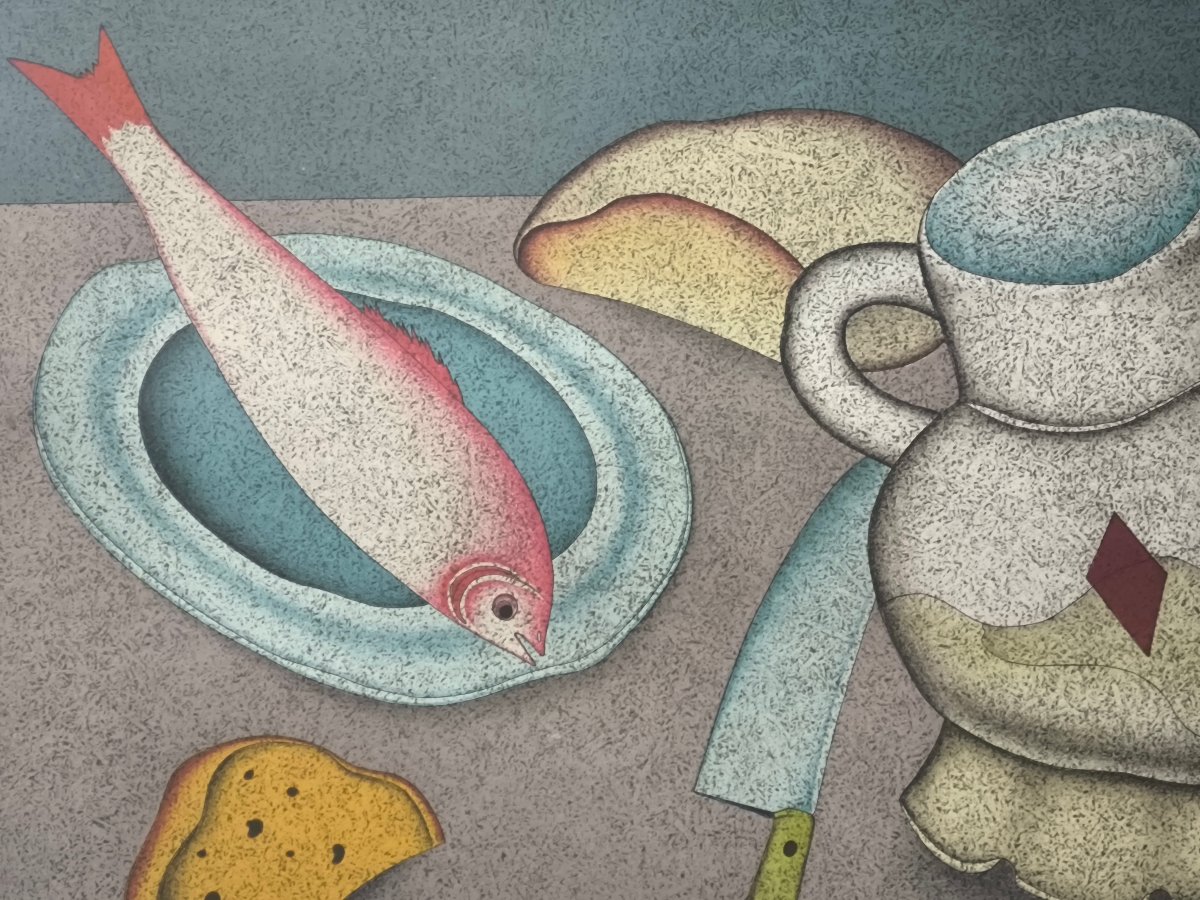
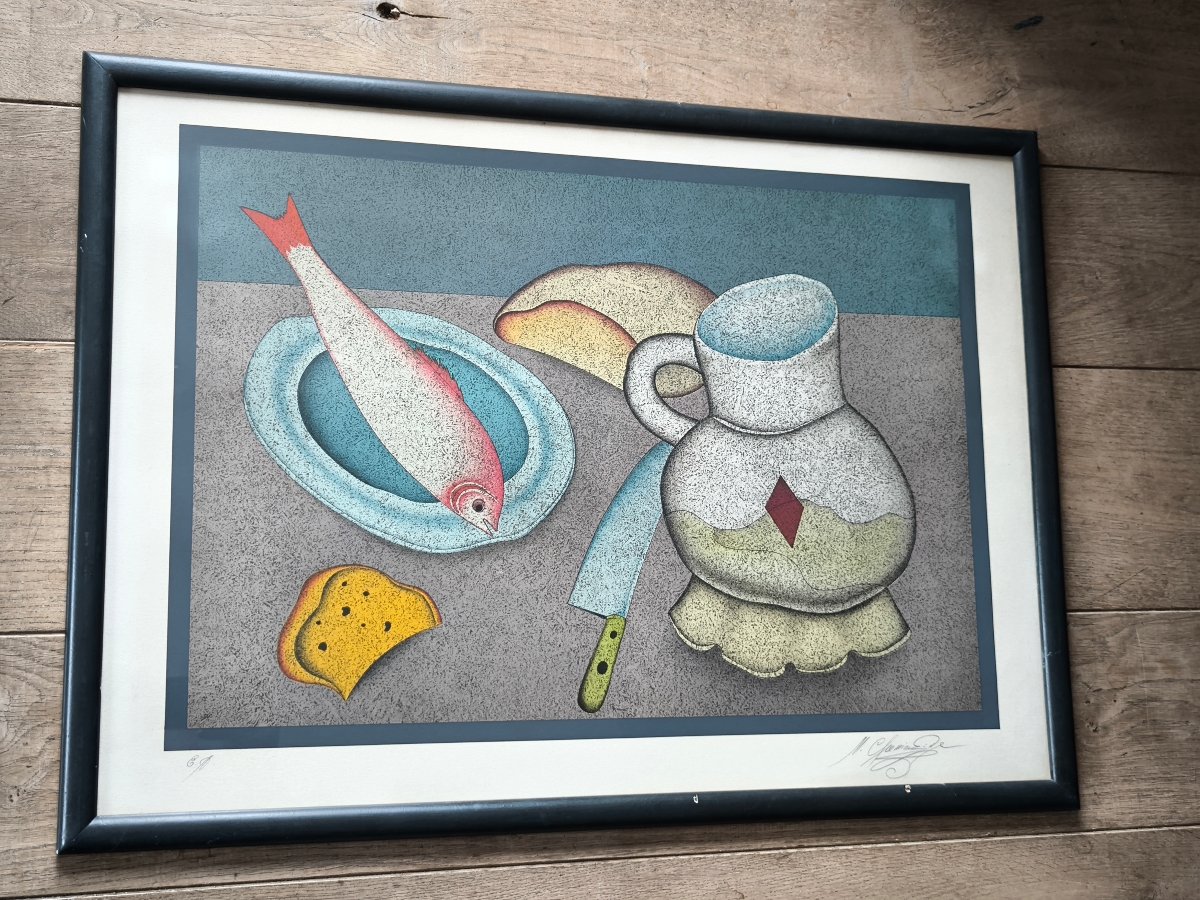


Mikail Chemiakin, Lithograph, 58 X 79.5 Cm (including Frame). "still Life With Fish, Bread, And
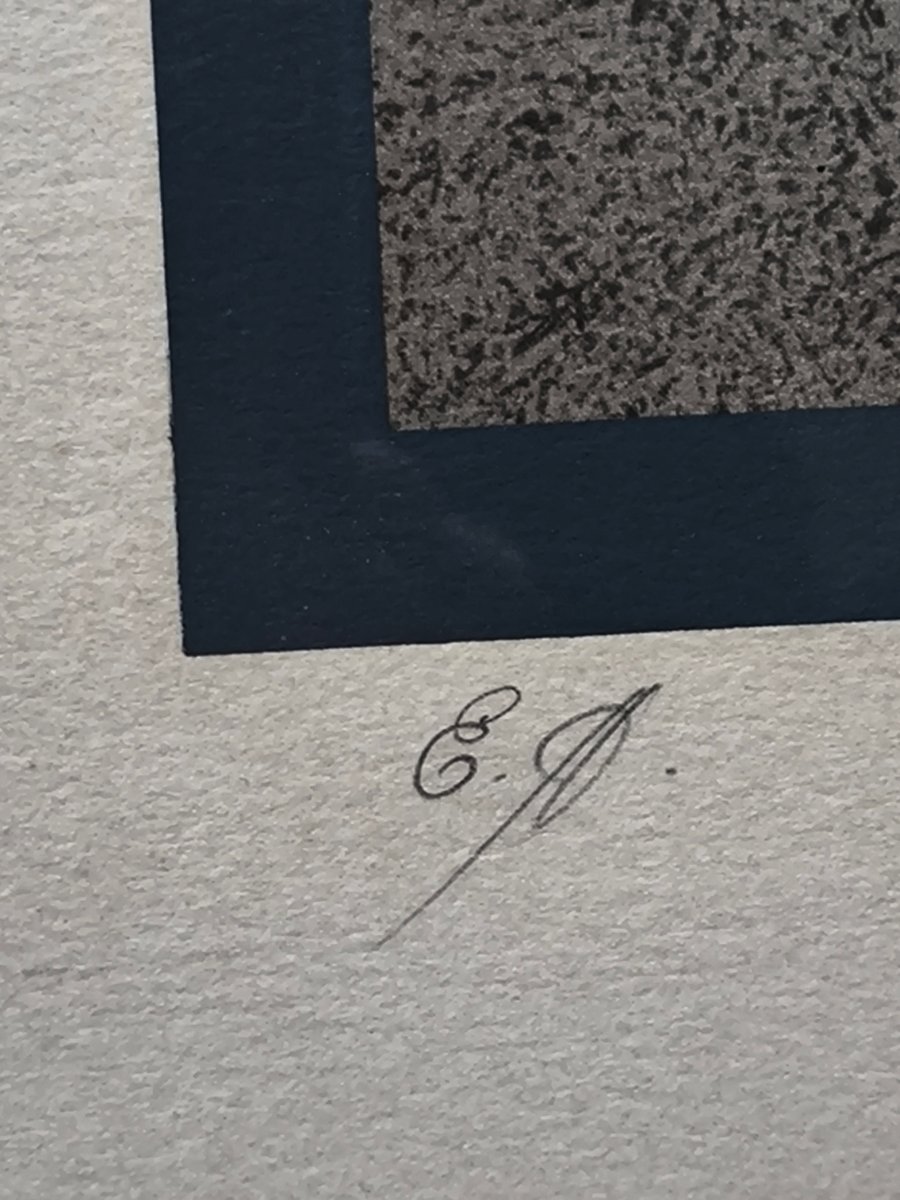
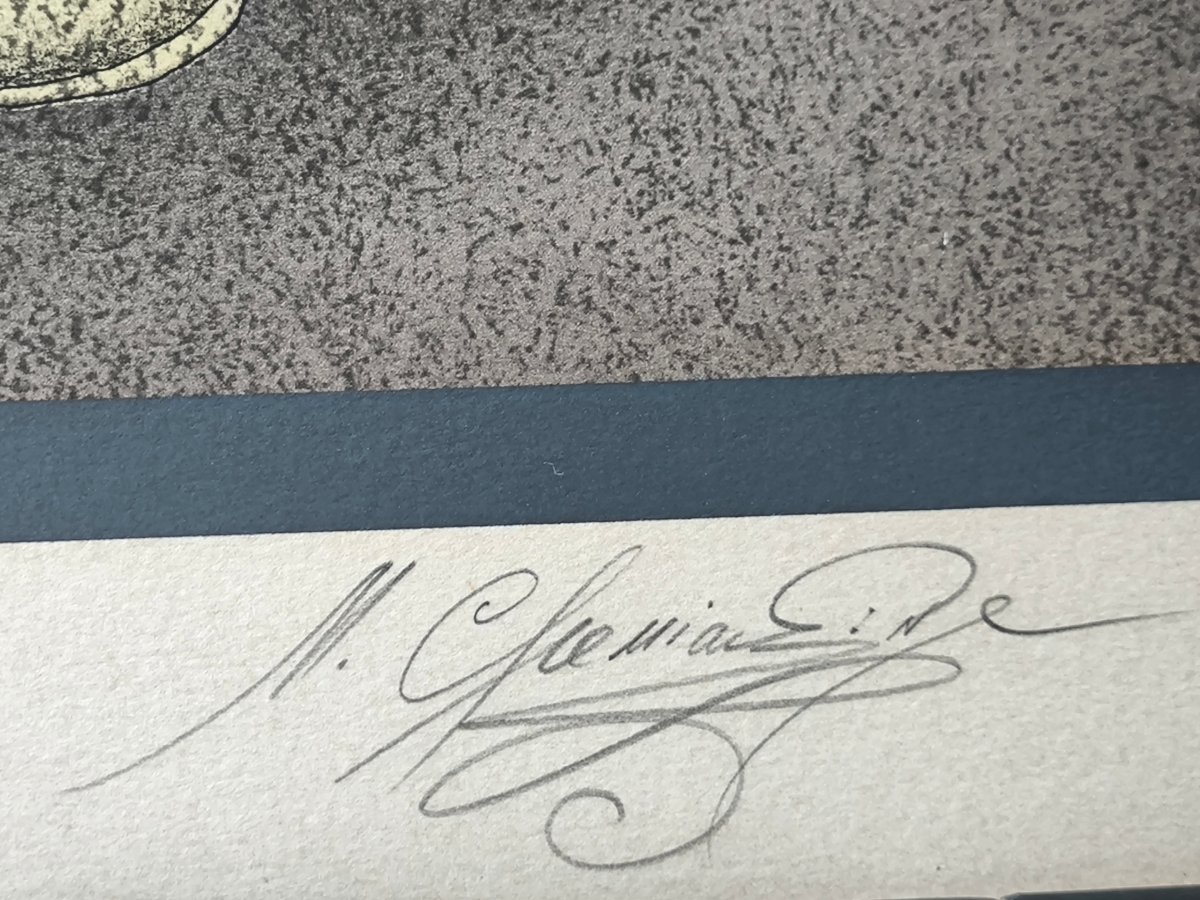
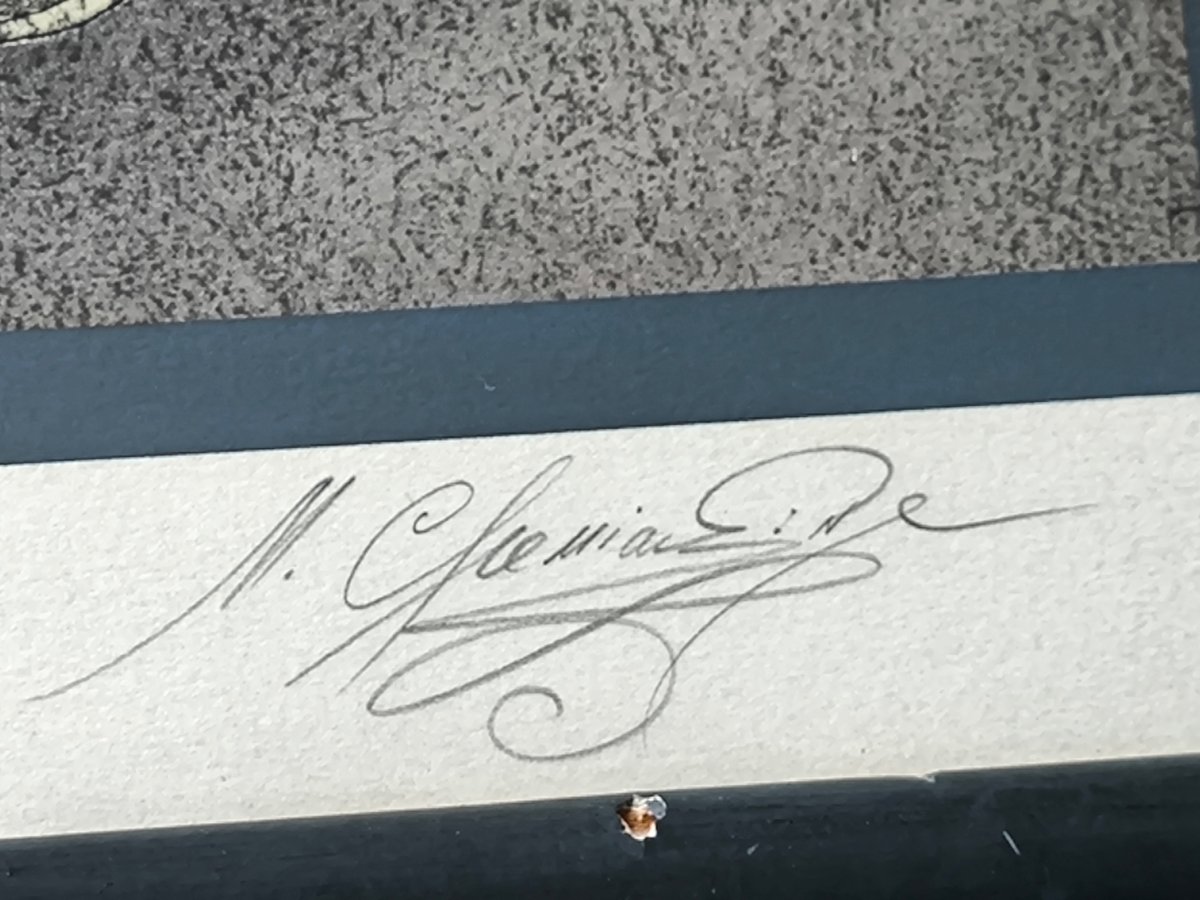
Mikail Chemiakin, lithograph, 58 x 79.5 cm (including frame). "Still Life with Fish, Bread, and Knife," 1978. Artist’s proof, signed.
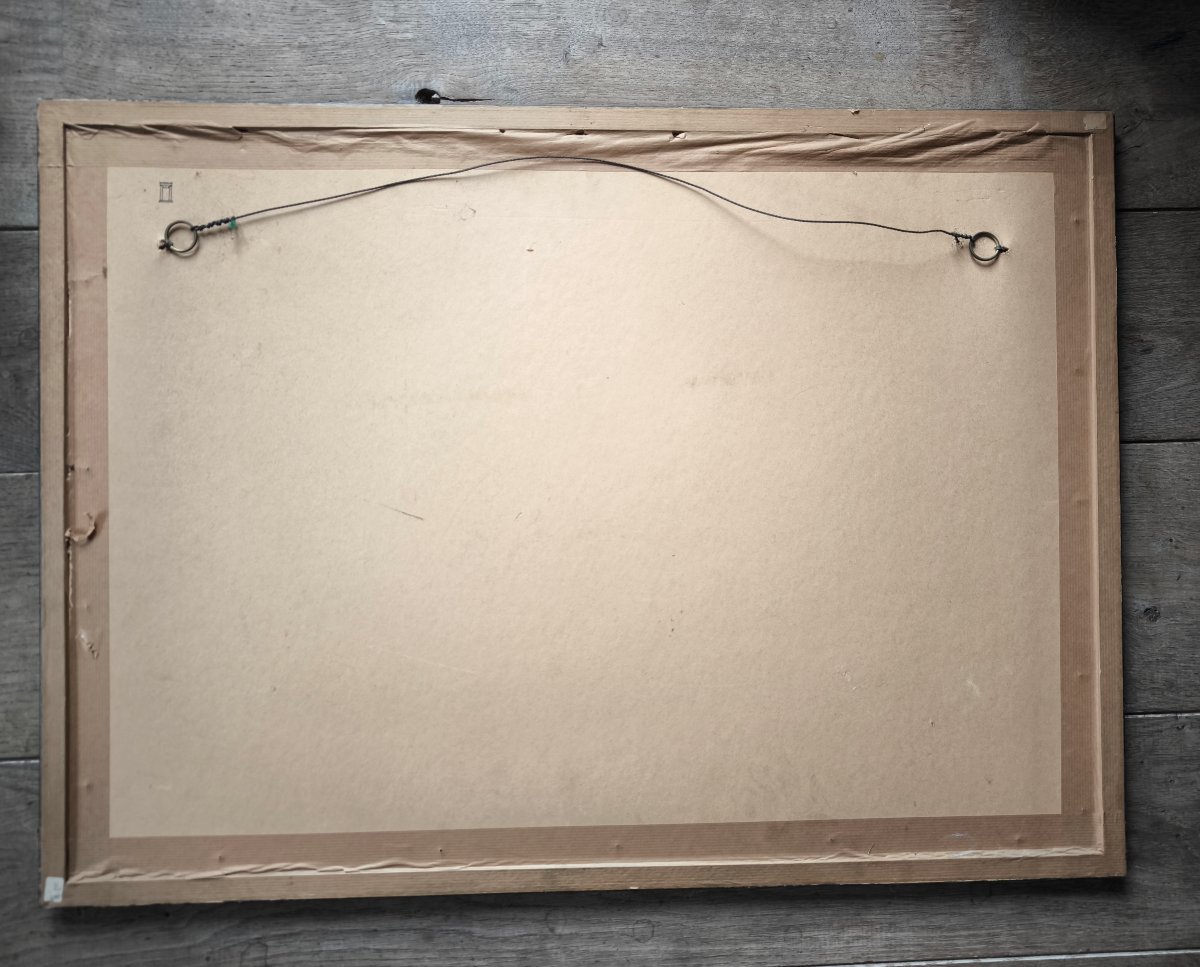
The frame has some minor dings and is in need of restoration.
Chemiakin was born in Moscow in 1943. He grew up in occupied East Germany and returned to Russia in 1957, where he was admitted to the special secondary art school at the Repin Academy of Fine Arts in Leningrad. He was expelled from the art school for failing to adhere to the standards of socialist realism; from 1959 to 1971, he worked in various jobs. He was forcibly interned in a psychiatric hospital—a common practice at the time for ideological dissidents. For five years, he worked on the maintenance staff at the Hermitage Museum. In 1967, the artist founded the St. Petersburg Group and developed the philosophy of "Metaphysical Synthetism," which sought to create a new form of icon painting based on the study of religious art from all eras and cultures.
In 1971, Chemiakin was forced by the Soviet authorities to leave the USSR. He settled first in France, and later, in 1981, moved to New York. In Paris, he edited and published *Apollon-77*, an almanac of post-Stalinist art, poetry, and photography, which served as the first platform for the work of many nonconformist artists. Chemiakin also recorded and released the first albums by the Romani singers Vladimir Poliakoff and Aliocha Dmitrievitch, both of whom were based in Paris. He worked for several years with the Russian bard Vladimir Vysotsky, systematically recording his songs for what would become a seven-disc box set dedicated to Vysotsky’s music. Through the Apollon Foundation for Artistic Research, Chemiakin continues to publish books and music by lesser-known artists.
In 1989, Chemiakin’s work returned to post-communist Russia with his first exhibition there since his exile. He has since continued to exhibit in Russia and has installed four monuments in Saint Petersburg: one to Peter the Great, one to the victims of political repression, one to the architects and builders of Saint Petersburg, and one to the assassinated deputy mayor, M. Manevich. His piece "Cybele, Goddess of Fertility" stands in the SoHo neighborhood of New York City. A variation of his monument to Peter the Great is on permanent display in Normandy. In 1998, a monument to Giacomo Casanova was installed in Venice to commemorate the bicentennial of his death. "Dialogue Between Plato and Socrates"—a memorial dedicated to Professor Harold Yuker—is located at Hofstra University in New York, and a monument to the actor Savely Kramarov can be found in San Francisco. Chemiakin’s monument to "Children—Victims of the Sins of Adults," commissioned by the city of Moscow, stands in Bolotnaya Square in the city’s historic center.
His research into the art of all eras and cultures, which began in the 1960s, has resulted in a collection of millions of images, organized into technical, historical, and philosophical categories. This body of work earned the artist five honorary doctorates and serves as the foundation for his Institute of Philosophy and Psychology of Art.
Chemiakin’s first theatrical work took place at the Rimsky-Korsakov Conservatory in Saint Petersburg (then Leningrad) in 1967. He designed the sets for Shostakovich’s satirical opera *The Nose*, directed by Fialkovsky. As everyone involved knew beforehand, the production was banned by the authorities immediately after its premiere. Thirty-four years later, his first staging of the ballet *The Nutcracker* took place directly across from the Conservatory, on the other side of Theatre Square.
Period: 20th century
Style: Modern Art
Condition: Excellent condition
Length: 79.5 cm
Height: 58 cm
Reference (ID): 1841054
Availability: In stock