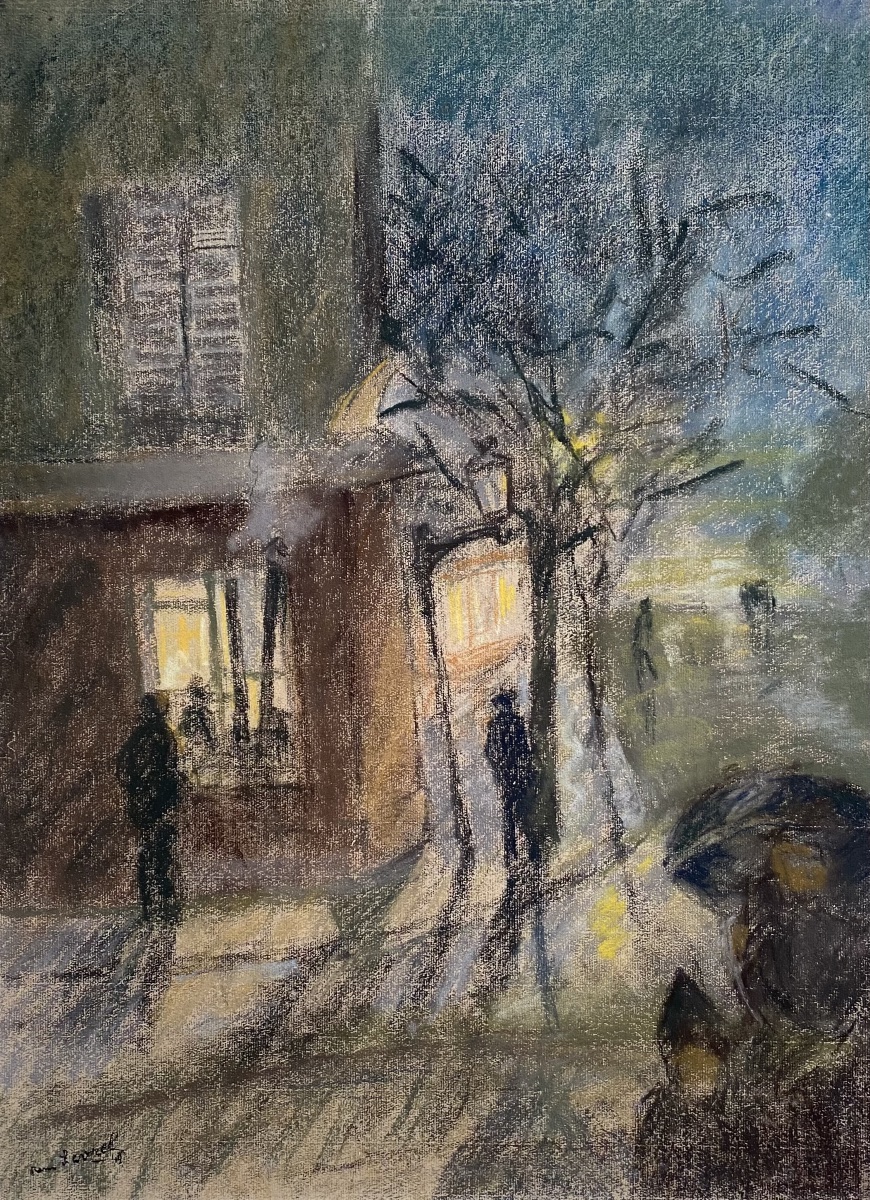
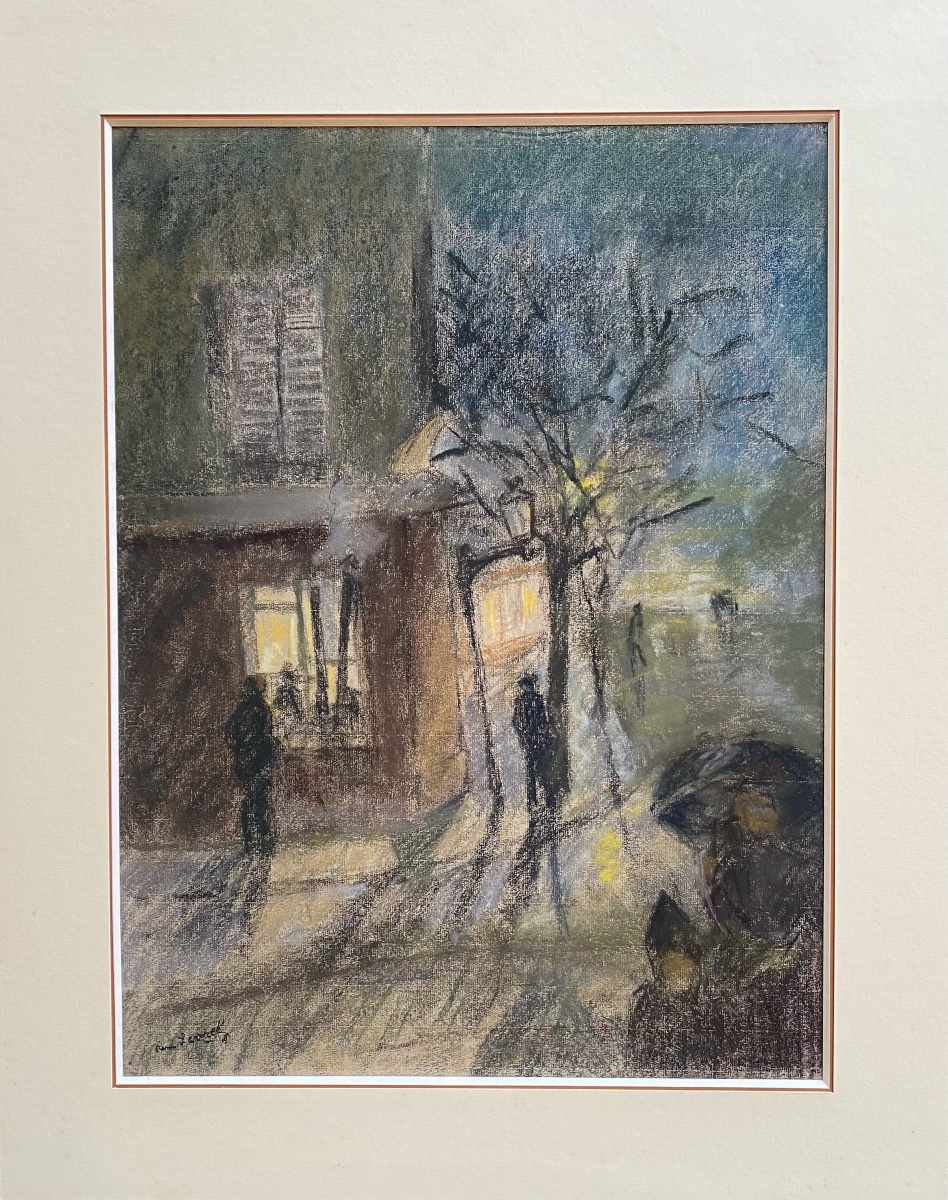
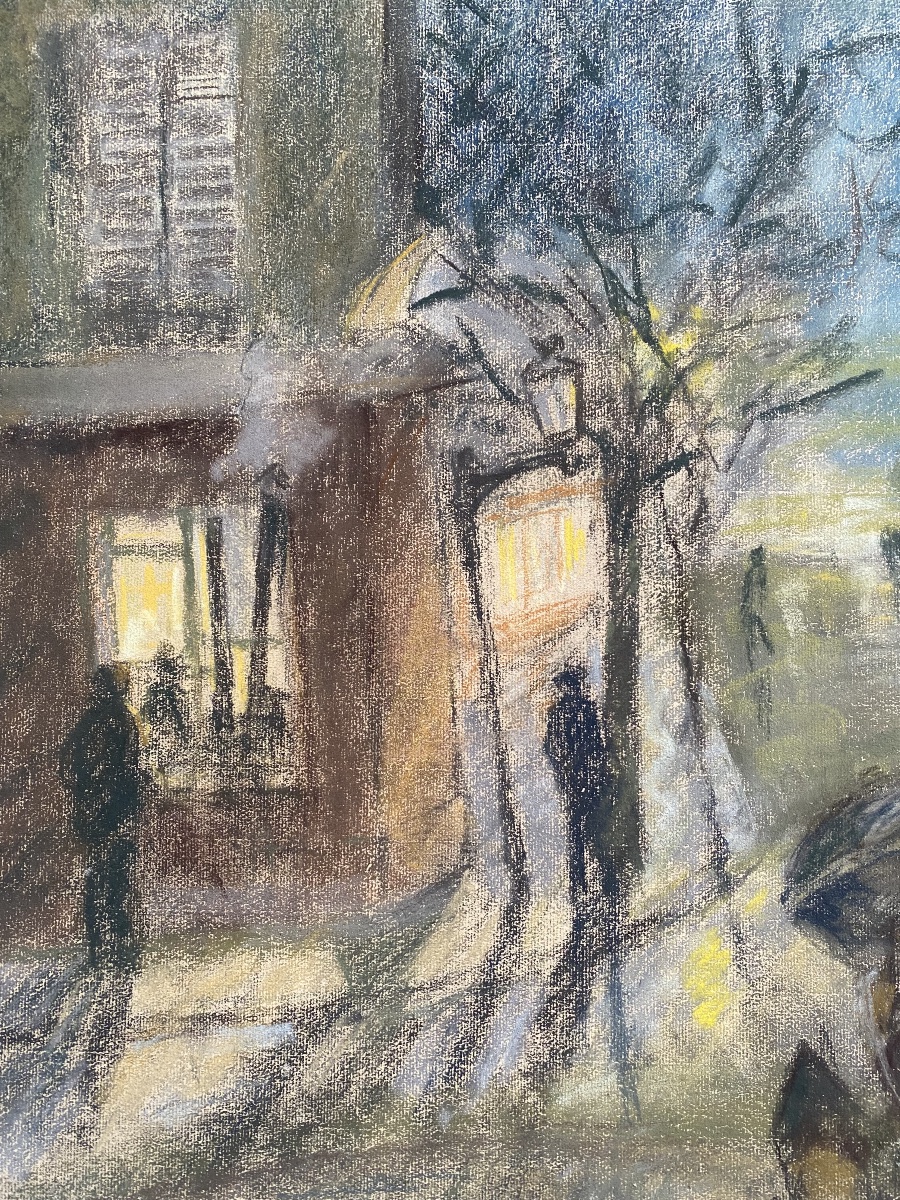
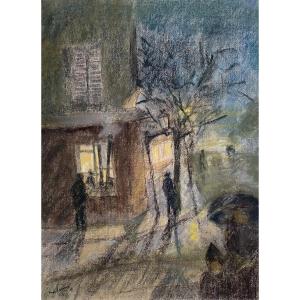


Montmartre By Night - René Levrel (1900–1981)
Artist: René Levrel (1900-1981)
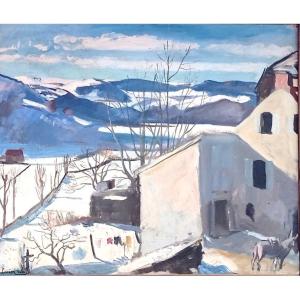
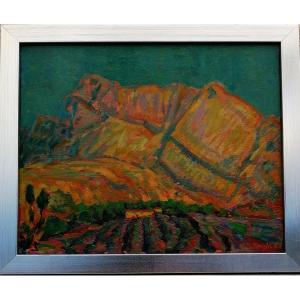
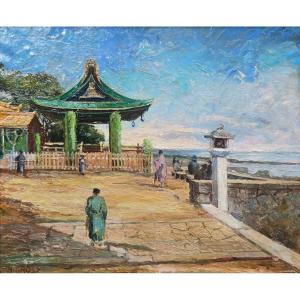
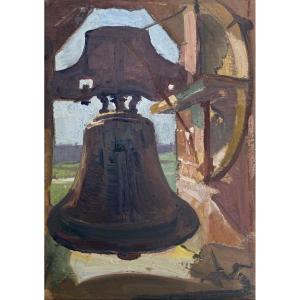
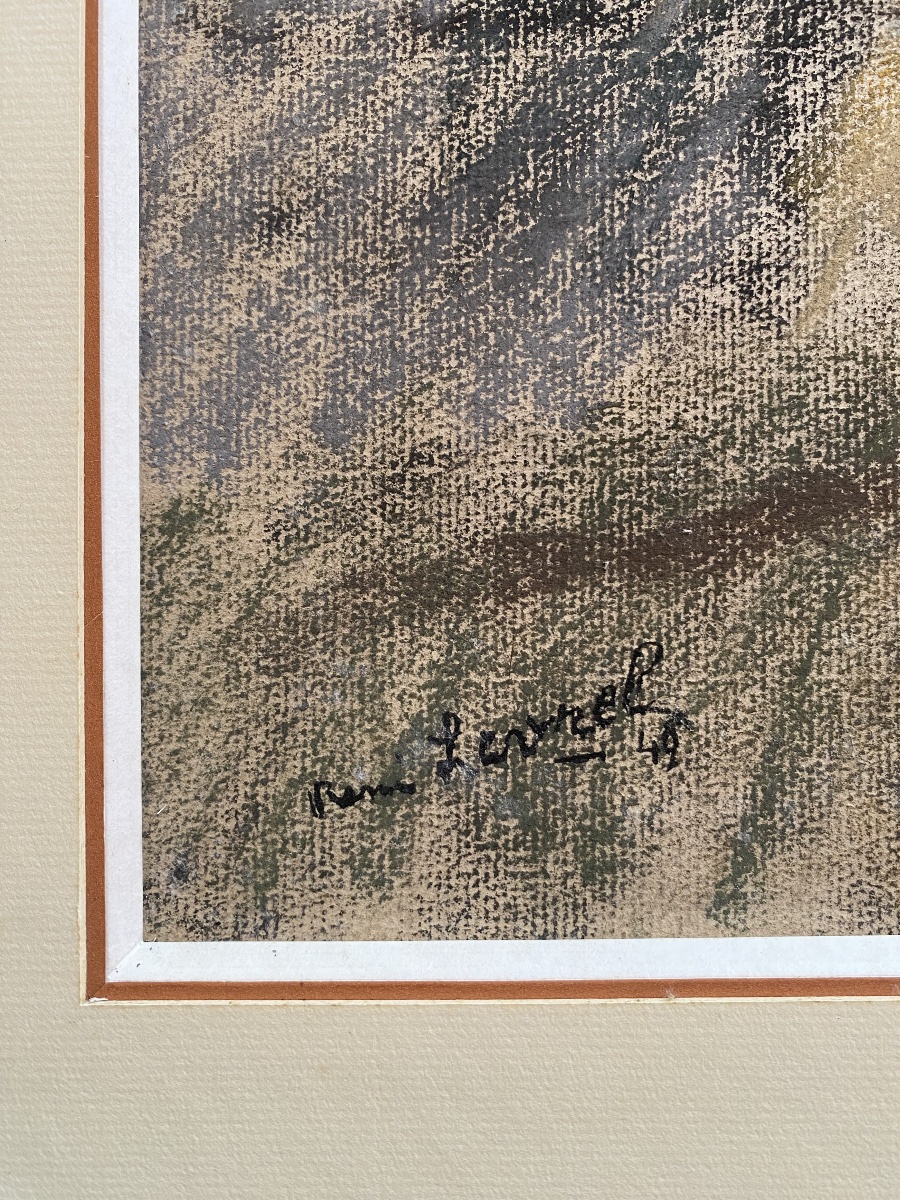
A night scene in Montmartre, signed "René Levrel" in the lower-left corner and dated 1942. Dimensions: 61.5 x 77.5 cm; 41 x 61 cm (visible area).
René Levrel was a French painter and engraver, born in Nantes on March 12, 1900, who died in Pruillé-l'Éguillé (Sarthe) on August 13, 1981. He enrolled at the École des Beaux-Arts in Nantes in 1916. During this time, he discovered the works of Gustave Courbet—even creating a copy of his painting *The Grain Sifters* (*Les Cribleuses de blé*)—as well as those of Pierre Bonnard, Pierre Laprade, and Félix Vallotton. In 1920, he began his studies at the École Nationale Supérieure des Beaux-Arts in Paris and produced numerous copies of works at the Louvre Museum (including pieces by Chardin and Rembrandt); the Fauvist painter Henry Ottmann even purchased his copy of Rembrandt’s *Bathsheba*. Levrel participated in the *Salon des Indépendants* in 1925 and held his first solo exhibition in 1927 at the gallery owned by the poet and playwright Charles Vildrac. During his first period in Algeria, he was awarded the *Prix Abd-el-Tif* in 1928. He stayed at the Villa Abd-el-Tif in Algiers, where he formed friendships with Étienne Bouchaud, Pierre-Eugène Clairin, Jean Launois, and Lucien Mainssieux. He became a committee member of the *Société des Artistes Orientalistes* and also served on the *Abd-el-Tif* jury. Deeply drawn to the Algerian south, he traveled to Touggourt and explored various parts of Algeria. He returned to France in 1930, where he discovered the Vendée region and the town of Saint-Jean-de-Monts—a place he would return to many times throughout his life. He created a monumental fresco for the 1937 World’s Fair, specifically for the Papal States pavilion. A painter associated with the School of Paris, he relocated—for professional reasons—alongside his wife (the sister of politician Pierre Abelin, who served as a minister under both the Fourth and Fifth Republics) to Douai, and later to Aix-en-Provence. This period in the south of France inspired a number of his oil paintings and watercolors, featuring subjects such as Corsica, Marseille, Provence, and Mont Sainte-Victoire. In 1942, he settled permanently in Paris, taking up residence at 27 Quai de la Tournelle—situated behind the apse of Notre-Dame and facing the Île Saint-Louis. From his studio, much like Albert Marquet, he produced numerous paintings centered on the Seine and the bridges of Paris (including the Pont Neuf, Pont Marie, Pont de la Tournelle, and the bridge to the Île Saint-Louis). He also dedicated many of his canvases to the Louvre, the Hôtel de la Monnaie, the Île Saint-Louis, the Institut de France, Notre-Dame, and the Jardin des Plantes. The exhibition catalog for his work, compiled by the museums of the Vendée region in 1992, describes the style of his Parisian paintings as follows: "It was in his Parisian studio that Levrel—alongside the watercolors he captured *en plein air* during his travels—produced large-scale oil paintings, a format in which he felt particularly at ease. Over the years, he became one of the artists who best succeeded in capturing the essence of Parisian life." He was fond of boulevards teeming with passersby, public squares, and all the iconic locations of the capital—from the dreary, somber atmosphere of the Métro (which he would later feature in an exhibition marking Paris’s two-thousandth anniversary) to the nighttime bustle outside the Opéra, the illuminated shop windows of La Samaritaine, the Jardin des Plantes, or the banks of the Seine—most notably the Quai de la Tournelle. This assessment echoed one made sixteen years earlier by the curator of the Musée des Beaux-Arts in Nantes, in a preface to the catalog for a retrospective of René Levrel’s work: "Levrel is, in fact, one of the finest painters of the Seine and of everyday Paris—a Paris he approaches with the total freedom of a poet (he does not bother to count the windows). Each time, his brushwork and his exploration of paint texture—which is always varied—reveal how the artist approaches every canvas with a fresh eye." René Levrel is associated with the "School of Paris" (École de Paris). Gérald Schurr, who places Levrel "within that interwar movement whose richness was long overshadowed by a boisterous avant-garde," described him in 1983 as follows: "René Levrel is one of those fundamentally independent artists—a painter who defies easy classification—whose natural expressionism appears strongly influenced by the intensity of the Fauves. Yet, his commitment to traditional values tempers his fervor, channeling it into compositions that are always rhythmically well-structured." His second Algerian period: In 1953, Levrel returned to Algeria as a grant recipient from the General Government for the Southern Territories, joining Étienne Bouchaud in Laghouat. He drew inspiration from the Algerian landscape, scenes of Algiers and its various villages, and the Roman ruins at Tipaza. In 1957, he collaborated with Étienne Bouchaud to create two decorative panels for the captain’s reception room aboard the *Penthièvre II*, a wine tanker that sailed between Oran and Nantes. A painter of both the sea and the countryside, he employed a *clair-obscur* (light-and-shadow) palette, despite having spent time in Algeria and traveled throughout the Mediterranean region. He was also an accomplished watercolorist. In France, his travels took him to Anjou (Champtoceaux), to Brittany—both in the late 1940s and in 1954 (Bénodet, Douarnenez, Telgruc)—as well as to the Île d'Yeu, the Charente region, the Dauphiné (in 1934, the City of Paris purchased his canvas *Spring in the Dauphiné*), the Alpes-de-Haute-Provence, Poitou, Seine-et-Marne, and the Vendée. As noted in the catalogue for the 1992 exhibition at Puy-du-Fou dedicated to his work: "Throughout these pieces, one finds his preferred subjects: storm-darkened skies, an exploration of nocturnal effects, and the calm waters of rivers and streams. The collection as a whole is imbued with that sense of melancholy which frequently permeates Levrel’s body of work." In 1962 he acquired a priory in a small Sarthe commune, Pruillé-l'Éguillé, which he made his second home until his death in 1981. His stays in Sarthe nourished part of the work at the end of his life, through the description of the countryside, throughout the seasons. He retraces the rural life of this period in strong and colorful canvases representing orchards, harvests, the forest, field work, animals and scenes of village festivals. During the 1950s and 1960s, he also traveled to England (London), Scotland, Spain (Ávila, Seville), Italy (Florence and Tuscany, Naples, Rome, Venice), and the Netherlands (Amsterdam). He brought back numerous watercolors and oil paintings from these trips: "The works created during these journeys consist of highly virtuosic watercolor sketches, as well as large-scale canvases produced in the studio based on notes taken at the time." He did not abandon the genre of still life, as evidenced by his paintings of flower bouquets or culinary dishes. In addition to numerous oil paintings and watercolors, Levrel left behind a body of graphic work—etchings and engravings—that drew inspiration from a diverse range of subjects, such as the banks of the Seine, the Jardin des Plantes, the marshlands of the Vendée, the area surrounding Nantes, and garden scenes. He also worked extensively in lithography; notably, he created 34 lithographs to illustrate Jean Giono’s *Naissance de l’Odyssée* (“Birth of the Odyssey”), published in 1959 by *Les Amis du Livre Moderne* in a limited edition of 180 copies.
René Levrel was a French painter and engraver, born in Nantes on March 12, 1900, who died in Pruillé-l'Éguillé (Sarthe) on August 13, 1981. He enrolled at the École des Beaux-Arts in Nantes in 1916. During this time, he discovered the works of Gustave Courbet—even creating a copy of his painting *The Grain Sifters* (*Les Cribleuses de blé*)—as well as those of Pierre Bonnard, Pierre Laprade, and Félix Vallotton. In 1920, he began his studies at the École Nationale Supérieure des Beaux-Arts in Paris and produced numerous copies of works at the Louvre Museum (including pieces by Chardin and Rembrandt); the Fauvist painter Henry Ottmann even purchased his copy of Rembrandt’s *Bathsheba*. Levrel participated in the *Salon des Indépendants* in 1925 and held his first solo exhibition in 1927 at the gallery owned by the poet and playwright Charles Vildrac. During his first period in Algeria, he was awarded the *Prix Abd-el-Tif* in 1928. He stayed at the Villa Abd-el-Tif in Algiers, where he formed friendships with Étienne Bouchaud, Pierre-Eugène Clairin, Jean Launois, and Lucien Mainssieux. He became a committee member of the *Société des Artistes Orientalistes* and also served on the *Abd-el-Tif* jury. Deeply drawn to the Algerian south, he traveled to Touggourt and explored various parts of Algeria. He returned to France in 1930, where he discovered the Vendée region and the town of Saint-Jean-de-Monts—a place he would return to many times throughout his life. He created a monumental fresco for the 1937 World’s Fair, specifically for the Papal States pavilion. A painter associated with the School of Paris, he relocated—for professional reasons—alongside his wife (the sister of politician Pierre Abelin, who served as a minister under both the Fourth and Fifth Republics) to Douai, and later to Aix-en-Provence. This period in the south of France inspired a number of his oil paintings and watercolors, featuring subjects such as Corsica, Marseille, Provence, and Mont Sainte-Victoire. In 1942, he settled permanently in Paris, taking up residence at 27 Quai de la Tournelle—situated behind the apse of Notre-Dame and facing the Île Saint-Louis. From his studio, much like Albert Marquet, he produced numerous paintings centered on the Seine and the bridges of Paris (including the Pont Neuf, Pont Marie, Pont de la Tournelle, and the bridge to the Île Saint-Louis). He also dedicated many of his canvases to the Louvre, the Hôtel de la Monnaie, the Île Saint-Louis, the Institut de France, Notre-Dame, and the Jardin des Plantes. The exhibition catalog for his work, compiled by the museums of the Vendée region in 1992, describes the style of his Parisian paintings as follows: "It was in his Parisian studio that Levrel—alongside the watercolors he captured *en plein air* during his travels—produced large-scale oil paintings, a format in which he felt particularly at ease. Over the years, he became one of the artists who best succeeded in capturing the essence of Parisian life." He was fond of boulevards teeming with passersby, public squares, and all the iconic locations of the capital—from the dreary, somber atmosphere of the Métro (which he would later feature in an exhibition marking Paris’s two-thousandth anniversary) to the nighttime bustle outside the Opéra, the illuminated shop windows of La Samaritaine, the Jardin des Plantes, or the banks of the Seine—most notably the Quai de la Tournelle. This assessment echoed one made sixteen years earlier by the curator of the Musée des Beaux-Arts in Nantes, in a preface to the catalog for a retrospective of René Levrel’s work: "Levrel is, in fact, one of the finest painters of the Seine and of everyday Paris—a Paris he approaches with the total freedom of a poet (he does not bother to count the windows). Each time, his brushwork and his exploration of paint texture—which is always varied—reveal how the artist approaches every canvas with a fresh eye." René Levrel is associated with the "School of Paris" (École de Paris). Gérald Schurr, who places Levrel "within that interwar movement whose richness was long overshadowed by a boisterous avant-garde," described him in 1983 as follows: "René Levrel is one of those fundamentally independent artists—a painter who defies easy classification—whose natural expressionism appears strongly influenced by the intensity of the Fauves. Yet, his commitment to traditional values tempers his fervor, channeling it into compositions that are always rhythmically well-structured." His second Algerian period: In 1953, Levrel returned to Algeria as a grant recipient from the General Government for the Southern Territories, joining Étienne Bouchaud in Laghouat. He drew inspiration from the Algerian landscape, scenes of Algiers and its various villages, and the Roman ruins at Tipaza. In 1957, he collaborated with Étienne Bouchaud to create two decorative panels for the captain’s reception room aboard the *Penthièvre II*, a wine tanker that sailed between Oran and Nantes. A painter of both the sea and the countryside, he employed a *clair-obscur* (light-and-shadow) palette, despite having spent time in Algeria and traveled throughout the Mediterranean region. He was also an accomplished watercolorist. In France, his travels took him to Anjou (Champtoceaux), to Brittany—both in the late 1940s and in 1954 (Bénodet, Douarnenez, Telgruc)—as well as to the Île d'Yeu, the Charente region, the Dauphiné (in 1934, the City of Paris purchased his canvas *Spring in the Dauphiné*), the Alpes-de-Haute-Provence, Poitou, Seine-et-Marne, and the Vendée. As noted in the catalogue for the 1992 exhibition at Puy-du-Fou dedicated to his work: "Throughout these pieces, one finds his preferred subjects: storm-darkened skies, an exploration of nocturnal effects, and the calm waters of rivers and streams. The collection as a whole is imbued with that sense of melancholy which frequently permeates Levrel’s body of work." In 1962 he acquired a priory in a small Sarthe commune, Pruillé-l'Éguillé, which he made his second home until his death in 1981. His stays in Sarthe nourished part of the work at the end of his life, through the description of the countryside, throughout the seasons. He retraces the rural life of this period in strong and colorful canvases representing orchards, harvests, the forest, field work, animals and scenes of village festivals. During the 1950s and 1960s, he also traveled to England (London), Scotland, Spain (Ávila, Seville), Italy (Florence and Tuscany, Naples, Rome, Venice), and the Netherlands (Amsterdam). He brought back numerous watercolors and oil paintings from these trips: "The works created during these journeys consist of highly virtuosic watercolor sketches, as well as large-scale canvases produced in the studio based on notes taken at the time." He did not abandon the genre of still life, as evidenced by his paintings of flower bouquets or culinary dishes. In addition to numerous oil paintings and watercolors, Levrel left behind a body of graphic work—etchings and engravings—that drew inspiration from a diverse range of subjects, such as the banks of the Seine, the Jardin des Plantes, the marshlands of the Vendée, the area surrounding Nantes, and garden scenes. He also worked extensively in lithography; notably, he created 34 lithographs to illustrate Jean Giono’s *Naissance de l’Odyssée* (“Birth of the Odyssey”), published in 1959 by *Les Amis du Livre Moderne* in a limited edition of 180 copies.
300 €
Period: 20th century
Style: Modern Art
Condition: Excellent condition
Material: Pastel
Width: 45 cm (à vue)
Height: 61 cm (à vue)
Reference (ID): 1840946
Availability: In stock
Print