

Brussels, 1757, Holy Water Font, Solid Silver, Holy Water Font
Silver and Silver-Gilt Domestic Holy-Water Stoup — Brussels, 1757
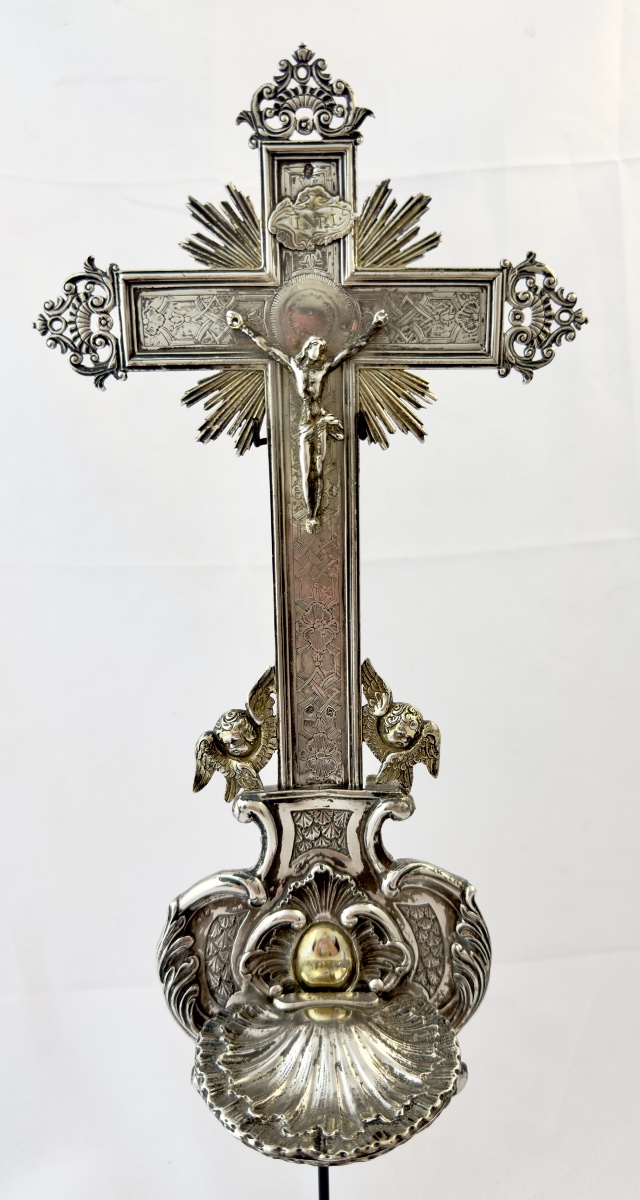
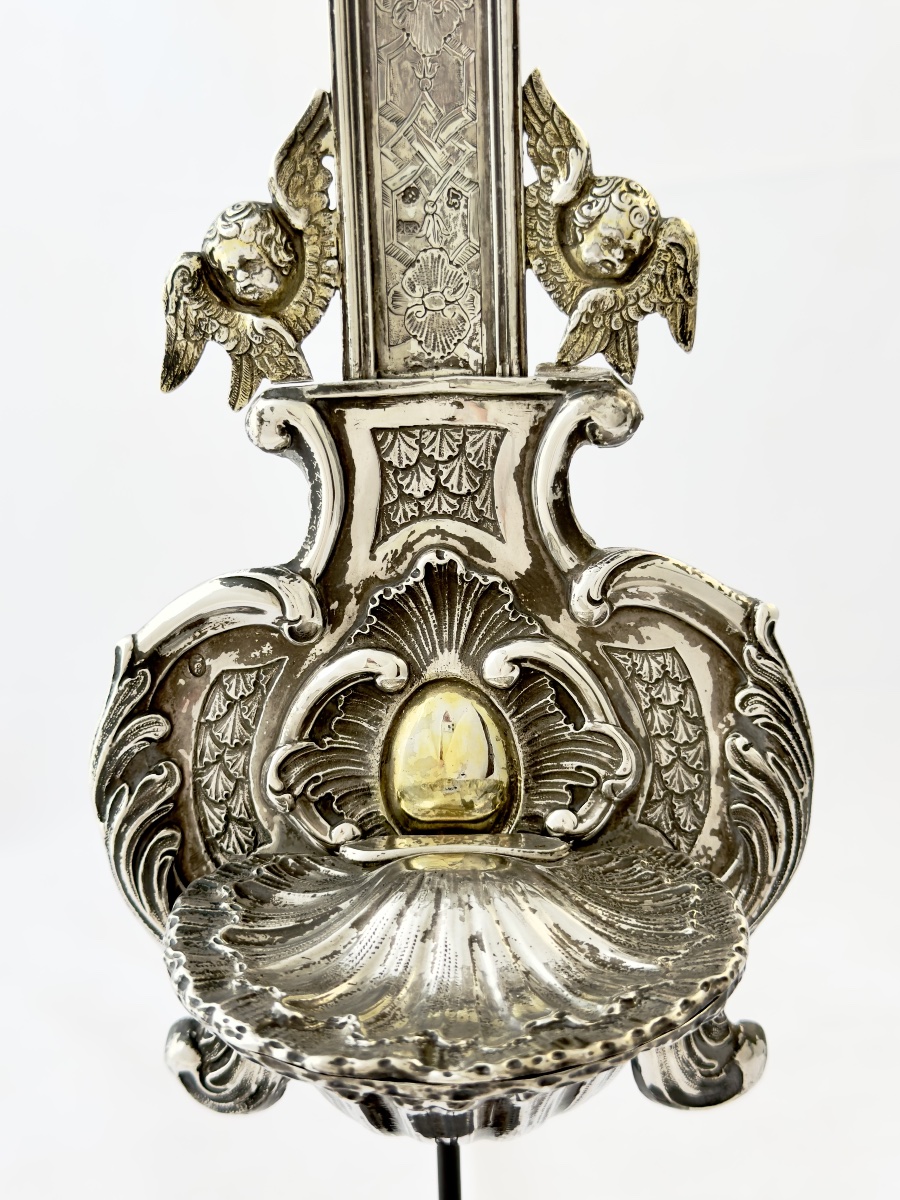
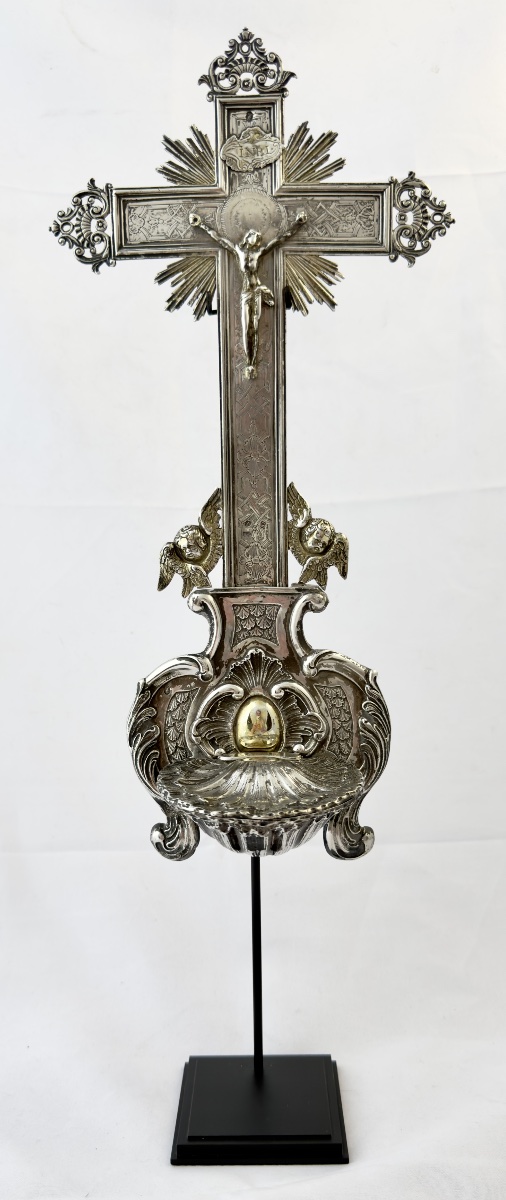
A domestic holy-water stoup in solid silver and silver-gilt, in the Régence style, whose architectural composition retains a Baroque grandeur inherited from the seventeenth century.
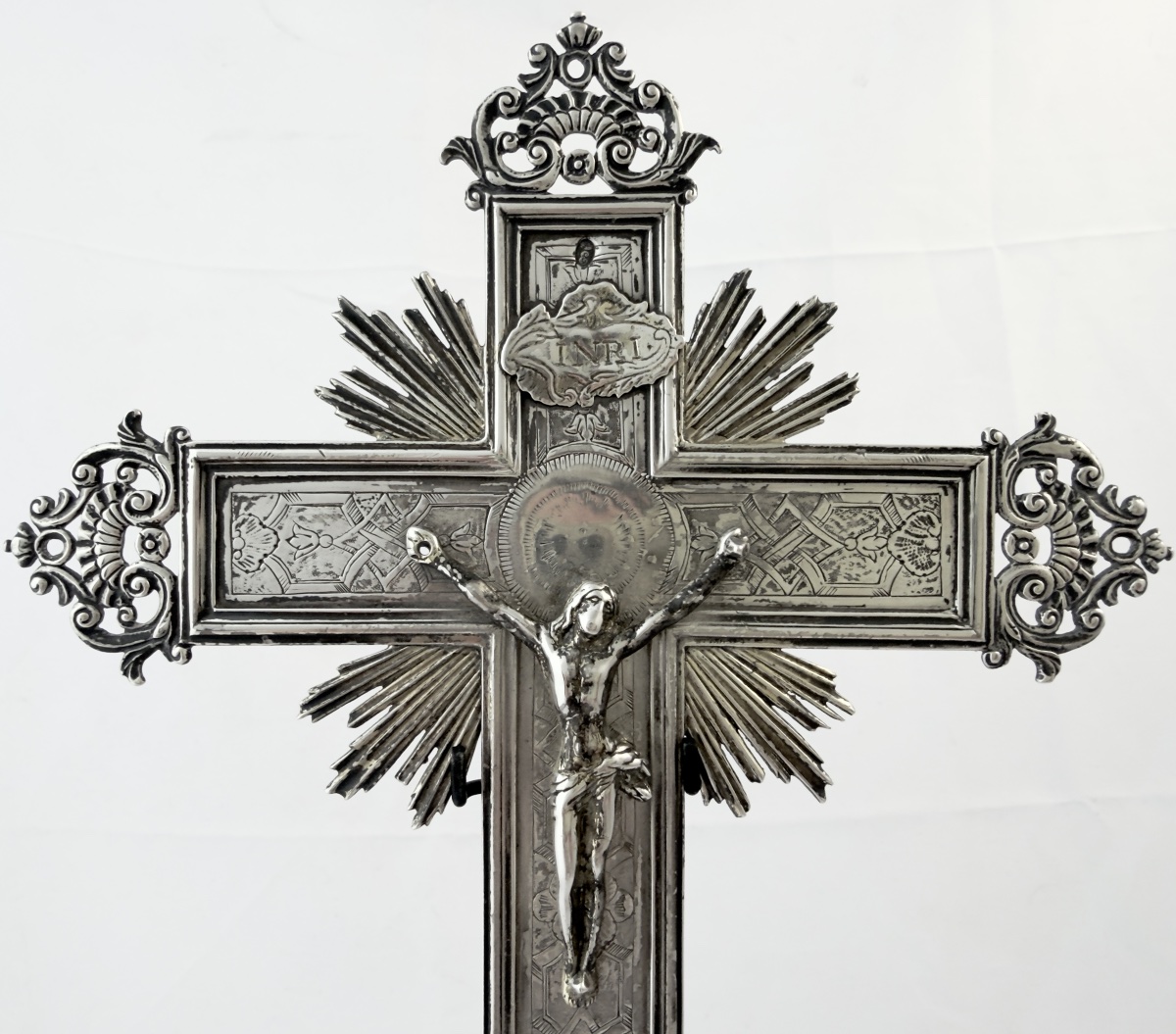
The composition is dominated by a tall Latin cross with moulded borders. Its arms feature a richly engraved decoration of geometric interlace, floral ornaments and foliate motifs against finely matted grounds. The three upper terminals extend into openwork ornaments combining shells, palmettes and scrolls.
The figure of Christ is shown in relief, with his head inclined, his body gently curved and a loincloth knotted at one side. A circular halo frames his head, while broad clusters of rays radiate from the four angles at the crossing. An ornate cartouche bearing the inscription “INRI” surmounts the figure.
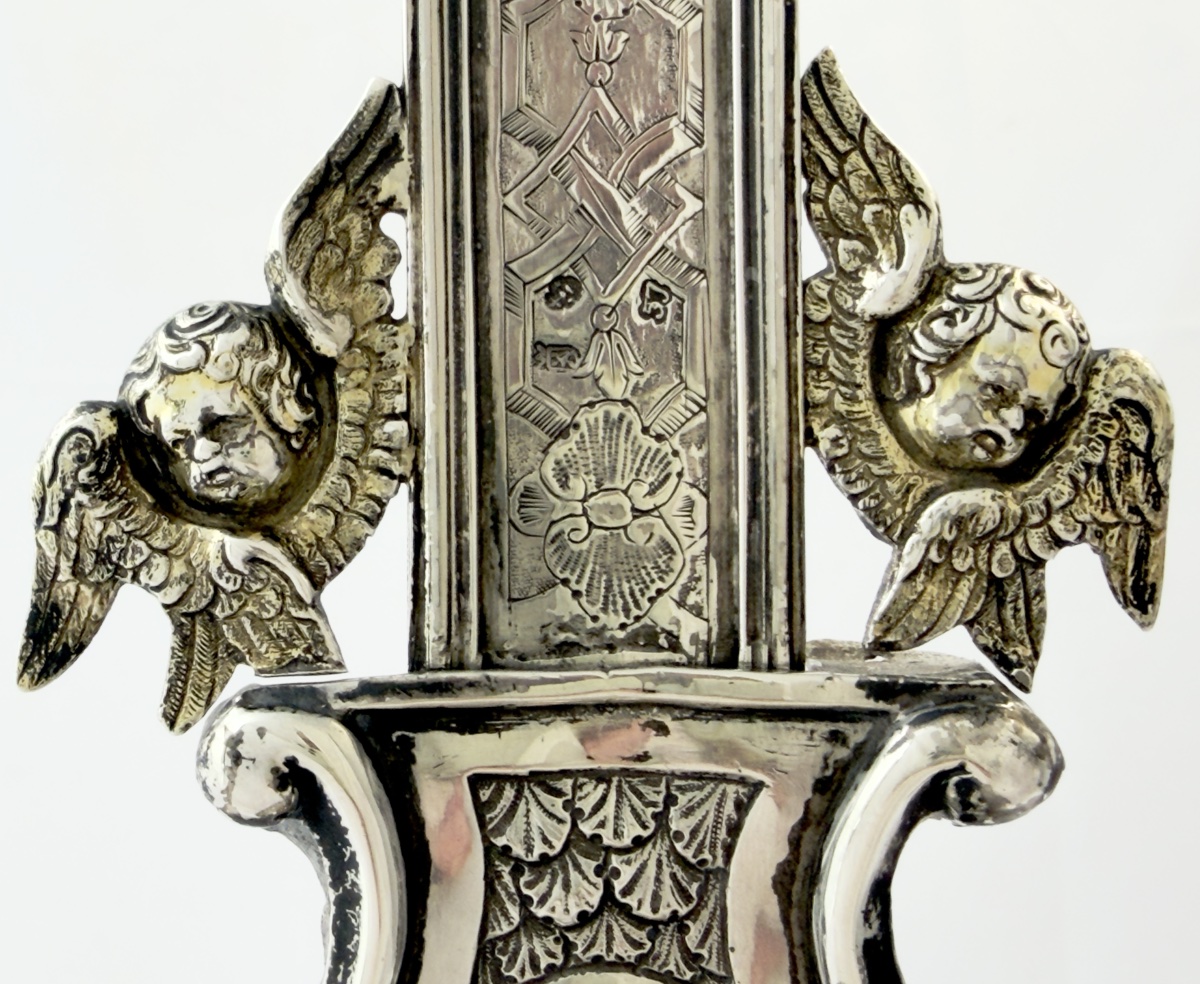
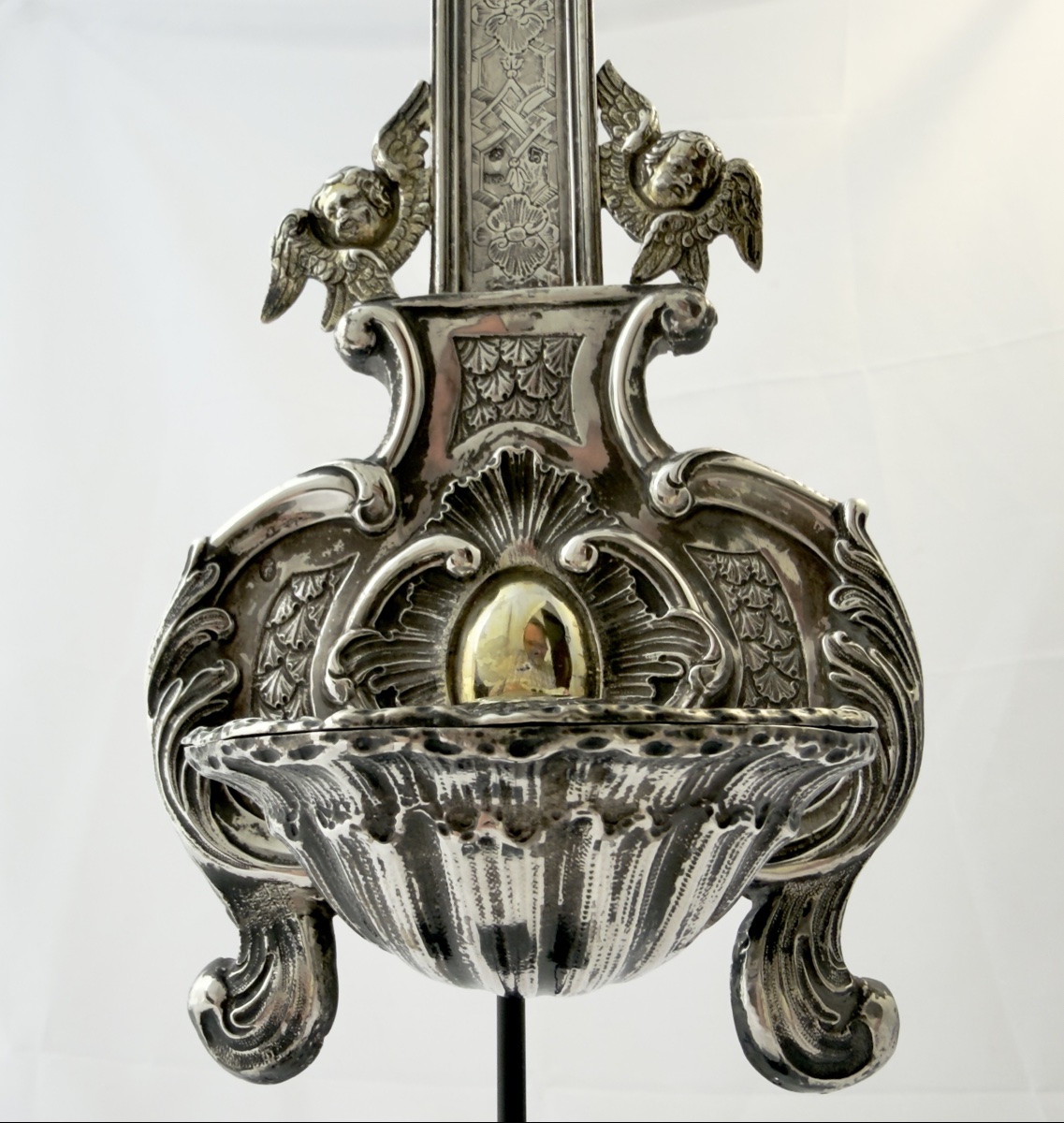
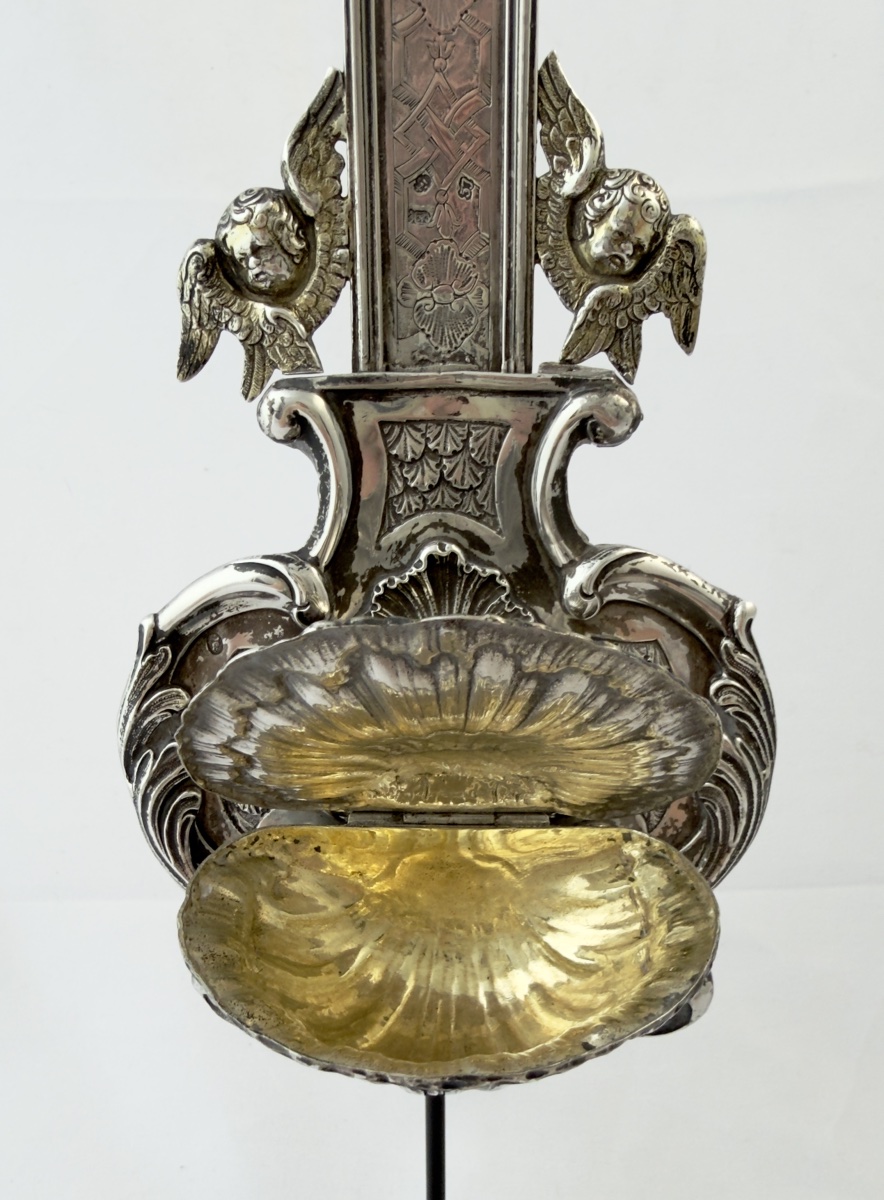
At the foot of the cross, two winged cherub heads flank the lower part of the upright. Their curling hair and feathers are carefully chased. They provide a transition to a broad, shaped backplate, enlivened by bold scrolls, acanthus leaves and panels decorated with overlapping fan-shaped motifs. At its centre, a convex, gilt oval ornament is framed by a radiating shell and scrolls.
The prominently projecting basin takes the form of a shell with radiating ribs and a scalloped rim. It retains its hinged cover, which follows the same design. The two cherubs, the rays surrounding Christ and the interior of the shell-shaped basin are silver-gilt, with wear to the gilding in places. The interplay of silver surfaces, matted grounds and gilt elements enhances the relief of the decoration.
Intended for private devotion, this stoup brings the monumental vocabulary of Baroque ecclesiastical silver into the domestic interior. Although made in 1757, it retains a symmetrical composition and a Régence ornamental repertoire still firmly rooted in seventeenth-century tradition.
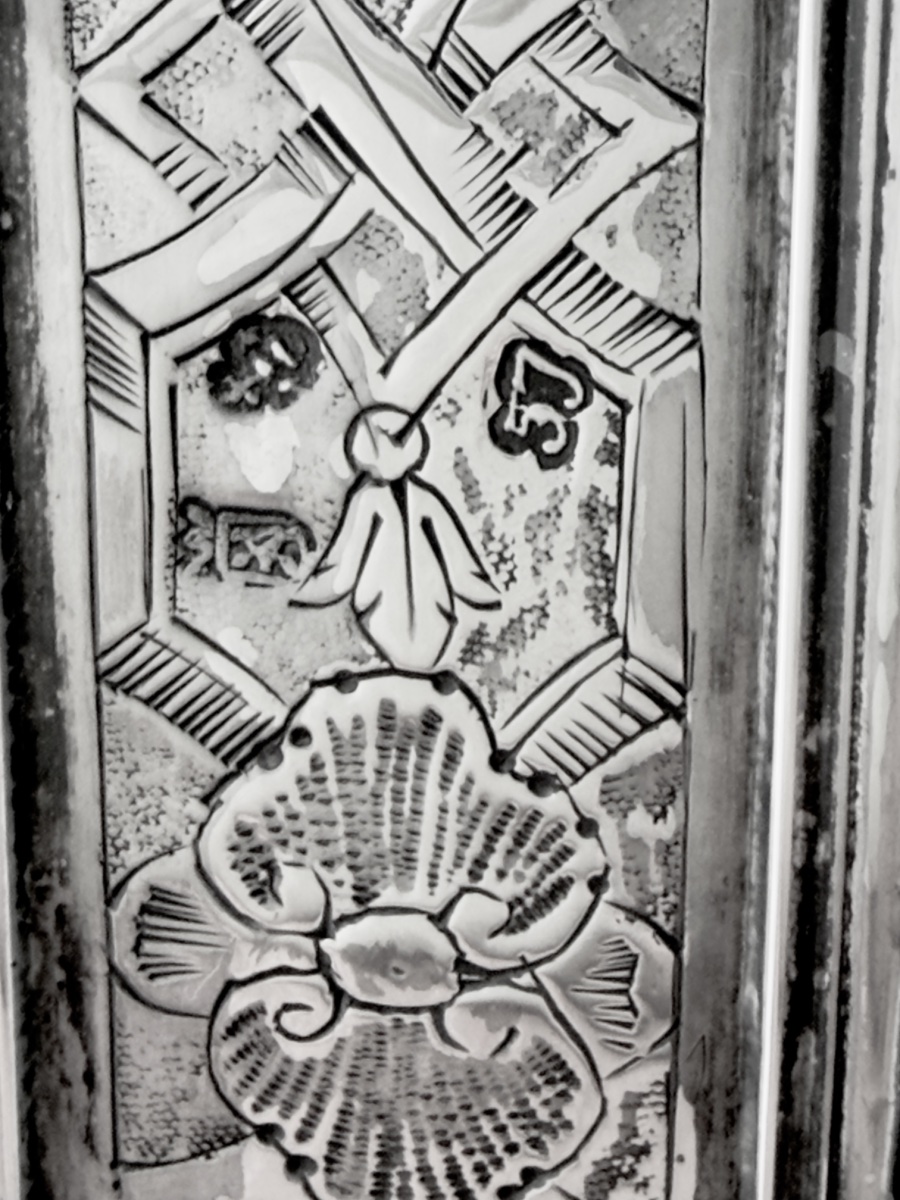
It bears the marks of the Brussels silversmiths’ guild: the lion of the Duchy of Brabant, the head of the Archangel Saint Michael and the date mark corresponding to 1757. The maker’s mark is illegible and does not allow the silversmith to be identified.
Height: 34 cm — Width: 16 cm — Weight: 335 g.
History of the Bedside or Domestic Holy-Water Stoup
The bedside holy-water stoup, also known as a domestic or wall-mounted holy-water stoup, brings into the private home the holy-water font placed at the entrance to churches. It derives from medieval holy-water buckets, fitted with a handle and sometimes accompanied by an aspergillum. Papal and princely inventories of the fourteenth and fifteenth centuries already record such objects in gold or silver.¹
During the fifteenth and sixteenth centuries, the vessel could still be suspended beneath a devotional image. From the late sixteenth century onwards, the image and basin were gradually brought together to form a single wall-mounted object: a decorated plaque resembling a miniature altarpiece, with a receptacle for holy water attached to its lower section. This form became widespread during the seventeenth century with the growth of domestic devotion.² ³
Its development belongs to the context of the Counter-Reformation. In many territories that had adopted Protestantism, the use of holy water and devotional images was condemned or abolished. Following the Council of Trent, the Catholic Church, by contrast, reaffirmed the legitimacy of sacred images and sacramentals. The domestic holy-water stoup thus brought together two Catholic practices challenged by the Reformers: making the sign of the cross with holy water and contemplating a religious image.⁴
During the seventeenth and eighteenth centuries, these stoups were hung beside the bed, against a doorpost, at the entrance to the home or in a private oratory. Family members would use them to make the sign of the cross upon rising, before retiring or before leaving the house. Holy water could also be used to bless children and the sick, and was regarded as a means of spiritual protection for the household. By combining a sacred image with a ritual gesture, the stoup formed, in a sense, a miniature domestic chapel.²
The backplate generally depicted Christ on the cross, the Virgin and Child, the Immaculate Conception, a saint, a guardian angel or cherub heads. The basin might bear the monograms of Jesus or Mary, the Instruments of the Passion or other religious emblems. Examples in silver or silver-gilt, reserved for wealthy families, aristocratic apartments and private chapels, ranged from modest objects for daily use to elaborate works of silver craftsmanship. The Louvre, for example, preserves a silver-gilt stoup made in Paris in 1677–1678 by Nicolas Delaunay, whose repoussé and chased backplate depicts the Adoration of the Shepherds.⁵ The spectacular stoup made in Rome around 1702 by Giovanni Giardini for Pope Clement XI demonstrates the degree of refinement that this type of object could attain.⁶
Their present rarity reflects both their initially limited production in precious metals and the numerous meltings and alterations brought about by wars, revolutions and changing tastes. Surviving examples bear witness to the central place of private devotion in the daily lives of Catholic families during the seventeenth and eighteenth centuries.
Sources
Period: 18th century
Style: Louis 14th, Regency
Condition: Excellent condition
Material: Sterling silver
Width: 16 cm
Height: 34 cm
Reference (ID): 1840449
Availability: In stock