

Casuar Bone Lime Spatula – Iatmul – Chambri – Papua New Guinea
Lime spatula made of cassowary bone – Iatmul – Chambri – Wosera-Gaui – Papua New Guinea
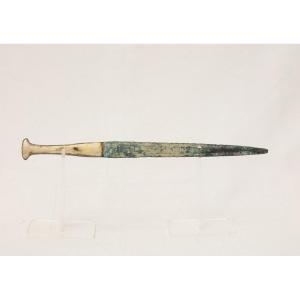
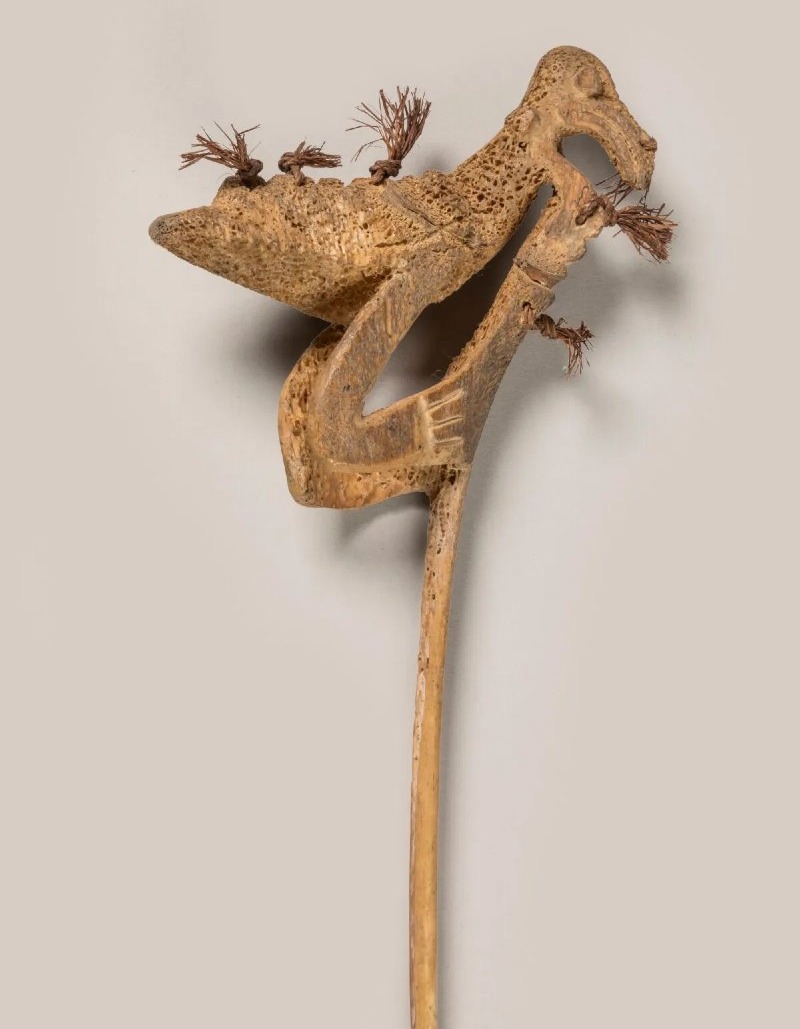
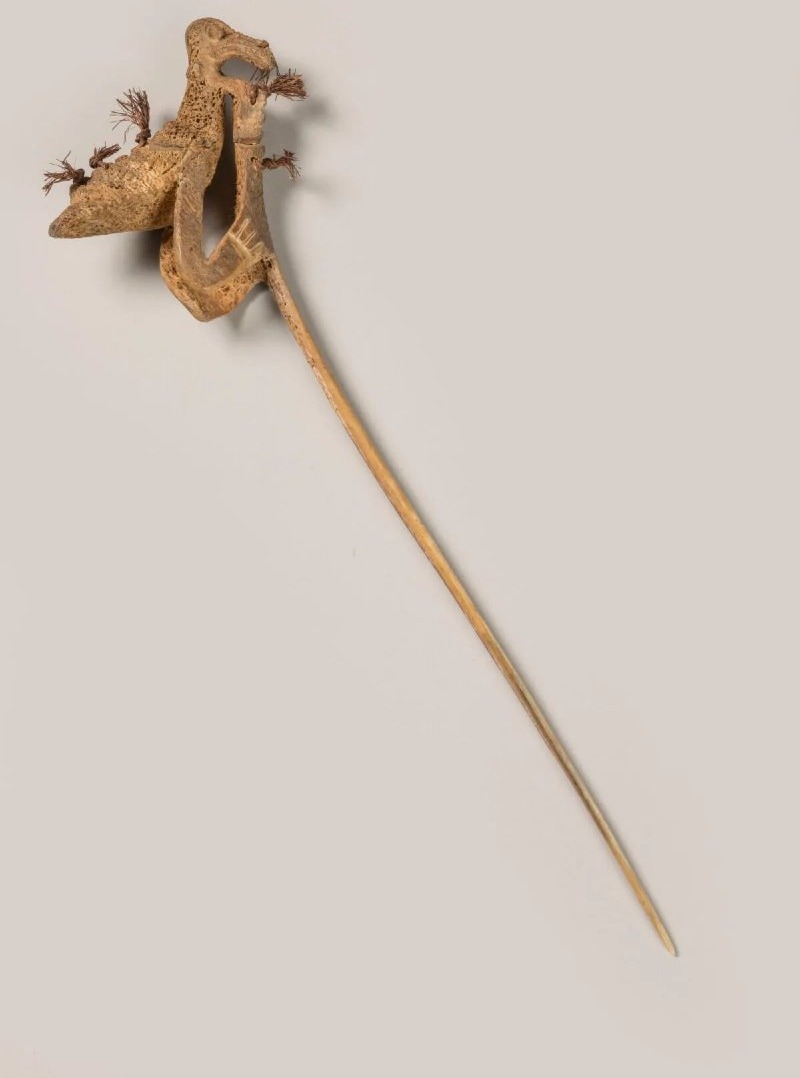
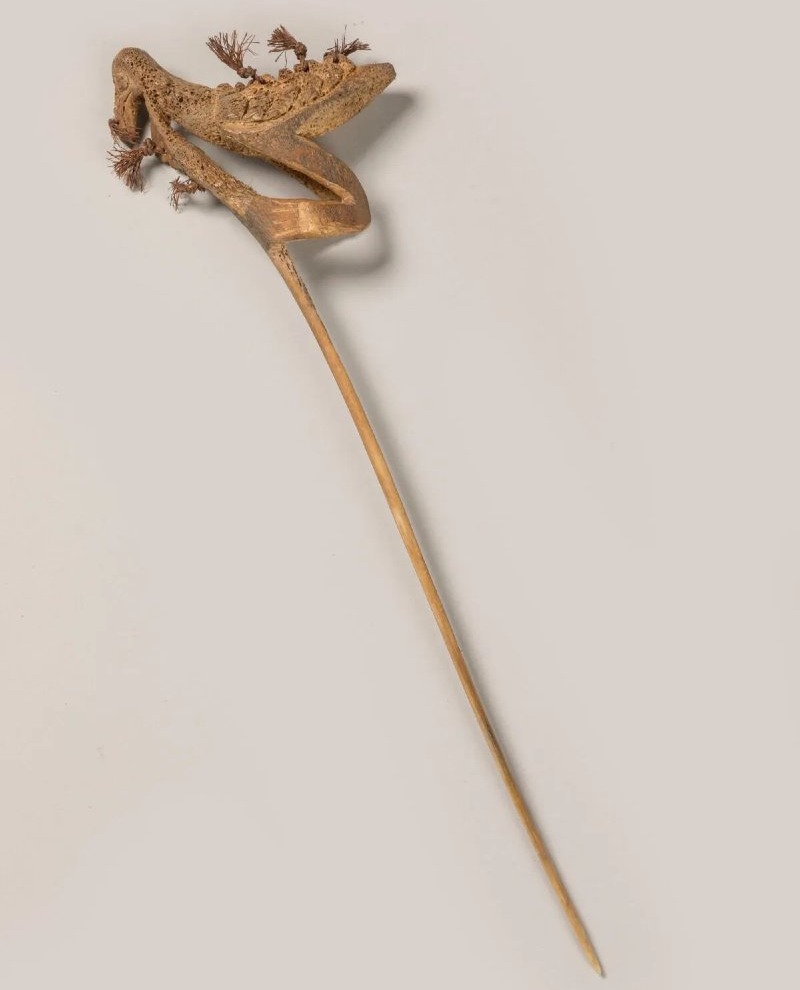
Lime spatula made of cassowary bone, carved with afigure of a fish eagle, a metaphor for the headhunter.
Long and elegant, this spatula is carved from acassowary bone and features at its tip a remarkable figure of a bird of prey,whose powerful and naturalistic character contrasts with the delicacy of thematerial.
Lime spatulas play an important role in thematerial culture of the Middle Sepik peoples. They were used toscoop lime from a container and then bring it to the mouthto mix it with areca nuts (Areca catechu) in the preparationof betel, a practice widespread in New Guinea.
Beyond thiseveryday use, these objects could take on a ceremonial andsymbolic dimension.
The Metropolitan Museum of Art, in particular, holds several Iatmul or Chambrilime spatulas and containers and highlights their role insocial and ritual practices.In Sepik art, the animal figures carved on theseobjects are not mere ornaments. They refer to a rich system ofrepresentations in which animals, ancestors, and supernatural beingsare intimately linked.
The depiction of the fish-eating eagle, here associatedwith the figure of the headhunter, gives this spatula a strongsymbolic dimension, evoking power, predation, and warrior status.Carving in cassowary bone is particularlycharacteristic of the region.
Comparable examples are held inseveral major international museum collections, notably at theMetropolitan Museum of Art and the Museum of Fine Arts in Houston. The latterholds a Sepik-style lime spatula made of cassowary bone measuring 36.3 cm, verysimilar in size to our specimen.
Probably first half of the 20th century
Origin: Iatmul / Chambri, Wosera-Gaui, Papua New Guinea
34 cm long
Provenance: private collection in Nièvre
Bibliographic and comparative references:
— The Metropolitan Museum of Art, New York, Lime Spatula (Tap), Iatmul,Middle Sepik, inv. 1978.412.821.
— The Metropolitan Museum of Art, New York, Ceremonial Lime Container (BandiNa Iavo), Iatmul or Chambri.
— Museum of Fine Arts, Houston, Lime Container and Spatula, peoples of theSepik, cassowary bone, 36.3 cm, inv. 98.479.A-B.
— Dorotheum, Vienna, Very fine Sepik lime container with spatula, ca.1900, cassowary bone, 37 cm. The piece is described as representing, in theform of a bird, the link between the living and the ancestors.
Lime spatula made of cassowary bone, carved with afigure of a fish eagle, a metaphor for the headhunter.
Long and elegant, this spatula is carved from acassowary bone and features at its tip a remarkable figure of a bird of prey,whose powerful and naturalistic character contrasts with the delicacy of thematerial.
Lime spatulas play an important role in thematerial culture of the Middle Sepik peoples. They were used toscoop lime from a container and then bring it to the mouthto mix it with areca nuts (Areca catechu) in the preparationof betel, a practice widespread in New Guinea.
Beyond thiseveryday use, these objects could take on a ceremonial andsymbolic dimension.
The Metropolitan Museum of Art, in particular, holds several Iatmul or Chambrilime spatulas and containers and highlights their role insocial and ritual practices.In Sepik art, the animal figures carved on theseobjects are not mere ornaments. They refer to a rich system ofrepresentations in which animals, ancestors, and supernatural beingsare intimately linked.
The depiction of the fish-eating eagle, here associatedwith the figure of the headhunter, gives this spatula a strongsymbolic dimension, evoking power, predation, and warrior status.Carving in cassowary bone is particularlycharacteristic of the region.
Comparable examples are held inseveral major international museum collections, notably at theMetropolitan Museum of Art and the Museum of Fine Arts in Houston. The latterholds a Sepik-style lime spatula made of cassowary bone measuring 36.3 cm, verysimilar in size to our specimen.
Probably first half of the 20th century
Origin: Iatmul / Chambri, Wosera-Gaui, Papua New Guinea
34 cm long
Provenance: private collection in Nièvre
Bibliographic and comparative references:
— The Metropolitan Museum of Art, New York, Lime Spatula (Tap), Iatmul,Middle Sepik, inv. 1978.412.821.
— The Metropolitan Museum of Art, New York, Ceremonial Lime Container (BandiNa Iavo), Iatmul or Chambri.
— Museum of Fine Arts, Houston, Lime Container and Spatula, peoples of theSepik, cassowary bone, 36.3 cm, inv. 98.479.A-B.
— Dorotheum, Vienna, Very fine Sepik lime container with spatula, ca.1900, cassowary bone, 37 cm. The piece is described as representing, in theform of a bird, the link between the living and the ancestors.
250 €
Period: 20th century
Style: Tribal Art
Condition: Excellent condition
Material: Bone
Length: 34
Reference (ID): 1834785
Availability: In stock
Print