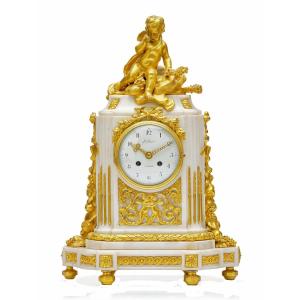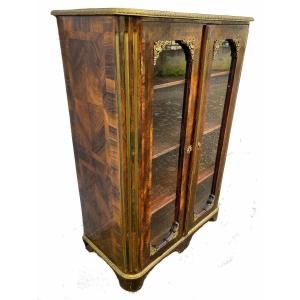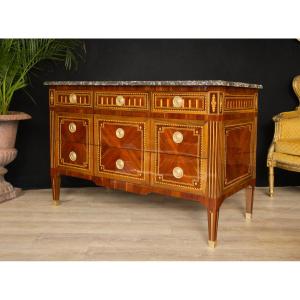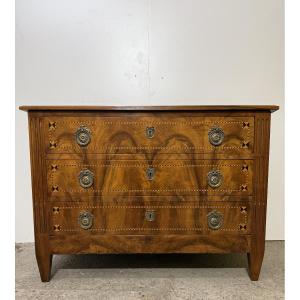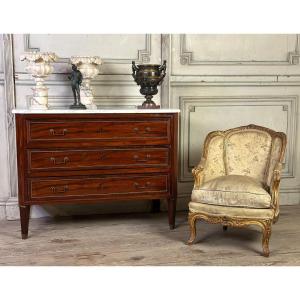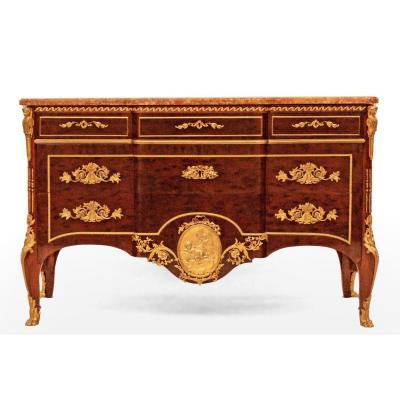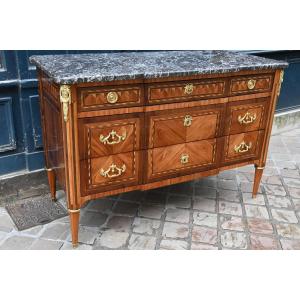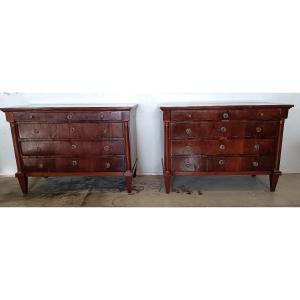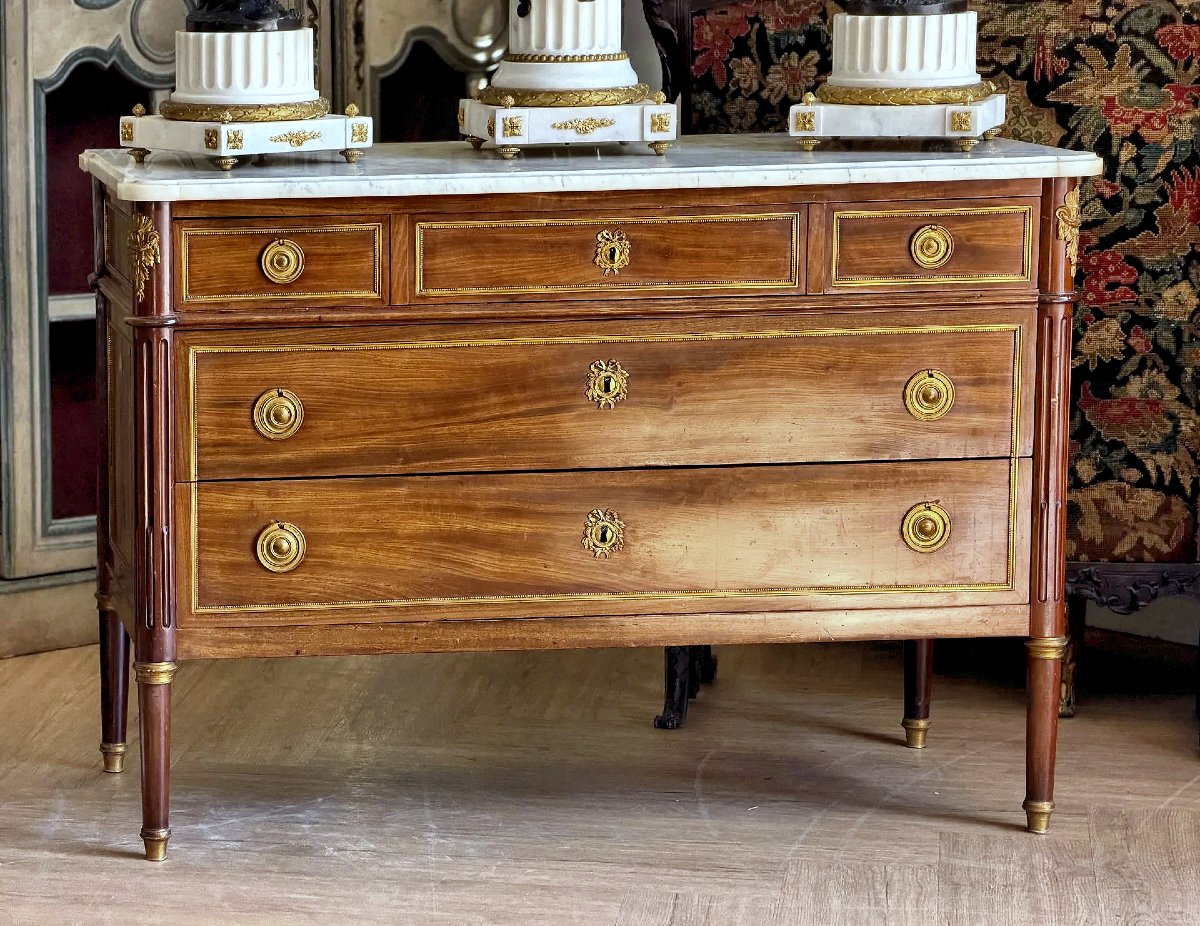
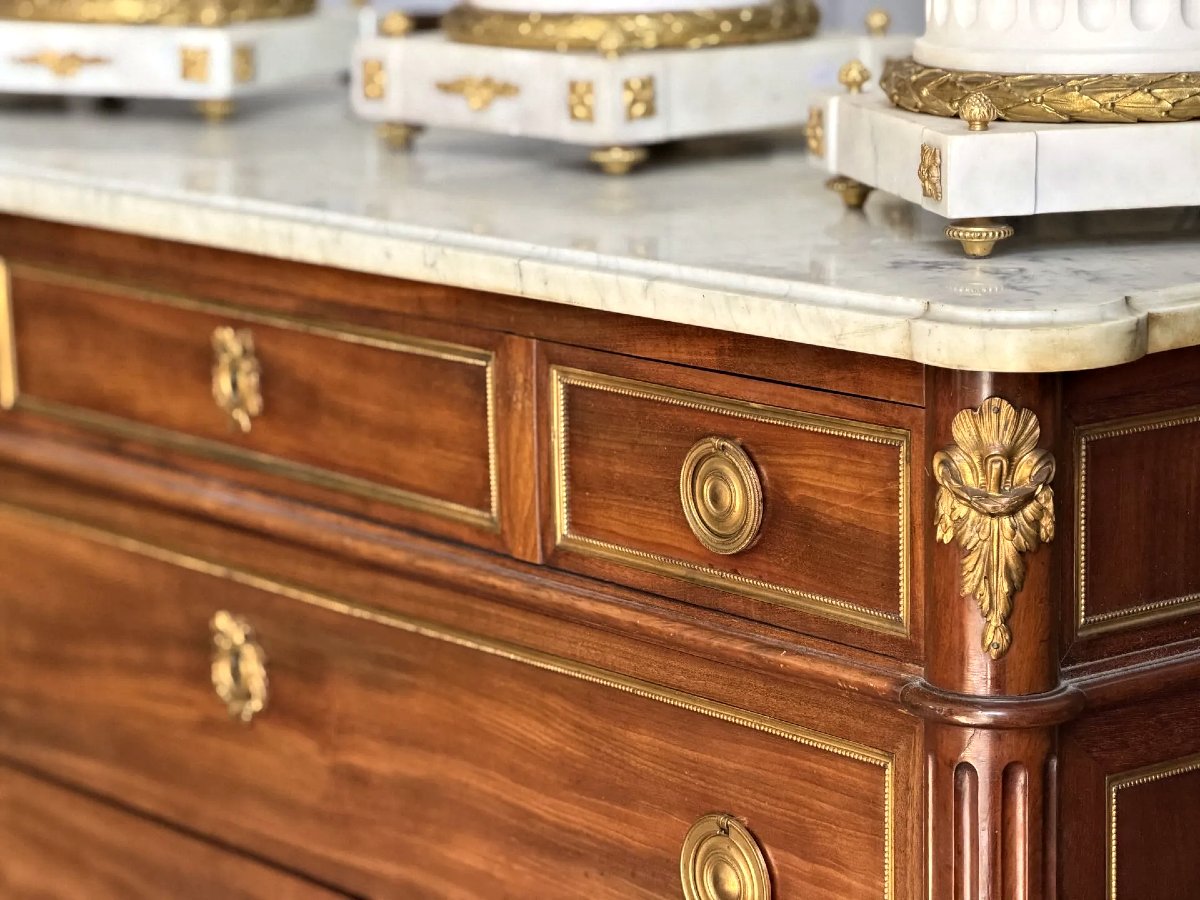
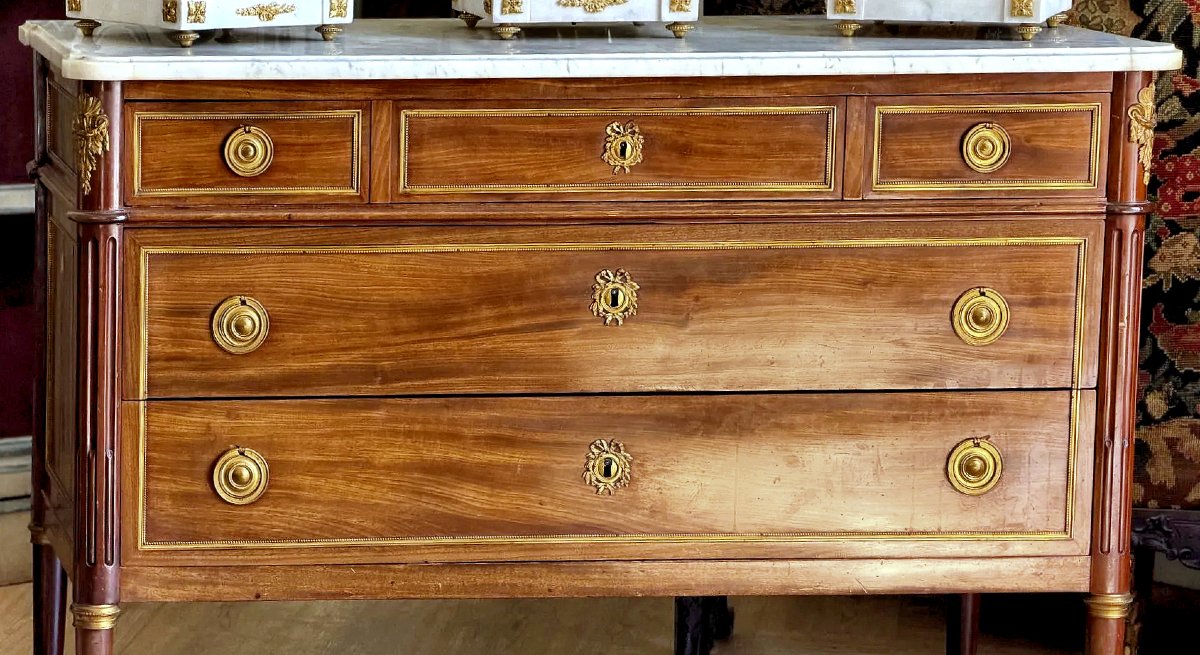
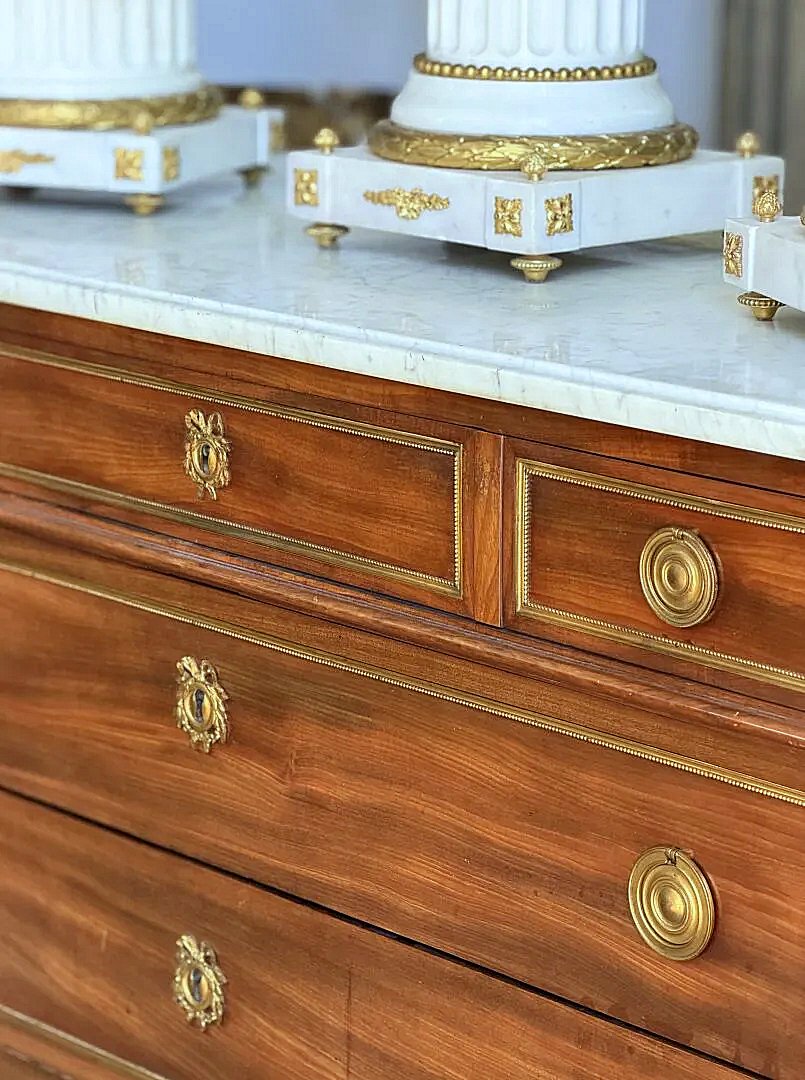

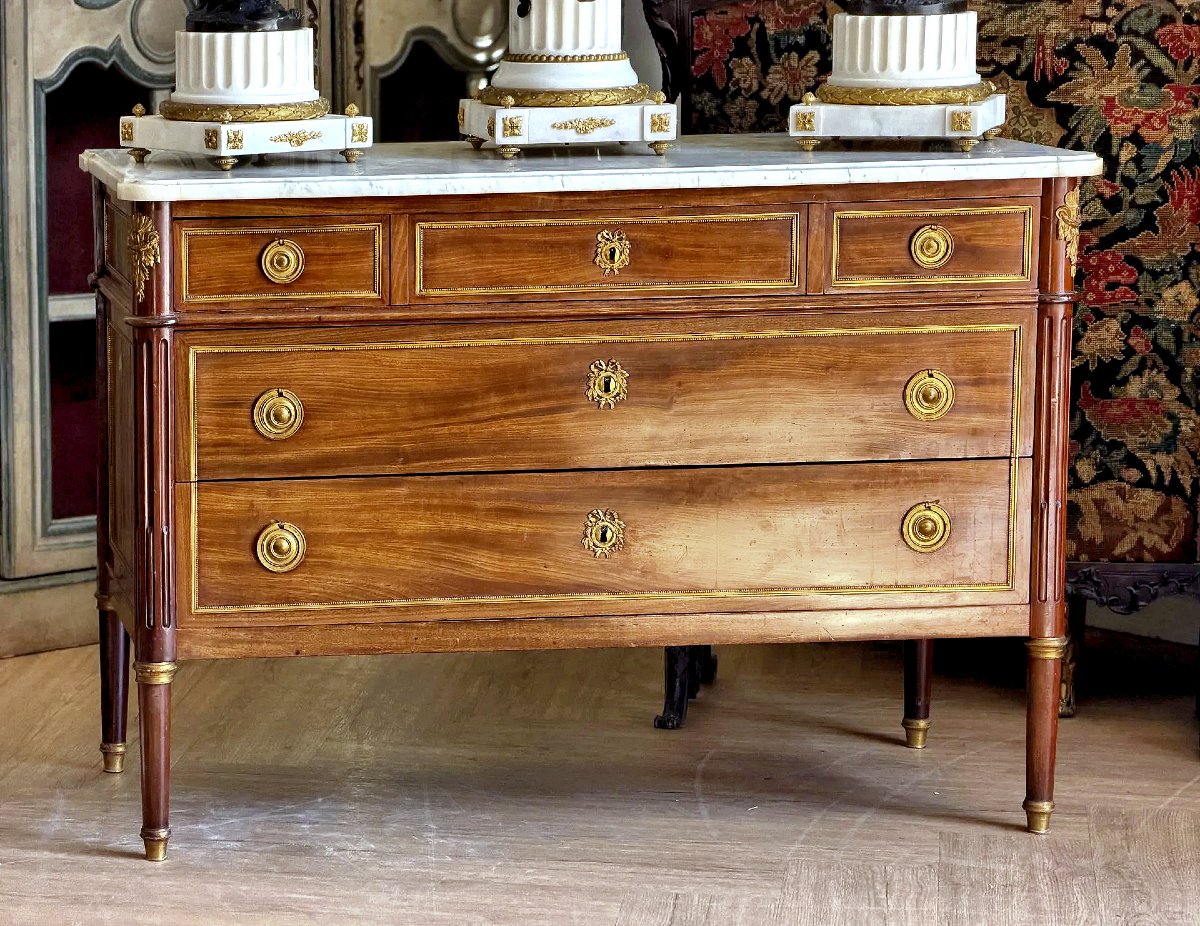
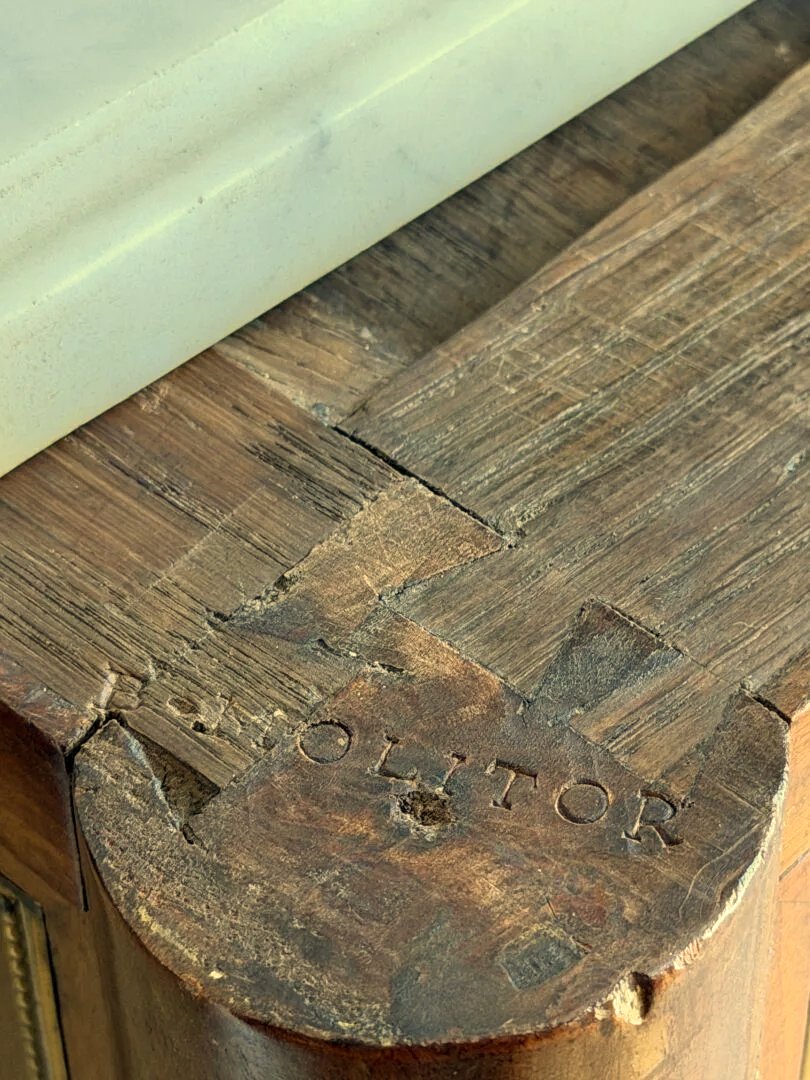
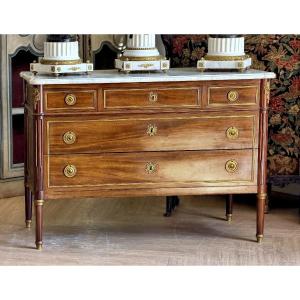


Louis XVI Chest Of Drawers Stamped "b.molitor," Circa 1790—bernard Molitor (1755–november 17, 1833)
Chest of drawers
Louis XVI
stamped
B.MOLITOR
circa 1780
H. 84.9 cm – W. 122.5 cm – D. 54.4 cm
Bernard Molitor
(1755–November 17, 1833)
Master craftsman since October 26, 1787
Bernard Molitor was among the most eminent cabinetmakers of the era of Louis XVI and Napoleon Bonaparte.
His exceptional furniture captivates with its outstanding quality.
Molitor grew up in Betzdorf, Luxembourg, where his father was a miller, and then moved to Paris in 1777, where one of his cousins was already working as a carpenter. During his early years in Paris, he earned a living as a merchant: in 1778, he sold insecticides, and six years later, he sold book-shaped hand warmers.
After marrying the daughter of a “carpenter to the king” in 1787, he became a “master cabinetmaker” and a member of the cabinetmakers’ guild. He opened a workshop on Rue de Bourbon (now Rue de Lille).
One of his first commissions came from Marie Antoinette, who commissioned him to create a mahogany wainscot for her boudoir at the Château de Fontainebleau. Just as Molitor was beginning to make a name for himself among the French nobility, the French Revolution broke out, and Molitor was forced to close his workshop, as most of his clients had either fled or been killed. Later, Molitor was able to reopen his workshop and employ several artisans who helped him produce a wide variety of furniture, including chests of drawers, tables, desks, and wardrobes. Molitor’s furniture was often veneered with precious woods and adorned with gilded bronze appliqués.
Napoleon Bonaparte commissioned several pieces of furniture from him for his residence at the Château de Saint-Cloud. In 1811, Molitor was appointed “supplier to the Imperial Court.”
In 1800, Bernard Molitor purchased a house on the elegant Rue du Faubourg Saint-Honoré. In 1815, he married a second time, then moved to Fontainebleau in 1820, where he died in 1833 at the age of 78. He is buried in the Fontainebleau cemetery.
In 1995, when Luxembourg was the European Capital of Culture, a retrospective dedicated to Molitor’s work drew the general public’s attention for the first time. Today, collectors pay considerable sums to acquire original Molitor furniture.
Three pieces by Molitor are part of the Royal Collection of the British royal family.
Other works by Molitor can be found notably at the Louvre in Paris, the Paul Getty Museum in Malibu, and the Wallace Collection in London.
Signed pieces dating from the Louis XVI period are extremely rare; most pieces of furniture are simply attributed to him.
See: Pierre Kjellberg, *Le Mobilier français du XVIIIe siècle*, 1989, p. 579 ff.
See:
Christie’s, London, November 15, 2017, lot 221: €30,300
for a chest of drawers with a simple design
Inv. No. 3.308
€8,900
Period: 18th century
Style: Louis 16th, Directory
Condition: Excellent condition
Material: Wood marquetry
Length: 122,5 cm
Height: 84,5 cm
Depth: 54,5 cm
Reference (ID): 1828398
Availability: In stock