THIS OBJECT WAS SOLD
Oil On Canvas By Emile Blanchon—born In 1845—“the Loading Of The Plaster.”

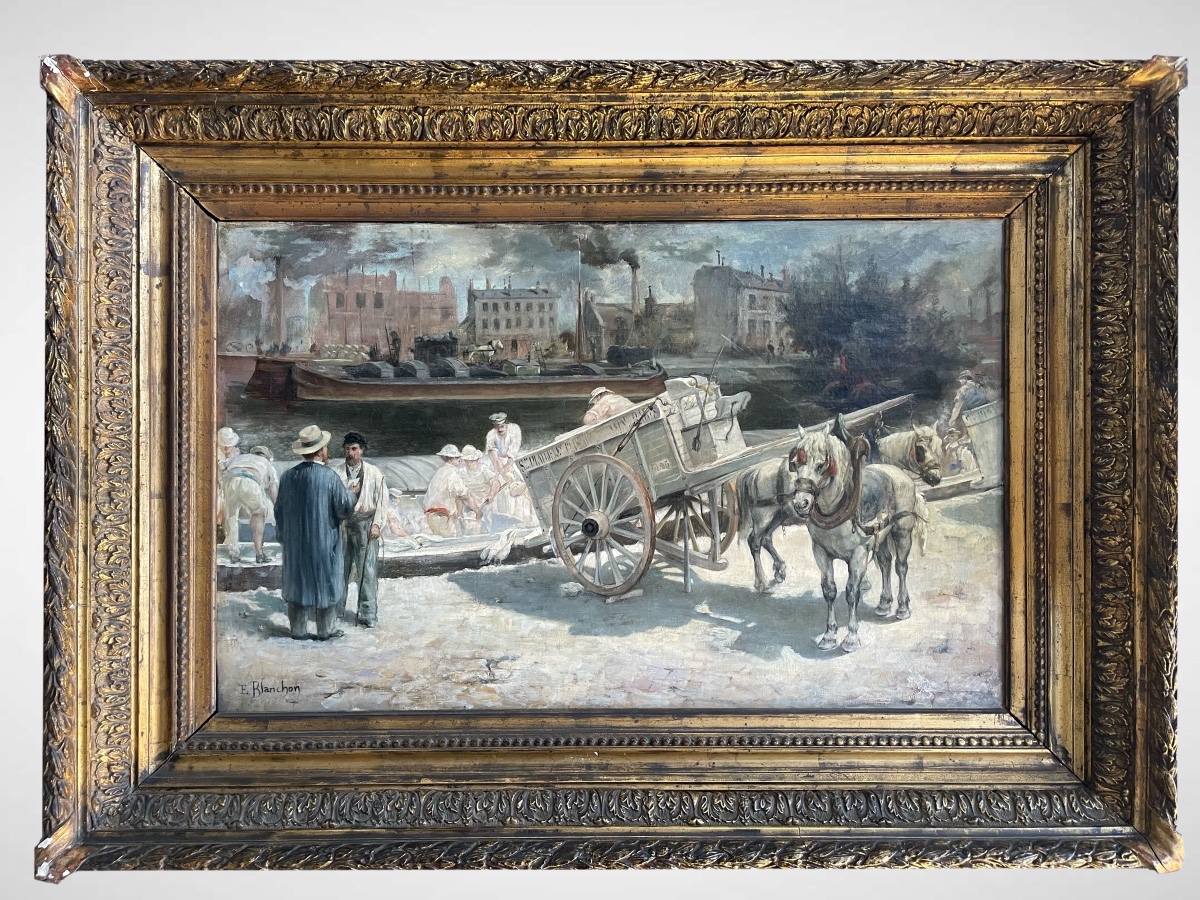
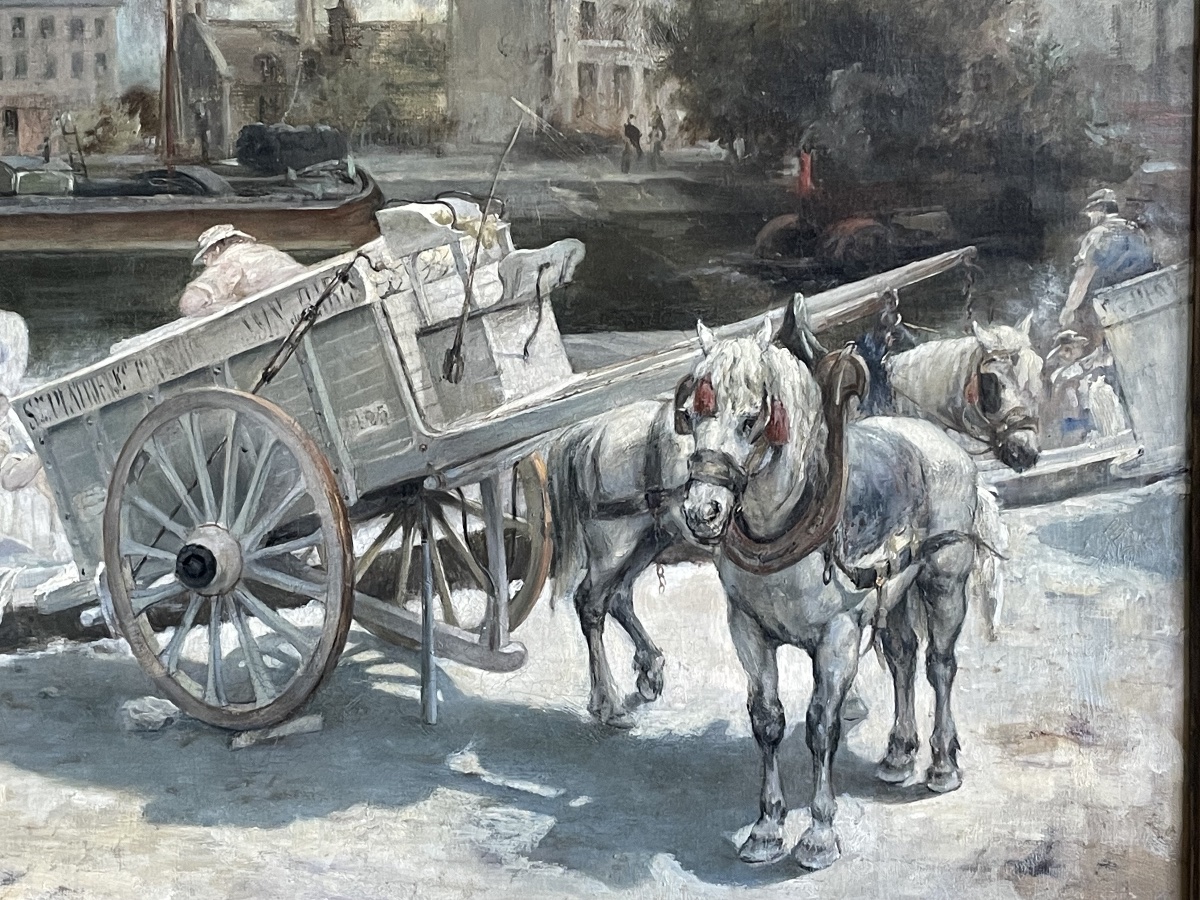


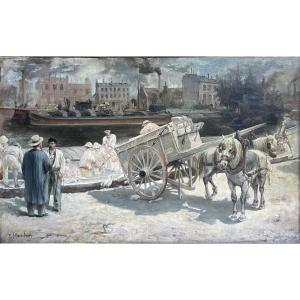


The scene, presumably set in Paris, depicts the transfer of a shipment of plaster from a cart to a barge docked at the wharf. While the workers are busy at work, in the foreground on the left, the transaction is formalized as the receipt slip is handed to the coachman.
To perform the maneuver, the horses are unhitched, and a movable wooden support allows the cart to be tilted backward.
On the side of the cart, the words “Société des plâtrières générales du bassin de Paris” are visible.
On the opposite quay, other commercial and transportation activities can be seen (stacking of barrels).
As early as 1830, spurred on by investment banker Jacques Laffitte, the Parisian plaster industry took off. In fact, the Paris region alone accounted for more than 70% of the nation’s gypsum resources. Soon after acquiring small outlying companies, Jacques Laffitte came to hold a virtual monopoly over Parisian plaster—from its extraction in gypsum quarries, through its processing in factories, to its sale. Initially divided into two companies—one in the east and one in the west—a merger around the 1880s led to a single company managing all of Paris’s plaster production.
In the banking district of Paris’s 9th arrondissement, a street is named after Jacques Laffitte.
As a testament to working-class life in Paris in the late 19th century, this painting by Émile Blanchon is reminiscent of certain works by Louis Robert Carrier-Belleuse—a contemporary of Blanchon’s—including “Les porteurs de farine” (The Flour Carriers), which can be seen in the collections of the Petit Palais.
Painting on canvas, mounted on a stretcher. Wooden frame with gilded stucco that needs cleaning.
View size: 72 cm x 45 cm
Frame size: 98 cm x 72 cm
Explore similar pieces and discover your ideal find:
Genre Scenes, Nudes