THIS OBJECT WAS SOLD
Late 18th-century Embroidery; Spanish War; Bonaparte Empire; Napoleon; Guipúzcoa; Basque Country; 1794; Irun
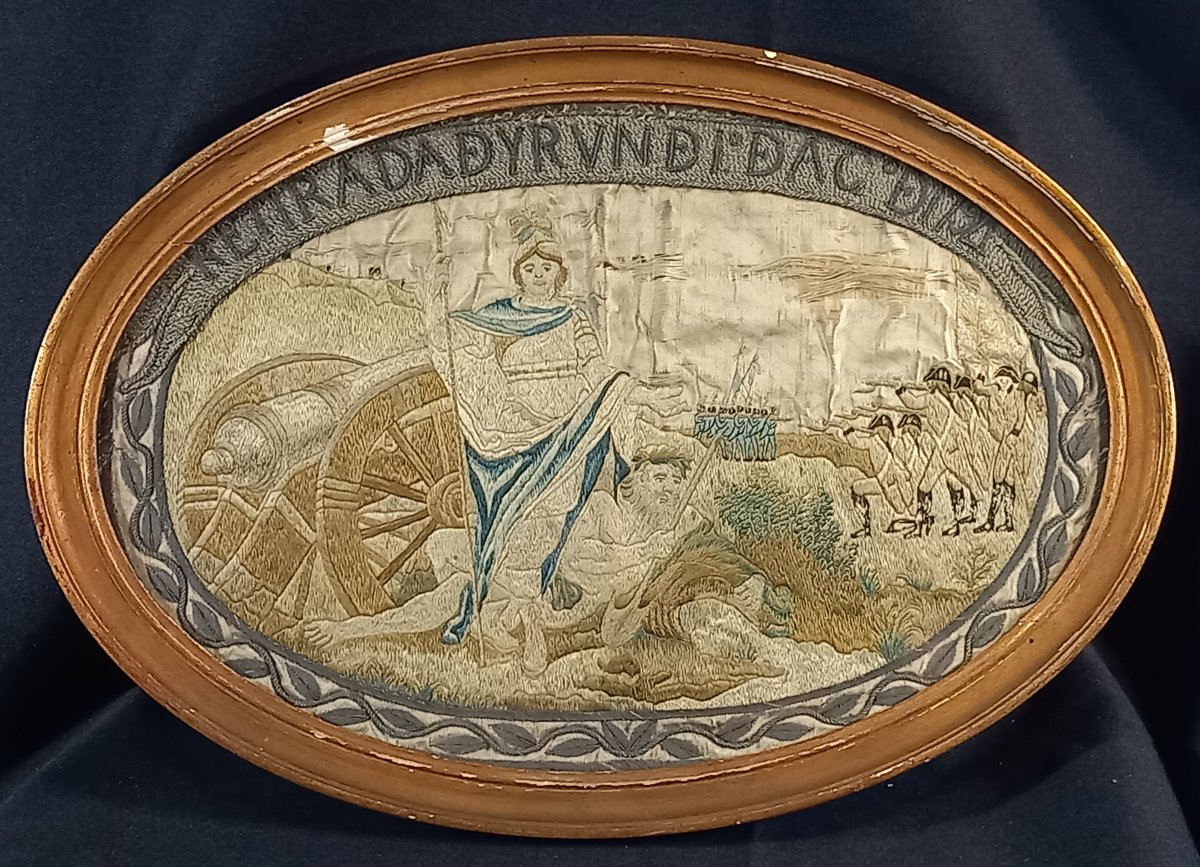
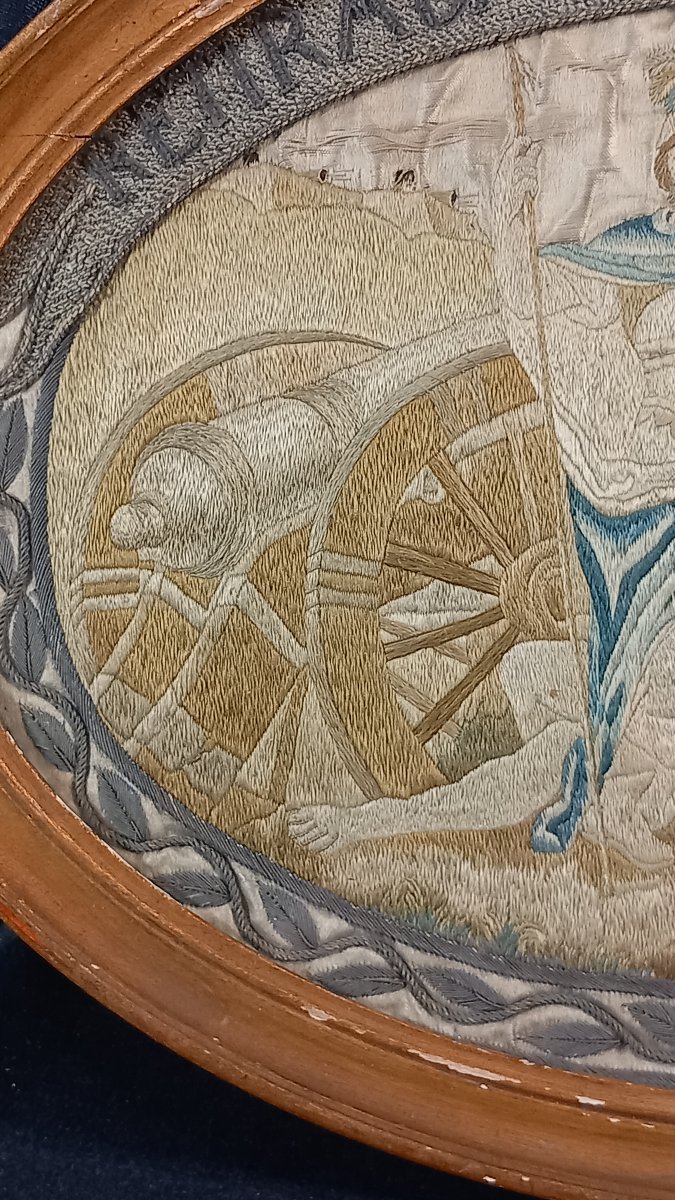
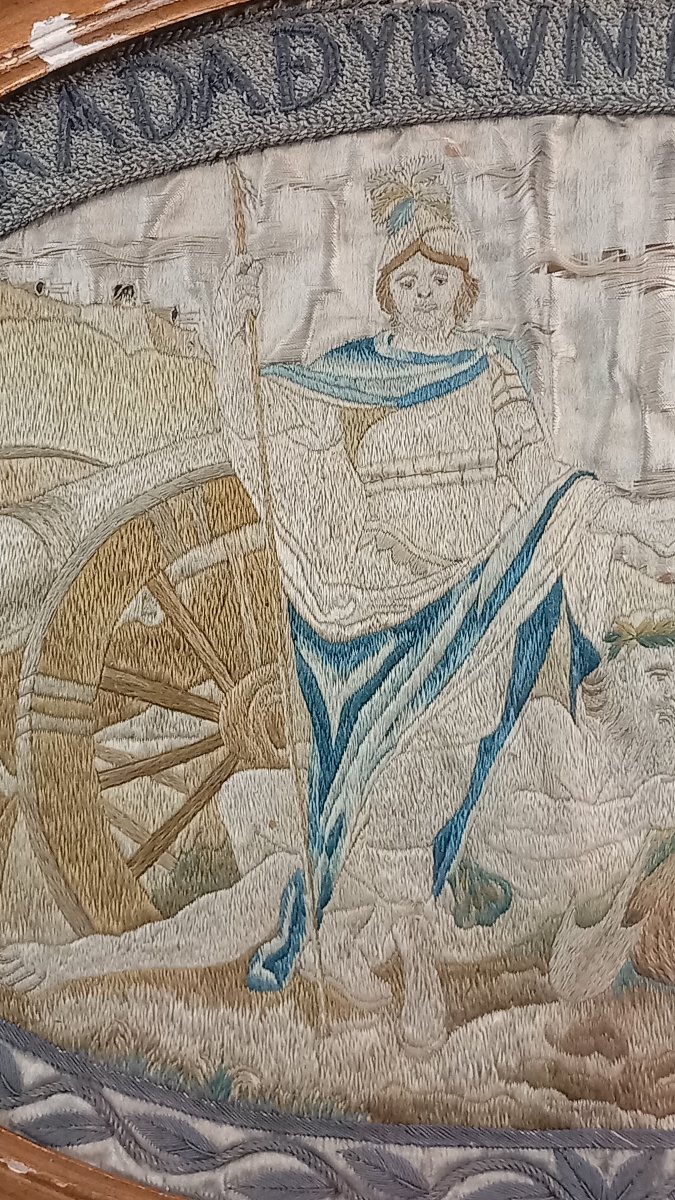
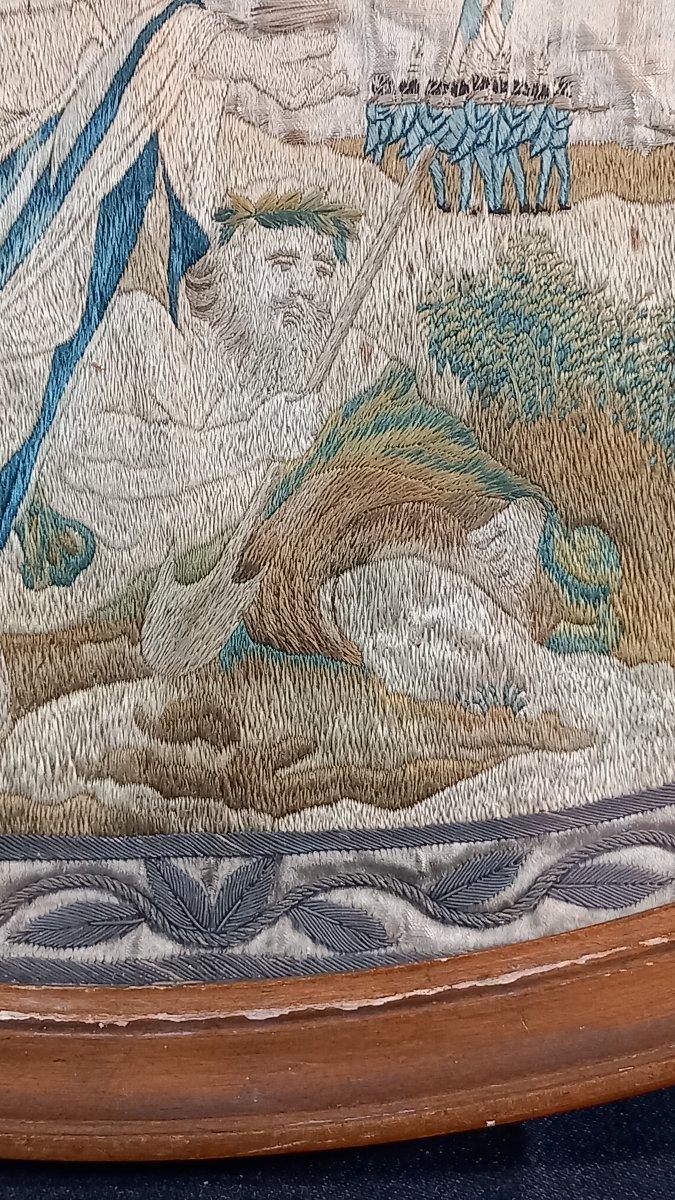
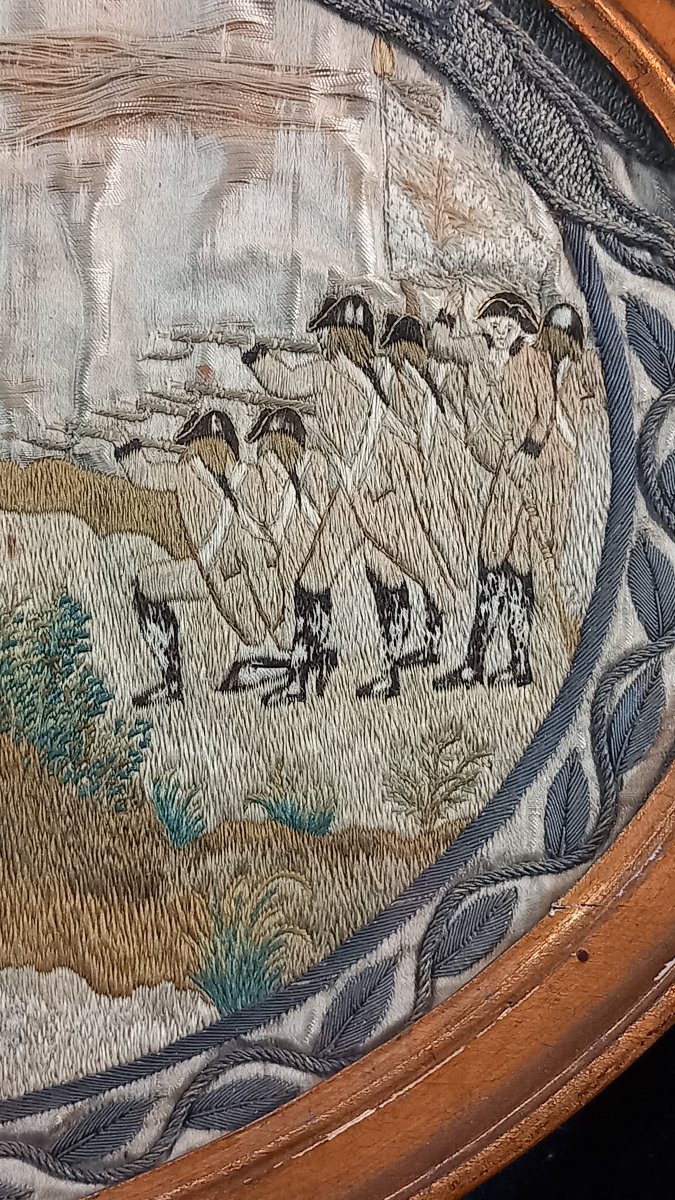


Oval embroidery decorated with canetille and gold and silver threads.
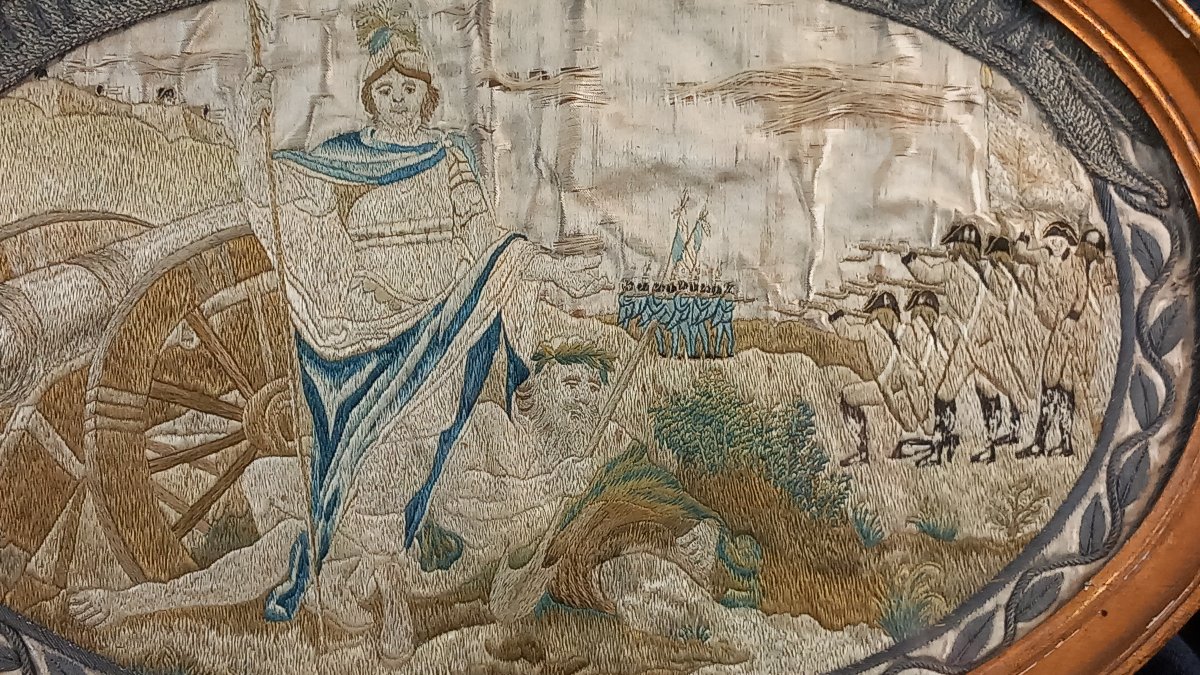
The main scene depicts an episode of the Battle of Iruan during the Spanish War amid the tumultuous revolutionary period. In July 1794, the Spanish army—which included many émigrés—faced off against French troops led by General Moncey.
While the background depicts this military battle, the foreground features a large Minerva, the goddess of war, leaning on a field cannon and towering over a bearded, reclining god—perhaps an allusion to the Bidasoa River, which marks the Franco-Spanish border.
Here is a description of this historic moment, provided by historian Maïté Lafourcade in her book on the occupation of Guipúzcoa and the Reign of Terror: "Justice and Politics: The Reign of Terror in the French Revolution," Presses de l’Université Toulouse Capitole, 2021.
Shortly after France declared war on Spain on March 7, 1793, the Spanish army—which included many French émigrés—under the command of General Ventura Caro crossed the border and invaded part of the French Basque Country. But it could not hold out for long against the French troops, who were more numerous and driven by great patriotic enthusiasm. Starting in February 1794, the situation reversed. The Spanish army was forced to retreat on July 24, 1794, in the face of Republican troops led by General Moncey, who sought to “compel this superstitious nation and this Capetian government to respect French territory...”. But not content with merely repelling the enemy and disregarding the principle of balance, the French in turn invaded Guipúzcoa—a task made all the easier, moreover, by the fact that the inhabitants of that province, invoking their privileges, refused to provide the conscripts demanded by General Caro. And, five days later, the tricolor flag flew over a vast portion of Basque territory in Spain.
An interesting and unique Spanish illustrated memento of this historic moment in the Revolutionary Wars between Guipúzcoa and the Basque Country.
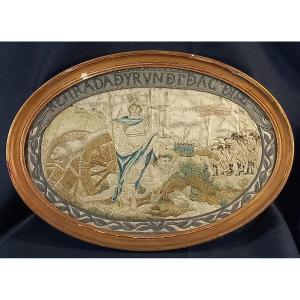
The embroidery bears the inscription “RETIRADA DYRUN DI° DAC° D1794” in a speech bubble at the top.
Frame dimensions: 39 x 27.4
The main scene depicts an episode of the Battle of Iruan during the Spanish War amid the tumultuous revolutionary period. In July 1794, the Spanish army—which included many émigrés—faced off against French troops led by General Moncey.
While the background depicts this military battle, the foreground features a large Minerva, the goddess of war, leaning on a field cannon and towering over a bearded, reclining god—perhaps an allusion to the Bidasoa River, which marks the Franco-Spanish border.
Here is a description of this historic moment, provided by historian Maïté Lafourcade in her book on the occupation of Guipúzcoa and the Reign of Terror: "Justice and Politics: The Reign of Terror in the French Revolution," Presses de l’Université Toulouse Capitole, 2021.
Shortly after France declared war on Spain on March 7, 1793, the Spanish army—which included many French émigrés—under the command of General Ventura Caro crossed the border and invaded part of the French Basque Country. But it could not hold out for long against the French troops, who were more numerous and driven by great patriotic enthusiasm. Starting in February 1794, the situation reversed. The Spanish army was forced to retreat on July 24, 1794, in the face of Republican troops led by General Moncey, who sought to “compel this superstitious nation and this Capetian government to respect French territory...”. But not content with merely repelling the enemy and disregarding the principle of balance, the French in turn invaded Guipúzcoa—a task made all the easier, moreover, by the fact that the inhabitants of that province, invoking their privileges, refused to provide the conscripts demanded by General Caro. And, five days later, the tricolor flag flew over a vast portion of Basque territory in Spain.
An interesting and unique Spanish illustrated memento of this historic moment in the Revolutionary Wars between Guipúzcoa and the Basque Country.
The embroidery bears the inscription “RETIRADA DYRUN DI° DAC° D1794” in a speech bubble at the top.
Frame dimensions: 39 x 27.4
Explore similar pieces and discover your ideal find:
Flags, Trophies