

Marcel Loth (1919–2009) Spring 72 Abstract Sculpture
Marcel LOTH
(L’Aigle 1919 – Ajat 2009)
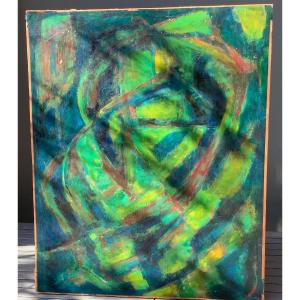
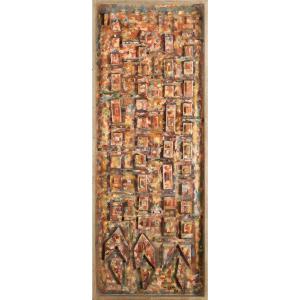
Spring 72
Oil on wood, with glued-on pieces of wood
H. 125 cm; W. 48 cm
Signed lower right, dated 1972 – Titled on the back, inscribed
Provenance: Acquired directly from the artist by Mr. and Mrs. Jacques Lagrange in May 1972.
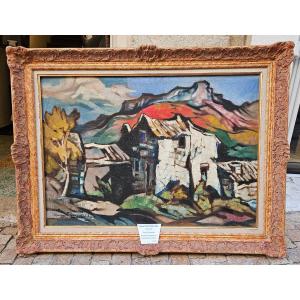
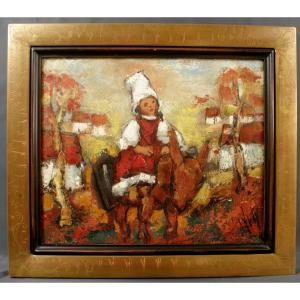
Self-taught in painting, Marcel Loth began his career in the 1940s with street scenes, portraits, and urban or rural landscapes, often imbued with a precise, sometimes ironic, view of the world. His early works were figurative, imbued with a spirit of observation that did not preclude a certain formal detachment. But it was in the 1950s that his painting truly came into its own: through his engagement with postwar artistic movements, the School of Paris, and especially under the influence of the painter Roger Bissière, whom he met in the Périgord art circle, Loth gradually shifted toward a constructed abstraction, where composition takes precedence over representation.
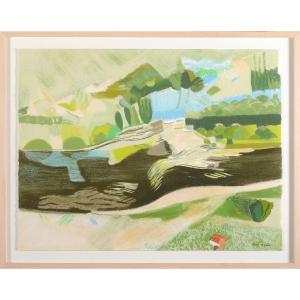
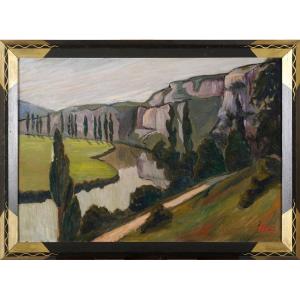
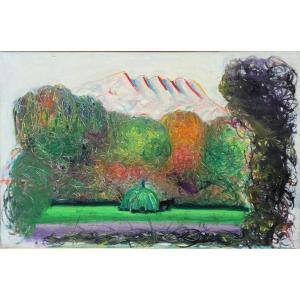
Far from fading, his connection to the Périgord became more subtle. Loth no longer painted recognizable landscapes, but he transposed their rhythms, masses, and internal tensions. The limestone cliffs of Les Eyzies become vertical planes; the hills are expressed as taut curves; the villages as colorful cubes. What the eye can no longer distinguish with certainty is recomposed by the memory of the place. The Périgord thus becomes less a subject than a mental foundation: an inner geography.
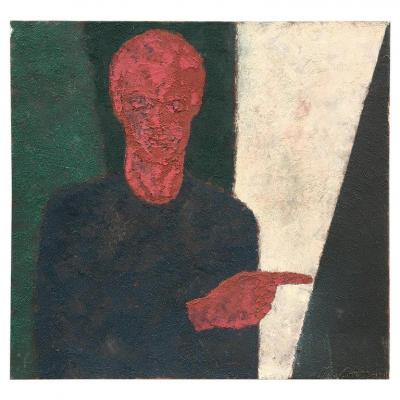
His palette, initially soft and earthy, has been enriched over the years with deep reds, saturated blues, and vivid greens. Loth loves the medium: he works it into impasto, scratches at it, and builds its structure. Each canvas is a construction, almost an architectural elevation. Here we see his dual background as an architect and a painter, in a rare fusion of built space and pictorial space. He never succumbs to the automatic tendencies of lyrical abstraction nor to the rigidity of pure geometric art: his painting remains vibrant, balanced, and personal.
Marcel Loth is not a solitary artist. In Périgueux, he associated with other artists who shaped the regional art scene: Jean Boyé, a painter and professor, who was also influenced by Bissière; Guy Célérier, committed to a sensitive form of figurative art; and François Augiéras, a writer-painter on the fringes of the art world. Together with them, Loth helped transform postwar Périgord into a laboratory for modern artistic experimentation—far from Paris yet in constant dialogue with the major artistic movements of his time.
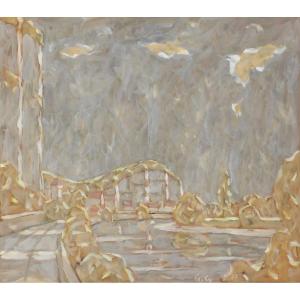
His works, long kept in the shadows of a discreet studio, are now being rediscovered for their uniqueness and coherence. Paintings such as Les Eyzies (1958), Abstraction No. 3 (1962), or Winter Triptych (1960) demonstrate a mastery of composition, a profound sense of color, and a visceral attachment to the mental landscape of the Dordogne.
The strength of Marcel Loth’s work lies in his ability to embody abstraction without ever breaking with reality. He does not paint “against” figuration: he extracts its essence, deconstructs it to better reconstruct it. He stands at the crossroads of two worlds: that of structure, line, and volume; and that of sensation, light, and place.
The Périgord is thus ever-present: not as a backdrop, but as a geological memory, a sense of gravity, an architecture of the gaze. In Loth’s work, painting becomes an act of rootedness and freedom—an abstraction that never forgets where it comes from.
This intriguing panel is part of a series of abstract works by Loth created in the 1970s. These wooden assemblages, initially constructed without any color, are then covered with the painter’s second artistic expression. Here, the composition can be read from top to bottom, beginning with these three arrows pointing us toward lines of small mounds on two levels, sometimes interspersed with small horizontal elements. Does the title “Printemps 72” offer a key to interpreting the work? It’s up to you to find the answer that your feelings will dictate!
When the couple purchased the work from Loth, Jacques Lagrange was a city council member in Périgueux serving under Yves Guéna. After a career as a photographer for Sud-Ouest and as a cameraman, he turned to publishing in 1982 by founding Pilote 24, a publishing house that produced the major works on the history and heritage of the Périgord region.
Period: 20th century
Style: Modern Art
Condition: Perfect condition
Material: Painted wood
Length: 125 cm
Width: 48 cm
Reference (ID): 1780879
Availability: In stock