

Saint Andrew. Carved And Polychrome Wood. Attributed To De Vahía, Alejo (? – C. 1515).
Saint Andrew. Carved and polychrome wood. Attributed to DE VAHÍA, Alejo (? – c. 1515).
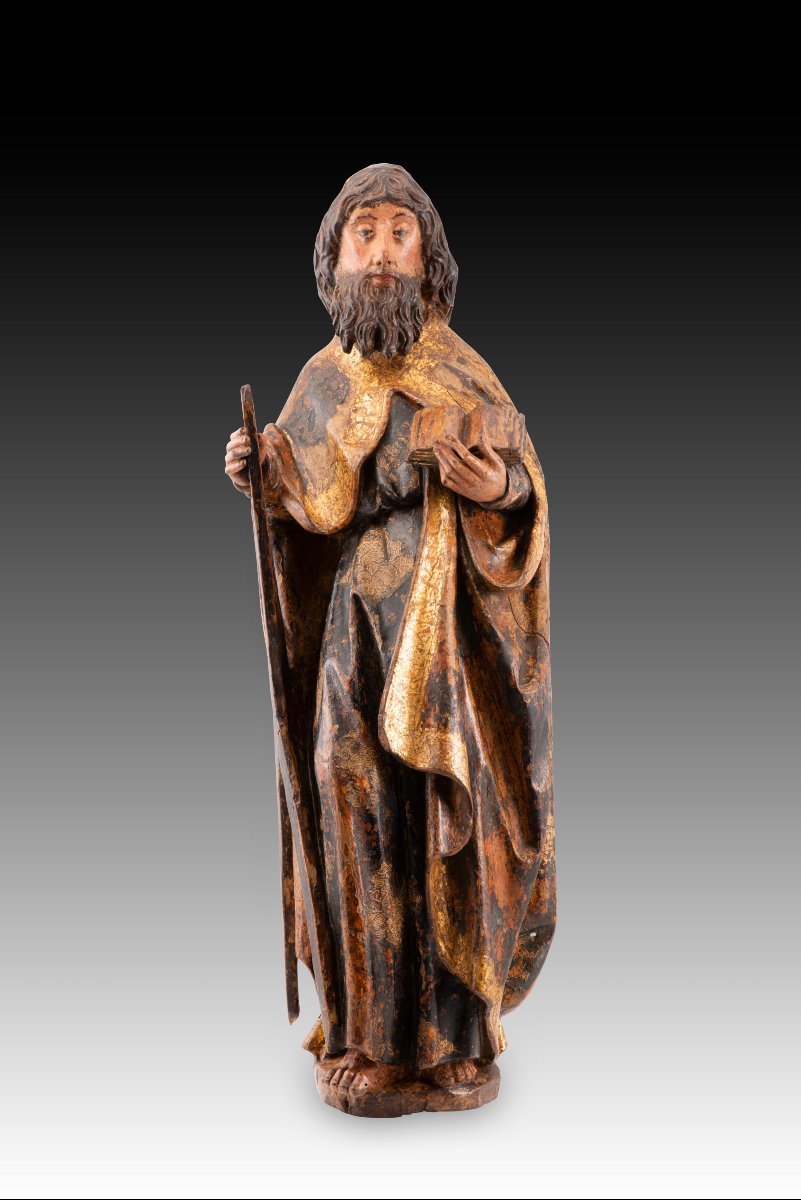
This figurative sculpture, carved from wood and painted in polychrome with traces of gilding still visible, depicts a standing male figure dressed in a tunic and a cloak. The figure, whose hands are missing, faces forward; he has a full beard and wavy hair. As is often the case in certain works intended for altarpieces, etc., the back is unfinished, revealing a metal support used to secure the piece to the wall. On one side of the figure are the remains of a St. Andrew’s cross, also known as a Burgundian cross, as the apostle Andrew—considered Jesus’s first disciple and Peter’s older brother—was crucified on this type of cross. The Acts of Andrew recount that Aegeas (or Aegeates), proconsul of Patras, ordered Andrew’s execution after learning that he had converted his wife. Alejo de Vahía (? – c. 1515) was a Gothic sculptor, likely of Northern European origin, as his artistic training appears to have come from the Lower Rhine region. We know that he worked in Spain (in the region of Becerril de Campos, for the regions of Palencia and Valladolid, etc.) for an unspecified period between 1475 and 1515 (it is assumed he died in 1515 or earlier), as he did not sign his works and to date we have only a single document concerning him. One of his major strengths lies in his highly distinctive and assertive personal style, which links him to works such as the choir stalls of Oviedo Cathedral, the tombs of the Núñez de la Serna family in the Church of Santiago in Valladolid, and many others. Compare the sculpture presented here with that of an apostle (perhaps Saint Philip) dating from around 1500, housed in the Museum of Sacred Art in Becerril de Campos, with that of Saint Onuphrius from the late 16th century, held at the National Sculpture Museum in Valladolid, or even with that of the Eternal Father (Pare Etern) from the school of Alejo de Vahía, dating from around 1505–1515, held at the parish church of Vega de Ruiponce in Valladolid. ·
Dimensions: 21 x 21 x 65 cm
This figurative sculpture, carved from wood and painted in polychrome with traces of gilding still visible, depicts a standing male figure dressed in a tunic and a cloak. The figure, whose hands are missing, faces forward; he has a full beard and wavy hair. As is often the case in certain works intended for altarpieces, etc., the back is unfinished, revealing a metal support used to secure the piece to the wall. On one side of the figure are the remains of a St. Andrew’s cross, also known as a Burgundian cross, as the apostle Andrew—considered Jesus’s first disciple and Peter’s older brother—was crucified on this type of cross. The Acts of Andrew recount that Aegeas (or Aegeates), proconsul of Patras, ordered Andrew’s execution after learning that he had converted his wife. Alejo de Vahía (? – c. 1515) was a Gothic sculptor, likely of Northern European origin, as his artistic training appears to have come from the Lower Rhine region. We know that he worked in Spain (in the region of Becerril de Campos, for the regions of Palencia and Valladolid, etc.) for an unspecified period between 1475 and 1515 (it is assumed he died in 1515 or earlier), as he did not sign his works and to date we have only a single document concerning him. One of his major strengths lies in his highly distinctive and assertive personal style, which links him to works such as the choir stalls of Oviedo Cathedral, the tombs of the Núñez de la Serna family in the Church of Santiago in Valladolid, and many others. Compare the sculpture presented here with that of an apostle (perhaps Saint Philip) dating from around 1500, housed in the Museum of Sacred Art in Becerril de Campos, with that of Saint Onuphrius from the late 16th century, held at the National Sculpture Museum in Valladolid, or even with that of the Eternal Father (Pare Etern) from the school of Alejo de Vahía, dating from around 1505–1515, held at the parish church of Vega de Ruiponce in Valladolid. ·
Dimensions: 21 x 21 x 65 cm
10 000 €
Period: 16th century
Style: Other Style
Condition: En l'etat
Material: Painted wood
Width: 21 cm
Height: 65 cm
Reference (ID): 1778739
Availability: In stock
Print