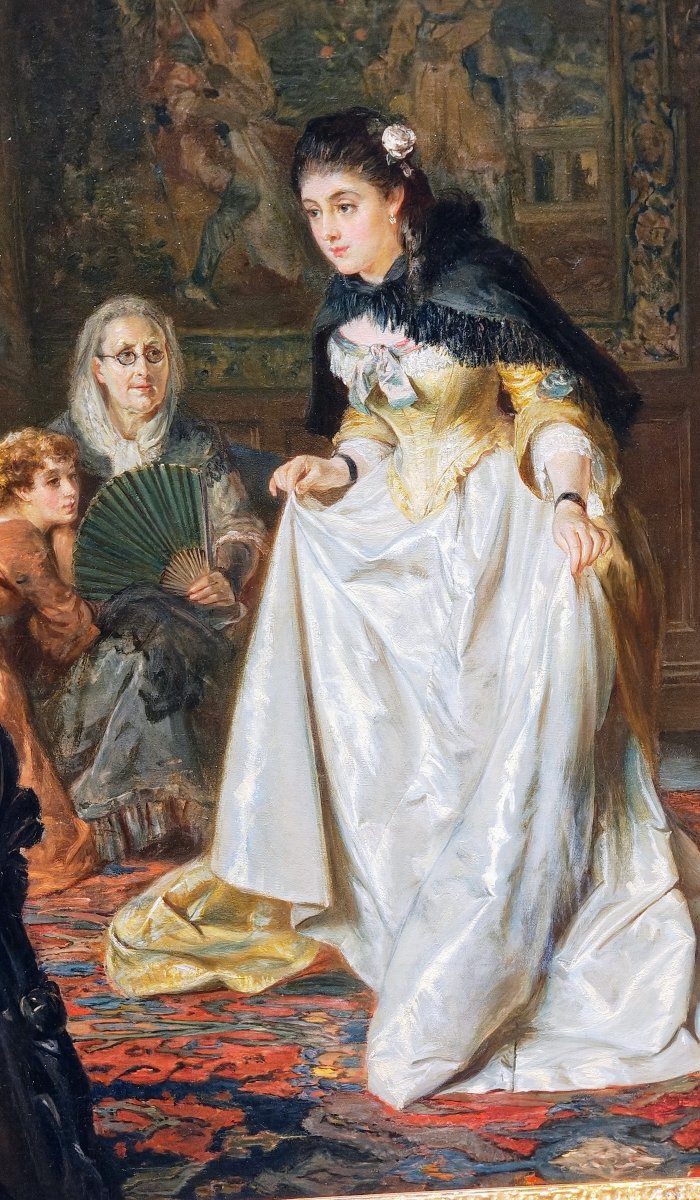

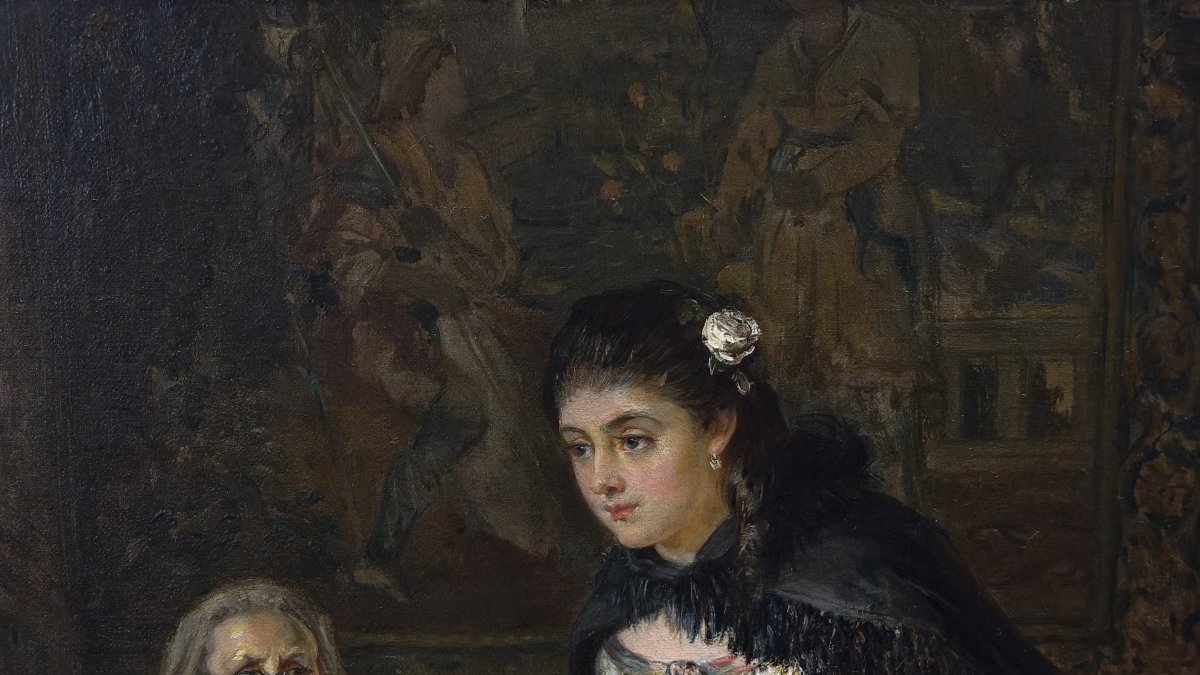


Frederick Morgan? A 19th-century Young Woman In A Drawing Room—disturbing
Artist: Frederick Morgan
Frederick Morgan? A 19th-century young girl in a drawing room, unsettling
Frederick Morgan (1847 – April 3, 1927) was an English painter of portraits, animals, interior scenes, and rural landscapes. He was famous for his idyllic genre scenes depicting childhood. [ 1 ] [ 2 ]
Biography
Feeding the Rabbits, also known as Alice in Wonderland
Morgan was born in London, the son of John Morgan and his wife, Henrietta Hester Clare. [ 3 ] His father was a renowned genre painter, sometimes nicknamed “Morgan the Jury” (after one of his paintings, The Gentlemen of the Jury). At the age of 14, his father took him out of school and gave him drawing lessons. At 16, while still studying with his father, his first painting, The Rehearsal, was exhibited at the Royal Academy, and after a hiatus of a few years, his works were regularly shown there. He worked for a time as a portrait artist for a photographer in Aylesbury. This training proved crucial, as it taught him to observe carefully and pay close attention to detail.
Over time, he began to explore other subjects, notably idyllic genre scenes depicting country life and childhood. For many years, beginning in 1874, the Thomas Agnew & Sons gallery acquired his entire body of work. During this period, he produced some of his most famous paintings, such as “The Doll’s Tea Party” (1874), “The Departure of the Emigrants” (1875), and “The School Beauties” (1877). Most of his paintings were created in the village of Shere, near Guildford, a popular summer retreat for artists. He also painted in Normandy, notably “Rest in the South” (1879) and “Apple Picking” (1880).
Although an accomplished portraitist, Morgan struggled to depict domestic and farm animals. Faced with these challenges, he sought the help of Arthur John Elsley or Allen Sealey (1850–1927).
He is best known for his romantic and sentimental paintings of children, in a style similar to that of his contemporary Arthur John Elsley. His works enjoyed immense success during his lifetime and were widely published. He exhibited at the Royal Academy and was a member of the Royal Institute of Oil Painters (ROI).
In 1872, he married another painter, Alice Mary Havers (1850–1890); they had three children. Their eldest son, Valentine, known as Val Havers (1873–1912), also became an artist and exhibited almost every year at the Royal Academy of Arts from 1898 until his untimely death at the age of thirty-nine. Frederick Morgan married twice more and had two children from his second marriage.
Morgan’s paintings are on display in numerous art galleries and museums, including the Walker Art Gallery in Liverpool and the Russell-Cotes Museum in Bournemouth. His painting "Turn Next" was used in an advertisement for Pears soap and is housed at the Lady Lever Art Gallery in Port Sunlight. [4]
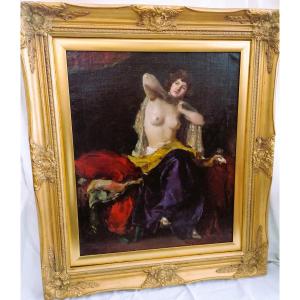
A highly decorative painting, ideal for a beautiful living room.
The painting is framed in a magnificent period frame.
Technique: Oil on canvas.
Condition: Very good after restoration.
Signature: Monogram FM.
Dimensions: Canvas 44 cm x 55 cm, approximately 54 cm x 65 cm with frame.
The gallery issues a certificate for each work.
Frederick Morgan (1847 – April 3, 1927) was an English painter of portraits, animals, interior scenes, and rural landscapes. He was famous for his idyllic genre scenes depicting childhood. [ 1 ] [ 2 ]
Biography
Feeding the Rabbits, also known as Alice in Wonderland
Morgan was born in London, the son of John Morgan and his wife, Henrietta Hester Clare. [ 3 ] His father was a renowned genre painter, sometimes nicknamed “Morgan the Jury” (after one of his paintings, The Gentlemen of the Jury). At the age of 14, his father took him out of school and gave him drawing lessons. At 16, while still studying with his father, his first painting, The Rehearsal, was exhibited at the Royal Academy, and after a hiatus of a few years, his works were regularly shown there. He worked for a time as a portrait artist for a photographer in Aylesbury. This training proved crucial, as it taught him to observe carefully and pay close attention to detail.
Over time, he began to explore other subjects, notably idyllic genre scenes depicting country life and childhood. For many years, beginning in 1874, the Thomas Agnew & Sons gallery acquired his entire body of work. During this period, he produced some of his most famous paintings, such as “The Doll’s Tea Party” (1874), “The Departure of the Emigrants” (1875), and “The School Beauties” (1877). Most of his paintings were created in the village of Shere, near Guildford, a popular summer retreat for artists. He also painted in Normandy, notably “Rest in the South” (1879) and “Apple Picking” (1880).
Although an accomplished portraitist, Morgan struggled to depict domestic and farm animals. Faced with these challenges, he sought the help of Arthur John Elsley or Allen Sealey (1850–1927).
He is best known for his romantic and sentimental paintings of children, in a style similar to that of his contemporary Arthur John Elsley. His works enjoyed immense success during his lifetime and were widely published. He exhibited at the Royal Academy and was a member of the Royal Institute of Oil Painters (ROI).
In 1872, he married another painter, Alice Mary Havers (1850–1890); they had three children. Their eldest son, Valentine, known as Val Havers (1873–1912), also became an artist and exhibited almost every year at the Royal Academy of Arts from 1898 until his untimely death at the age of thirty-nine. Frederick Morgan married twice more and had two children from his second marriage.
Morgan’s paintings are on display in numerous art galleries and museums, including the Walker Art Gallery in Liverpool and the Russell-Cotes Museum in Bournemouth. His painting "Turn Next" was used in an advertisement for Pears soap and is housed at the Lady Lever Art Gallery in Port Sunlight. [4]
A highly decorative painting, ideal for a beautiful living room.
The painting is framed in a magnificent period frame.
Technique: Oil on canvas.
Condition: Very good after restoration.
Signature: Monogram FM.
Dimensions: Canvas 44 cm x 55 cm, approximately 54 cm x 65 cm with frame.
The gallery issues a certificate for each work.
2 900 €
Period: 19th century
Style: Other Style
Condition: Good condition
Material: Oil painting
Length: 44
Height: 55
Reference (ID): 1778443
Availability: In stock
Print