
Large Dish Japan Turquoise Blue Background Fan Flowers Enamel Cloisonné Tortoiseshell 19th Century
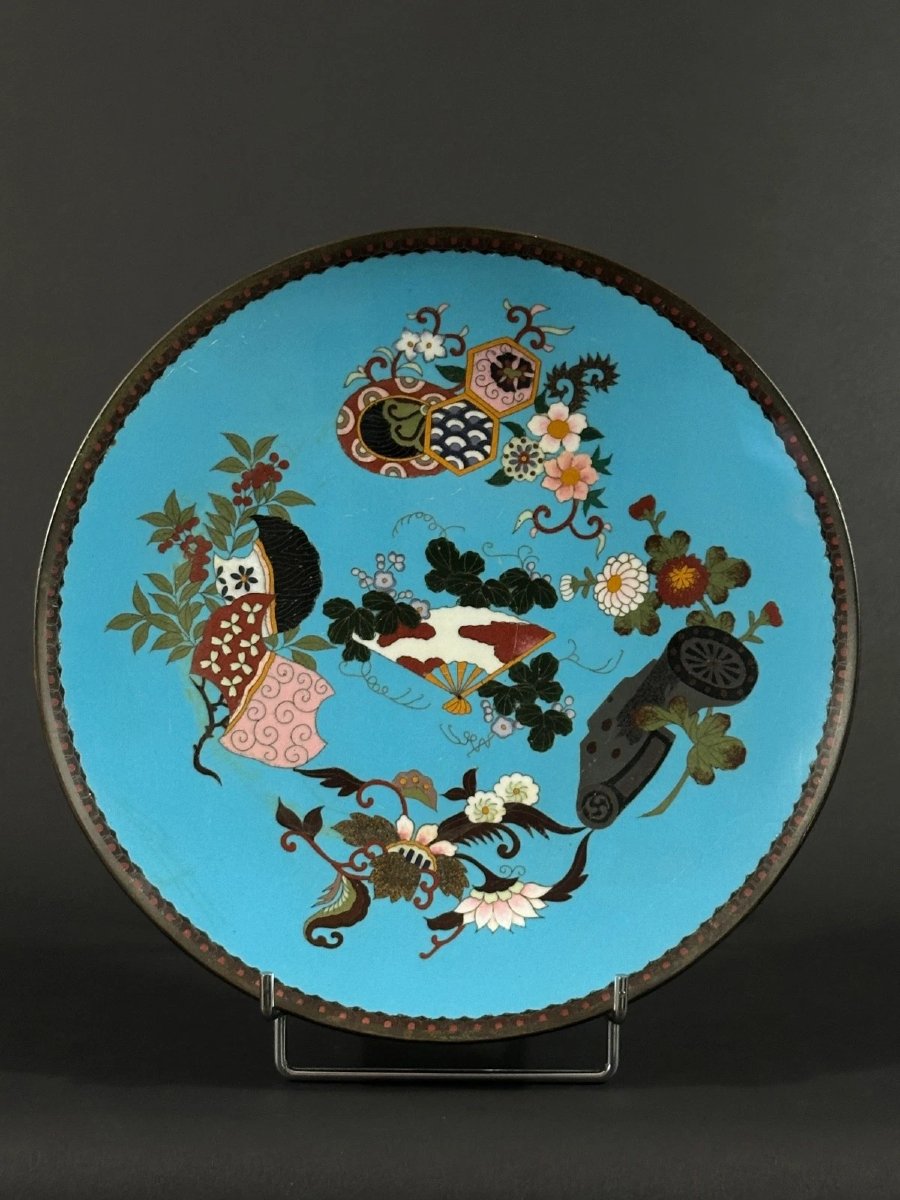
Large-format Japanese dish, late 19th century, Meiji period, executed in cloisonné enamel on metal. Beautiful luminous blue background, animated by a decoration of fans, flowers, foliage and ornamental motifs arranged in a crown around the center.
The main decoration is organized as an asymmetrical crown on a turquoise-blue background,echoing the Japanese ornamental repertoire mixing objects of refinement, flowers and good-luck motifs.
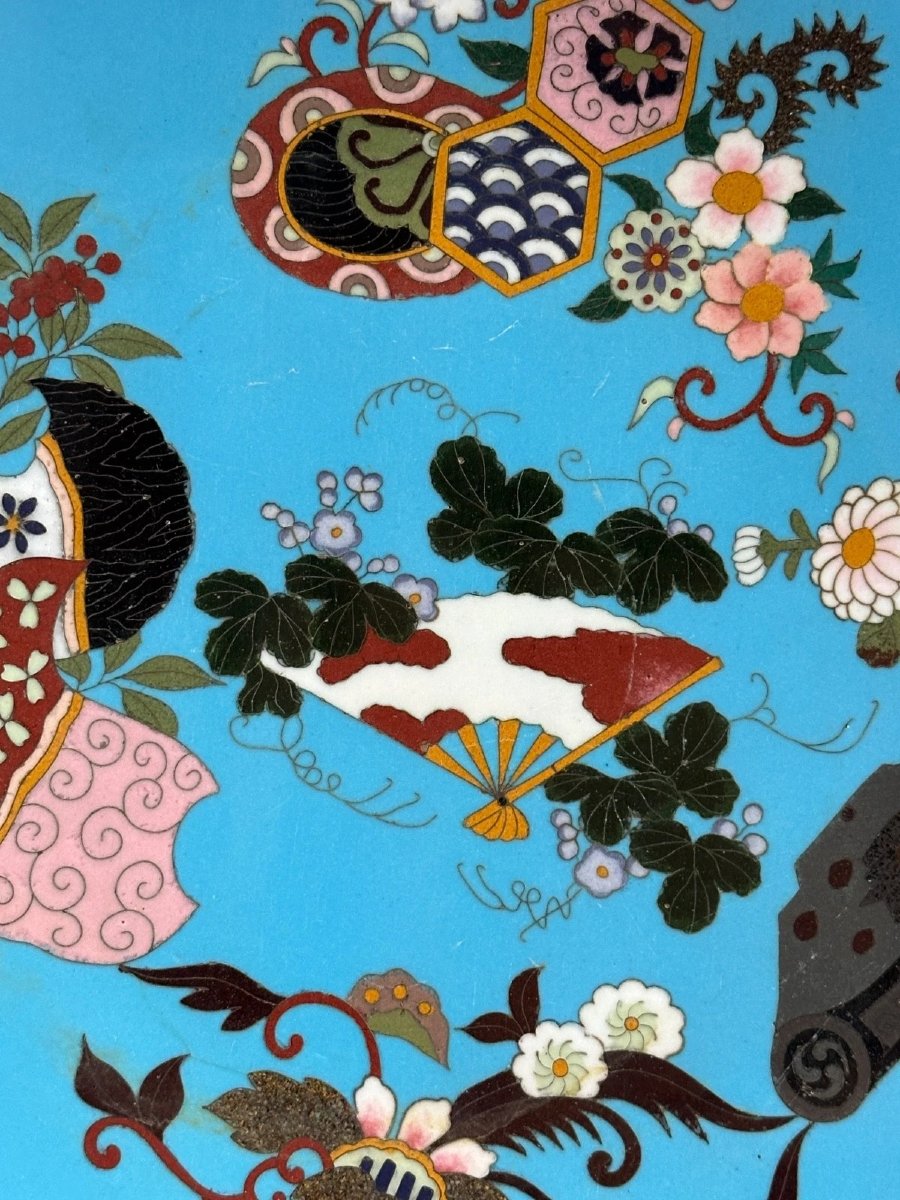
In the center and around the basin, several open or partially unfurled fans stand out. In Japanese art, the fan evokes elegance, festivity, dance and the feminine world, but also openness and the happy unfolding of destiny. Its widening shape is often associated with the idea of prosperity and growth.
Fans are associated with stylized flowers: in particular, we see chrysanthemums, recognizable by their radiating petals, a very important motif in Japan, linked to longevity, nobility and the imperial emblem. Small white flowers, such as prunus or cherry, are associated with spring, brief beauty and renewal. The larger pink flowers, with foliage, can be brought closer to the peony or stylized lotus repertoire, depending on the decorative intent.
The large dark motif on the right resembles a stylized vase or incense burner, set like a precious object among the flowers. It reinforces the idea of a scholar's décor or refined interior: fans, flowers, objets d'art, plant scrolls.
The central red, white and black motif, set in dark foliage, can be read as a textile element or decorative cartouche. It is reminiscent of Japanese fabric decorations, with a highly graphic opposition between light, red-orange solids and foliage.
Vegetal scrolls and cut leaves give movement to the whole. The decoration is not strictly symmetrical: it functions by circulation, like a floating garland. This is very characteristic of late 19th-century Japanese taste, where balance is achieved through rhythm and emptiness, rather than Western symmetry.
The reverse is important: the blue eca..... decoration is an ancient Japanese motif, close to the seigaiha or stylized eca... motif. It can evoke water, protection, continuity and good fortune. On a dish with a blue background, this reverse lends an aquatic and decorative coherence to the object. The small raised ring foot confirms a carefully crafted piece, designed to be viewed from the front as much as handled.
The dark border punctuated with small red or gold motifs frames the composition well. It acts as a frieze and visually retains the blue of the background. This is a frequent feature of Japanese cloisonné dishes intended for export: strong contrast, immediate legibility, rich but well-contained decoration.
This type of Japanese cloisonné dish is part of the refined production of the Meiji period, during which Japanese workshops developed high-quality export pieces for Western connoisseurs of Japanese art. The blue background gives the object a very elegant presence, enhanced by the floral touches and polychrome fans.
Condition: good overall condition. Please note: a small lack of enamel below, near the border. See photos for details.
Dimensions:
Diameter: 30.5 cm
Height: 4 cm
Period: 19th century
Style: Renaissance, Louis 13th
Condition: Good condition
Material: Enamel
Diameter: 30,5
Reference (ID): 1769592
Availability: In stock