

Vanitas Still Life, Franciscus Gysbrechts (antwerp, 1649 – Leiden, 1677)
Artist: Franciscus Gysbrechts (anversa, 1649 – Leida 1677 Circa)
Franciscus Gysbrechts (Antwerp, 1649 – Leiden, c. 1677)
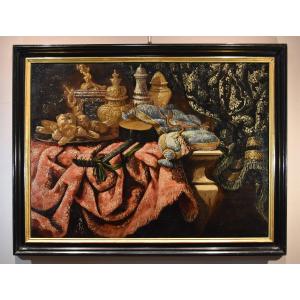
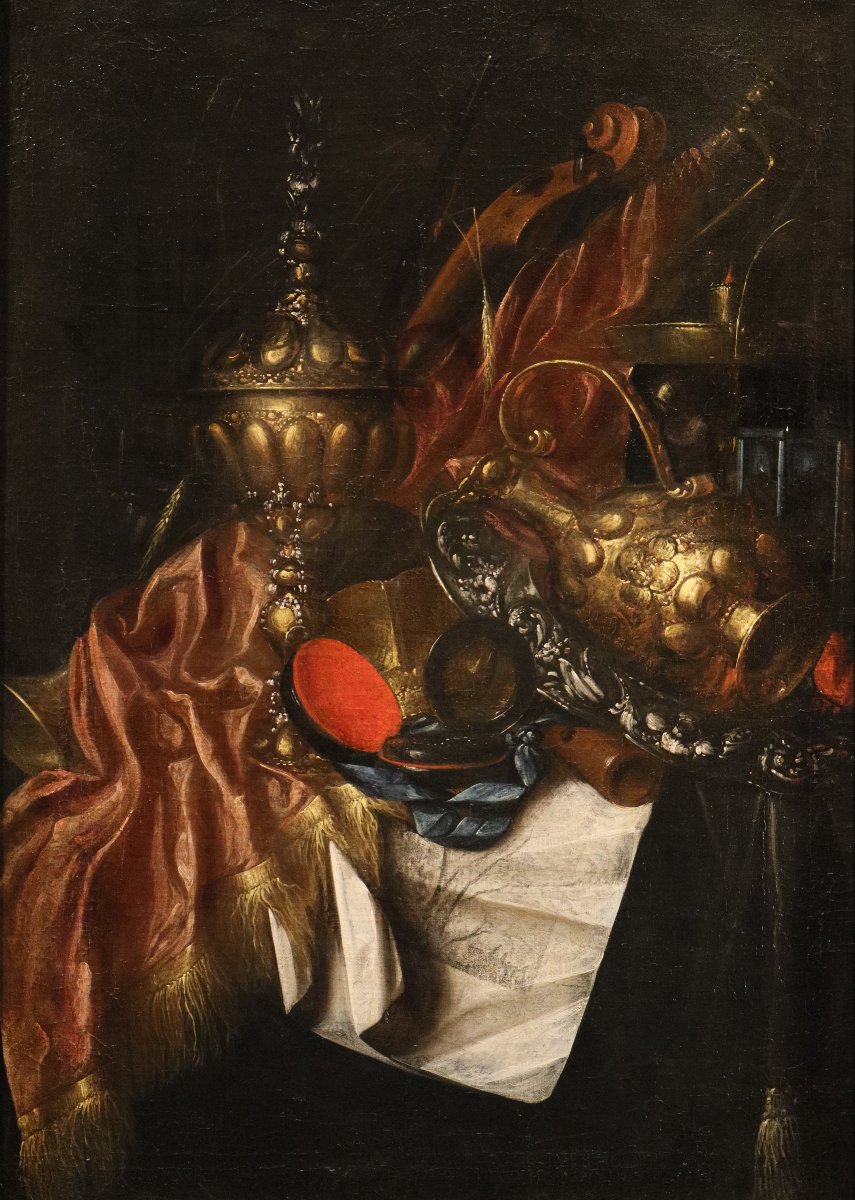
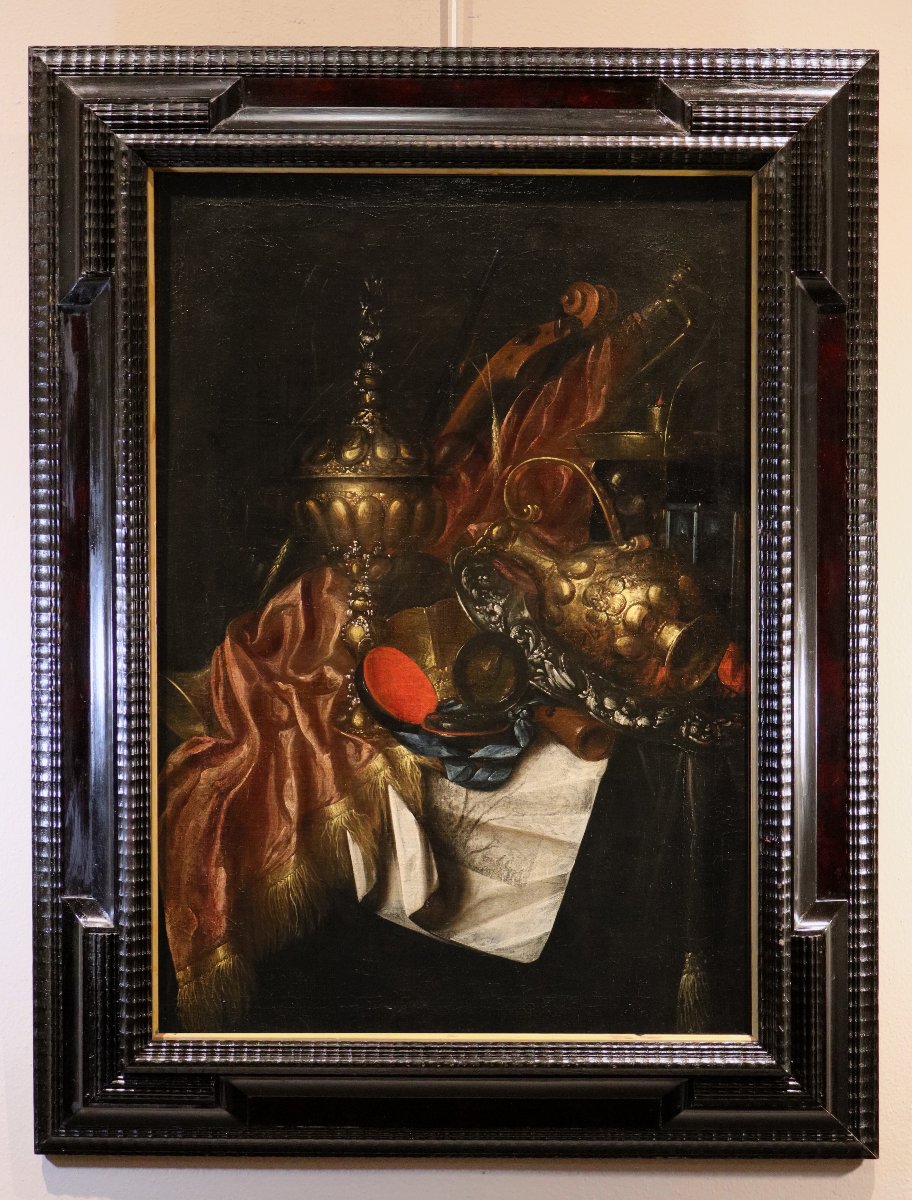
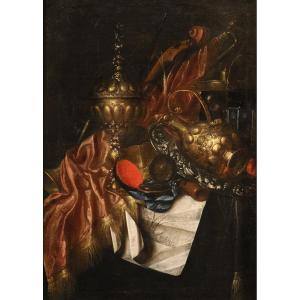
Vanitas still life with a gilded helmet-shaped jug, a basin, musical instruments and prints
Oil on canvas
81 x 57 cm. - Framed 102 x 78 cm.
FULL DETAILS OF THIS PAINTING (CLICK HERE)
The sumptuous still life we present here is attributed to the 17th-century Flemish painter Franciscus Gijsbrechts (Antwerp, 1649 – Leiden, c. 1677): it is a classic example of a Dutch allegory linked to the concept of Vanitas, intended to reflect on the futility of material goods and earthly pleasures, and on the transience of life, based on the biblical concept ‘Vanitas vanitatum et omnia vanitas’ (vanity of vanities, all is vanity).
Following in the footsteps of his father, the renowned painter Cornelis Norbertus Gijsbrechts, Franciscus focused his output precisely on this genre, becoming an undisputed master of it, with works characterised by a meditative and introspective atmosphere, leaving an indelible mark on Flemish art of the second half of the 17th century.
As we can see in the still life on display here, Gijsbrechts’ works, considered an emblem of Flemish Baroque, are arranged around a meticulously detailed composition, featuring a wide variety of luxurious and refined objects, musical instruments, precious fabrics, and other items of great symbolic value.
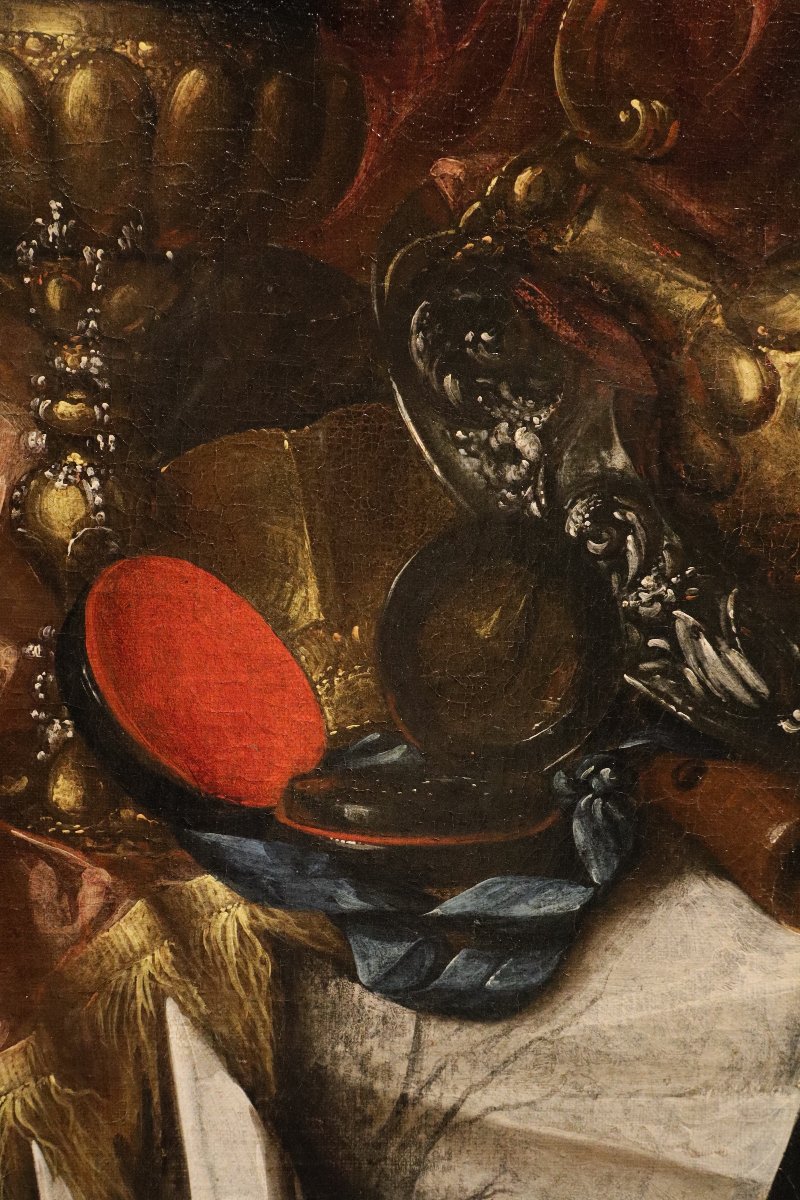
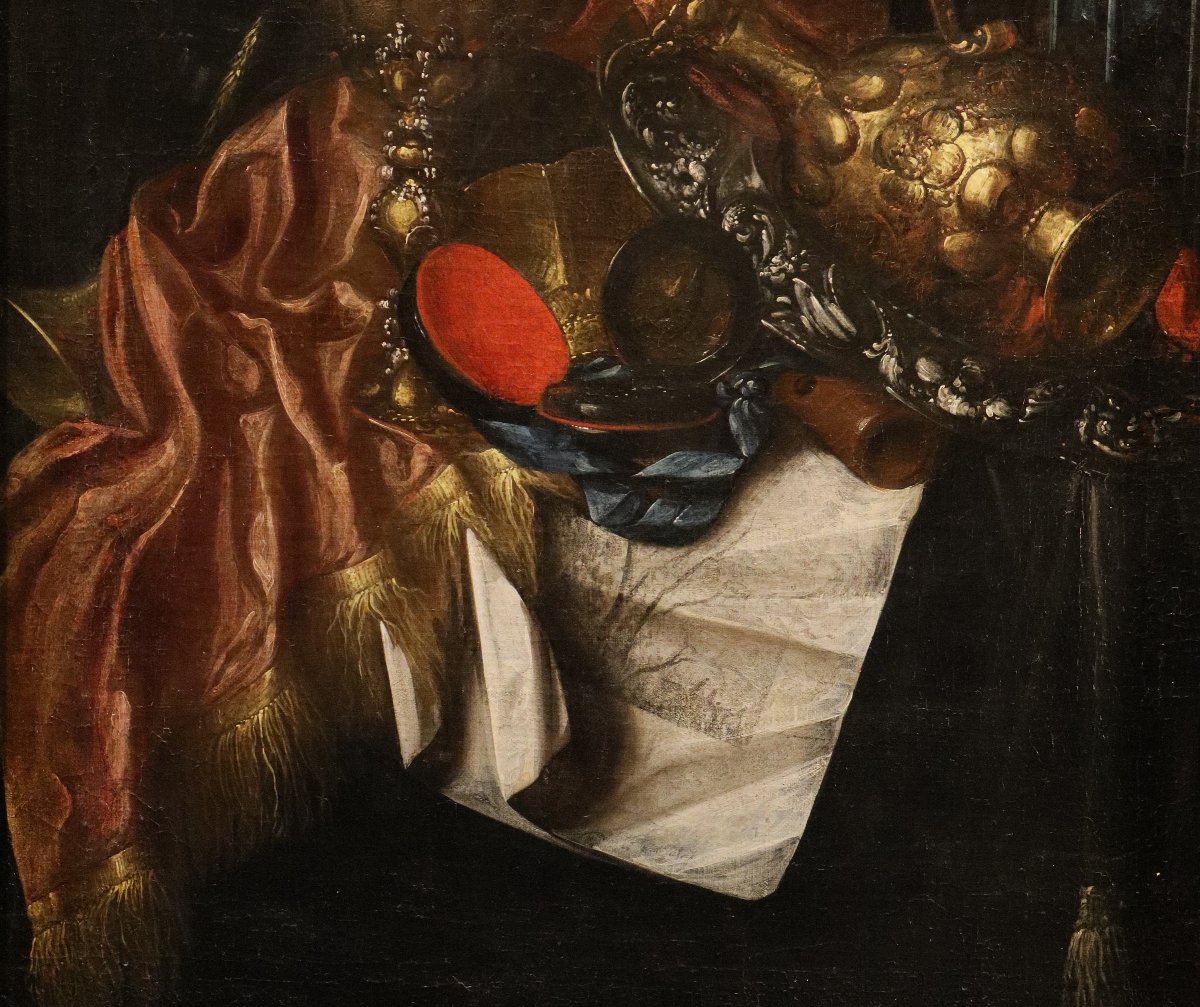
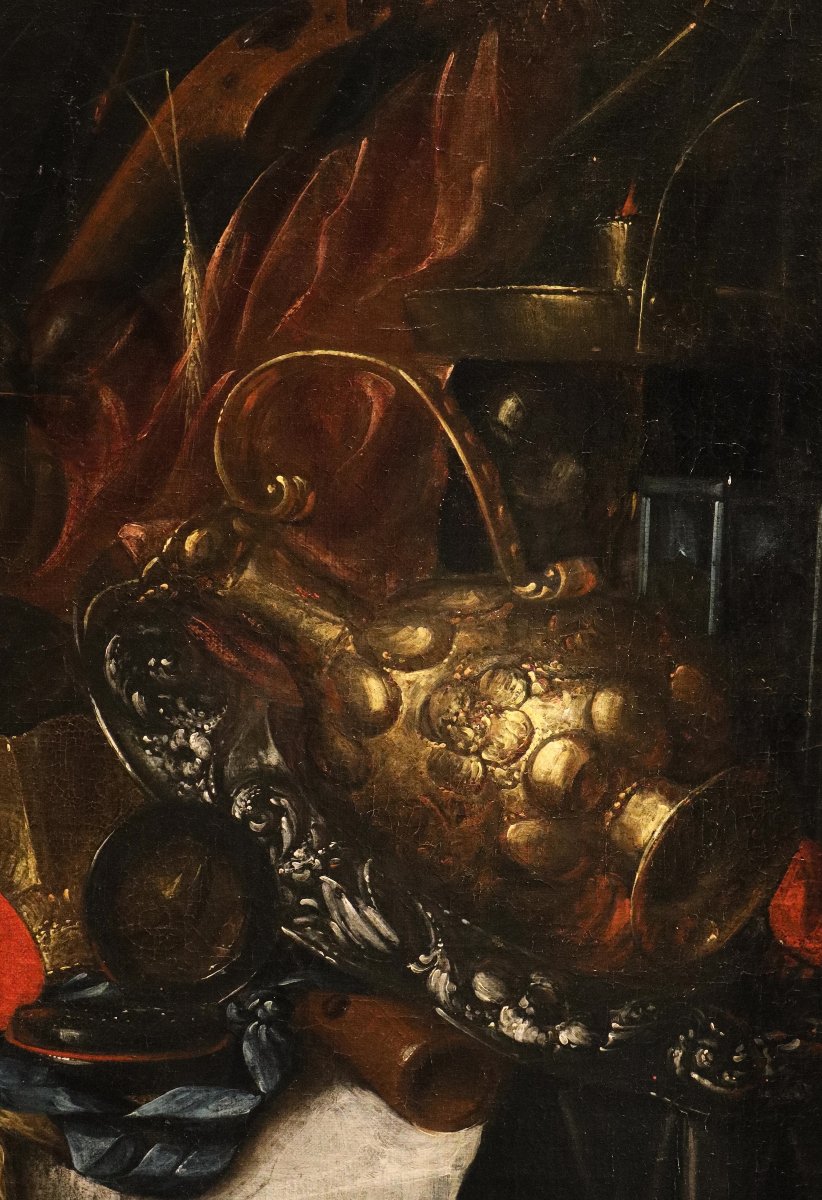
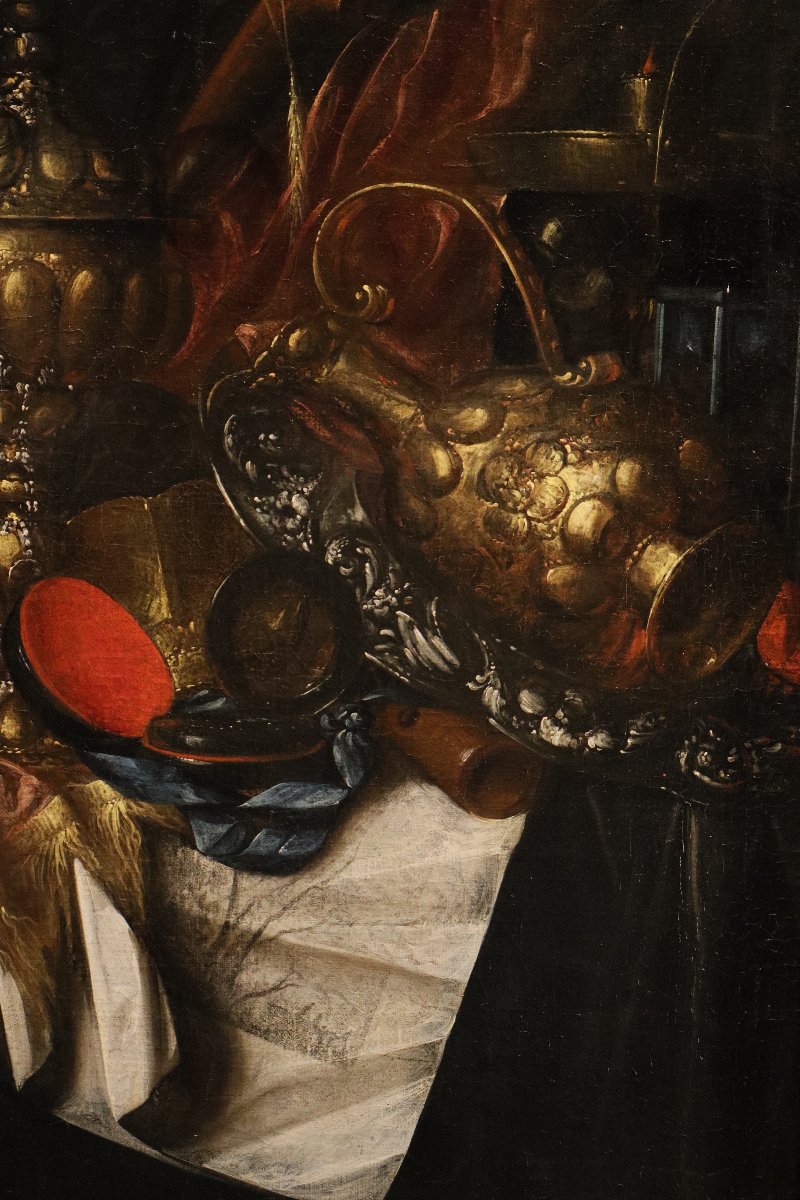
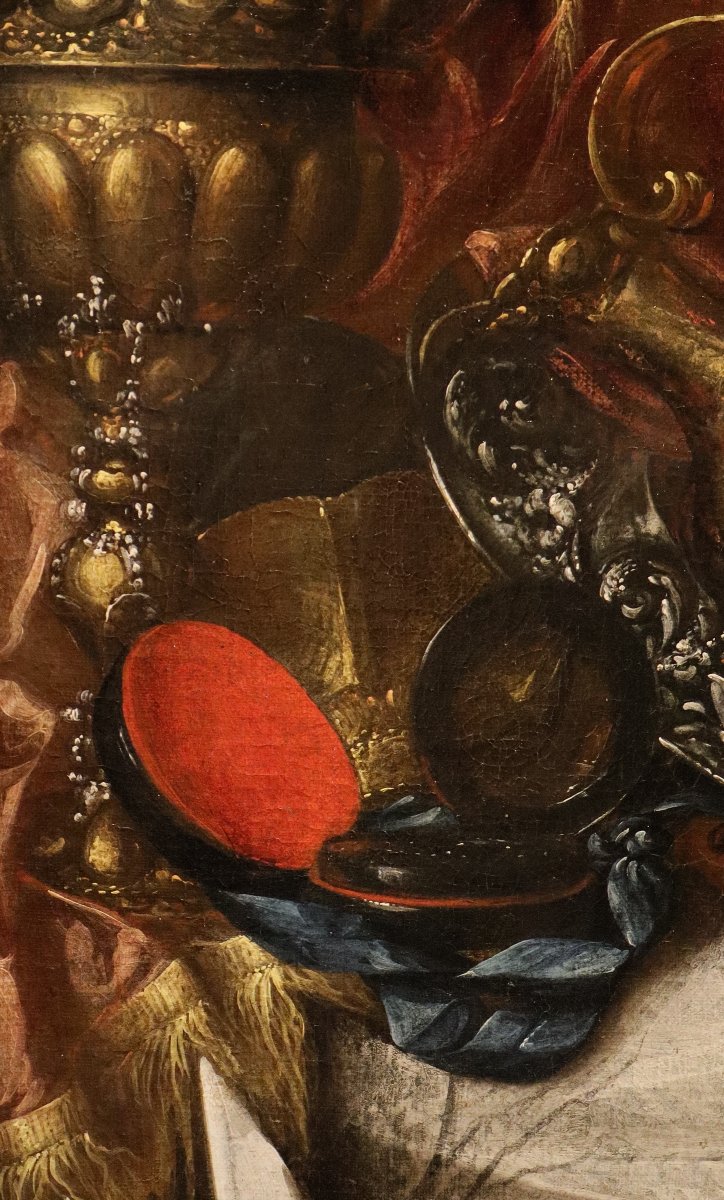
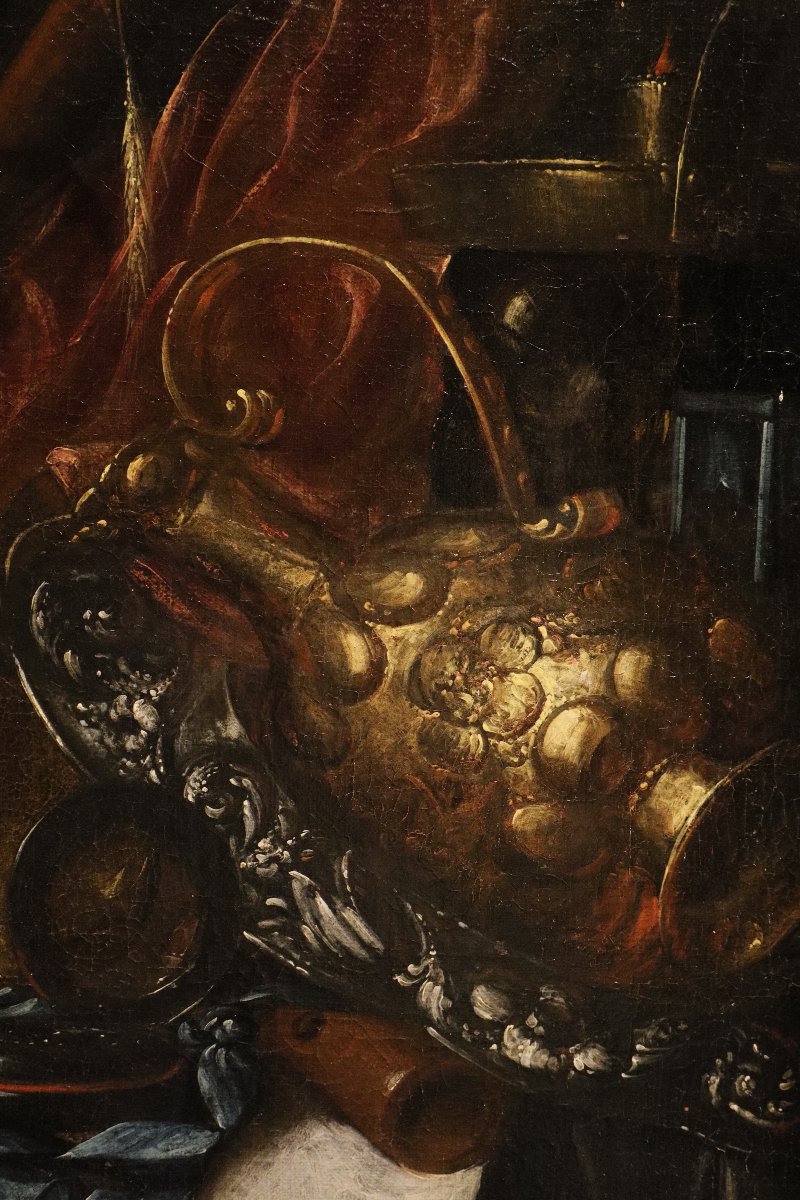
In this instance, the foreground features a sumptuous gilded jug resting on a finely crafted silver basin and an imposing cup with an embossed lid. These elements represent the ‘vita voluptaria’ (a life devoted to pleasure), material wealth and social prestige, all destined to fade with time.
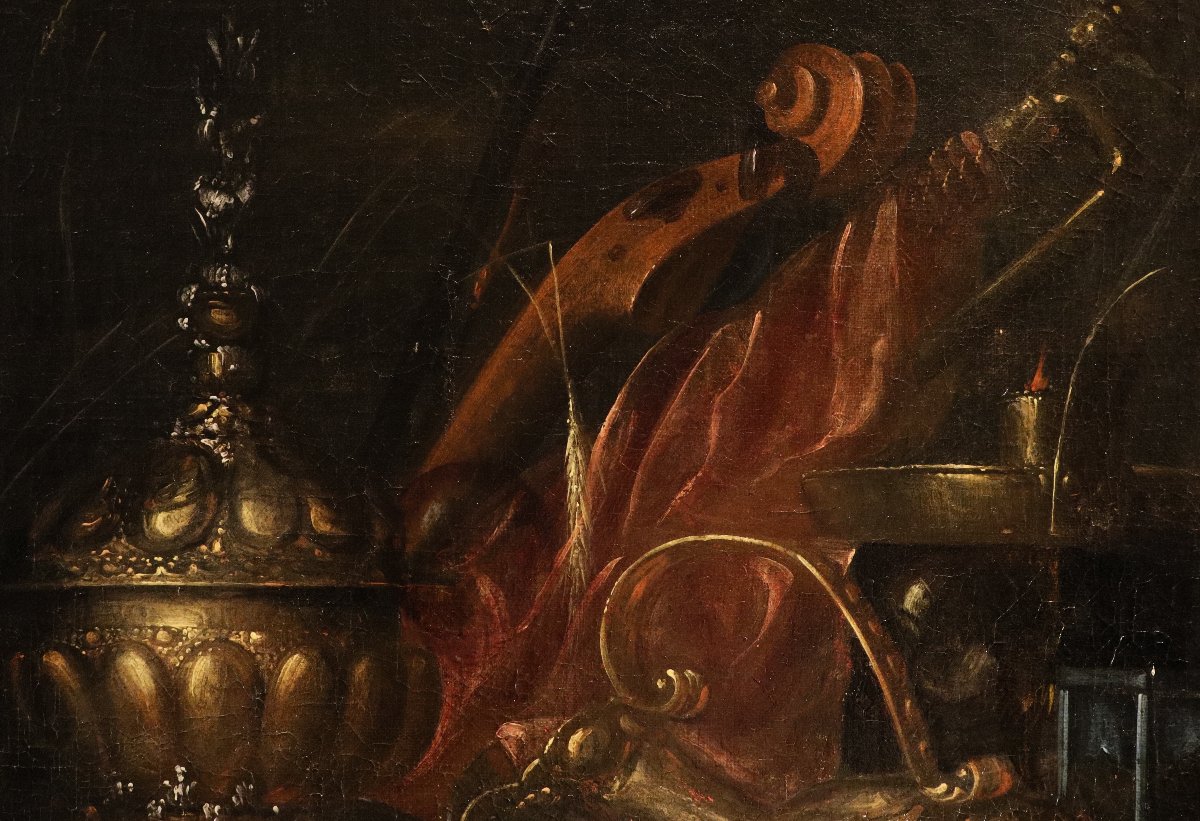
In the upper part of the composition, the neck and soundbox of a violin can be glimpsed: music symbolises fleeting worldly pleasures, as the sound vanishes into the air a moment after being produced.
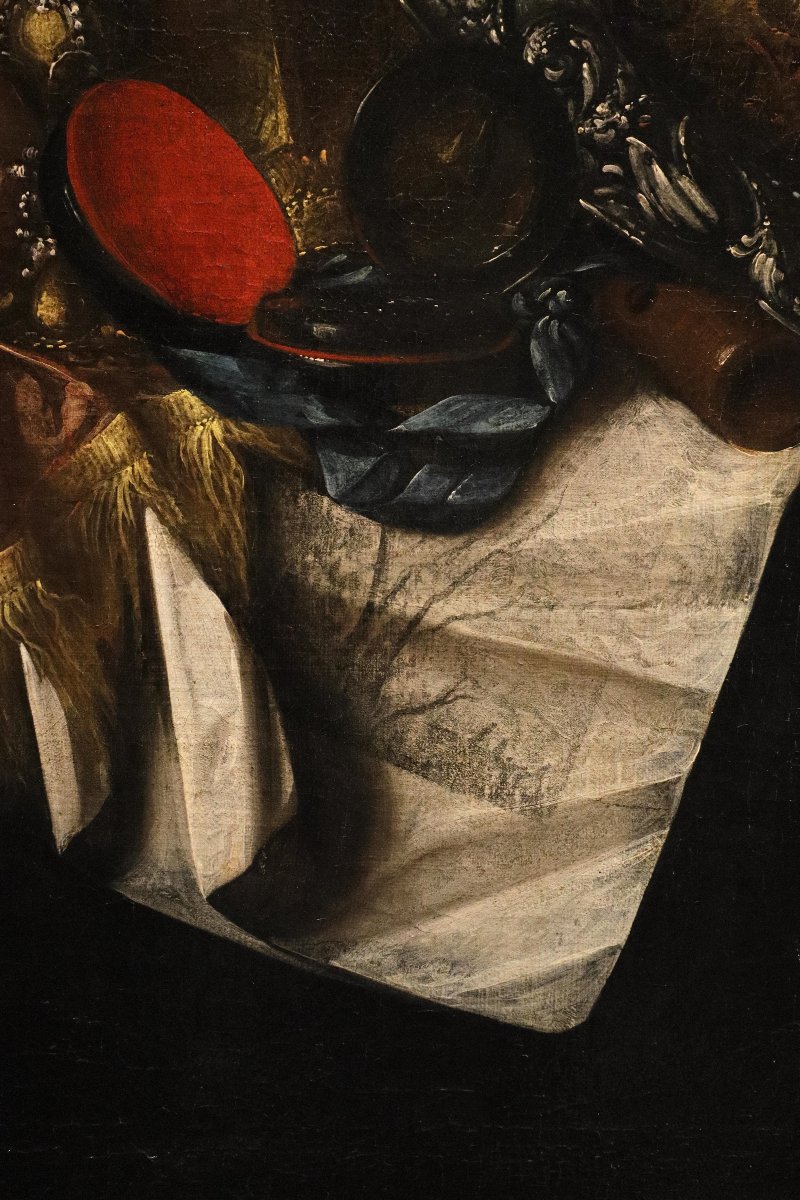
The objects rest on a table covered by two drapes, a darker one serving as a base and a second one of shiny coral/pink silk with golden fringes. The contrasts of light (chiaroscuro) highlight the folds of the fabrics, accentuating the theatrical effect and the three-dimensional optical illusion typical of the artist’s style.
Finally, there are crumpled pencil drawings, protruding slightly from the edge of the table, and an open watch case with a red interior, a symbol of time passing inexorably.
As in every masterpiece by Gijsbrechts, great importance is placed on the deep and mysterious atmosphere, where objects emerge from the darkness of the background, inviting the viewer to reflect on the beauty and fragility of existence.
The use of colour is also an important aspect of his works: the objects are painted with a rich and deep colour palette, ranging from the brilliant gold of precious objects, to the white of the paper, to the bright red of the watch case. In this regard, an object of this colour is always present in his works, standing out against the rich array of objects: whether it be, for example, a red bow or a red wax seal, an object of this colour is always recurrent as a ‘signature motif’, acting as the painter’s true hidden signature.
His works are now held in renowned European art collections, notably the famous Vanitas painting housed at the Royal Museum of Fine Arts in Antwerp (KMSKA) and the canvas on display at the Museum of Fine Arts in Budapest.
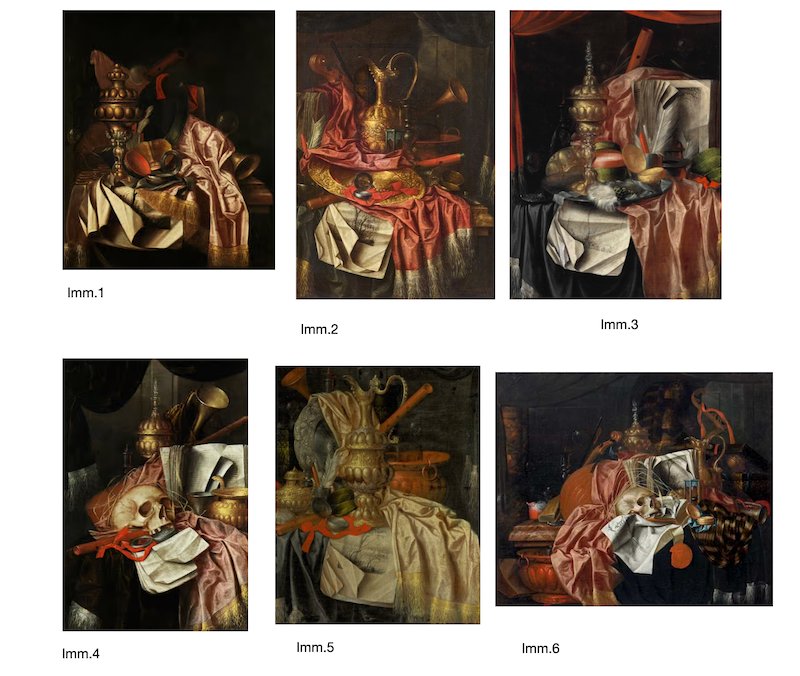
On the collectors’ market, his rare paintings fetch considerable auction prices. We can mention a few works, very similar to ours:
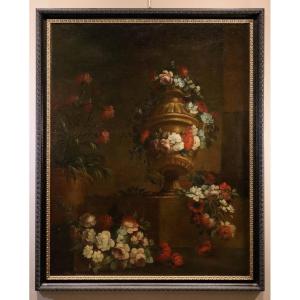
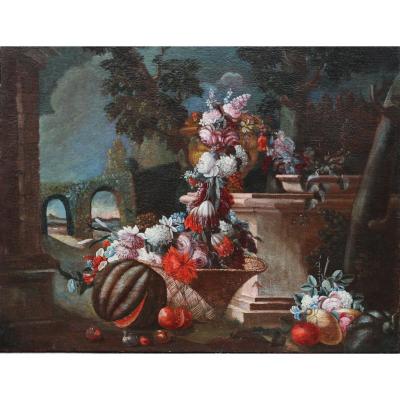
- Fig. 1 - F. Gijsbrechts, Vanitas, Hampel, 28 September 2017, lot 763
- Fig. 2 - F. Gijsbrechts, Vanitas, Van Ham Fine Art Auctions, 14 November 2024, lot 1213
- Fig. 3 - F. Gijsbrechts, Vanitas, Bruun Rasmussen Bredgade, Denmark, 1 June 2021, lot 920
- Fig. 4 - F. Gijsbrechts, Vanitas, Hampel, 28 September 2017, lot 761
- Fig. 5 - F. Gijsbrechts, Vanitas, Sotheby’s London, 7 May 2020, lot 46
- Fig. 6 - F. Gijsbrechts, Vanitas, Koller Zurich, 7 September 2019, lot 3052
ADDITIONAL INFORMATION:
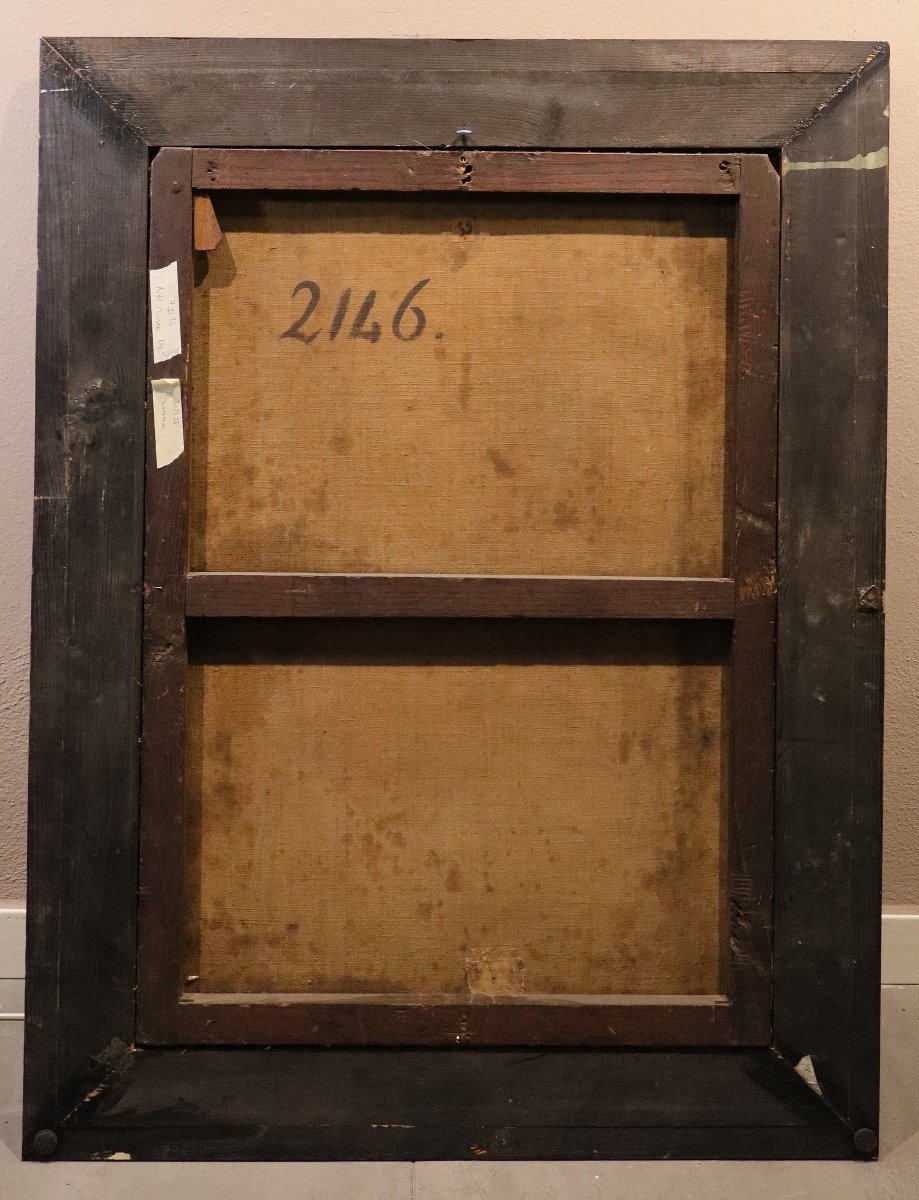
The painting is sold complete with a black lacquered wooden frame and is accompanied by a certificate of authenticity and a descriptive iconographic sheet.
We arrange and organise the transport of purchased works, both within Italy and abroad, using professional and insured carriers.
Should you wish to view this or other works in person, we would be delighted to welcome you to our new gallery in Riva del Garda, at Viale Giuseppe Canella 18. We look forward to seeing you!
Please contact us for any information or to arrange a visit; we will be happy to assist you.
Follow us on:
https://www.instagram.com/galleriacastelbarco/?hl=it https://www.facebook.com/galleriacastelbarco/
Vanitas still life with a gilded helmet-shaped jug, a basin, musical instruments and prints
Oil on canvas
81 x 57 cm. - Framed 102 x 78 cm.
FULL DETAILS OF THIS PAINTING (CLICK HERE)
The sumptuous still life we present here is attributed to the 17th-century Flemish painter Franciscus Gijsbrechts (Antwerp, 1649 – Leiden, c. 1677): it is a classic example of a Dutch allegory linked to the concept of Vanitas, intended to reflect on the futility of material goods and earthly pleasures, and on the transience of life, based on the biblical concept ‘Vanitas vanitatum et omnia vanitas’ (vanity of vanities, all is vanity).
Following in the footsteps of his father, the renowned painter Cornelis Norbertus Gijsbrechts, Franciscus focused his output precisely on this genre, becoming an undisputed master of it, with works characterised by a meditative and introspective atmosphere, leaving an indelible mark on Flemish art of the second half of the 17th century.
As we can see in the still life on display here, Gijsbrechts’ works, considered an emblem of Flemish Baroque, are arranged around a meticulously detailed composition, featuring a wide variety of luxurious and refined objects, musical instruments, precious fabrics, and other items of great symbolic value.
In this instance, the foreground features a sumptuous gilded jug resting on a finely crafted silver basin and an imposing cup with an embossed lid. These elements represent the ‘vita voluptaria’ (a life devoted to pleasure), material wealth and social prestige, all destined to fade with time.
In the upper part of the composition, the neck and soundbox of a violin can be glimpsed: music symbolises fleeting worldly pleasures, as the sound vanishes into the air a moment after being produced.
The objects rest on a table covered by two drapes, a darker one serving as a base and a second one of shiny coral/pink silk with golden fringes. The contrasts of light (chiaroscuro) highlight the folds of the fabrics, accentuating the theatrical effect and the three-dimensional optical illusion typical of the artist’s style.
Finally, there are crumpled pencil drawings, protruding slightly from the edge of the table, and an open watch case with a red interior, a symbol of time passing inexorably.
As in every masterpiece by Gijsbrechts, great importance is placed on the deep and mysterious atmosphere, where objects emerge from the darkness of the background, inviting the viewer to reflect on the beauty and fragility of existence.
The use of colour is also an important aspect of his works: the objects are painted with a rich and deep colour palette, ranging from the brilliant gold of precious objects, to the white of the paper, to the bright red of the watch case. In this regard, an object of this colour is always present in his works, standing out against the rich array of objects: whether it be, for example, a red bow or a red wax seal, an object of this colour is always recurrent as a ‘signature motif’, acting as the painter’s true hidden signature.
His works are now held in renowned European art collections, notably the famous Vanitas painting housed at the Royal Museum of Fine Arts in Antwerp (KMSKA) and the canvas on display at the Museum of Fine Arts in Budapest.
On the collectors’ market, his rare paintings fetch considerable auction prices. We can mention a few works, very similar to ours:
- Fig. 1 - F. Gijsbrechts, Vanitas, Hampel, 28 September 2017, lot 763
- Fig. 2 - F. Gijsbrechts, Vanitas, Van Ham Fine Art Auctions, 14 November 2024, lot 1213
- Fig. 3 - F. Gijsbrechts, Vanitas, Bruun Rasmussen Bredgade, Denmark, 1 June 2021, lot 920
- Fig. 4 - F. Gijsbrechts, Vanitas, Hampel, 28 September 2017, lot 761
- Fig. 5 - F. Gijsbrechts, Vanitas, Sotheby’s London, 7 May 2020, lot 46
- Fig. 6 - F. Gijsbrechts, Vanitas, Koller Zurich, 7 September 2019, lot 3052
ADDITIONAL INFORMATION:
The painting is sold complete with a black lacquered wooden frame and is accompanied by a certificate of authenticity and a descriptive iconographic sheet.
We arrange and organise the transport of purchased works, both within Italy and abroad, using professional and insured carriers.
Should you wish to view this or other works in person, we would be delighted to welcome you to our new gallery in Riva del Garda, at Viale Giuseppe Canella 18. We look forward to seeing you!
Please contact us for any information or to arrange a visit; we will be happy to assist you.
Follow us on:
https://www.instagram.com/galleriacastelbarco/?hl=it https://www.facebook.com/galleriacastelbarco/
9 500 €
Period: 17th century
Style: Louis 15th - Transition
Condition: Excellent condition
Material: Oil painting
Width: encadré 85 cm.
Height: encadré 55 cm.
Reference (ID): 1768492
Availability: In stock
Print