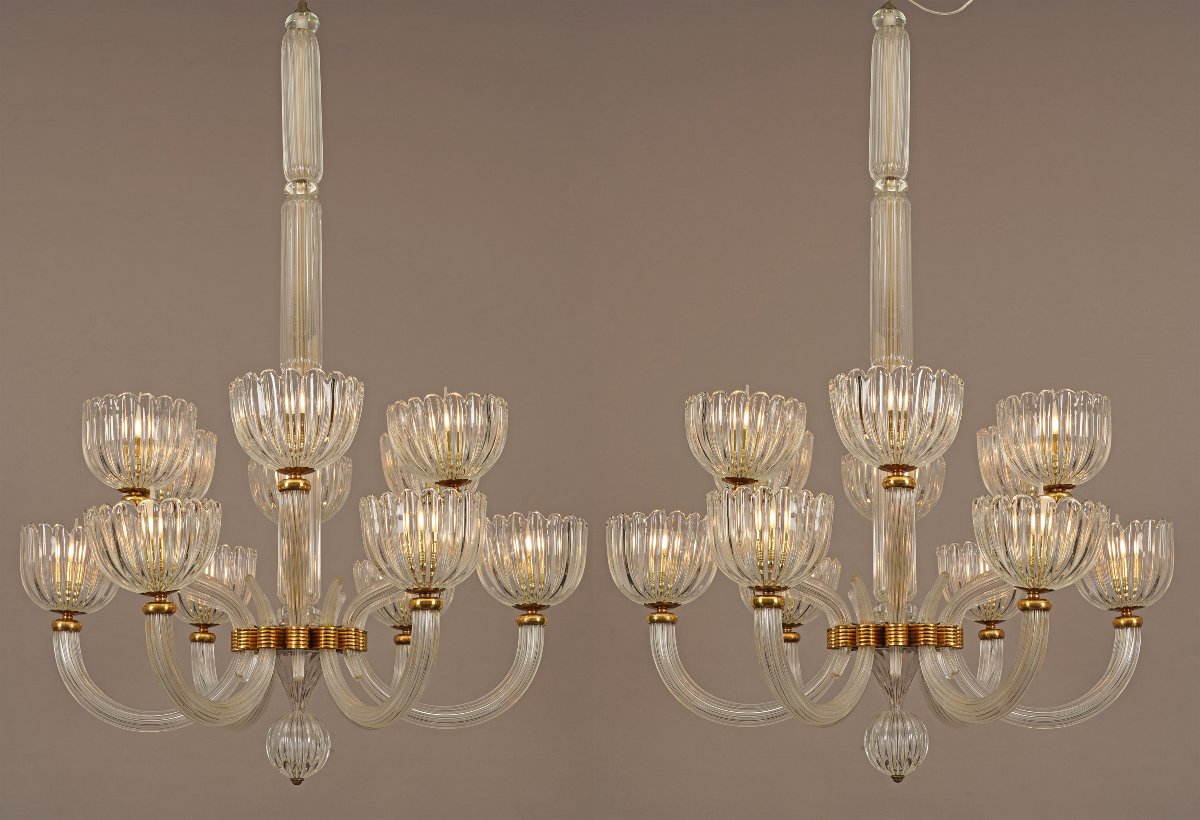
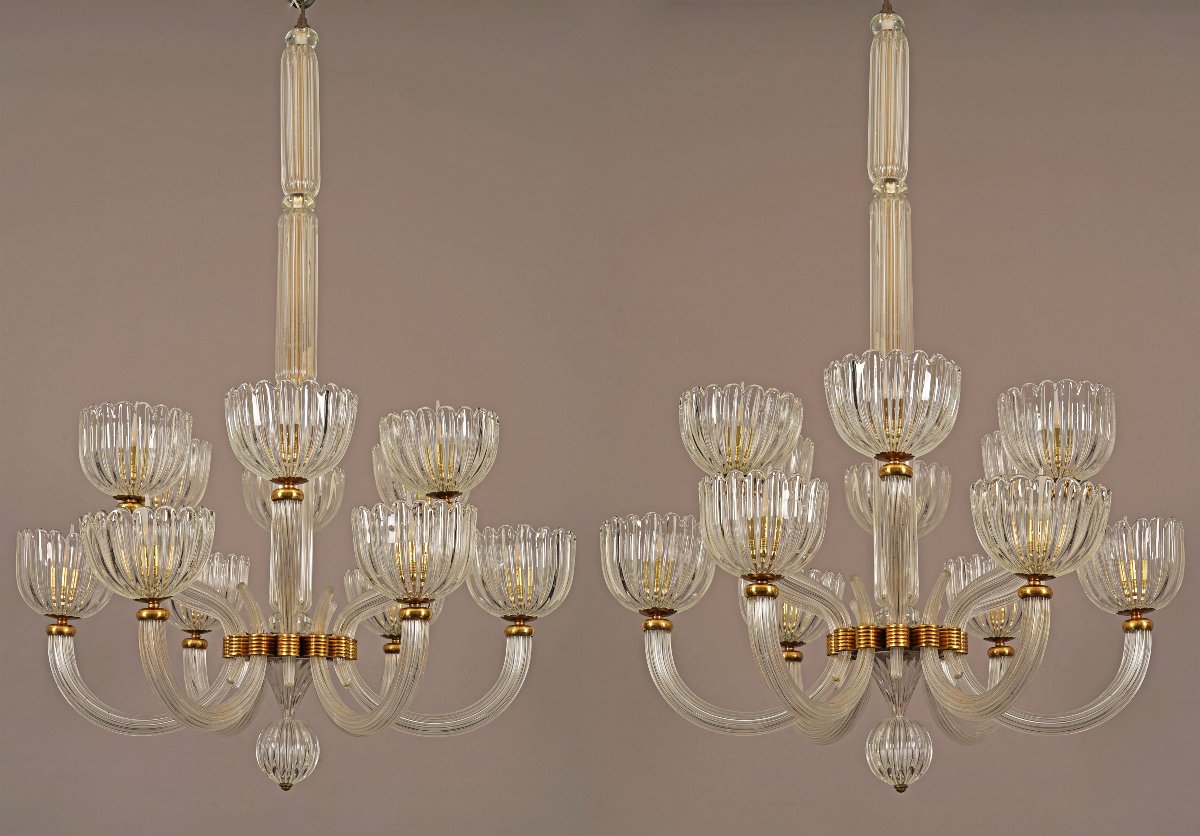


Barovier & Toso, Pair Of Murano Chandeliers, Italy, Circa 1940
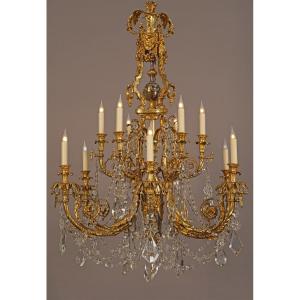
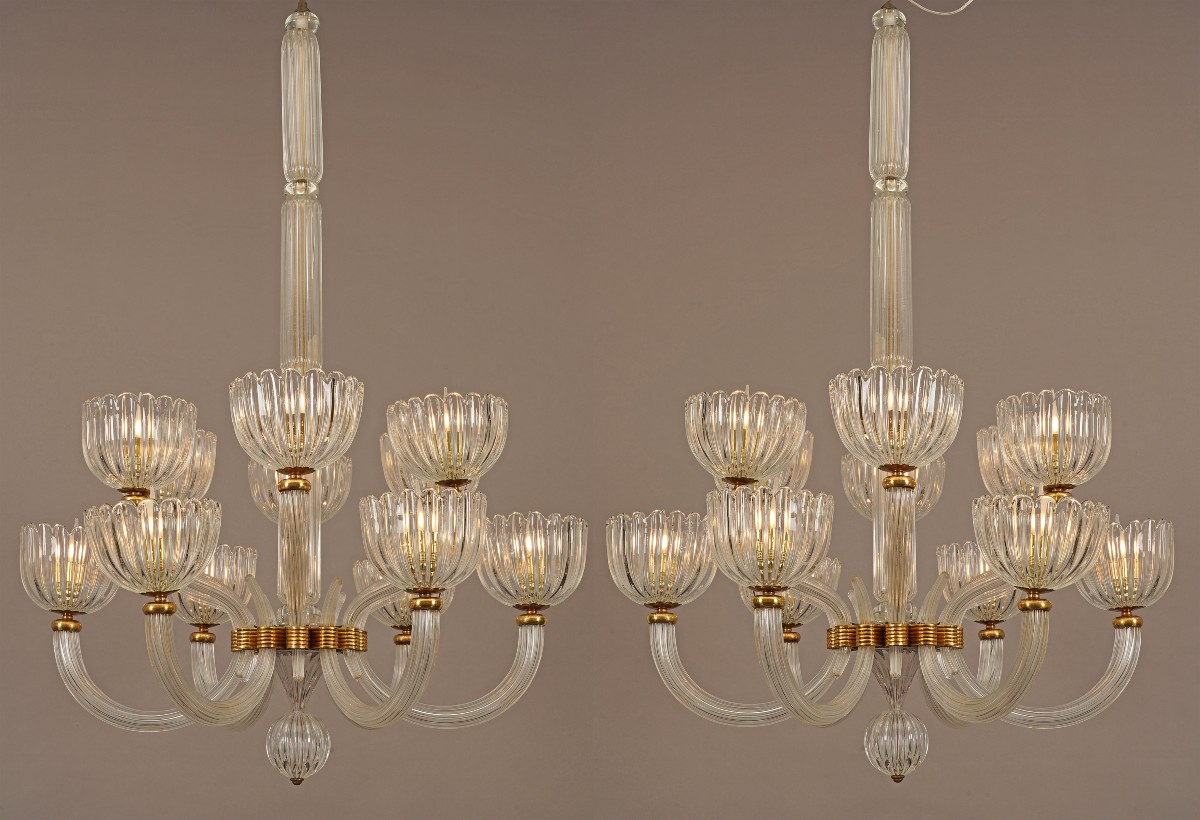
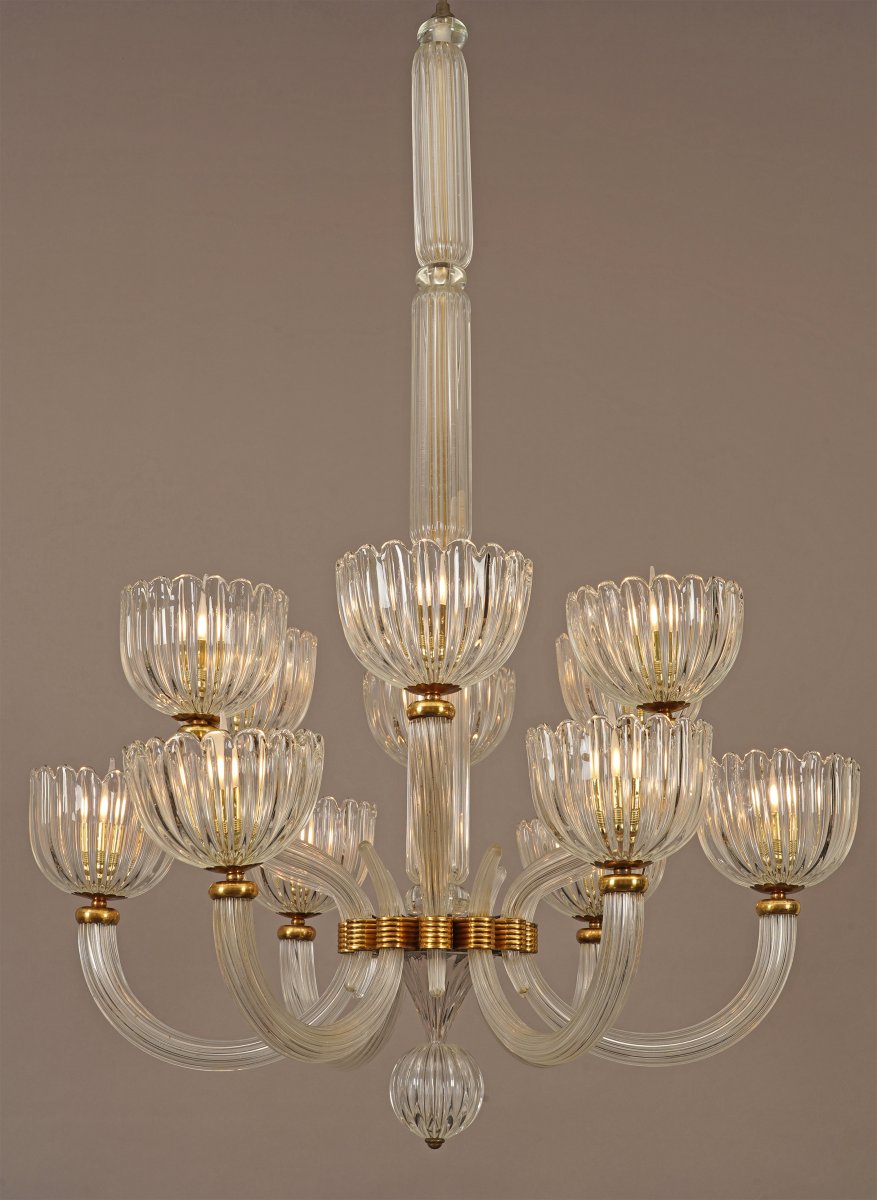
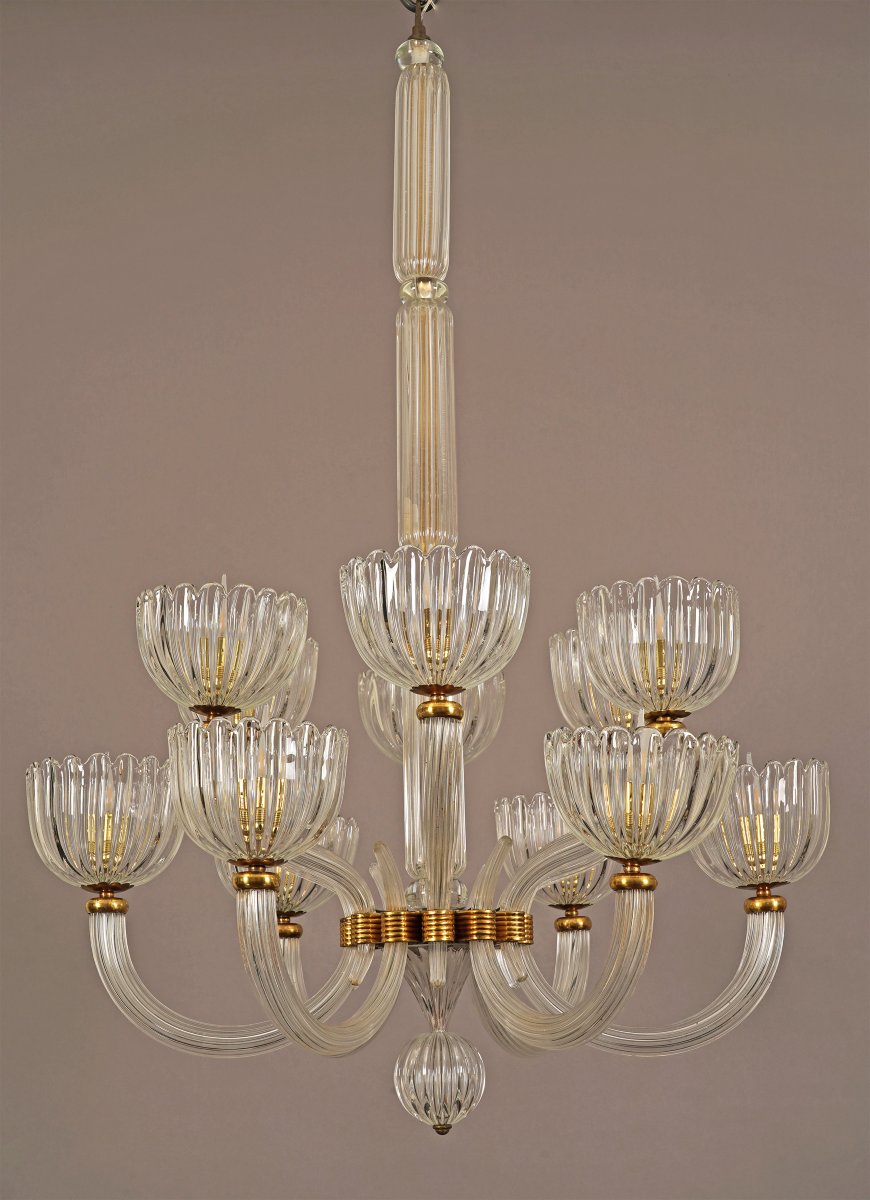
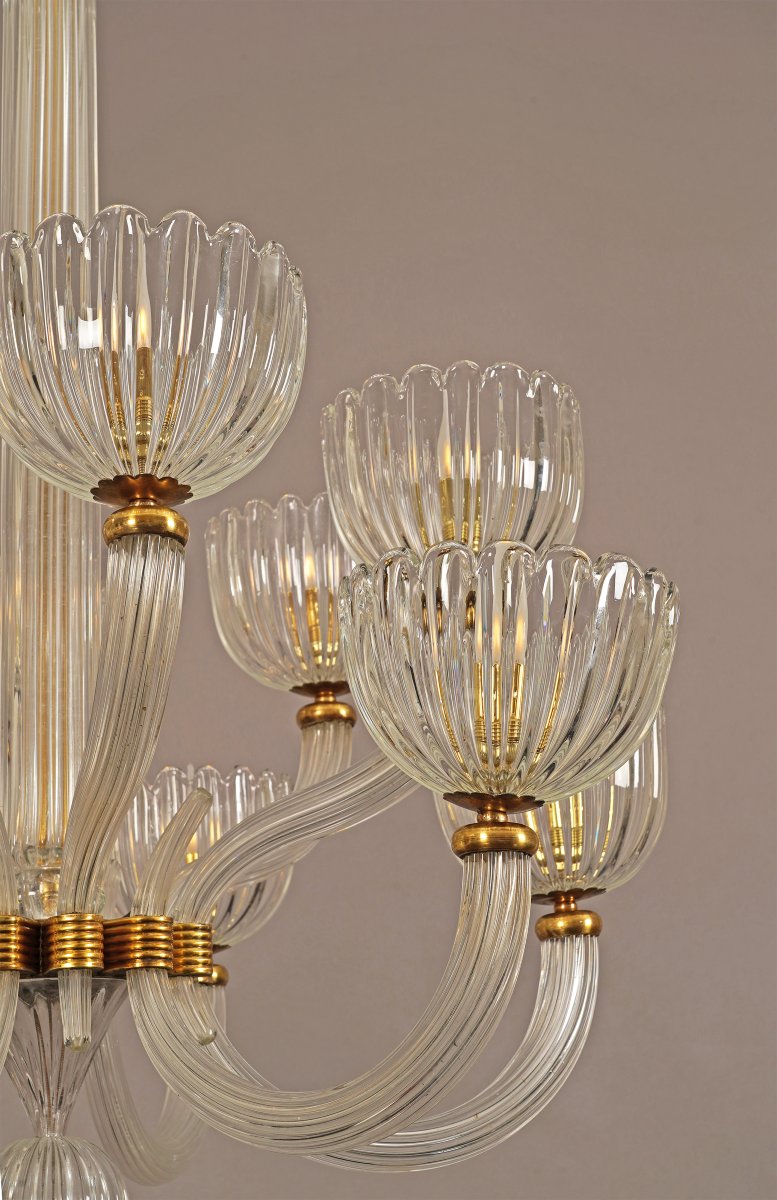
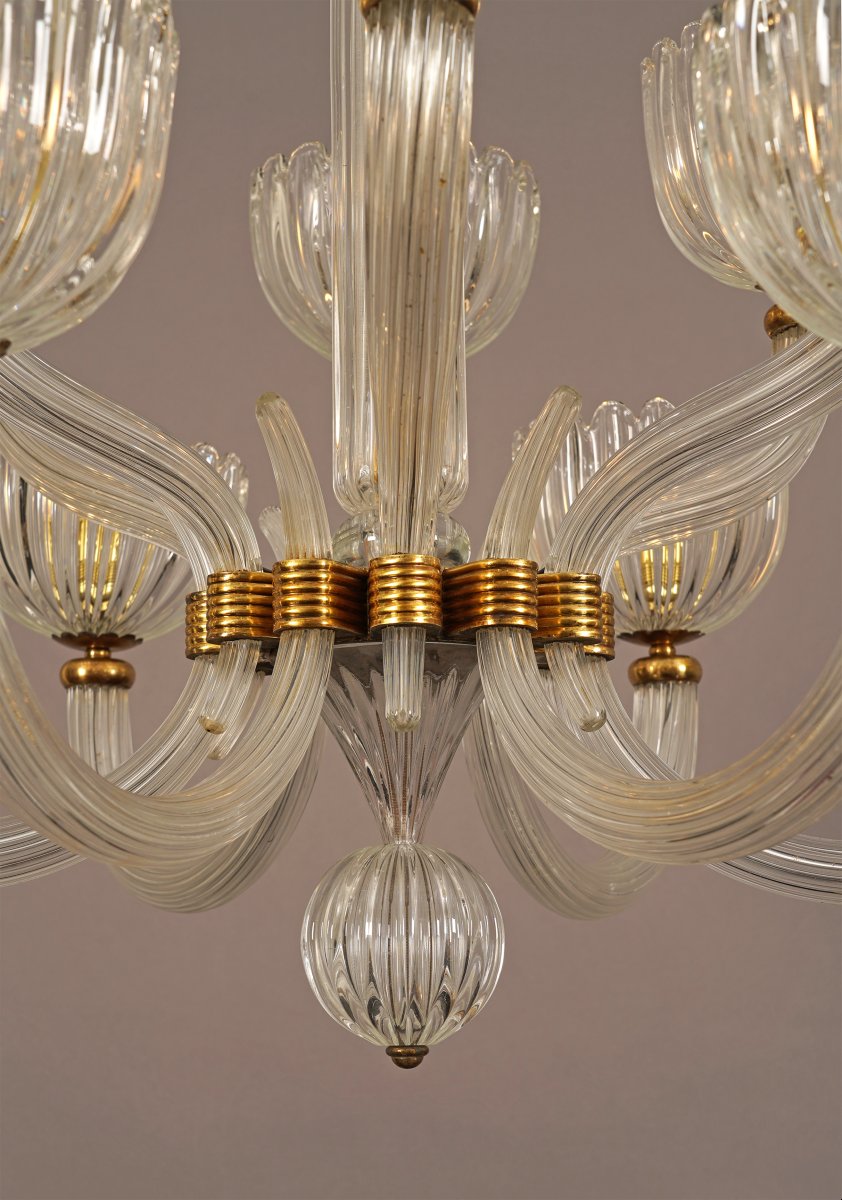
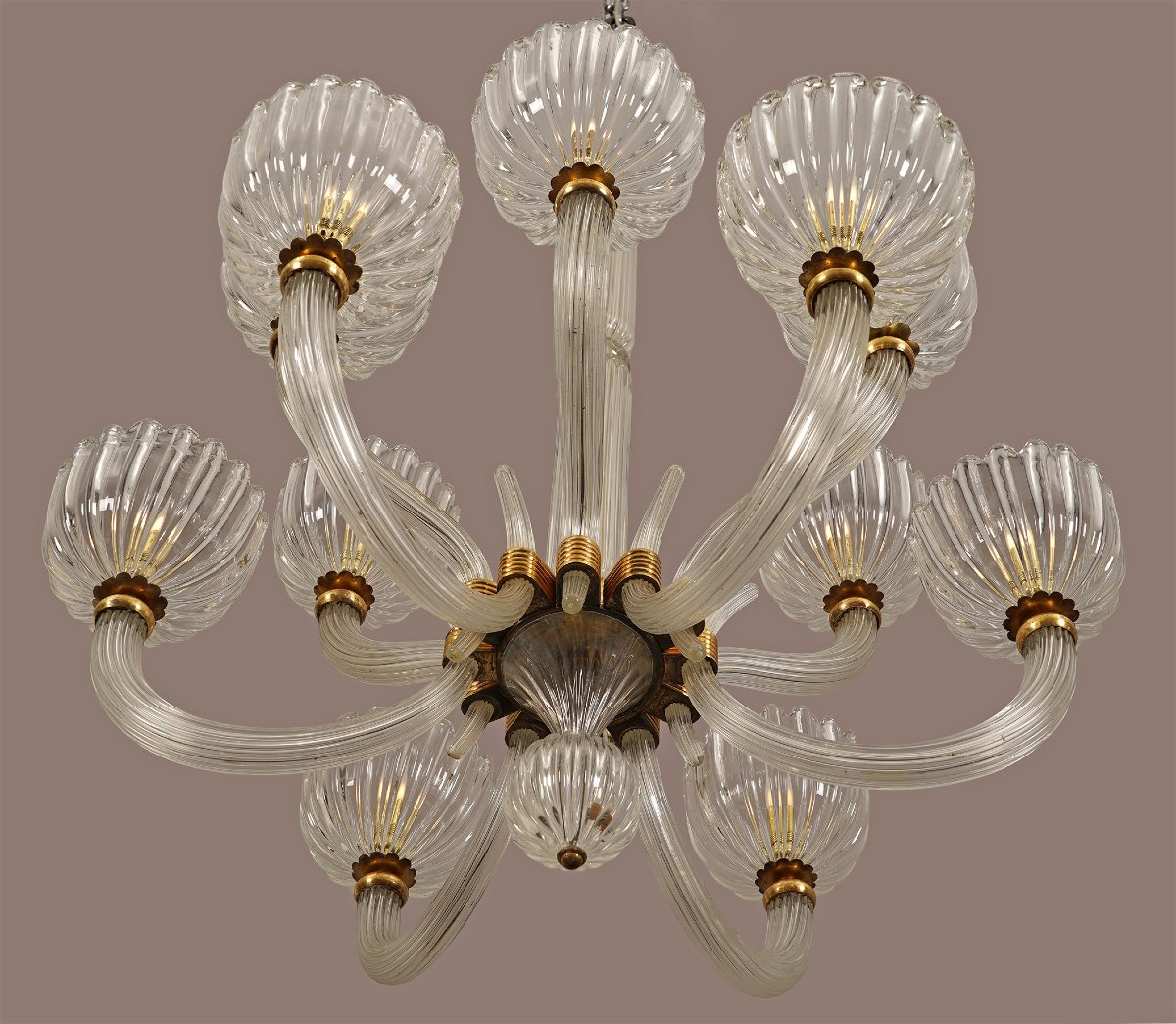
Beautiful pair of twelve-light Murano ribbed glass chandeliers (vetro costolato) attr. to Barovier & Toso, exemplifying the excellence and revival of Venetian glassmaking in the mid-20th century.These chandeliers are structured around a central axis composed of stacked glass cylinders, from which multiple swan-neck light arms radiate across two tiers, each ending in scalloped corolla-shaped cups. The lower section terminates in a ribbed glass sphere. The junction points are accentuated with brass mounts, notably the large gadrooned central ring embracing the base of the arms, as well as the smaller rings crowning each arm before the corolla, ensuring the solidity of the piece while providing a warm chromatic contrast to the cool, translucent, crystalline quality of the glass.
The use of vetro costolato is not merely aesthetic but also optical. The fluted glass acts as countless prisms that refract, diffuse, and soften the light from the bulbs, creating a shimmering, kinetic effect characteristic of great Murano craftsmanship.
This pair of chandeliers stands as an eloquent testament to the Italian Novecento movement in the decorative arts. Here, the master glassmaker abandoned the pendants and excessive flourishes of 18th-century Venetian design (the Rezzonico style) in favor of emphasizing the material itself, sculpted by light and structured through clear, fluid, and rhythmic lines.
Biography :
The firm Barovier & Toso was established in 1935 through the merger of two Venetian glassworks: Vetreria Artistica Barovier & C., directed by Ercole Barovier, and S.A.I.A.R. (Società Anonima Italiana Arti Riunite) Ferro Toso & C., led by Decio and Artemio Toso. In the region, however, the names of the Barovier and Toso families had already been associated for centuries with the craft and trade of glassmaking (respectively since the 14th and 17th centuries). The firms Fratelli Toso and Fratelli Barovier had moreover existed since 1854 and 1883. Initially named Ferro Toso Barovier & C., then Barovier Toso & C. from 1938 onward, the company adopted its current name, Barovier & Toso, in 1942.
First named Ferro Toso Barovier & C., then Barovier Toso & C. from 1938, the firm took its present name, Barovier & Toso, in 1942.
The use of vetro costolato is not merely aesthetic but also optical. The fluted glass acts as countless prisms that refract, diffuse, and soften the light from the bulbs, creating a shimmering, kinetic effect characteristic of great Murano craftsmanship.
This pair of chandeliers stands as an eloquent testament to the Italian Novecento movement in the decorative arts. Here, the master glassmaker abandoned the pendants and excessive flourishes of 18th-century Venetian design (the Rezzonico style) in favor of emphasizing the material itself, sculpted by light and structured through clear, fluid, and rhythmic lines.
Biography :
The firm Barovier & Toso was established in 1935 through the merger of two Venetian glassworks: Vetreria Artistica Barovier & C., directed by Ercole Barovier, and S.A.I.A.R. (Società Anonima Italiana Arti Riunite) Ferro Toso & C., led by Decio and Artemio Toso. In the region, however, the names of the Barovier and Toso families had already been associated for centuries with the craft and trade of glassmaking (respectively since the 14th and 17th centuries). The firms Fratelli Toso and Fratelli Barovier had moreover existed since 1854 and 1883. Initially named Ferro Toso Barovier & C., then Barovier Toso & C. from 1938 onward, the company adopted its current name, Barovier & Toso, in 1942.
First named Ferro Toso Barovier & C., then Barovier Toso & C. from 1938, the firm took its present name, Barovier & Toso, in 1942.
22 000 €
Period: 20th century
Style: Other Style
Condition: Good condition
Material: Glass
Diameter: 75
Height: 120
Reference (ID): 1766491
Availability: In stock
Print