19th Century Baccarat Crystal Service With Enamel Decoration By Eugène Rousseau
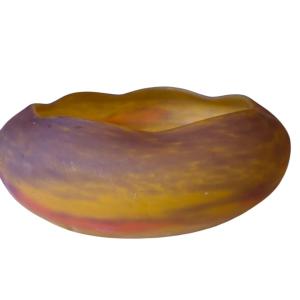
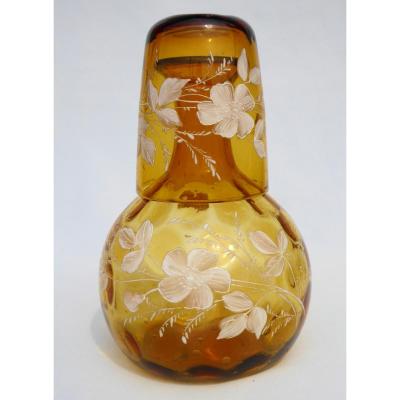
Magnificent antique French enameled glass dinner service, signed Eugène Rousseau (1827-1890) for Baccarat. This ten-piece service is ideal for fruit, desserts or punches.
The glass features a delightful two-tone yellow and violet finish. The service includes a bowl with lid on a raised foot, six matching glasses on round feet and a round tray. This antique, unsigned Baccarat service pre-dates the acid-etched signature of 1936. The famous crystal maker used paper labels from 1860 to 1936, often lost, worn or washed off. In good very good condition, with no chips or cracks,
The compotier measures 21.6 cm high and its opening has a diameter of 15.2 cm. The glasses measure 6.7 cm high and their opening has a diameter of 6.4 cm. The tray measures 27.3 cm in diameter and 2.5 cm high.
François-Eugène Rousseau (1827-1890), known as Eugène Rousseau, was a master glassmaker who established himself in 1855 as a porcelain and earthenware dealer at 43, rue Coquillière in Paris. Around 1867, he turned his attention to glass, calling on the talents of Eugène Michel to engrave a range of glassware. That same year, fascinated by Japanese motifs, Eugène Rousseau asked Félix Bracquemond to create a porcelain service for the Paris Universal Exhibition. For the first time, a European artist directly copied a Japanese artist, reproducing animal figures from Hokusai's manga. Following the success of this service, Japanese aesthetics had a profound influence on Rousseau's production. In 1869, two of his painted glasses were acquired by the Victoria and Albert Museum. His Japanese glassware, probably produced with the help of the Appert brothers in Clichy and the Baccarat crystal works, was presented in Paris in 1874 at the fourth exhibition of the Union centrale des beaux-arts appliqués à l'industrie. A member of the Union centrale des arts décoratifs since its creation in 1862, he was awarded the Légion d'honneur. At the end of his career, he joined forces with Ernest Leveillé, who was also his pupil. Leveillé continued Eugène Rousseau's work after the latter's death, having bought his studio on rue Coquillière in 1885.
Possible shipment
Further information 06 09 03 18 46 or napoliantic@gmail.com
Period: 19th century
Style: Napoleon 3rd
Condition: Excellent condition
Material: Crystal
Diameter: 27
Height: 16
Reference (ID): 1745115
Availability: In stock