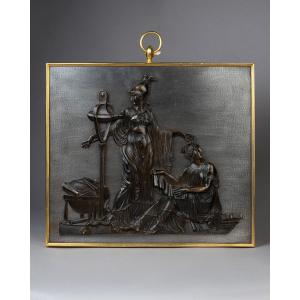

Reason Guiding Science Through Conscience
Reason guiding Science through Conscience
Patinated bronze
France
1790-1810
34 x 31 cm
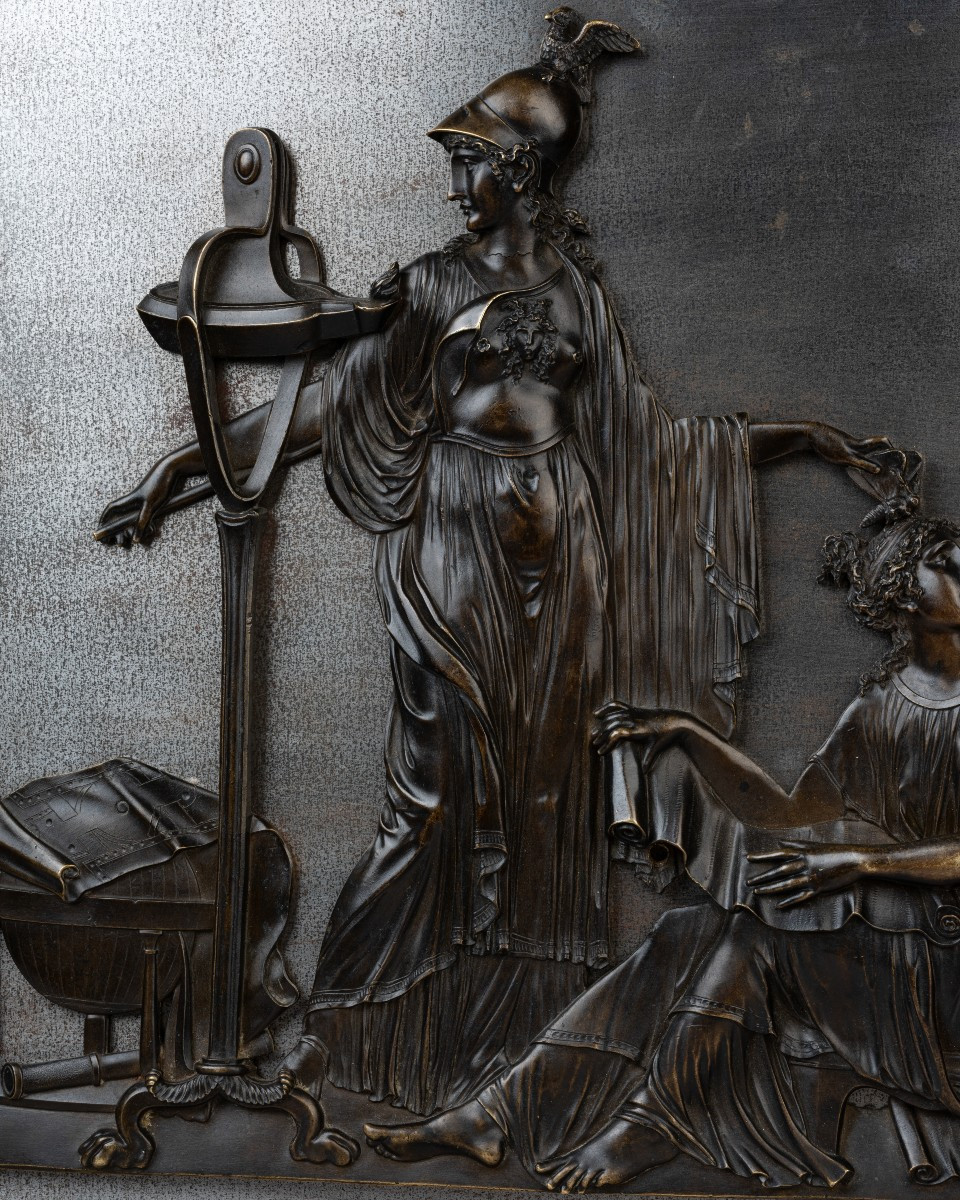
The gesture of Minerva, placing a butterfly on the head of another woman, is borrowed from a type of ancient sarcophagus where Athena, or Minerva, breathes the soul into Protoplasm, i.e. the first man fashioned by Prometheus. Such a sarcophagus, from the collections of Camille Borghese, has been in the Louvre since 1807, where Minerva's gesture is simplified so that the wings of the characteristic butterfly cannot be distinguished.
On a Capitoline sarcophagus of the same type, however, where, as in the Louvre, Prometheus, seated, holds, with his left hand, the Protoplasm standing on his lap on whose head Minerva, on his right, places a hand, the butterfly, which she holds by both wings, is clearly visible. Berthel Thorvaldsen repeats the same gesture in a series of bassorilievi, probably conceived in Rome around 1806-1807 and listed in the catalog of the Thorvaldsen Museum in Copenhagen as Minerve granting the soul to the human being created by Prometheus.
Here, then, is a rare but not unprecedented motif, here adapted to the iconography of the Republic and the Enlightenment: Minerva, allegory of Reason or Wisdom, and who wears the aegis on her breast, places a butterfly on the head of a young woman, in whom we should no doubt see a personification of the Sciences - surrounded by books, a globe, a long view, and an oil lamp signifying by whose light one lights up on nights of study. Minerva thus represents Reason guiding the Sciences by means of the soul, so to speak - and to quote Pantagruel's famous quote - the conscience, without which science would be but the ruin of the soul.
The origin of this relief is not known: its dimensions and patina make it unlikely that it was intended as an applique for the base of a clock or a frieze for a mantelpiece. The remarkable quality of the modelling and chasing, in particular the panneggio bagnato of Phidias and Arogacrite - here a demonstration of virtuosity and also a reference to the Athena Parthenos - supports the hypothesis of a relief conceived as a work of art in its own right, although the position of the seated woman suggests a continuation of the scene on the right, which is confirmed by the shape of the terrace.
Period: 19th century
Style: Consulat, Empire
Condition: Excellent condition
Material: Bronze
Width: 31 cm
Height: 34 cm
Reference (ID): 1740775
Availability: In stock