

Robert Gignoux (1872-1906) Equestrian Portrait Of Carl Costa De Beauregard - Horse
Artist: Robert Gignoux
Robert GIGNOUX
(Paris, 1872 - 1906)
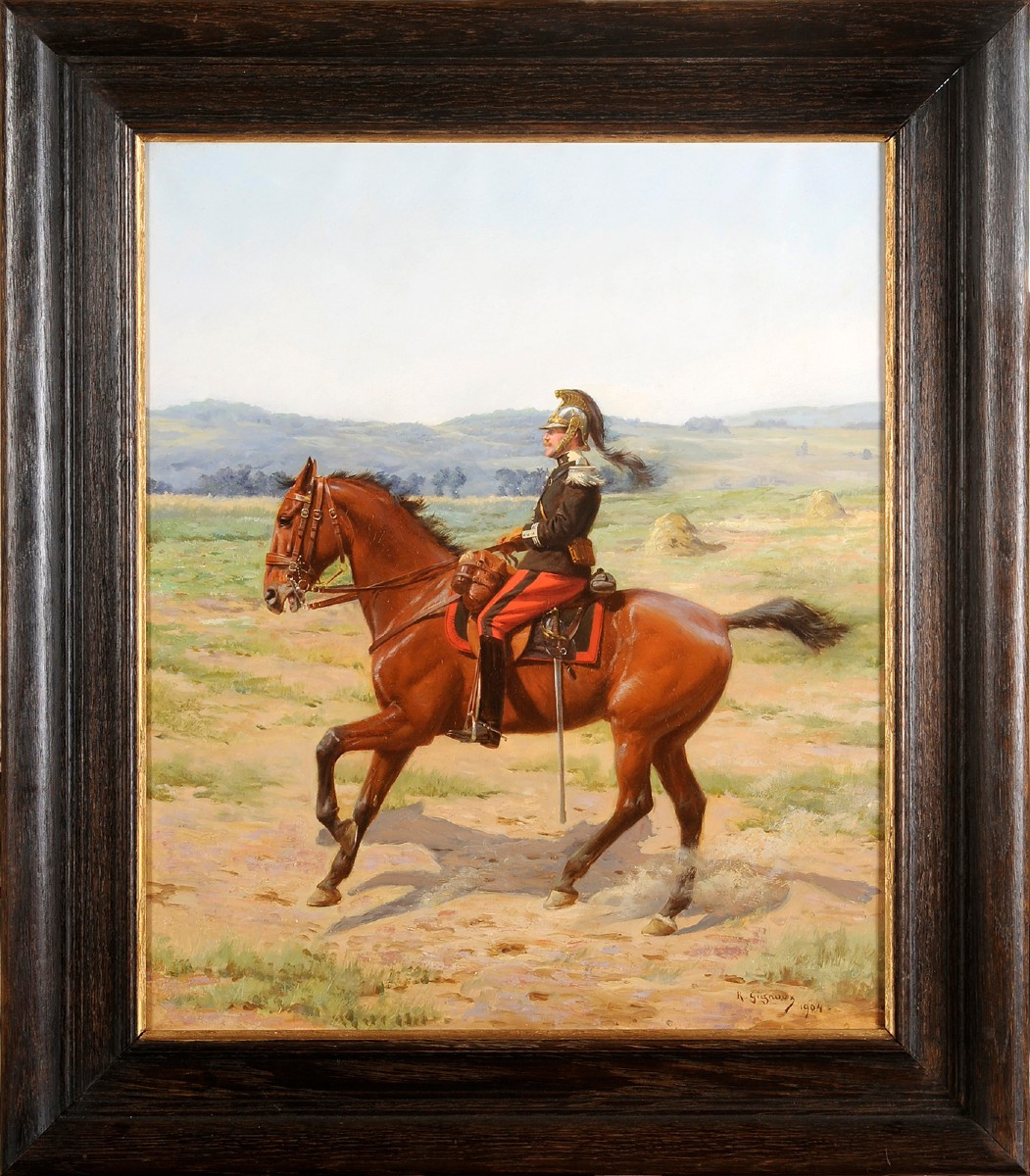
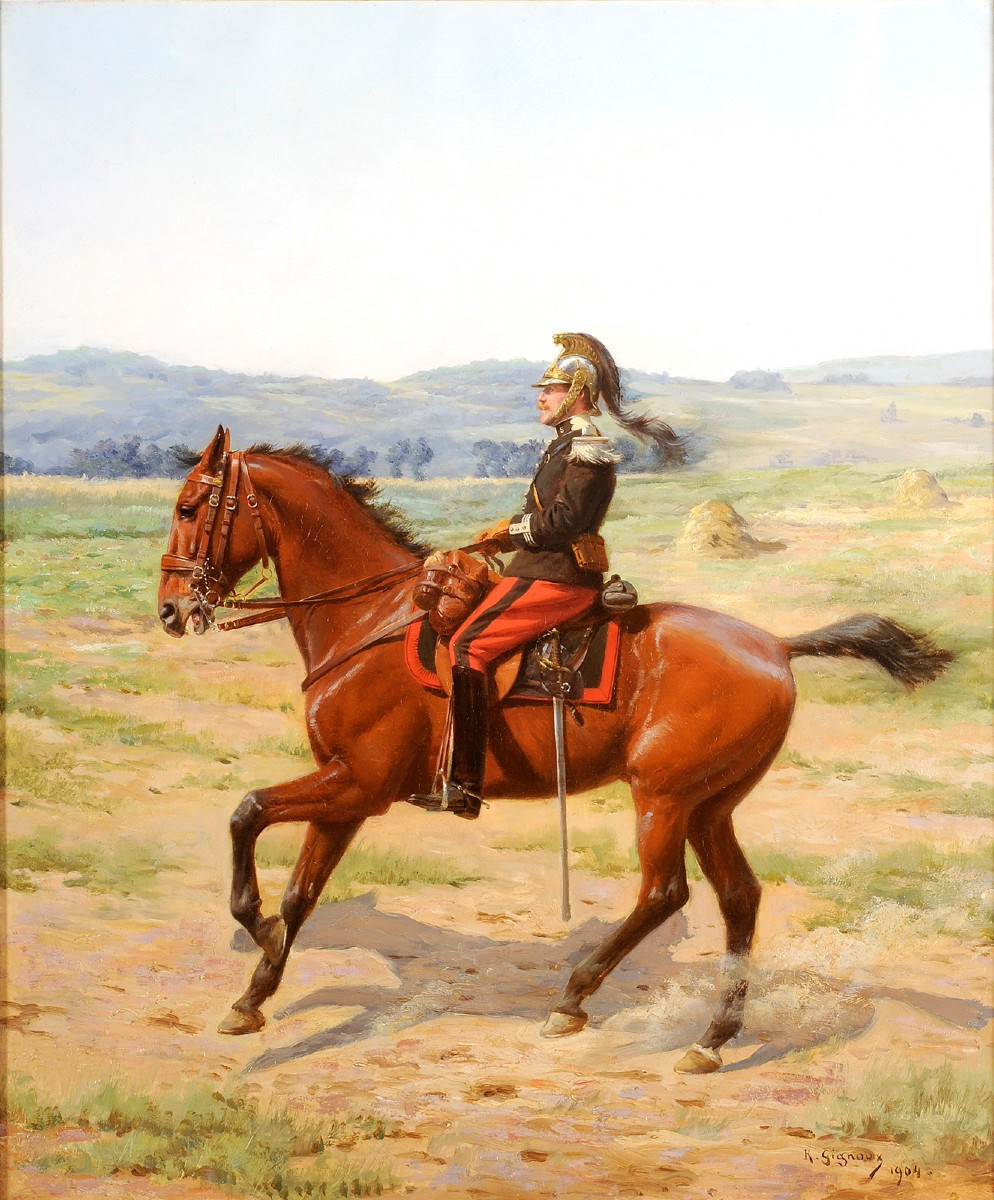
Equestrian Portrait of Carl Costa de Beauregard
Oil on canvas
H. 65 cm; W. 54 cm
Signed and dated lower right
1904
A student of the painters Fernand Cormon and Edouard Detaille, Robert Gignoux executed a number of military paintings, which he exhibited at the Salon des Artistes Français; he even received an honorable mention at the 1904 Salon for The Arrest of a Spy.
Frequent in aristocratic circles, he was fond of sporting subjects: horse racing, hunting, etc., which he exhibited at the Cercle Volney or the Société des Peintres Hippiques.
Reflecting the world in which he moved, he was an artist with an elegant brush and pencil. His workshop was located at 33 rue Bayen, in the 17th arrondissement of Paris.
Barthélémy Marie Charles, known as Carl, Costa de Beauregard (Saint-Léger-sous-Beuvray, 1867 – Hyères, 1915), a graduate of the Saint-Cyr military academy (Timbuktu class of 1887-1889), belonged, like his brother Victor (1862-1922), to the 5th Dragoon Regiment; their older brother Stanislas (1857-1918) belonged to the 25th Regiment.
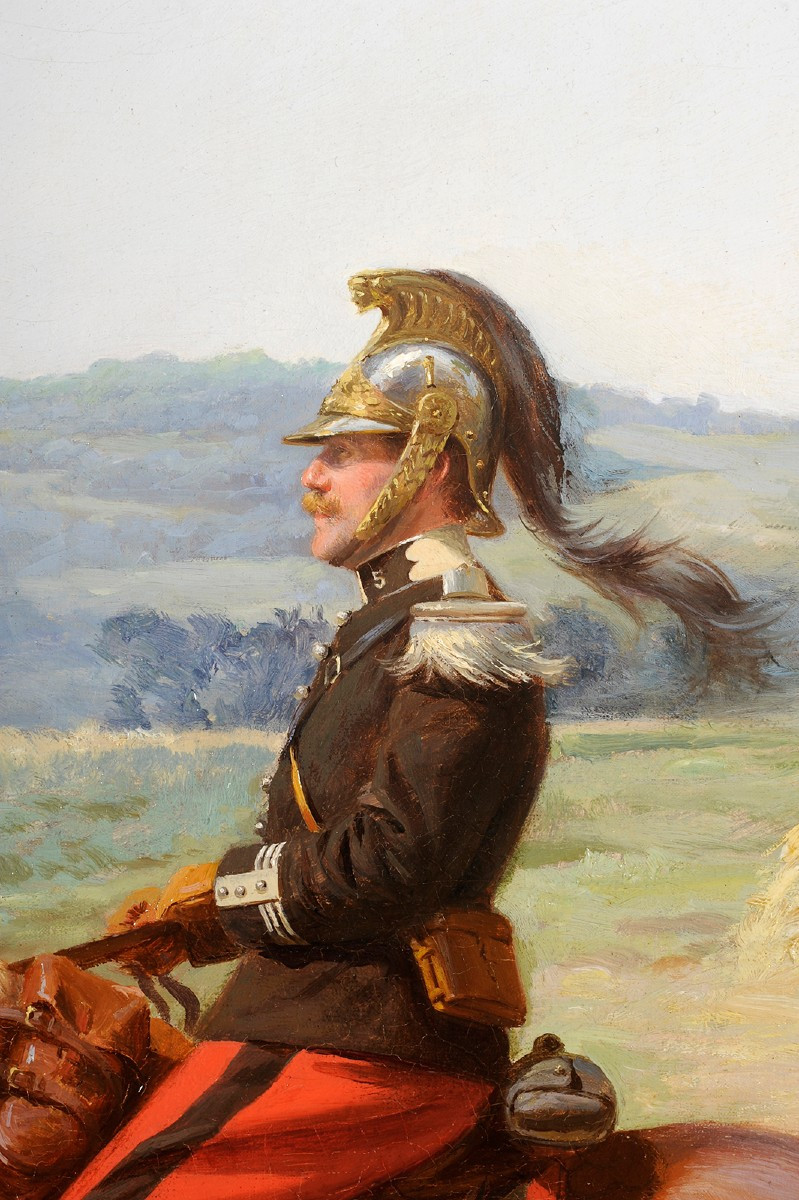
At his marriage in 1895 to Jeanne Aubry-Vitet (daughter of Eugène Aubry-Vitet, an archivist-paleographer, a trusted confidant of the Count of Paris, and connected to high society and political and economic circles), the announcement described him as a lieutenant, a rank he still held in 1902, upon the death of his father, Bérald. Unlike Victor, who would only reach the rank of second lieutenant, Carl would become a captain, and it is likely that our painting, in which he proudly displays his three stripes, was commissioned to celebrate this promotion. Established as such in 1791, the 5th Regiment had Louis Bonaparte as its famous colonel in 1800. From 1885, it was stationed in Compiègne, and it was in this town that Carl's children were born: Jean (1896-1908), Elisabeth (1899-?), and Amédée (1905-1954).
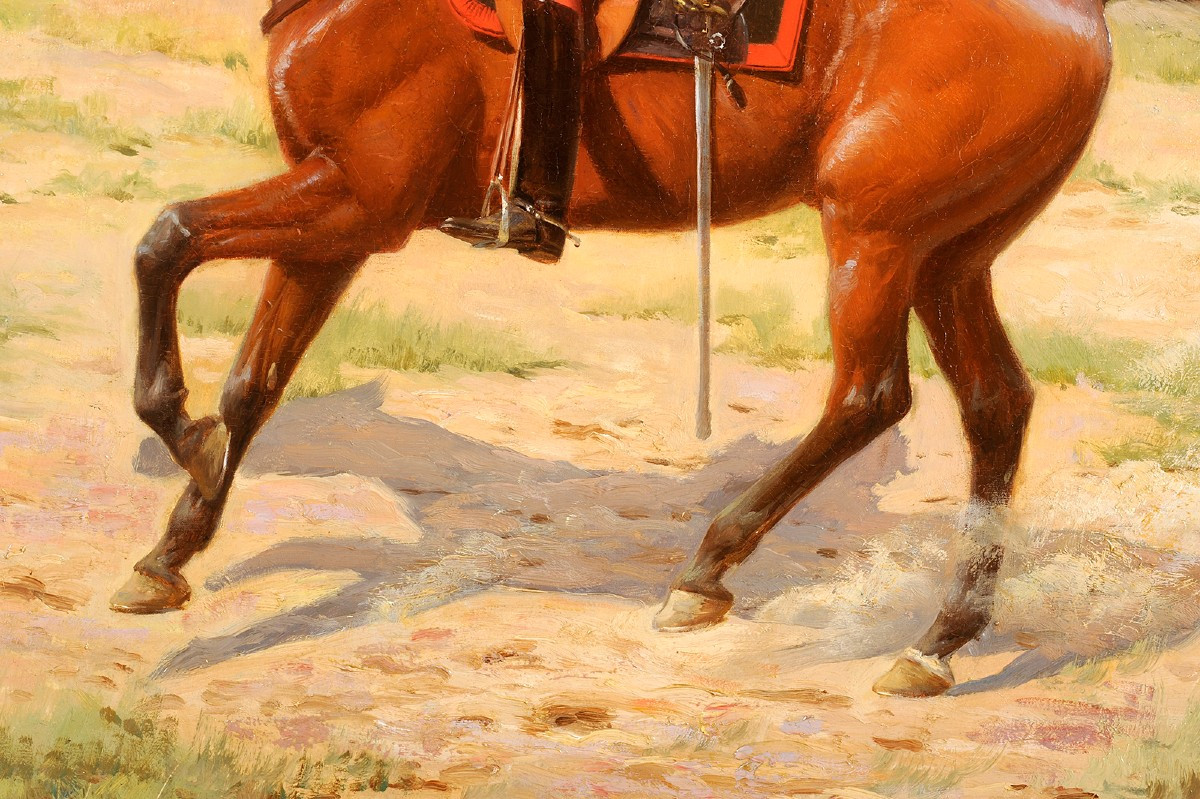
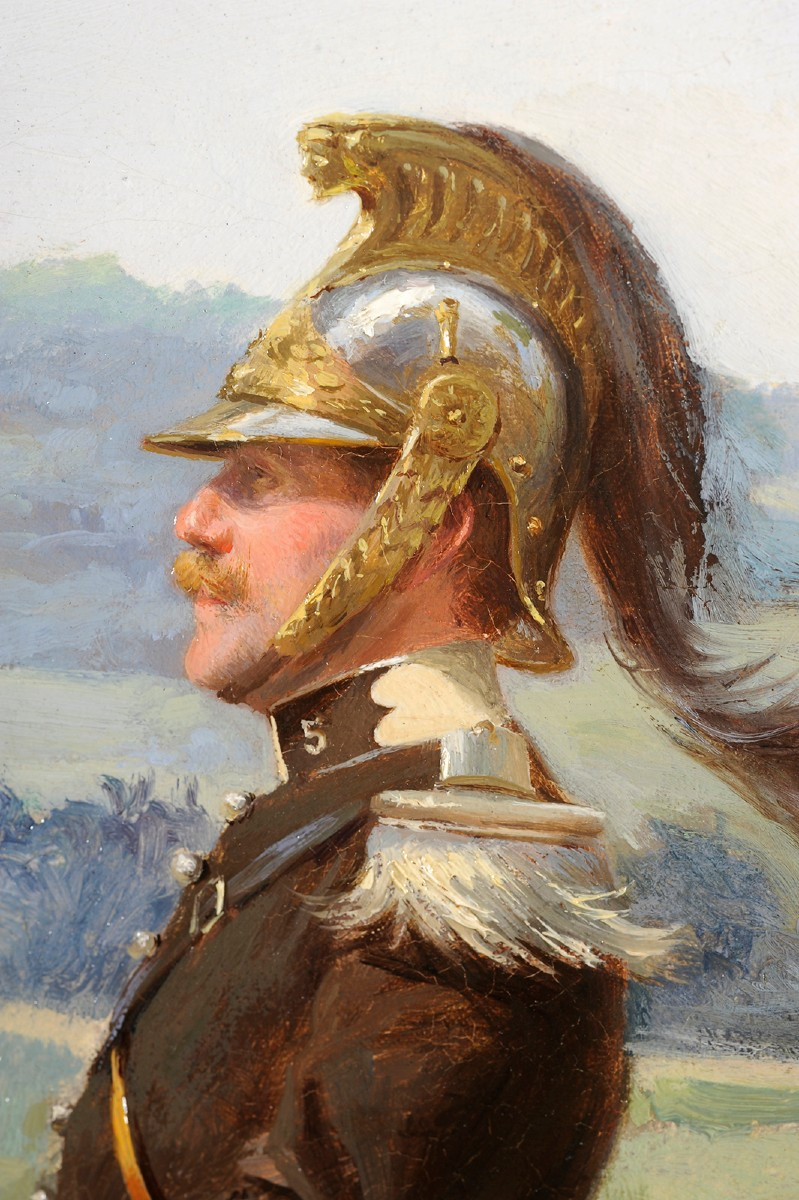
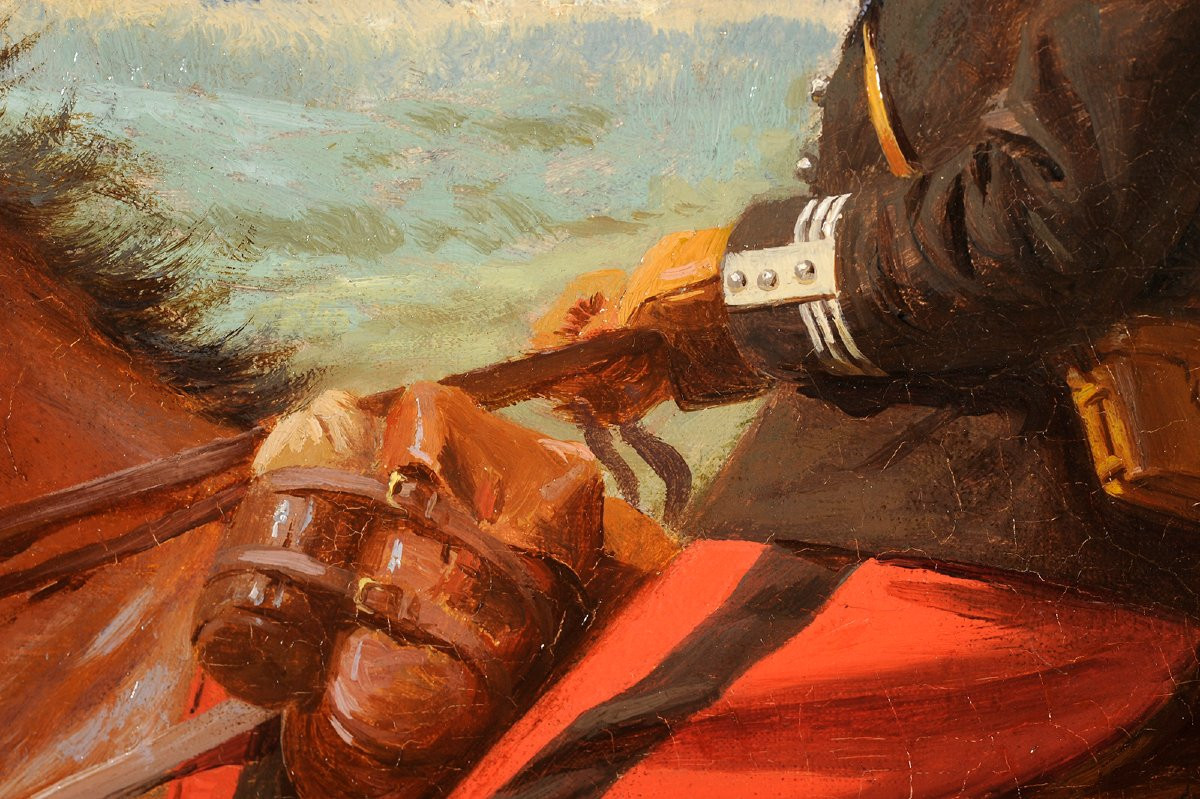
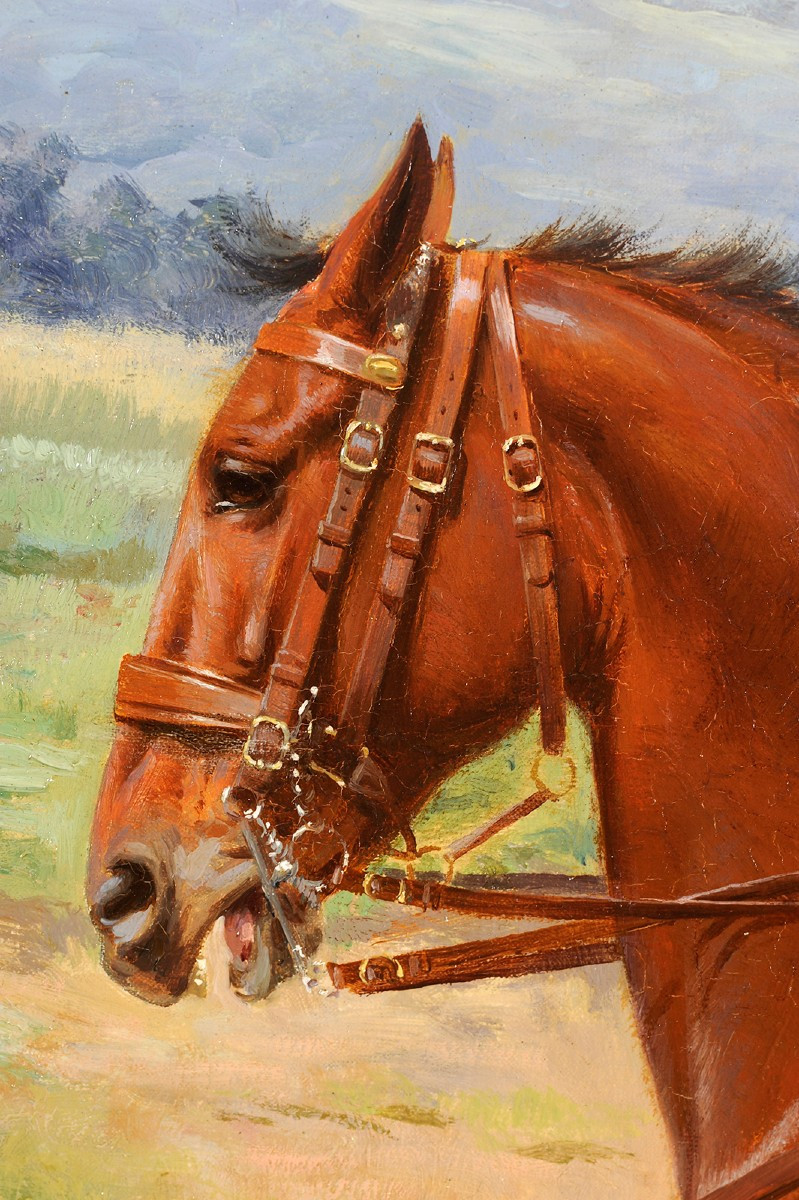
Our work possesses the realism of a photographic snapshot and a great elegance, evident in the horse's brilliant light bay coat and the rider's posture (head carriage, grip on the reins). The dust beneath the hind hooves, the epaulettes, and the mane of the helmet (model 1872/74) blowing in the wind all contribute to the impression of movement.
(Paris, 1872 - 1906)
Equestrian Portrait of Carl Costa de Beauregard
Oil on canvas
H. 65 cm; W. 54 cm
Signed and dated lower right
1904
A student of the painters Fernand Cormon and Edouard Detaille, Robert Gignoux executed a number of military paintings, which he exhibited at the Salon des Artistes Français; he even received an honorable mention at the 1904 Salon for The Arrest of a Spy.
Frequent in aristocratic circles, he was fond of sporting subjects: horse racing, hunting, etc., which he exhibited at the Cercle Volney or the Société des Peintres Hippiques.
Reflecting the world in which he moved, he was an artist with an elegant brush and pencil. His workshop was located at 33 rue Bayen, in the 17th arrondissement of Paris.
Barthélémy Marie Charles, known as Carl, Costa de Beauregard (Saint-Léger-sous-Beuvray, 1867 – Hyères, 1915), a graduate of the Saint-Cyr military academy (Timbuktu class of 1887-1889), belonged, like his brother Victor (1862-1922), to the 5th Dragoon Regiment; their older brother Stanislas (1857-1918) belonged to the 25th Regiment.
At his marriage in 1895 to Jeanne Aubry-Vitet (daughter of Eugène Aubry-Vitet, an archivist-paleographer, a trusted confidant of the Count of Paris, and connected to high society and political and economic circles), the announcement described him as a lieutenant, a rank he still held in 1902, upon the death of his father, Bérald. Unlike Victor, who would only reach the rank of second lieutenant, Carl would become a captain, and it is likely that our painting, in which he proudly displays his three stripes, was commissioned to celebrate this promotion. Established as such in 1791, the 5th Regiment had Louis Bonaparte as its famous colonel in 1800. From 1885, it was stationed in Compiègne, and it was in this town that Carl's children were born: Jean (1896-1908), Elisabeth (1899-?), and Amédée (1905-1954).
Our work possesses the realism of a photographic snapshot and a great elegance, evident in the horse's brilliant light bay coat and the rider's posture (head carriage, grip on the reins). The dust beneath the hind hooves, the epaulettes, and the mane of the helmet (model 1872/74) blowing in the wind all contribute to the impression of movement.
8 000 €
Period: 19th century
Style: Napoleon 3rd
Condition: Perfect condition
Material: Oil painting
Length: 65 cm hors cadre
Width: 54 cm hors cadre
Reference (ID): 1740307
Availability: In stock
Print