Leonardo Roda (racconigi, 1868 – Turin, 1933), View Of Mount Breithorn
Leonardo Roda (Racconigi, 1868 – Turin, 1933)
View of Mount Breithorn
Oil on canvas, 117 x 156 cm
With frame, 127 x 166 cm
Signed lower right: “L. RODA”
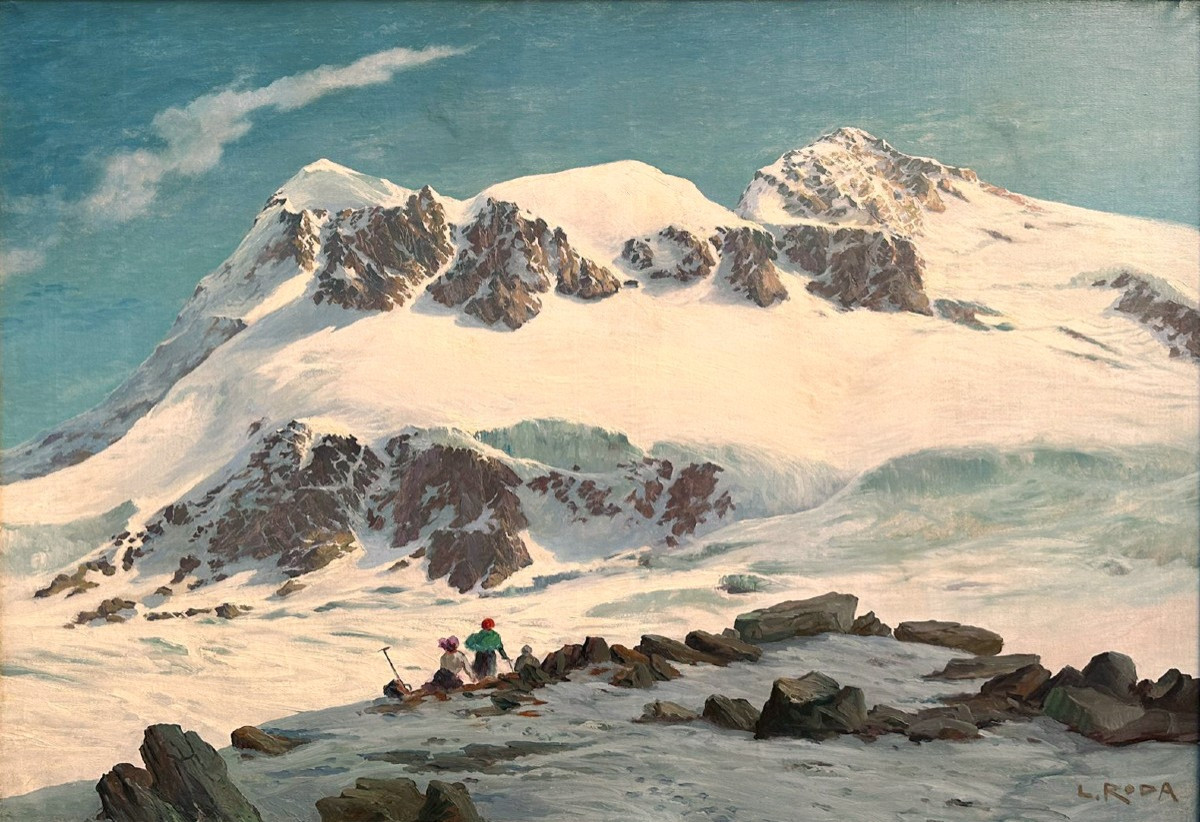
The painting analyzed here belongs to the rich catalogue of the Piedmontese painter Leonardo Roda (Racconigi, 1868 – Turin, 1933), whose authorship is confirmed by the autograph signature visible at the bottom right. Roda, a prominent figure in the landscape panorama between the late nineteenth and early twentieth centuries, is best known for his masterful interpretations of the rural world and mountain contexts. Originally from Racconigi, in the province of Cuneo, Roda trained essentially as a self-taught artist, despite having refined his technique in Turin by frequenting the studio of the artist Marco Calderini (1850 – 1941), from whom he inherited a profound sensitivity towards natural data, developing a style aimed at immortalising the quiet and beauty of the landscape. His artistic production ranges from broad bucolic views, populated by farmers and small hilltop villages, to powerful representations of the Alpine peaks, in which he demonstrates an exceptional ability to manage the chiaroscuro and luminous reflections on the rock walls. He regularly exhibited his works in important Italian cities such as Milan, Turin, Genoa and Florence, participating in various exhibitions, including the Promotrici di Torino and the annual exhibitions at the Circolo degli Artisti until 1925, thus effectively earning the appreciation of the public and critics. His style, while remaining faithful to the landscape tradition, showed a modern sensibility in brushwork and use of colour. A great enthusiast of mountaineering and botany, Roda chose the city of Valtournanche as his usual creative home. Here he devoted himself with an almost monastic obsession to the Matterhorn, portraying it in countless versions —from the quick and fresh sketch to the large-format canvas — to capture every atmospheric and luminous variation. In addition to the peaks, the painter was fascinated by the Ligurian Riviera and the French Riviera, thanks to his friendship with the writer Edmondo De Amicis (who celebrated him posthumously in the magazine Aosta). Roda traveled the coast from Levante to Ponente, often staying in Bordighera and leaving pictorial testimonies of places such as Celle and Albisola. The artist died in Turin in 1933, leaving a pictorial legacy that continues to be a point of reference for Piedmontese vedutism. In this imposing Alpine view, entitled View of Mount Breithorn and dating back to around 1895-1900, Roda offers the viewer a masterful synthesis of his pictorial poetics, suspended between the analytical realism of the Rivara School and an almost impressionist sensitivity to light. The mountain portrayed is Mount Breithorn, which is part of the Monte Rosa chain, a short distance from Mount Cervino, and exceeds 4100 meters above sea level. The composition is dominated by the majestic mass of the mountain massif, which occupies almost the entire pictorial surface: the choice of a close-up point of view, which emphasizes the monumentality of the mountain, effectively projects us into the high-altitude landscape. The structure is defined by oblique and horizontal lines that guide the eye through the different bands of the landscape, the rocky foreground, the middle glacier and the snow-capped peaks in the background. A crucial element of the canvas is the presence of three human figures in the foreground, probably mountain guides, hikers or hunters, portrayed resting on a rocky outcrop. Their tiny scale, compared to the vastness of the landscape, underlines the immensity of nature and the smallness of man in front of it, recalling that theme so dear to nineteenth-century men of the relationship between man and nature, a central theme in nineteenth-century landscape painting. The painting technique here is characterized by a pasty and vibrant application, with the color applied in rapid and dense touches, which restore the materiality of the rock, snow and ice. Roda does not limit itself to a mere photographic reproduction of reality, but seeks to capture the atmosphere and emotion of the landscape: an invitation to contemplate the beauty of nature, and a tribute to the grandeur and mystery of the Alps.
View of Mount Breithorn
Oil on canvas, 117 x 156 cm
With frame, 127 x 166 cm
Signed lower right: “L. RODA”
The painting analyzed here belongs to the rich catalogue of the Piedmontese painter Leonardo Roda (Racconigi, 1868 – Turin, 1933), whose authorship is confirmed by the autograph signature visible at the bottom right. Roda, a prominent figure in the landscape panorama between the late nineteenth and early twentieth centuries, is best known for his masterful interpretations of the rural world and mountain contexts. Originally from Racconigi, in the province of Cuneo, Roda trained essentially as a self-taught artist, despite having refined his technique in Turin by frequenting the studio of the artist Marco Calderini (1850 – 1941), from whom he inherited a profound sensitivity towards natural data, developing a style aimed at immortalising the quiet and beauty of the landscape. His artistic production ranges from broad bucolic views, populated by farmers and small hilltop villages, to powerful representations of the Alpine peaks, in which he demonstrates an exceptional ability to manage the chiaroscuro and luminous reflections on the rock walls. He regularly exhibited his works in important Italian cities such as Milan, Turin, Genoa and Florence, participating in various exhibitions, including the Promotrici di Torino and the annual exhibitions at the Circolo degli Artisti until 1925, thus effectively earning the appreciation of the public and critics. His style, while remaining faithful to the landscape tradition, showed a modern sensibility in brushwork and use of colour. A great enthusiast of mountaineering and botany, Roda chose the city of Valtournanche as his usual creative home. Here he devoted himself with an almost monastic obsession to the Matterhorn, portraying it in countless versions —from the quick and fresh sketch to the large-format canvas — to capture every atmospheric and luminous variation. In addition to the peaks, the painter was fascinated by the Ligurian Riviera and the French Riviera, thanks to his friendship with the writer Edmondo De Amicis (who celebrated him posthumously in the magazine Aosta). Roda traveled the coast from Levante to Ponente, often staying in Bordighera and leaving pictorial testimonies of places such as Celle and Albisola. The artist died in Turin in 1933, leaving a pictorial legacy that continues to be a point of reference for Piedmontese vedutism. In this imposing Alpine view, entitled View of Mount Breithorn and dating back to around 1895-1900, Roda offers the viewer a masterful synthesis of his pictorial poetics, suspended between the analytical realism of the Rivara School and an almost impressionist sensitivity to light. The mountain portrayed is Mount Breithorn, which is part of the Monte Rosa chain, a short distance from Mount Cervino, and exceeds 4100 meters above sea level. The composition is dominated by the majestic mass of the mountain massif, which occupies almost the entire pictorial surface: the choice of a close-up point of view, which emphasizes the monumentality of the mountain, effectively projects us into the high-altitude landscape. The structure is defined by oblique and horizontal lines that guide the eye through the different bands of the landscape, the rocky foreground, the middle glacier and the snow-capped peaks in the background. A crucial element of the canvas is the presence of three human figures in the foreground, probably mountain guides, hikers or hunters, portrayed resting on a rocky outcrop. Their tiny scale, compared to the vastness of the landscape, underlines the immensity of nature and the smallness of man in front of it, recalling that theme so dear to nineteenth-century men of the relationship between man and nature, a central theme in nineteenth-century landscape painting. The painting technique here is characterized by a pasty and vibrant application, with the color applied in rapid and dense touches, which restore the materiality of the rock, snow and ice. Roda does not limit itself to a mere photographic reproduction of reality, but seeks to capture the atmosphere and emotion of the landscape: an invitation to contemplate the beauty of nature, and a tribute to the grandeur and mystery of the Alps.
9 000 €
Period: 19th century
Style: Other Style
Condition: Good condition
Material: Oil painting
Width: 156
Height: 117
Reference (ID): 1738787
Availability: In stock
Print