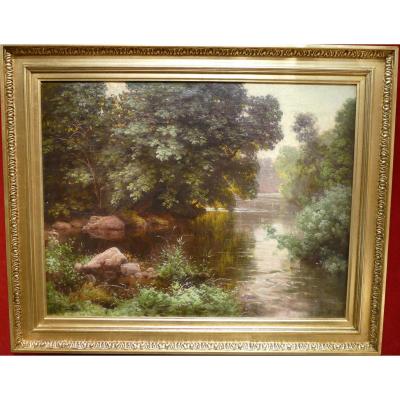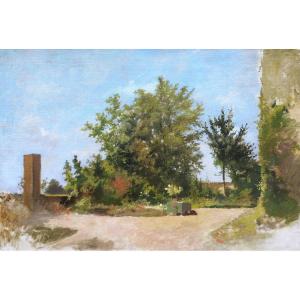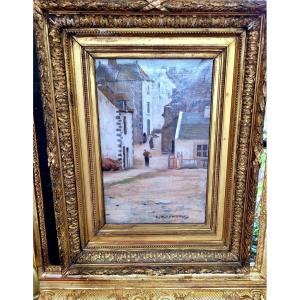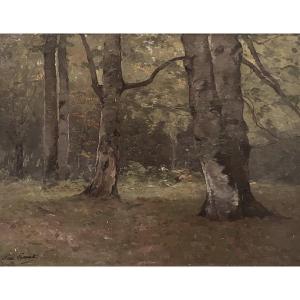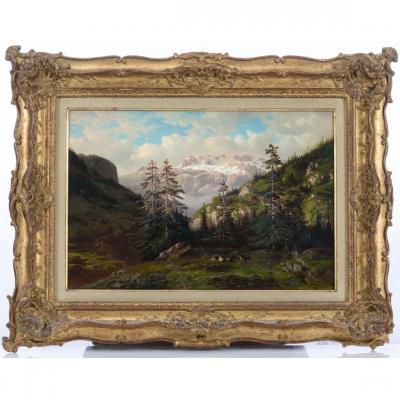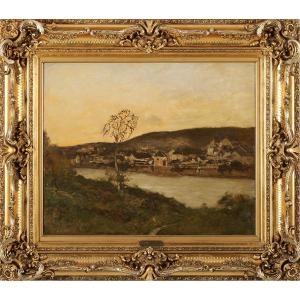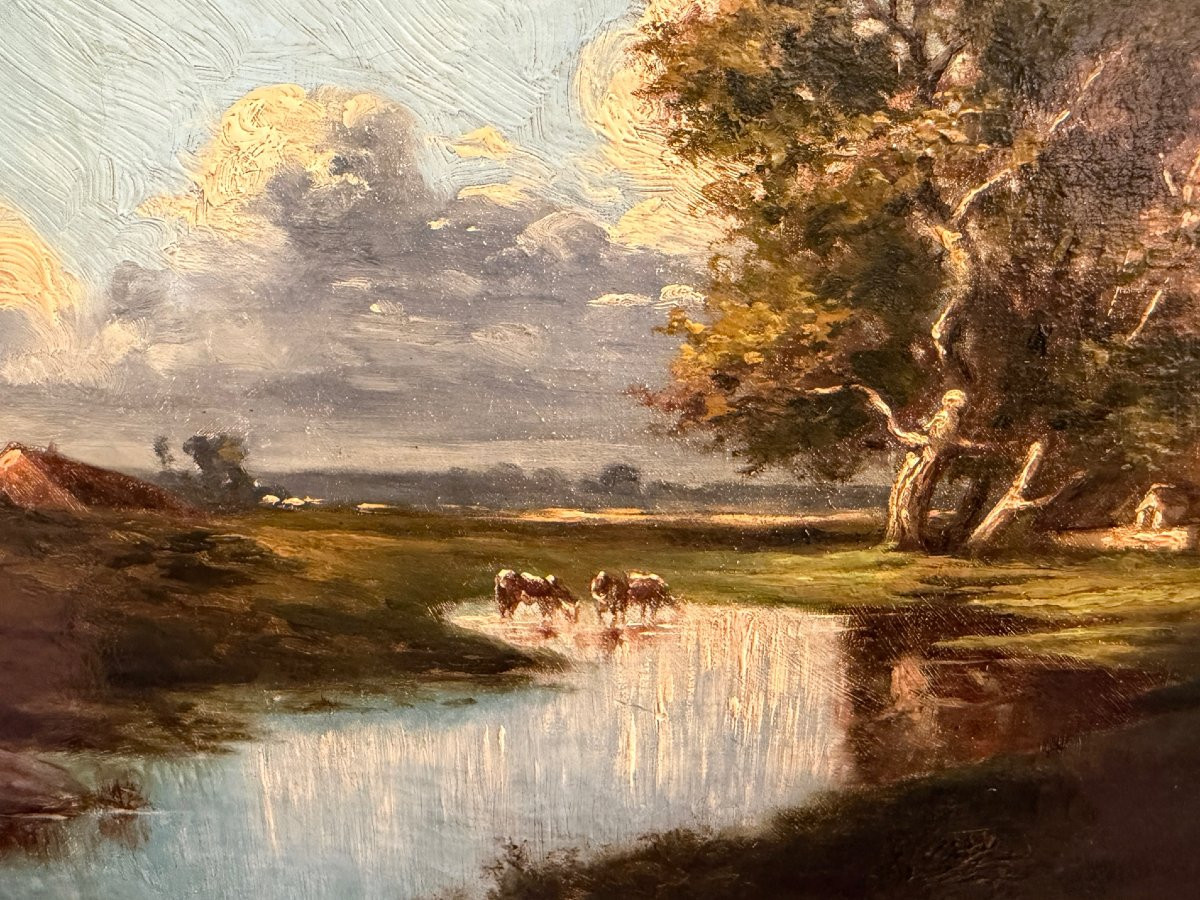


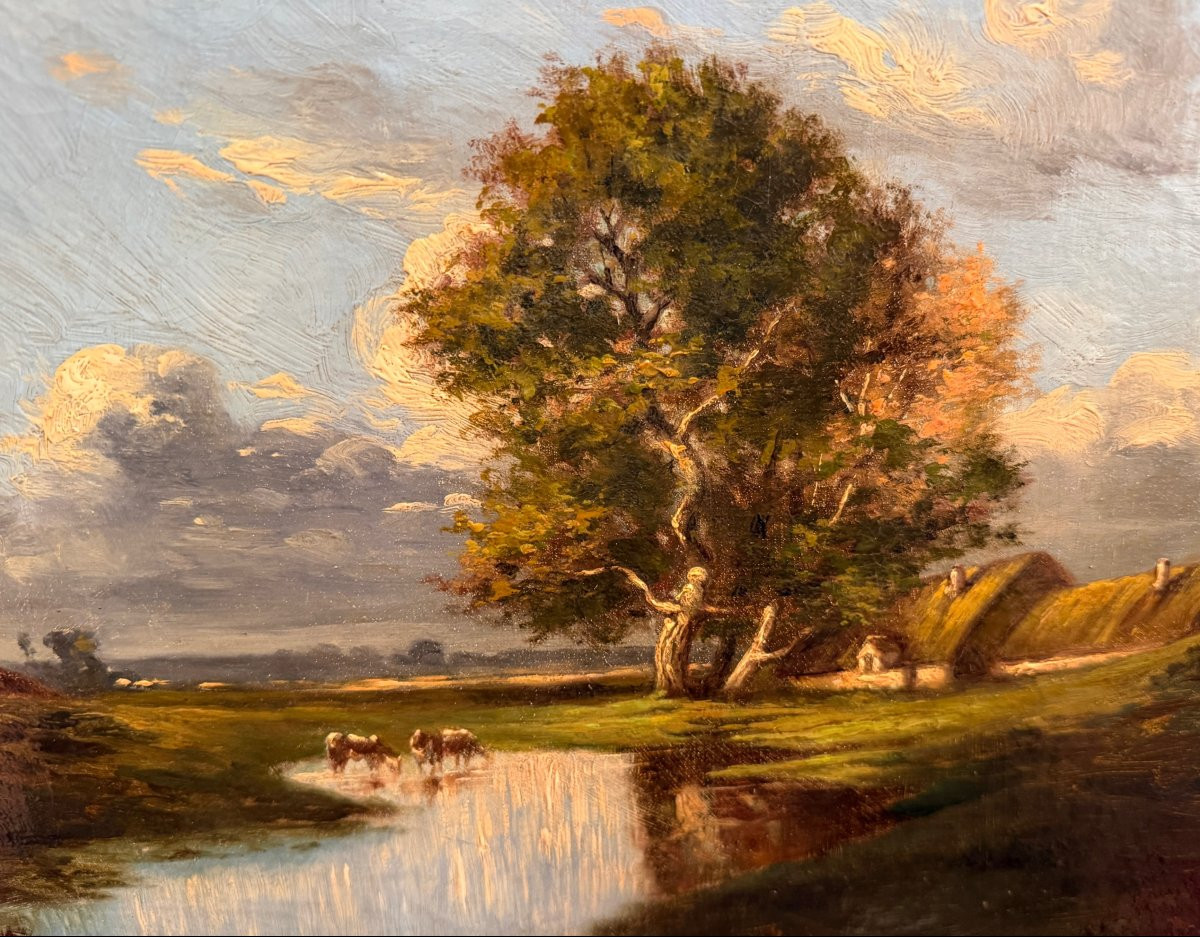


Dupre Jules Barbizon School 19th Century Thatched Cottages And Cows Drinking Oil Painting Signed Certificate
Artist: Dupre Jules ( 1811 / 1889 )
Jules DUPRE ( 1811 / 1889 )
Thatched Cottages and Cows Drinking.
Oil on canvas signed lower right.
12,9 x 16,1 in
Certificate of authenticity.
Jules Dupré
A renowned 19th-century landscape painter and founder of the School of Modern French Landscape Painting, Jules Dupré came from an old family in L'Isle-Adam. He was born in Nantes on April 5, 1811, into his mother’s family.
In 1815, his father, François Dupré, owner of earthenware factories in Creil and Saint-Yrieix-la-Perche, in the canton of Limoges, opened a new porcelain factory in Parmain. From the age of 15, Jules decorated plates inspired by the region’s flora.
François Dupré, appointed to manage a porcelain factory in Limoges, moved his family there. There, Jules learned from his father all the techniques of porcelain making and plate decoration, but he was drawn to painting from life.
Thus, he enrolled at the École des Beaux-Arts in Paris. To round out his training, he took classes in the studio of Jean-Michel Diéboldt, whose work bridges the styles of David, Géricault, and Delacroix.
Jules Dupré became associated with the Barbizon School: Cabat, Paul Huet, Troyon, Flers, and Théodore Rousseau, with whom he undertook numerous trips throughout France in search of rural landscapes.
At age 20, he was accepted into the Salon.
In 1831, he exhibited “A View of L’Isle-Adam” and “A Farmyard.” He met Lord Graves, who introduced him to the landscapes of England.
In 1833, the banks of the Oise and the Montmorency Valley inspired him. In 1835, the Salon established his reputation.
In 1841, he moved with Rousseau to Montsoult. Having a little money, in October 1845, he rented a studio in L'Isle-Adam across from the church, on the corner of the Grande Rue.
In 1847, he was made a Knight of the Legion of Honor, which led to a falling-out with his friend Rousseau.
In 1860, he married Stéphanie-Augustine Moreau, the daughter of an architect, in Champagne-sur-Oise.
In 1870, Jules Dupré was promoted to Officer of the Legion of Honor. Two years later, he bought a house in L'Isle-Adam, near the Place du Pâtis, large enough to entertain his friends: Corot, Daubigny, Rousseau, Boulard, Geoffroy-Dechaume, and Daumier. He had a large studio built in the attic, from which he had a breathtaking view of the Oise River.
The 1889 World’s Fair cemented Jules Dupré’s reputation. Suffering from kidney stones, he had to undergo surgery. However, he did not recover from the procedure and died in L’Isle-Adam on October 6, 1889, where he was buried.
On June 30, 1890, his studio was sold. In July 1894, the town of L'Isle-Adam, along with the painter’s admirers and friends, erected a memorial to him at the corner of Rue Mellet and Place du Pâtis.
Jules Dupré's house was demolished around 1900. A street in L'Isle-Adam that leads to the Oise River—a source of inspiration for some of his works—bears his name today.
Many French museums, as well as major international museums such as the Hermitage in Saint Petersburg, exhibit his works.
Argentina, Buenos Aires, National Museum of Fine Arts; Australia, Melbourne, National Gallery of Victoria; Azerbaijan, Baku, Azerbaijan National Art Museum; Brazil, Rio de Janeiro, National Museum of Fine Arts; Denmark, Copenhagen: Ordrupgaard Museum, Statens Museum for Kunst.
United States
Akron (Ohio), Akron Art Museum; Andover (Massachusetts), Addison Gallery of American Art. Baltimore, Walters Art Museum; Boise, Art Museum; Boston, Museum of Fine Arts; Brighton, McMullen Museum of Art; Chicago: Art Institute of Chicago, DePaul University Museum; Cleveland, Cleveland Museum of Art; Detroit (Michigan): Detroit Institute of Arts, Miami Beach, Minneapolis, Minneapolis Institute of Art, New York: Brooklyn Museum, Frick Collection, Metropolitan Museum of Art, Memphis, Brooks Museum of Art, Pasadena: Norton Simon Museum, Rhode Island School of Design Museum, Rochester (New York), Memorial Art Gallery, St. Louis: Mildred Lane Kemper Museum, St. Louis Art Museum, San Francisco Museum, Washington: National Gallery of Art, Smithsonian American Art Museum, Wellesley (Massachusetts), Davis Museum, Woodstock (Vermont), Marsh-Billings-Rockefeller, National Historical Park.
France :
Agen, Museum of Fine Arts
Alençon, Museum of Fine Arts and Lace, Angoulême, Angoulême Museum, Bagnères-de-Bigorre, Salies Museum, Bayonne, Bonnat-Helleu Museum, Beauvais, Oise Prefecture Building, Oise Departmental Museum, Châlons-en-Champagne, Museum of Fine Arts and Archaeology, Chantilly, Condé Museum, Dijon: Magnin Museum, Museum of Fine Arts, Évreux, Museum of Art, History, and Archaeology, Flers-de-l'Orne, Flers Castle Museum, Grenoble, Grenoble Museum. Laval, Vieux-Château Museum, Lille, Palace of Fine Arts: The Battle of Hondschoote, Lisieux, Museum of Art and History, L'Isle-Adam, Louis-Senlecq Museum of Art and History: about a hundred works (paintings, sculptures, prints), Lyon, Museum of Fine Arts; Marseille, Grobet-Labadié Museum; Montpellier, Fabre Museum; Nantes: Nantes Museum of Art, Thomas-Dobrée Departmental Museum; Nemours, Nemours Castle Museum; Nice, Museum of Fine Arts.
Paris :
National Furniture Collection, Eugène Delacroix National Museum. Louvre Museum, Musée d'Orsay, Musée de la Vie Romantique, Musée du Petit Palais, Pau, Museum of Fine Arts, Reims, Museum of Fine Arts, Rennes, Museum of Fine Arts, Rouen, Museum of Fine Arts, Saint-Lô, Museum of Fine Arts, Saint-Quentin, Musée Antoine-Lécuyer, Vire, Municipal Museum.
Hungary:
Budapest, Museum of Fine Arts,
Japan:
Hachiōji, Murauchi Art Museum
Luxembourg:
Luxembourg, Villa Vauban.
Netherlands, Amsterdam Van Gogh Museum, Rijksmuseum.
The Hague, Mesdag Collection.
Poland:
Warsaw, National Museum, Wrocław, Museum of Fine Arts.
Portugal:
Lisbon, National Museum of Ancient Art.
United Kingdom:
Cambridge, Fitzwilliam Museum; Edinburgh, National Gallery of Scotland; Forres, Brodie Castle; Glasgow, Glasgow Museum Resource Centre; Leeds, Leeds Art Gallery.
London:
National Gallery, The Wallace Collection, Sheffield, Sheffield Galleries and Museums Trust.
Russia:
Moscow, Pushkin Museum of Fine Arts.
Saint Petersburg, Hermitage Museum.
Sweden:
Stockholm, Nationalmuseum.
Taiwan, Chimei Museum.
violondingres.fr
Thatched Cottages and Cows Drinking.
Oil on canvas signed lower right.
12,9 x 16,1 in
Certificate of authenticity.
Jules Dupré
A renowned 19th-century landscape painter and founder of the School of Modern French Landscape Painting, Jules Dupré came from an old family in L'Isle-Adam. He was born in Nantes on April 5, 1811, into his mother’s family.
In 1815, his father, François Dupré, owner of earthenware factories in Creil and Saint-Yrieix-la-Perche, in the canton of Limoges, opened a new porcelain factory in Parmain. From the age of 15, Jules decorated plates inspired by the region’s flora.
François Dupré, appointed to manage a porcelain factory in Limoges, moved his family there. There, Jules learned from his father all the techniques of porcelain making and plate decoration, but he was drawn to painting from life.
Thus, he enrolled at the École des Beaux-Arts in Paris. To round out his training, he took classes in the studio of Jean-Michel Diéboldt, whose work bridges the styles of David, Géricault, and Delacroix.
Jules Dupré became associated with the Barbizon School: Cabat, Paul Huet, Troyon, Flers, and Théodore Rousseau, with whom he undertook numerous trips throughout France in search of rural landscapes.
At age 20, he was accepted into the Salon.
In 1831, he exhibited “A View of L’Isle-Adam” and “A Farmyard.” He met Lord Graves, who introduced him to the landscapes of England.
In 1833, the banks of the Oise and the Montmorency Valley inspired him. In 1835, the Salon established his reputation.
In 1841, he moved with Rousseau to Montsoult. Having a little money, in October 1845, he rented a studio in L'Isle-Adam across from the church, on the corner of the Grande Rue.
In 1847, he was made a Knight of the Legion of Honor, which led to a falling-out with his friend Rousseau.
In 1860, he married Stéphanie-Augustine Moreau, the daughter of an architect, in Champagne-sur-Oise.
In 1870, Jules Dupré was promoted to Officer of the Legion of Honor. Two years later, he bought a house in L'Isle-Adam, near the Place du Pâtis, large enough to entertain his friends: Corot, Daubigny, Rousseau, Boulard, Geoffroy-Dechaume, and Daumier. He had a large studio built in the attic, from which he had a breathtaking view of the Oise River.
The 1889 World’s Fair cemented Jules Dupré’s reputation. Suffering from kidney stones, he had to undergo surgery. However, he did not recover from the procedure and died in L’Isle-Adam on October 6, 1889, where he was buried.
On June 30, 1890, his studio was sold. In July 1894, the town of L'Isle-Adam, along with the painter’s admirers and friends, erected a memorial to him at the corner of Rue Mellet and Place du Pâtis.
Jules Dupré's house was demolished around 1900. A street in L'Isle-Adam that leads to the Oise River—a source of inspiration for some of his works—bears his name today.
Many French museums, as well as major international museums such as the Hermitage in Saint Petersburg, exhibit his works.
Argentina, Buenos Aires, National Museum of Fine Arts; Australia, Melbourne, National Gallery of Victoria; Azerbaijan, Baku, Azerbaijan National Art Museum; Brazil, Rio de Janeiro, National Museum of Fine Arts; Denmark, Copenhagen: Ordrupgaard Museum, Statens Museum for Kunst.
United States
Akron (Ohio), Akron Art Museum; Andover (Massachusetts), Addison Gallery of American Art. Baltimore, Walters Art Museum; Boise, Art Museum; Boston, Museum of Fine Arts; Brighton, McMullen Museum of Art; Chicago: Art Institute of Chicago, DePaul University Museum; Cleveland, Cleveland Museum of Art; Detroit (Michigan): Detroit Institute of Arts, Miami Beach, Minneapolis, Minneapolis Institute of Art, New York: Brooklyn Museum, Frick Collection, Metropolitan Museum of Art, Memphis, Brooks Museum of Art, Pasadena: Norton Simon Museum, Rhode Island School of Design Museum, Rochester (New York), Memorial Art Gallery, St. Louis: Mildred Lane Kemper Museum, St. Louis Art Museum, San Francisco Museum, Washington: National Gallery of Art, Smithsonian American Art Museum, Wellesley (Massachusetts), Davis Museum, Woodstock (Vermont), Marsh-Billings-Rockefeller, National Historical Park.
France :
Agen, Museum of Fine Arts
Alençon, Museum of Fine Arts and Lace, Angoulême, Angoulême Museum, Bagnères-de-Bigorre, Salies Museum, Bayonne, Bonnat-Helleu Museum, Beauvais, Oise Prefecture Building, Oise Departmental Museum, Châlons-en-Champagne, Museum of Fine Arts and Archaeology, Chantilly, Condé Museum, Dijon: Magnin Museum, Museum of Fine Arts, Évreux, Museum of Art, History, and Archaeology, Flers-de-l'Orne, Flers Castle Museum, Grenoble, Grenoble Museum. Laval, Vieux-Château Museum, Lille, Palace of Fine Arts: The Battle of Hondschoote, Lisieux, Museum of Art and History, L'Isle-Adam, Louis-Senlecq Museum of Art and History: about a hundred works (paintings, sculptures, prints), Lyon, Museum of Fine Arts; Marseille, Grobet-Labadié Museum; Montpellier, Fabre Museum; Nantes: Nantes Museum of Art, Thomas-Dobrée Departmental Museum; Nemours, Nemours Castle Museum; Nice, Museum of Fine Arts.
Paris :
National Furniture Collection, Eugène Delacroix National Museum. Louvre Museum, Musée d'Orsay, Musée de la Vie Romantique, Musée du Petit Palais, Pau, Museum of Fine Arts, Reims, Museum of Fine Arts, Rennes, Museum of Fine Arts, Rouen, Museum of Fine Arts, Saint-Lô, Museum of Fine Arts, Saint-Quentin, Musée Antoine-Lécuyer, Vire, Municipal Museum.
Hungary:
Budapest, Museum of Fine Arts,
Japan:
Hachiōji, Murauchi Art Museum
Luxembourg:
Luxembourg, Villa Vauban.
Netherlands, Amsterdam Van Gogh Museum, Rijksmuseum.
The Hague, Mesdag Collection.
Poland:
Warsaw, National Museum, Wrocław, Museum of Fine Arts.
Portugal:
Lisbon, National Museum of Ancient Art.
United Kingdom:
Cambridge, Fitzwilliam Museum; Edinburgh, National Gallery of Scotland; Forres, Brodie Castle; Glasgow, Glasgow Museum Resource Centre; Leeds, Leeds Art Gallery.
London:
National Gallery, The Wallace Collection, Sheffield, Sheffield Galleries and Museums Trust.
Russia:
Moscow, Pushkin Museum of Fine Arts.
Saint Petersburg, Hermitage Museum.
Sweden:
Stockholm, Nationalmuseum.
Taiwan, Chimei Museum.
violondingres.fr
12 500 €
Period: 19th century
Style: Napoleon 3rd
Condition: Excellent condition
Material: Oil painting
Width: 41 cm
Height: 33 cm
Reference (ID): 1737918
Availability: In stock
Print