THIS OBJECT WAS SOLD
Spain. Antique Baroque Andalusian Knife. Malaga, 18th–19th Century
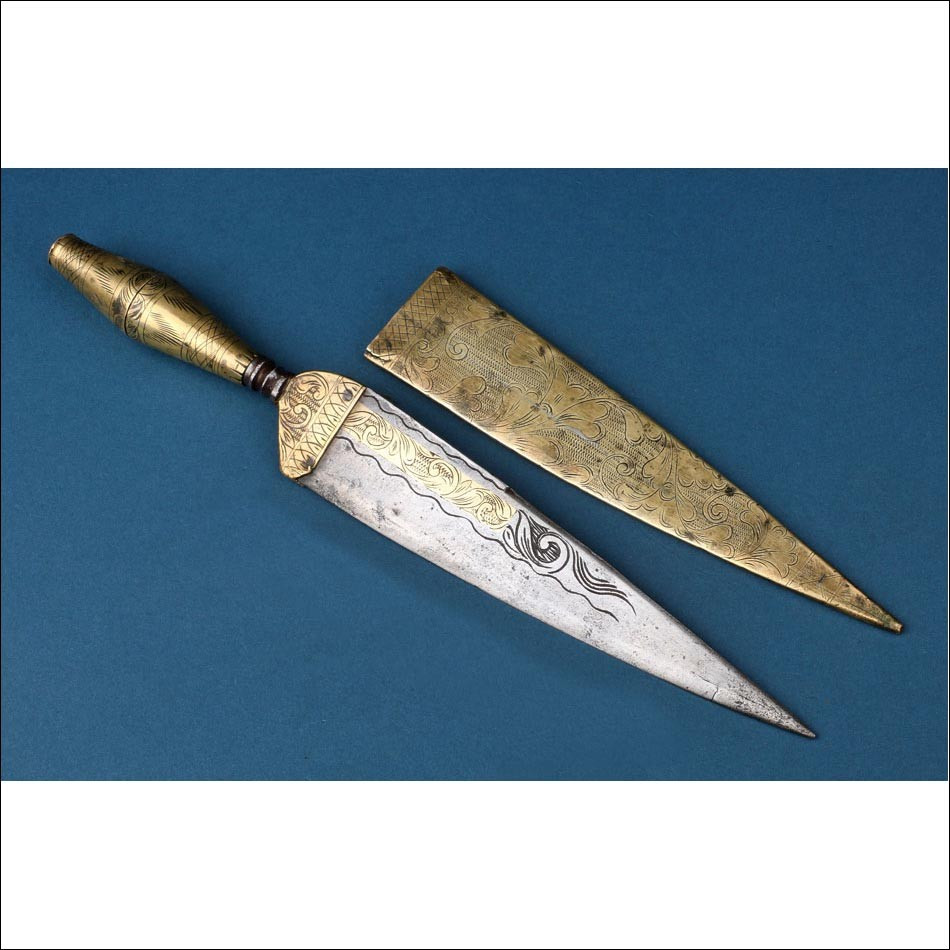

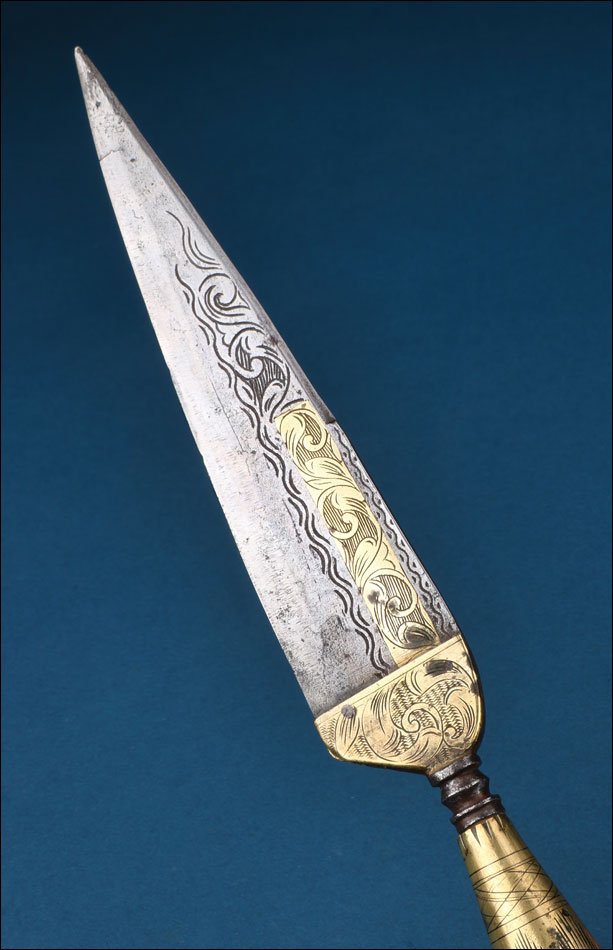
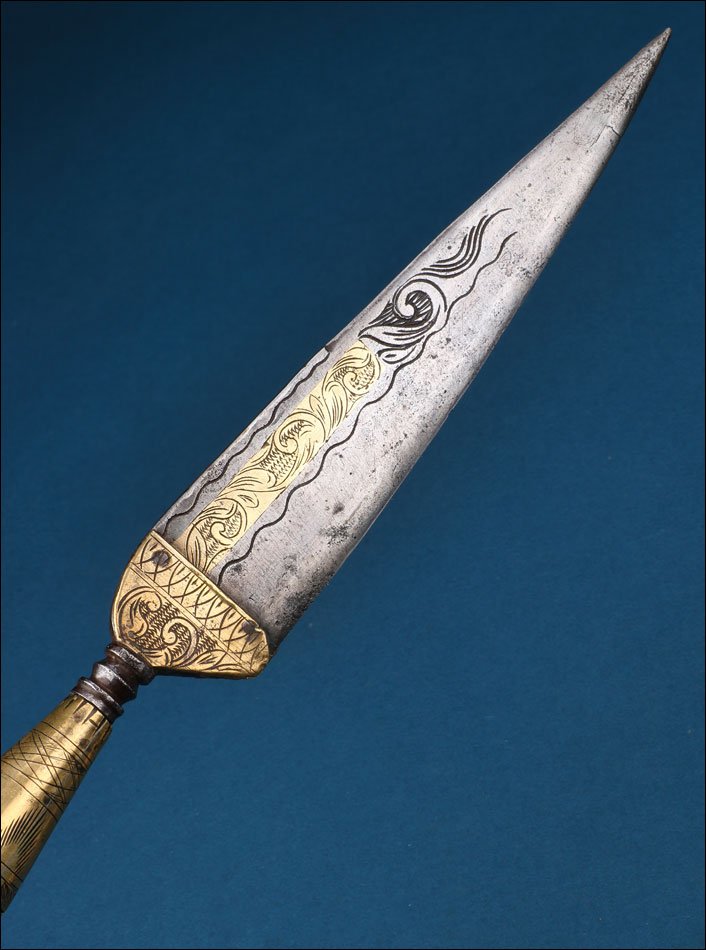
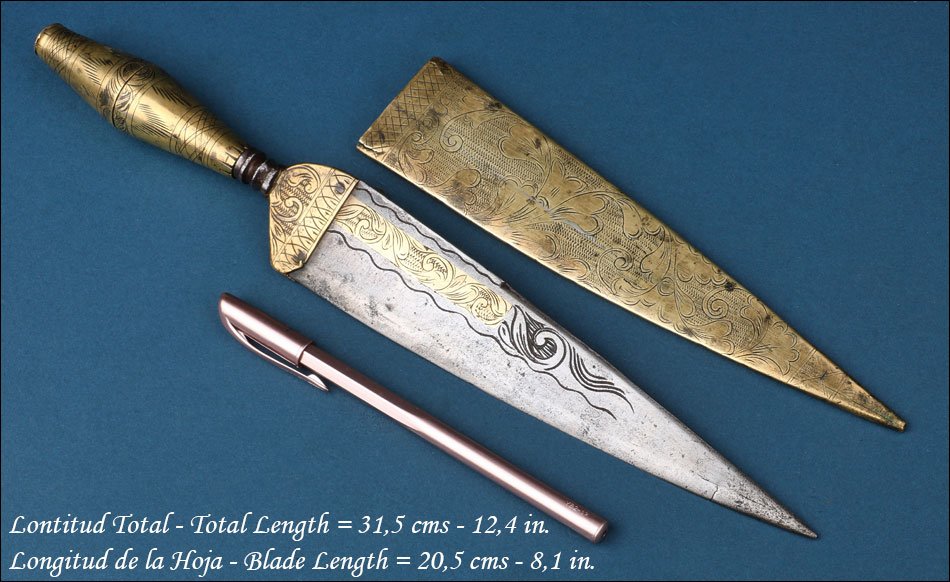
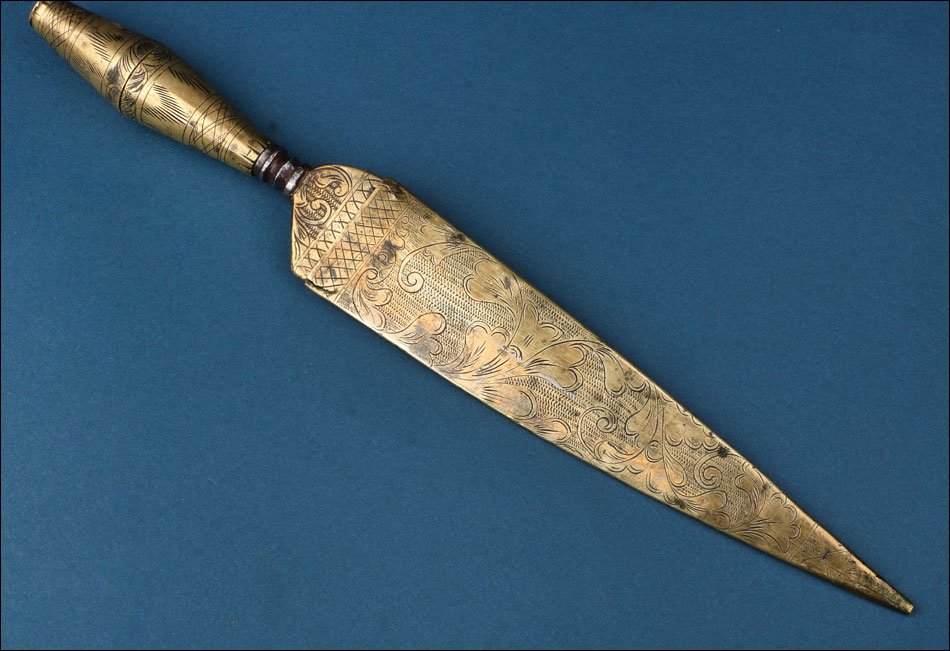
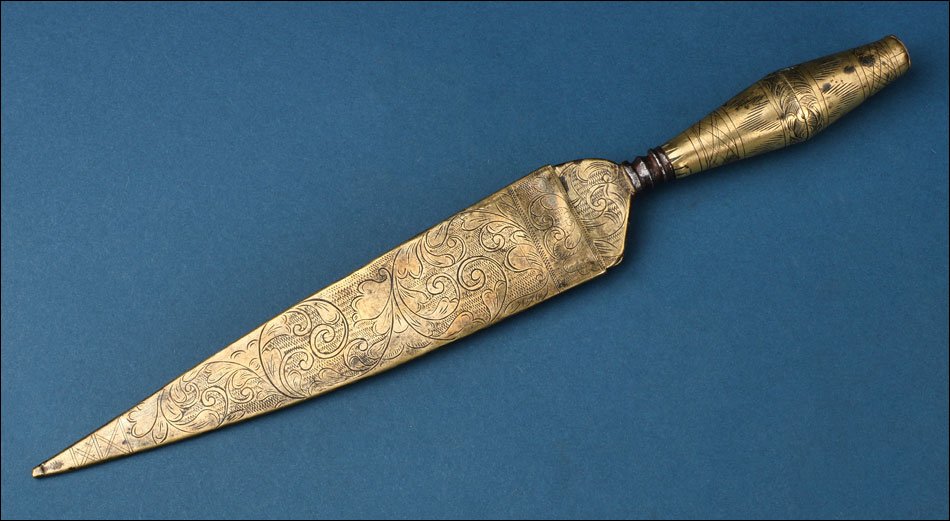
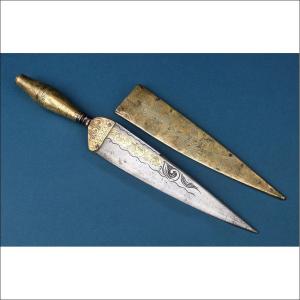


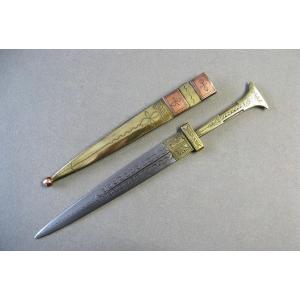
Exceptional and rare large antique Spanish knife attributable to the Andalusian sphere, specifically to the Malaga knife making tradition and typologically related to the documented examples from the town of Tolox, in the Sierra de las Nieves. Datable between the late 18th century and the early years of the 19th century, it is a piece of notable historical, artistic and ethnographic value, representative of traditional civilian armament in southern Spain.
This type of knife, characterised by its large format, richly decorated metal scabbard and the presence of brass inlays on the blade, is mentioned in various collections and historical publications as an old Andalusian production, already considered in the 19th century as Spanish antiques of interest.
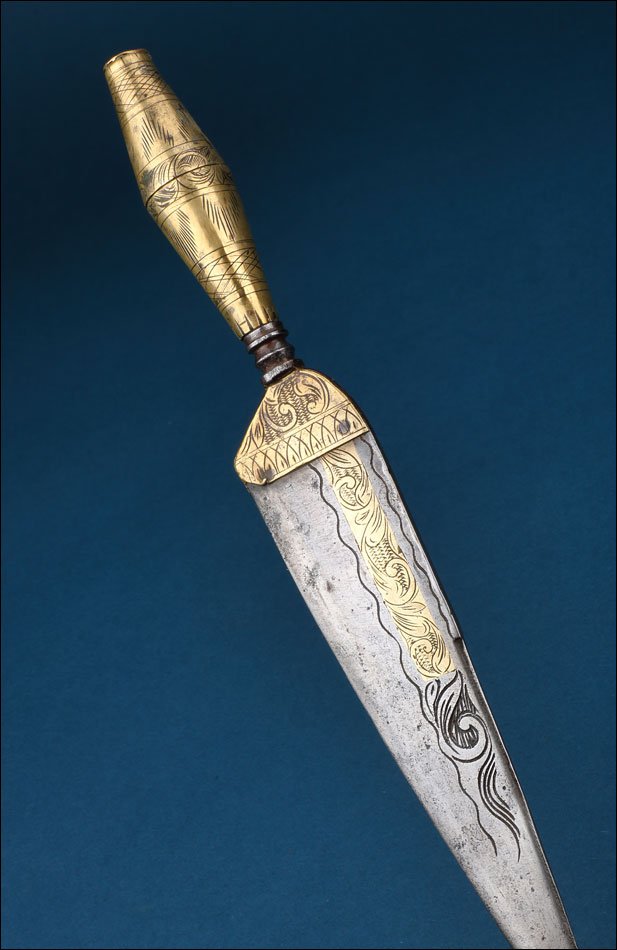
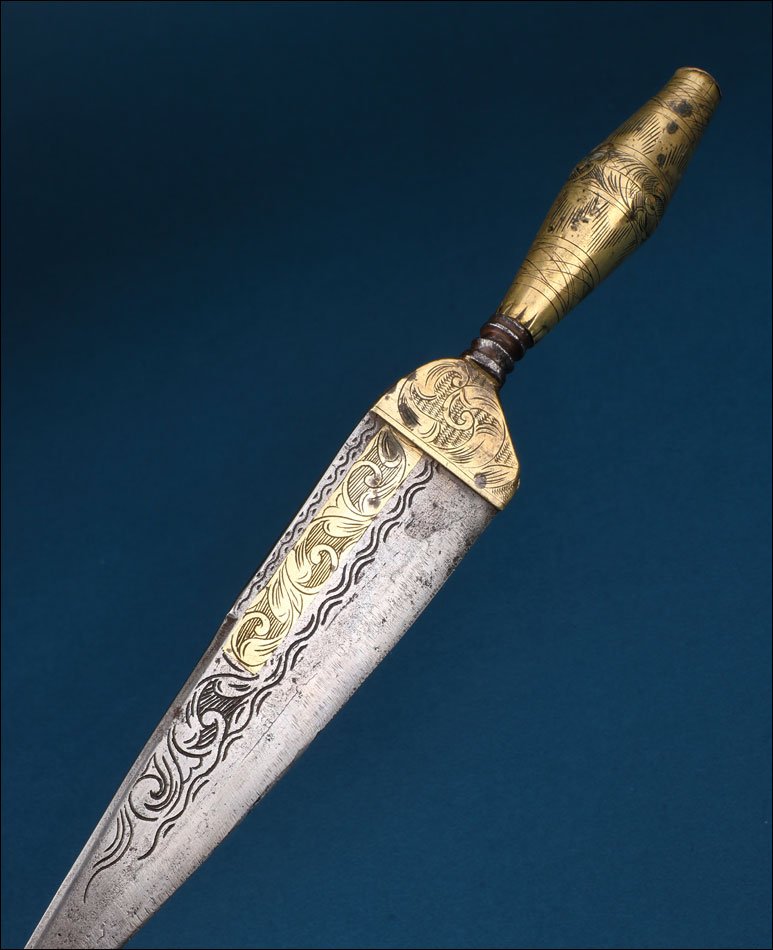
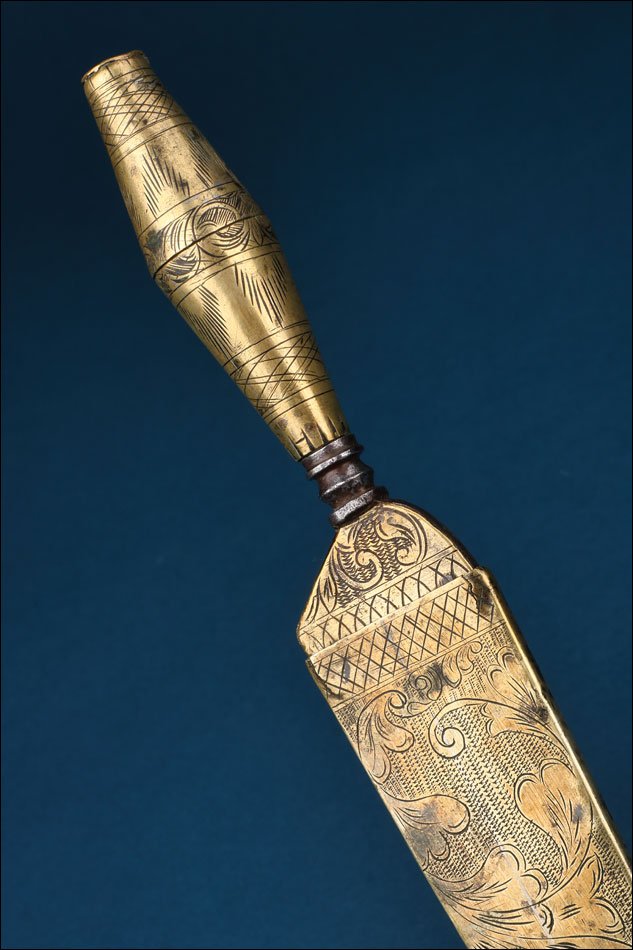
The hilt presents an elegant tapered configuration composed of finely burin engraved brass tronconical elements with vegetal motifs and incised lines. The tang is riveted at the end with a metal washer, a traditional construction system in Spanish artisanal knife making.
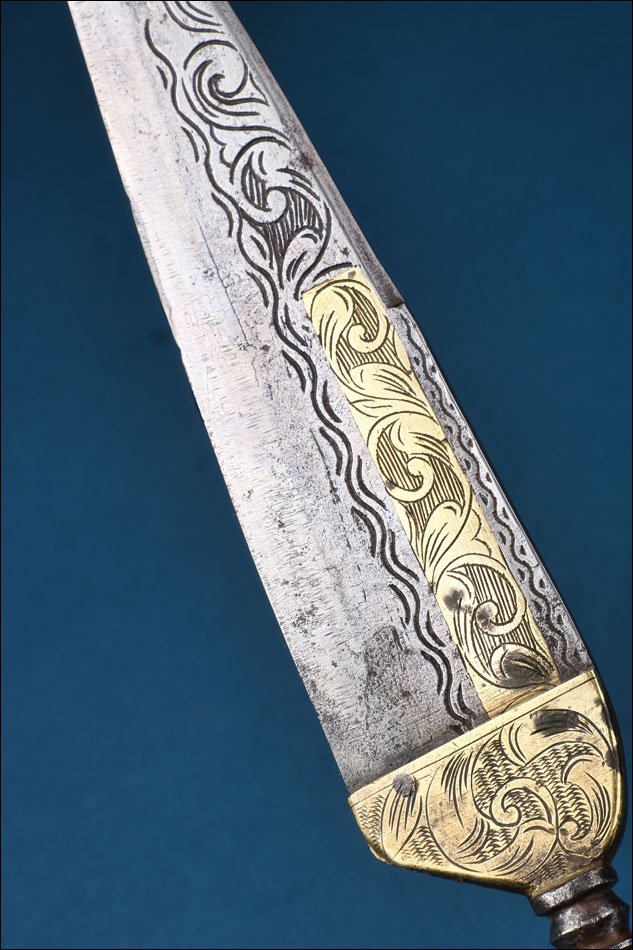
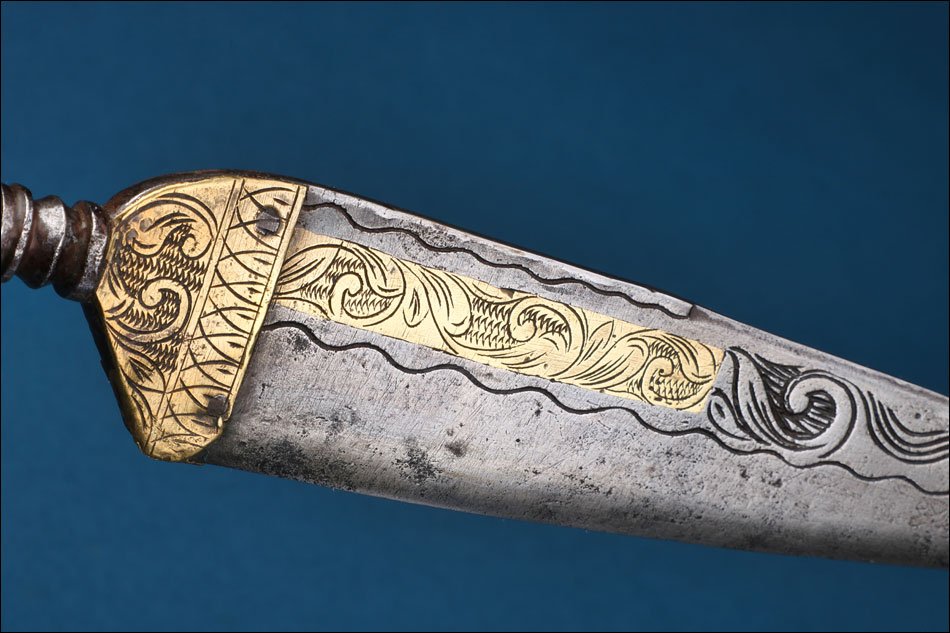
The blade, of large dimensions and solid execution in carbon steel, adopts a lanceolate profile tending towards triangular, with a false edge occupying much of the back, optimising its functional efficiency. Particularly noteworthy is the refined decoration consisting of a longitudinal inlay of engraved brass with vegetal scrolls, accompanied by burin engraved undulating lines running along the surface of the blade, demonstrating a high technical and aesthetic level.
The knife retains its original scabbard entirely made of brass, decorated with dense Baroque foliage ornamentation executed by burin engraving. The composition covers almost the entire surface, generating an ornamental effect of great visual richness. The quality of the work makes this scabbard a true piece of high level craftsmanship, conceived specifically for this example.
The decoration responds to an ornamental language inherited from the Spanish Baroque, based on dynamic vegetal repertories, sinuous scrolls and dense compositions similar to those present in altarpieces, embroideries and luxury arts of the 17th and 18th centuries. This aesthetic persisted in traditional Andalusian craftsmanship during the 19th century.
The overall state of conservation is very good, with homogeneous wear consistent with its age and full structural integrity. The preservation of the original scabbard, the ornamental quality and the large format place this example among the most notable within specialised collecting of historic Spanish knife making.
A piece of great historical personality, notable ethnographic interest and strong visual impact.
Measurements. Total length 31.5 cm (12.4 in). Blade 20.5 cm (8.1 in).
History of Antique Malaga Knives
During the 18th and 19th centuries, various Andalusian localities developed their own knife making traditions aimed at the civilian market. Among them, the Sierra de las Nieves area in Malaga has been pointed out by local historiographical tradition as a production centre for certain models characterised by their decorated metal scabbard and elaborate ornamentation.
These knives formed part of the attire and material culture of popular and rural classes, being used both as functional tools and as elements of social identity. The continuity of Baroque ornamental languages in these pieces reflects the persistence of traditional aesthetic models within Spanish craftsmanship.
Today, large Baroque Andalusian knives represent material testimonies of great historical and ethnographic value, especially appreciated for their rarity, decorative richness and connection with the popular culture of southern Spain.
This type of knife, characterised by its large format, richly decorated metal scabbard and the presence of brass inlays on the blade, is mentioned in various collections and historical publications as an old Andalusian production, already considered in the 19th century as Spanish antiques of interest.
The hilt presents an elegant tapered configuration composed of finely burin engraved brass tronconical elements with vegetal motifs and incised lines. The tang is riveted at the end with a metal washer, a traditional construction system in Spanish artisanal knife making.
The blade, of large dimensions and solid execution in carbon steel, adopts a lanceolate profile tending towards triangular, with a false edge occupying much of the back, optimising its functional efficiency. Particularly noteworthy is the refined decoration consisting of a longitudinal inlay of engraved brass with vegetal scrolls, accompanied by burin engraved undulating lines running along the surface of the blade, demonstrating a high technical and aesthetic level.
The knife retains its original scabbard entirely made of brass, decorated with dense Baroque foliage ornamentation executed by burin engraving. The composition covers almost the entire surface, generating an ornamental effect of great visual richness. The quality of the work makes this scabbard a true piece of high level craftsmanship, conceived specifically for this example.
The decoration responds to an ornamental language inherited from the Spanish Baroque, based on dynamic vegetal repertories, sinuous scrolls and dense compositions similar to those present in altarpieces, embroideries and luxury arts of the 17th and 18th centuries. This aesthetic persisted in traditional Andalusian craftsmanship during the 19th century.
The overall state of conservation is very good, with homogeneous wear consistent with its age and full structural integrity. The preservation of the original scabbard, the ornamental quality and the large format place this example among the most notable within specialised collecting of historic Spanish knife making.
A piece of great historical personality, notable ethnographic interest and strong visual impact.
Measurements. Total length 31.5 cm (12.4 in). Blade 20.5 cm (8.1 in).
History of Antique Malaga Knives
During the 18th and 19th centuries, various Andalusian localities developed their own knife making traditions aimed at the civilian market. Among them, the Sierra de las Nieves area in Malaga has been pointed out by local historiographical tradition as a production centre for certain models characterised by their decorated metal scabbard and elaborate ornamentation.
These knives formed part of the attire and material culture of popular and rural classes, being used both as functional tools and as elements of social identity. The continuity of Baroque ornamental languages in these pieces reflects the persistence of traditional aesthetic models within Spanish craftsmanship.
Today, large Baroque Andalusian knives represent material testimonies of great historical and ethnographic value, especially appreciated for their rarity, decorative richness and connection with the popular culture of southern Spain.
Explore similar pieces and discover your ideal find:
Edged Weapons