

The Discovery Of Romulus And Remus By Faustulus , Dated 1564
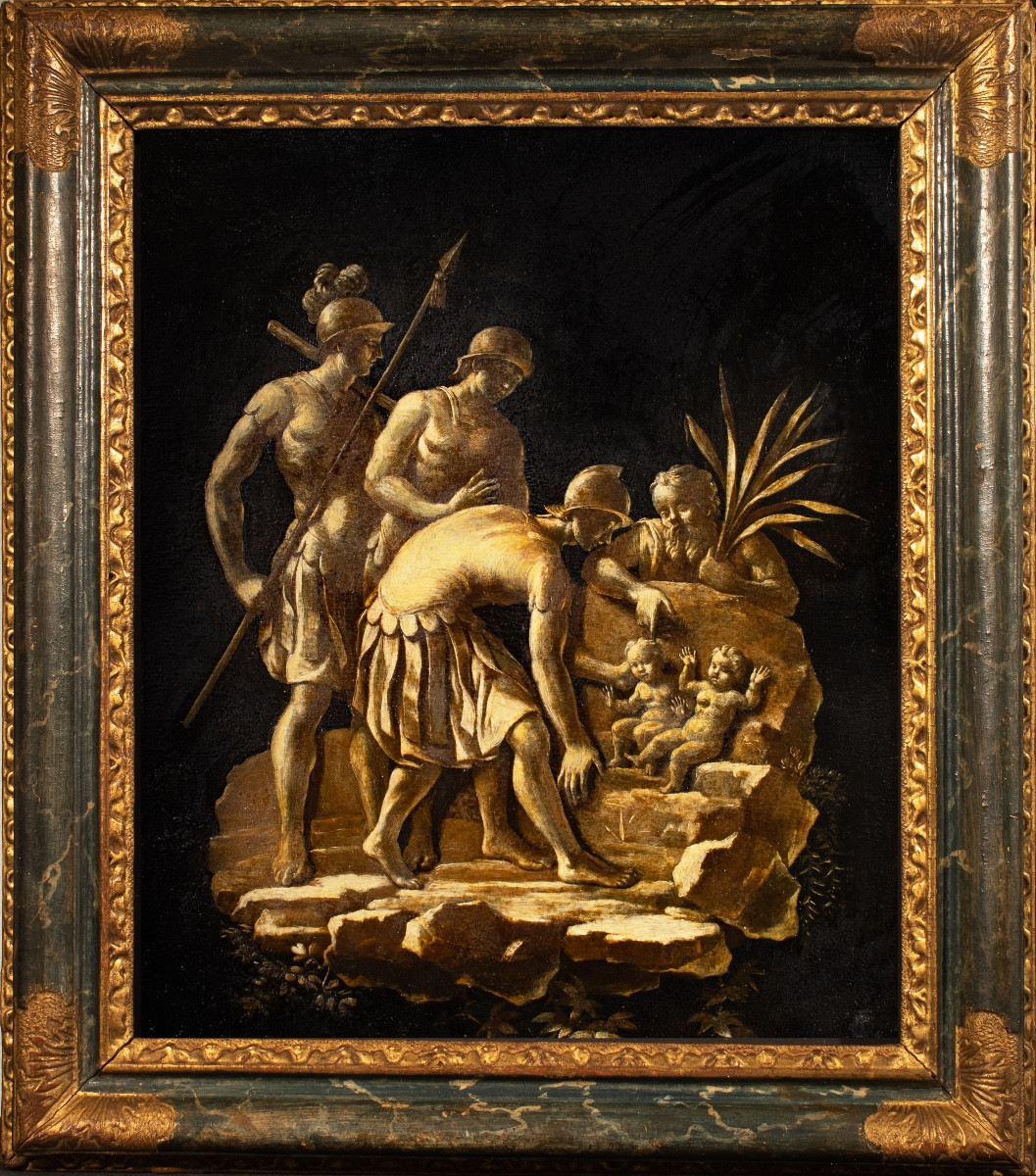
The discovery of Romulus and Remus by Faustulus , oil on wood panel size 50.5 cm x 43 cm , with its antique frame 75 cm x 63 cm , 16th century Mannerist school , dated 1564 , on the rock
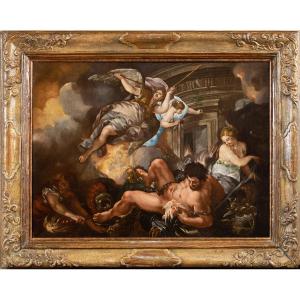
The work represents the mythological scene of the discovery of Romulus and Remus by the shepherd Faustulus . Three armed figures, dressed in antique style, advance from the left; the central figure leans towards the two infants seated on a rocky promontory. On the right, a bearded old man gestures at the children , it is probabily the river Tibre .
The rocky setting, the leafy tree and the dark background create a dramatic space where the light shapes the bodies like an antique bas-relief. The masterful brown cameo reinforces this sculptural effect.
The theme of Romulus and Remus, the legendary founders of Rome, was a popular humanist subject in the XVIᵉ century. It enabled artists to demonstrate their erudition and virtuosity in the representation of the male body, while evoking the legitimacy of power and the origins of Roman civilization.
The work is clearly part of the Mantegnesque tradition of cameo in bas-relief imitation , inherited from Andrea Mantegna (1431-1506) . Several elements attest to this:
Brown cameo: Mantegna popularized the use of grisaille and brunaille to create sculpted relief effects. This aesthetic had a profound effect on Cinquecento artists.
Sculptural treatment of figures: elongated silhouettes, precise modeling, broken drapery, theatrical gestures, all characteristics of Mantegna's heritage.
Frieze composition: typical of works inspired by ancient reliefs, which Mantegna studied and imitated.
The spread of his style: in the middle of the XVIᵉ century, workshops in Northern Italy and the Fontainebleau school adopted Mantegnesque models on a massive scale, notably through engravings.
The date 1564 corresponds perfectly to this period of reception and imitation of Mantegna's inventions. The filasse panel, a reinforced support, is also consistent with the technical practices of this tradition.
Thus, without being a work by Mantegna himself, the painting belongs to a late Mantegnesque vein, much sought-after in the cabinets of XVIᵉ century amateurs .
Provenance : Collection Pierre de de Demandalx Dedons
The work represents the mythological scene of the discovery of Romulus and Remus by the shepherd Faustulus . Three armed figures, dressed in antique style, advance from the left; the central figure leans towards the two infants seated on a rocky promontory. On the right, a bearded old man gestures at the children , it is probabily the river Tibre .
The rocky setting, the leafy tree and the dark background create a dramatic space where the light shapes the bodies like an antique bas-relief. The masterful brown cameo reinforces this sculptural effect.
The theme of Romulus and Remus, the legendary founders of Rome, was a popular humanist subject in the XVIᵉ century. It enabled artists to demonstrate their erudition and virtuosity in the representation of the male body, while evoking the legitimacy of power and the origins of Roman civilization.
The work is clearly part of the Mantegnesque tradition of cameo in bas-relief imitation , inherited from Andrea Mantegna (1431-1506) . Several elements attest to this:
Brown cameo: Mantegna popularized the use of grisaille and brunaille to create sculpted relief effects. This aesthetic had a profound effect on Cinquecento artists.
Sculptural treatment of figures: elongated silhouettes, precise modeling, broken drapery, theatrical gestures, all characteristics of Mantegna's heritage.
Frieze composition: typical of works inspired by ancient reliefs, which Mantegna studied and imitated.
The spread of his style: in the middle of the XVIᵉ century, workshops in Northern Italy and the Fontainebleau school adopted Mantegnesque models on a massive scale, notably through engravings.
The date 1564 corresponds perfectly to this period of reception and imitation of Mantegna's inventions. The filasse panel, a reinforced support, is also consistent with the technical practices of this tradition.
Thus, without being a work by Mantegna himself, the painting belongs to a late Mantegnesque vein, much sought-after in the cabinets of XVIᵉ century amateurs .
Provenance : Collection Pierre de de Demandalx Dedons
8 500 €
Period: 16th century
Style: Renaissance, Louis 13th
Condition: Excellent condition
Material: Oil painting on wood
Length: 50,5 cm ( 75 cm avec le cadre )
Width: 43 cm ( 63 cm avec le cadre )
Reference (ID): 1737390
Availability: In stock
Print