
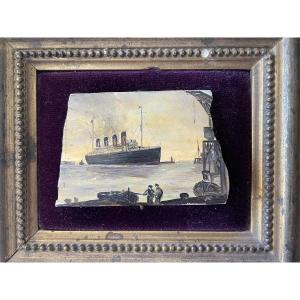


Transatlantic Liner (probably The Rms Titanic Or Rms Olympic) Oil Circa 1911-1914
Early 20th century European school
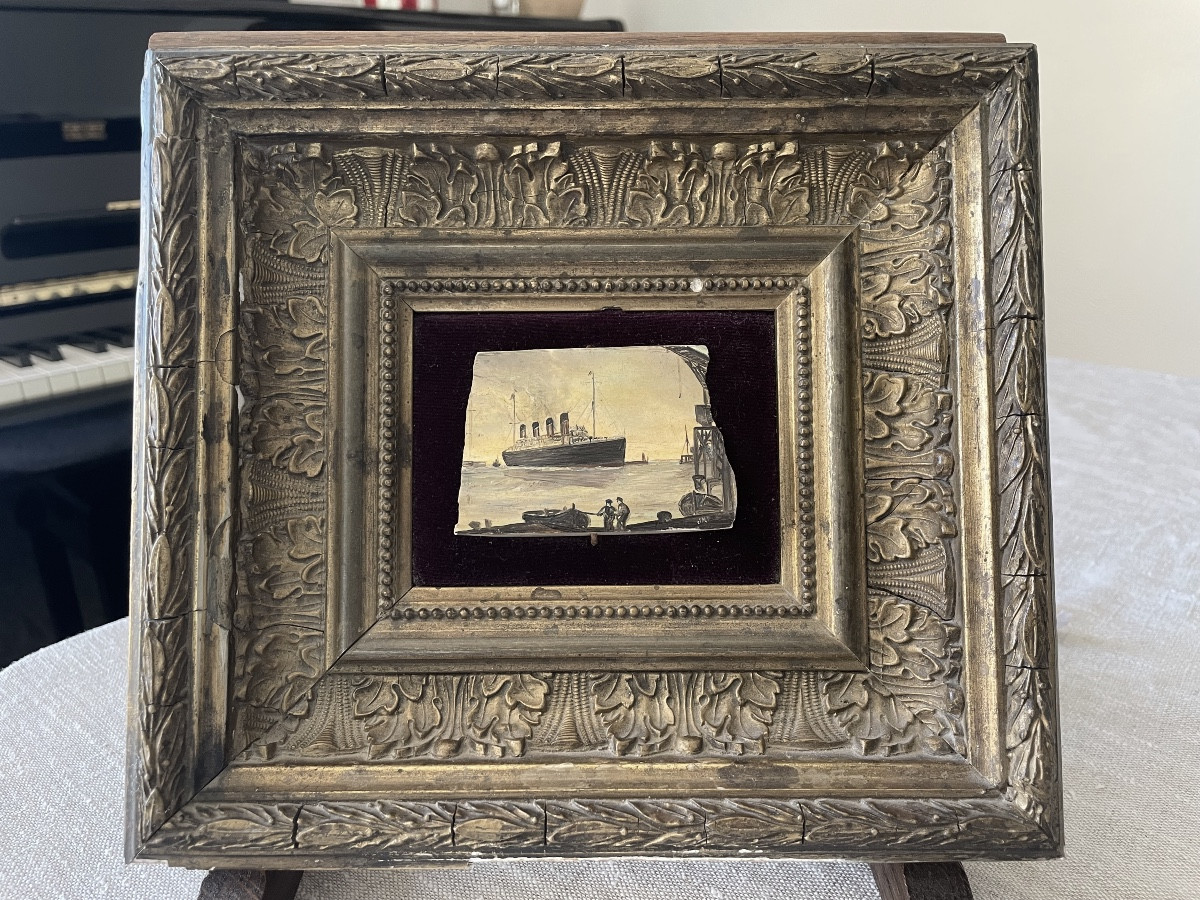
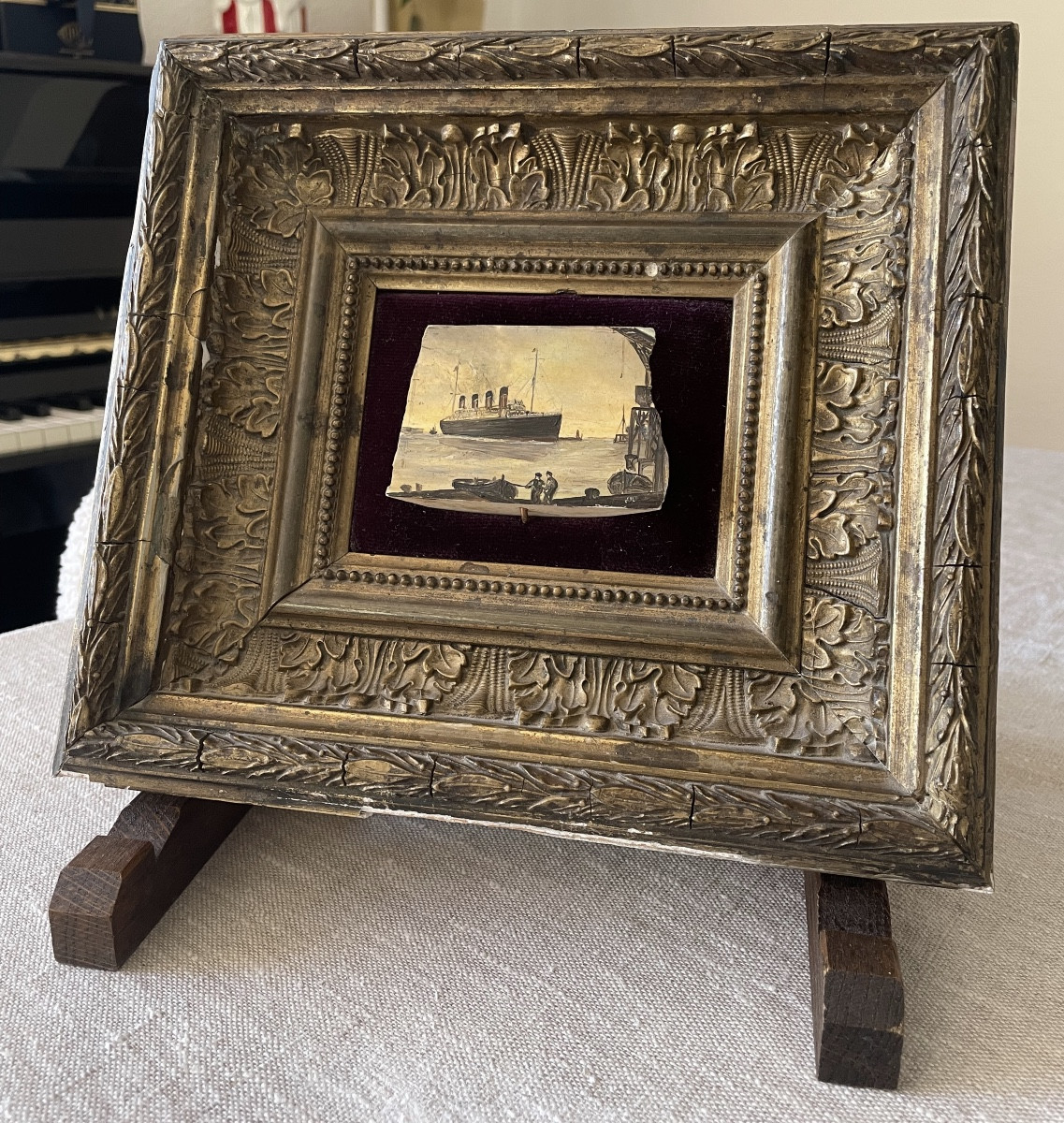
Transatlantic liner (probably the RMS Titanic or the RMS Olympic), circa 1911-1914
Oil on stone fragment, 7 × 5 cm (irregular edges),
mounted on velvet and framed in a molded and gilded baguette.
Frame dimensions 22.5 x 20 cm.
This singular work, executed in oil on a fragment of stone with irregular contours, is a particularly rare testimony to the representation of the great transatlantic liners at the beginning of the 20th century. With its small dimensions and atypical support, it resembles an intimate or occasional production, perhaps produced on the motif or from direct observation in a port context.
The composition depicts an imposing four-smokestack liner, seen from three-quarters up, moving through an area of maritime activity suggested by the presence of boats and a port structure to the right. The synthetic yet precise treatment of volumes, particularly in the rendering of superstructures and chimneys, clearly evokes the great liners of the White Star Line, and more particularly the Olympic-class ships.
Among these, the RMS Titanic, commissioned in 1912, remains the most famous. Conceived as one of the most luxurious and safest liners of its time, it sank tragically on the night of April 14-15, 1912, during its maiden voyage, following a collision with an iceberg, claiming the lives of over 1,500 passengers and crew. This event, which left a lasting impression on the imagination, helped to make the Titanic a symbol of modernity confronted with its own limitations.
The precise identification of the ship depicted remains tricky, however. The Titanic's sister-ship, the RMS Olympic, launched in 1911, had very similar visual characteristics. Nevertheless, comparative analysis and the opinions of several connoisseurs lead us to cautiously favor the hypothesis of a representation of the Titanic, possibly made shortly before or shortly after her entry into service.
The rarity of such contemporary representations must be emphasized. Before the 1912 disaster, these liners, though prestigious, were not systematically the subject of elaborate artistic iconography, outside of commercial or illustrative production. After the sinking, representations of the Titanic multiplied, but were often based on memorial or reconstructed iconography. In this respect, a small-format painting, executed on such an unusual medium, and which can be traced back to direct observation, is a document of particular interest.
Finally, the mounting of the work - a fragment carefully presented on a velvet case and framed in a molded, gilded baguette - testifies to a desire for later enhancement, transforming what might originally have been a sketch or souvenir into a collector's item.
By its nature, subject matter and possible contemporaneity with the event, this work stands at the crossroads of visual testimony, maritime memory and the material culture of the first twentieth century.
Period: 20th century
Style: Other Style
Condition: Good condition
Length: 7
Width: 5
Reference (ID): 1736490
Availability: In stock