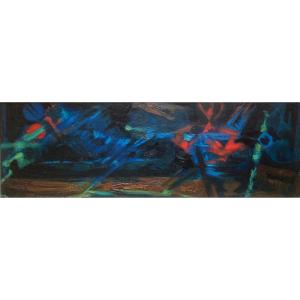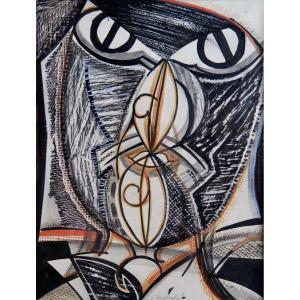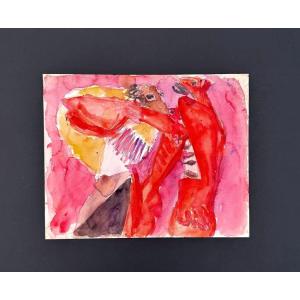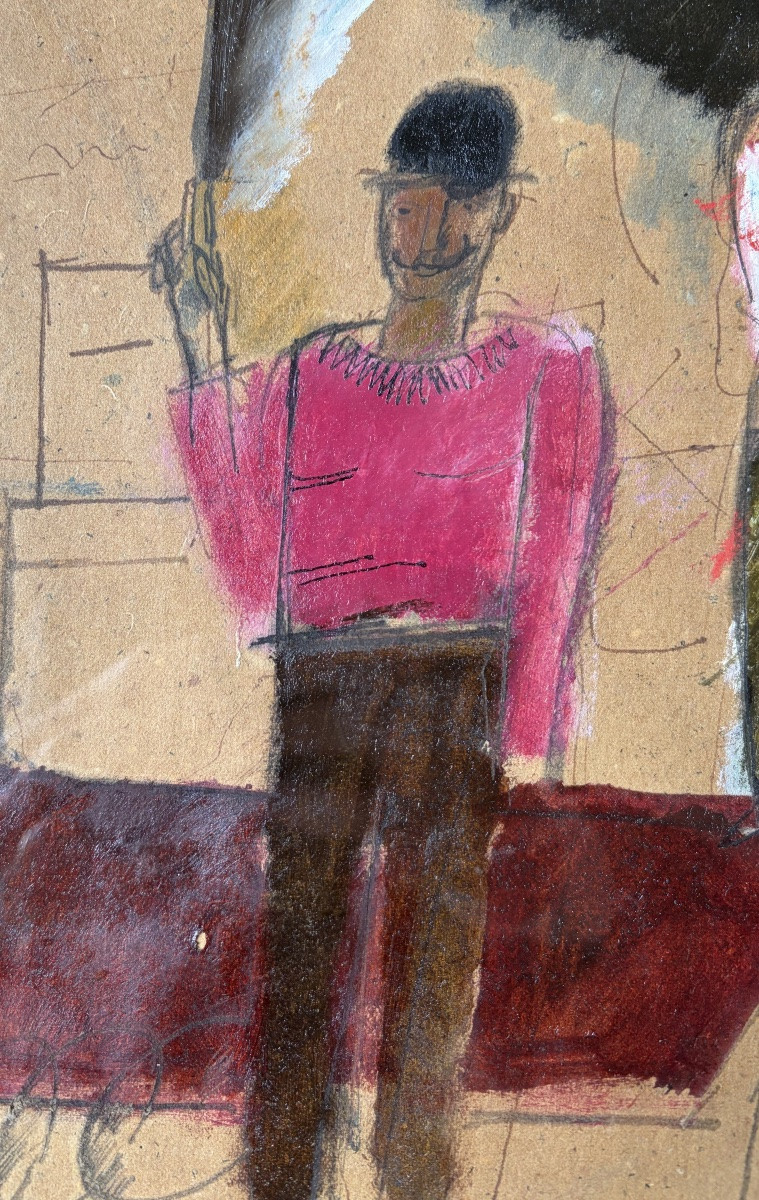


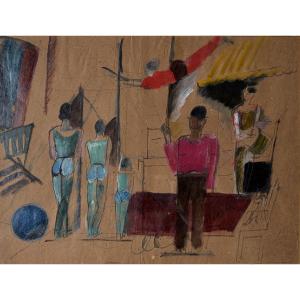


Charles Dufresne, Au Cirque, Ca. 1918-19, Oil On Paper
Artist: Charles Dufresne (1876-1938)
Charles Dufresne (1876-1938)
Au cirque, circa 1918-19
Oil and ink on paper
Signed lower left
33 x 43 cm
Provenance:
- Whitford Fine Art, London
- private collection, London.
Born in 1876, Charles Dufresne belonged to the Fauve generation. He received academic training at the Ecole des Beaux-Arts in Paris, in the studio of the medallist Ponscarme. His early works are those of a wise artist whose production is inspired by reality. In 1903, he became a member of the Salon de la Société nationale and exhibited at the Salon des Artistes Indépendants. Dunoyer de Segonzac, Despiau, Waroquier and then Ceria became his close friends.
His stay in Algeria between 1910 and 1912 was a revelation that marked his development considerably. In contact with oriental nature, he was awakened to faraway lands and exotic landscapes.
During the war, he executed drawings and watercolors in a cubist spirit, often of an imaginary nature. On his return, memories of his Algerian sojourn reappeared, and he painted oriental hunting scenes, jungles and exotic landscapes. These canvases, with their dark tones of green and brown, are extremely dense. While relying on a rigorous construction, like the cubists, the painter does not treat the depth of space. Using a palette knife, he paints large, simple volumes in a dense material.
By 1930, Dufresne had freed himself from the constraints of academia and poured himself into a dazzling lyricism. He renewed himself entirely, tackling compositions with multiple figures, and became more fauve, breaking up colors, exalting tones with unreal light, in an expanded, constructed space, where his search for movement joined his admiration for Baroque painters. He became the French Baroque painter par excellence, with his sense of eloquence, lyricism and instinct for decoration, making him the Delacroix of modern times.
His works are held in numerous museums in France and abroad, includingthe Centre Pompidou, the Musée d'Art Moderne in Paris, the Musée Calvet in Avignon, the Musée des Beaux-Arts in Dijon, the Musée Fabre in Montpellier, the Tate Gallery, the National Gallery of Art in Washington and the Art Institute of Chicago.
Au cirque, circa 1918-19
Oil and ink on paper
Signed lower left
33 x 43 cm
Provenance:
- Whitford Fine Art, London
- private collection, London.
Born in 1876, Charles Dufresne belonged to the Fauve generation. He received academic training at the Ecole des Beaux-Arts in Paris, in the studio of the medallist Ponscarme. His early works are those of a wise artist whose production is inspired by reality. In 1903, he became a member of the Salon de la Société nationale and exhibited at the Salon des Artistes Indépendants. Dunoyer de Segonzac, Despiau, Waroquier and then Ceria became his close friends.
His stay in Algeria between 1910 and 1912 was a revelation that marked his development considerably. In contact with oriental nature, he was awakened to faraway lands and exotic landscapes.
During the war, he executed drawings and watercolors in a cubist spirit, often of an imaginary nature. On his return, memories of his Algerian sojourn reappeared, and he painted oriental hunting scenes, jungles and exotic landscapes. These canvases, with their dark tones of green and brown, are extremely dense. While relying on a rigorous construction, like the cubists, the painter does not treat the depth of space. Using a palette knife, he paints large, simple volumes in a dense material.
By 1930, Dufresne had freed himself from the constraints of academia and poured himself into a dazzling lyricism. He renewed himself entirely, tackling compositions with multiple figures, and became more fauve, breaking up colors, exalting tones with unreal light, in an expanded, constructed space, where his search for movement joined his admiration for Baroque painters. He became the French Baroque painter par excellence, with his sense of eloquence, lyricism and instinct for decoration, making him the Delacroix of modern times.
His works are held in numerous museums in France and abroad, includingthe Centre Pompidou, the Musée d'Art Moderne in Paris, the Musée Calvet in Avignon, the Musée des Beaux-Arts in Dijon, the Musée Fabre in Montpellier, the Tate Gallery, the National Gallery of Art in Washington and the Art Institute of Chicago.
2 200 €
Period: 20th century
Style: Modern Art
Condition: Good condition
Material: Oil painting on paper
Reference (ID): 1735776
Availability: In stock
Print