

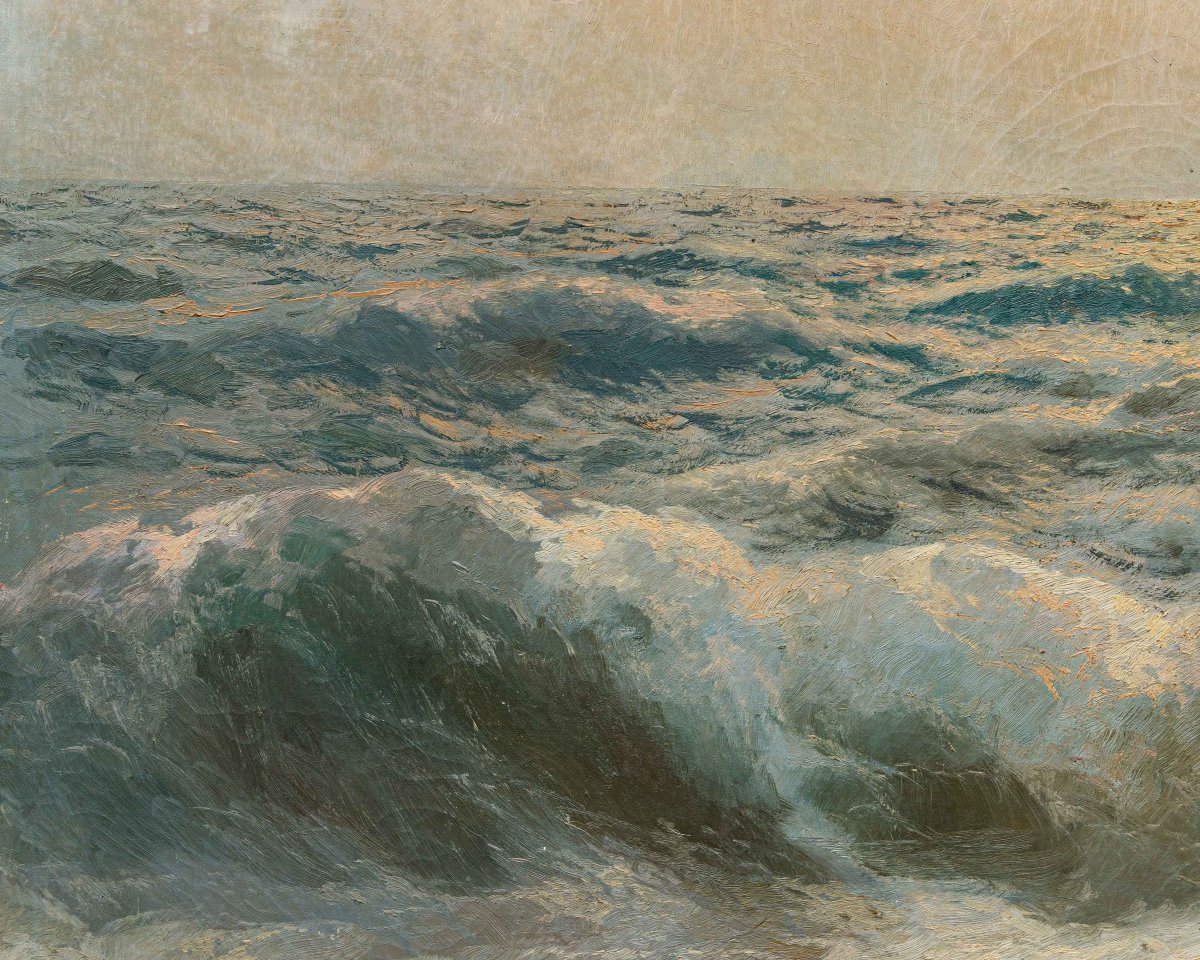


Alexander Dzigurski (stari Becej, 1911 – San Francisco, 1995), Navy
Alexander Dzigurski (Stari Becej, 1911 – San Francisco, 1995)
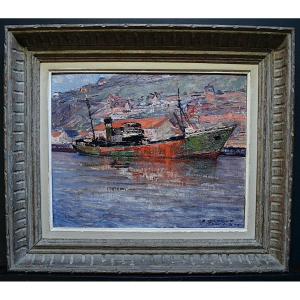
Navy
Oil on canvas, 85 x 111 cm
With frame, cm 108 x 134
Signed lower right: “A. Dzigurski”
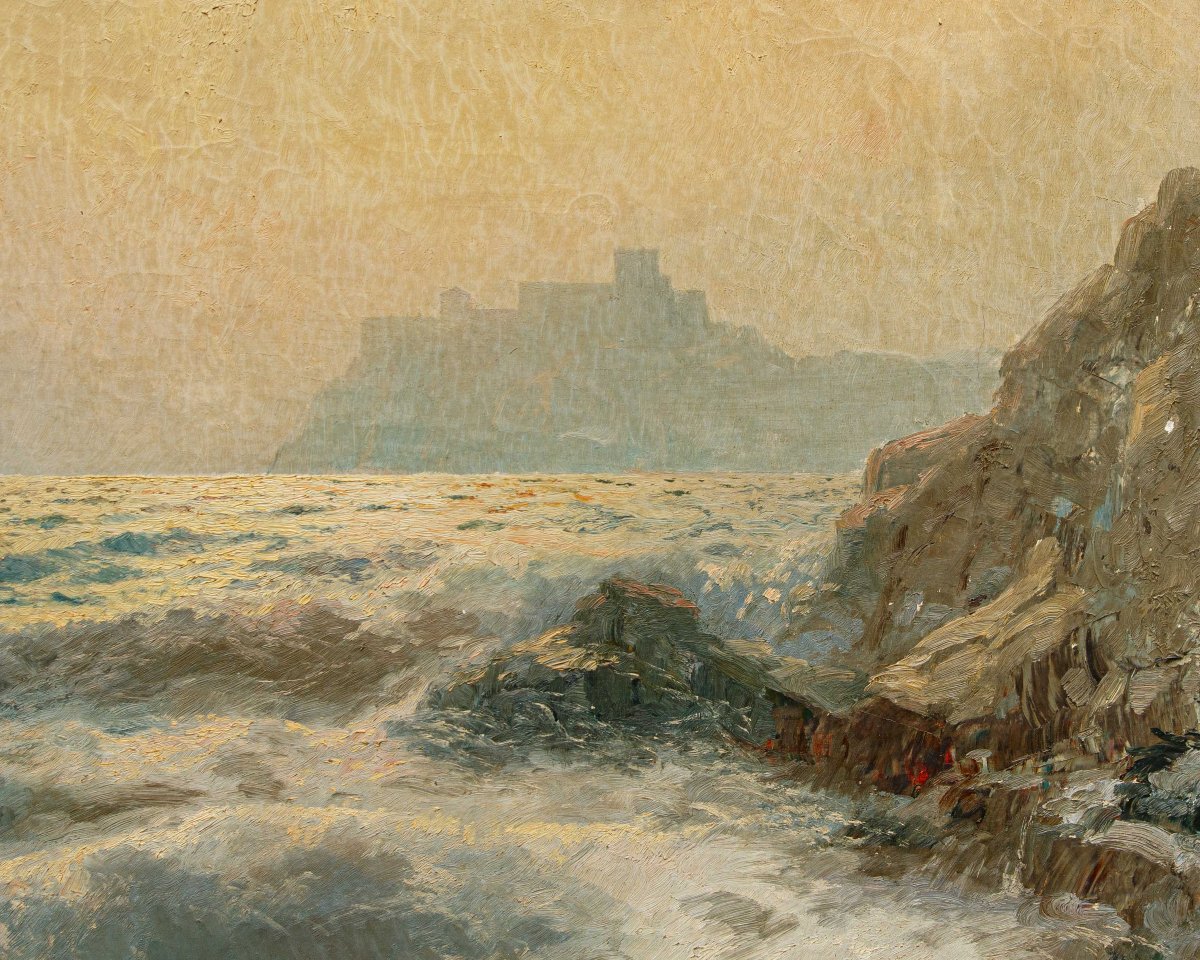
The canvas under examination bears the signature, at the bottom right, of Alexander Dzigurski (1911–1995), whose figure stands out in the twentieth-century artistic panorama as that of a painter capable of transfiguring the force of the elements into visual poetry. Born in Stari Becej, in what was then Yugoslavia, to a family of humble peasant origins, Dzigurski showed an early crystalline talent that the Serbian Church chose to indulge, leading him to Belgrade. Here, between the walls of the Rakovica monastery and the classrooms of the Art School, the artist forged the foundations of a masterly technique, graduating in 1929 and initially distinguishing himself as a sought-after portraitist and decorator of sacred buildings. However, it was his voluntary enlistment in the Royal Navy between 1939 and 1941 that marked his artistic epiphany: life at sea offered him the opportunity to study water in every facet, understanding its motions, transparencies, and primordial power. The precipitating events of the war and the imprisonment of his naval unit at the hands of the German army did not break his spirit; having miraculously escaped, Dzigurski embarked on a journey that took him to Vienna and, finally, to Italy. It was in the Friulian capital, Trieste, that his works found their first exhibition consecration and where the artist was subjected to the magnetic charm of the Adriatic coast. This Italian season marked a definitive turning point in his poetics, orienting it towards an exquisitely romantic landscape style that would accompany him even after moving to the United States in 1949. Overseas, along with his wife Lenka and daughter Jelena, Dzigurski achieved extraordinary success: American collectors were enchanted by his views of the Rocky Mountains, national parks, and the rugged coastlines of New England, recognizing in him a unique interpreter of the majesty of the New World. The canvas under examination, depicting in the background the rocky spur on which Duino Castle stands, in the province of Trieste, represents a perfect example of his expressive maturity. In this work, the artist eschews the modernist avant-garde to embrace a language of dynamism and executive vigor, where the extensive use of the spatula gives the surface an almost tactile vibration. The nickname "Poet of the Sea," given to him by the Chicago Tribune, seals his ability to capture the very essence of the ocean, elevating him to one of the greatest exponents of the genre. Shortly before passing away in San Francisco, Dzigurski entrusted history with a reflection that today sounds like a solemn promise: “I love art. I'll leave as if everyone is gone, but my art will outlive me”.
Navy
Oil on canvas, 85 x 111 cm
With frame, cm 108 x 134
Signed lower right: “A. Dzigurski”
The canvas under examination bears the signature, at the bottom right, of Alexander Dzigurski (1911–1995), whose figure stands out in the twentieth-century artistic panorama as that of a painter capable of transfiguring the force of the elements into visual poetry. Born in Stari Becej, in what was then Yugoslavia, to a family of humble peasant origins, Dzigurski showed an early crystalline talent that the Serbian Church chose to indulge, leading him to Belgrade. Here, between the walls of the Rakovica monastery and the classrooms of the Art School, the artist forged the foundations of a masterly technique, graduating in 1929 and initially distinguishing himself as a sought-after portraitist and decorator of sacred buildings. However, it was his voluntary enlistment in the Royal Navy between 1939 and 1941 that marked his artistic epiphany: life at sea offered him the opportunity to study water in every facet, understanding its motions, transparencies, and primordial power. The precipitating events of the war and the imprisonment of his naval unit at the hands of the German army did not break his spirit; having miraculously escaped, Dzigurski embarked on a journey that took him to Vienna and, finally, to Italy. It was in the Friulian capital, Trieste, that his works found their first exhibition consecration and where the artist was subjected to the magnetic charm of the Adriatic coast. This Italian season marked a definitive turning point in his poetics, orienting it towards an exquisitely romantic landscape style that would accompany him even after moving to the United States in 1949. Overseas, along with his wife Lenka and daughter Jelena, Dzigurski achieved extraordinary success: American collectors were enchanted by his views of the Rocky Mountains, national parks, and the rugged coastlines of New England, recognizing in him a unique interpreter of the majesty of the New World. The canvas under examination, depicting in the background the rocky spur on which Duino Castle stands, in the province of Trieste, represents a perfect example of his expressive maturity. In this work, the artist eschews the modernist avant-garde to embrace a language of dynamism and executive vigor, where the extensive use of the spatula gives the surface an almost tactile vibration. The nickname "Poet of the Sea," given to him by the Chicago Tribune, seals his ability to capture the very essence of the ocean, elevating him to one of the greatest exponents of the genre. Shortly before passing away in San Francisco, Dzigurski entrusted history with a reflection that today sounds like a solemn promise: “I love art. I'll leave as if everyone is gone, but my art will outlive me”.
2 400 €
Period: 20th century
Style: Other Style
Condition: Good condition
Material: Oil painting
Width: 111
Height: 85
Reference (ID): 1731225
Availability: In stock
Print