THIS OBJECT WAS SOLD
Young Woman With A Red Veil, Circle Of Pietro Rotari (1707 – 1762)



Oil on panel. Northern Italy, mid-18th century, circle of Pietro Rotari.
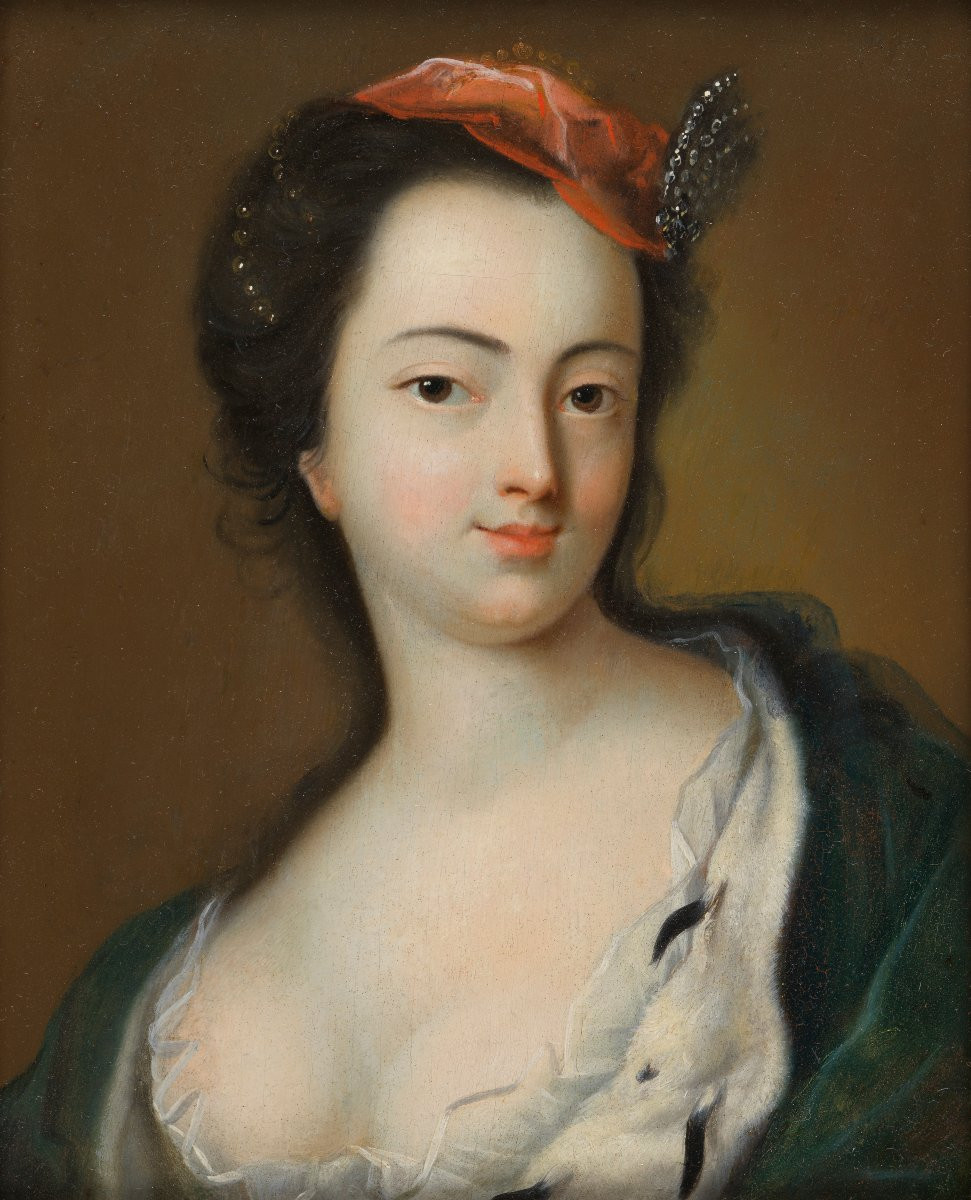
This portrait offers a delightful way of capturing a fleeting moment: the young woman, caught in a half-turn, lets her lively, almost mischievous gaze shine through. A warm light illuminates the young woman's skin, highlighting the freshness of her features. Her brown hair, gathered into soft curls, is adorned with a red veil topped with a pearl plume, a detail that adds a touch of understated preciousness to the portrait. The deep neckline of her white chemise, enlivened by flowing folds, contrasts with the sumptuous blue velvet coat trimmed with ermine fur that drapes over her shoulders. The deliberately neutral brown background allows all attention to be focused on the young woman's luminous face.
In the soft modeling, the freshness of the flesh tones, and the emphasis on expression rather than pomp, the influence of Pietro Rotari and his circle is clearly evident. This portrait belongs to the delicate and seductive vein of the Italian Settecento, where young female figures are idealized without losing their naturalness, and where a simple glance is enough to create a connection with the viewer.
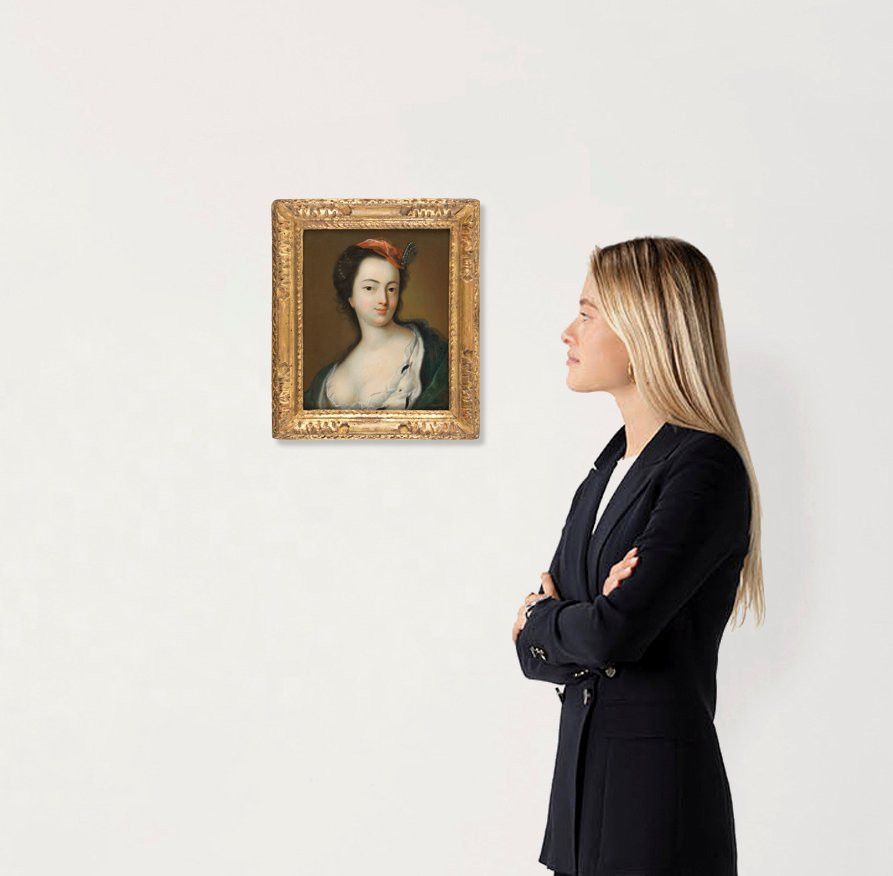
Our delightful portrait is presented in a carved and gilded Louis XIII period wooden frame.
Dimensions: 25.5 x 19.5 cm – 32.5 x 28 cm with frame.
Biography: Pietro Antonio Rotari (Verona 1707 – Saint Petersburg 1762) is one of the most refined portrait painters of the 18th century, at the crossroads of the late Baroque and Rococo styles. Trained successively in Verona, Venice, Rome, and Naples under masters such as Balestra, Trevisani, and Solimena, he quickly assimilated a style blending Venetian colorism, Roman delicacy, and Neapolitan theatricality. Returning to Verona in the 1730s, he founded a school and rapidly established himself in enlightened circles. His career then took on a European dimension: he worked in Dresden, Vienna, and Munich, where his talent captivated the German courts. In 1756, he was summoned to Saint Petersburg by Tsarina Elizabeth Petrovna. It was in Russia that he created his famous series of "Heads of Young Girls," bust portraits of restrained grace, now housed in Peterhof and the Hermitage. His style is distinguished by a light palette, smooth surfaces, delicate modeling, and a melancholic elegance that makes his female figures true icons of Rococo taste.
This portrait offers a delightful way of capturing a fleeting moment: the young woman, caught in a half-turn, lets her lively, almost mischievous gaze shine through. A warm light illuminates the young woman's skin, highlighting the freshness of her features. Her brown hair, gathered into soft curls, is adorned with a red veil topped with a pearl plume, a detail that adds a touch of understated preciousness to the portrait. The deep neckline of her white chemise, enlivened by flowing folds, contrasts with the sumptuous blue velvet coat trimmed with ermine fur that drapes over her shoulders. The deliberately neutral brown background allows all attention to be focused on the young woman's luminous face.
In the soft modeling, the freshness of the flesh tones, and the emphasis on expression rather than pomp, the influence of Pietro Rotari and his circle is clearly evident. This portrait belongs to the delicate and seductive vein of the Italian Settecento, where young female figures are idealized without losing their naturalness, and where a simple glance is enough to create a connection with the viewer.
Our delightful portrait is presented in a carved and gilded Louis XIII period wooden frame.
Dimensions: 25.5 x 19.5 cm – 32.5 x 28 cm with frame.
Biography: Pietro Antonio Rotari (Verona 1707 – Saint Petersburg 1762) is one of the most refined portrait painters of the 18th century, at the crossroads of the late Baroque and Rococo styles. Trained successively in Verona, Venice, Rome, and Naples under masters such as Balestra, Trevisani, and Solimena, he quickly assimilated a style blending Venetian colorism, Roman delicacy, and Neapolitan theatricality. Returning to Verona in the 1730s, he founded a school and rapidly established himself in enlightened circles. His career then took on a European dimension: he worked in Dresden, Vienna, and Munich, where his talent captivated the German courts. In 1756, he was summoned to Saint Petersburg by Tsarina Elizabeth Petrovna. It was in Russia that he created his famous series of "Heads of Young Girls," bust portraits of restrained grace, now housed in Peterhof and the Hermitage. His style is distinguished by a light palette, smooth surfaces, delicate modeling, and a melancholic elegance that makes his female figures true icons of Rococo taste.
Explore similar pieces and discover your ideal find:
Portraits