


Caravaggio School Painting, Portrait Of Saint Peter In Penitence, 17th Century, Ribera
Artist: école Du Caravage
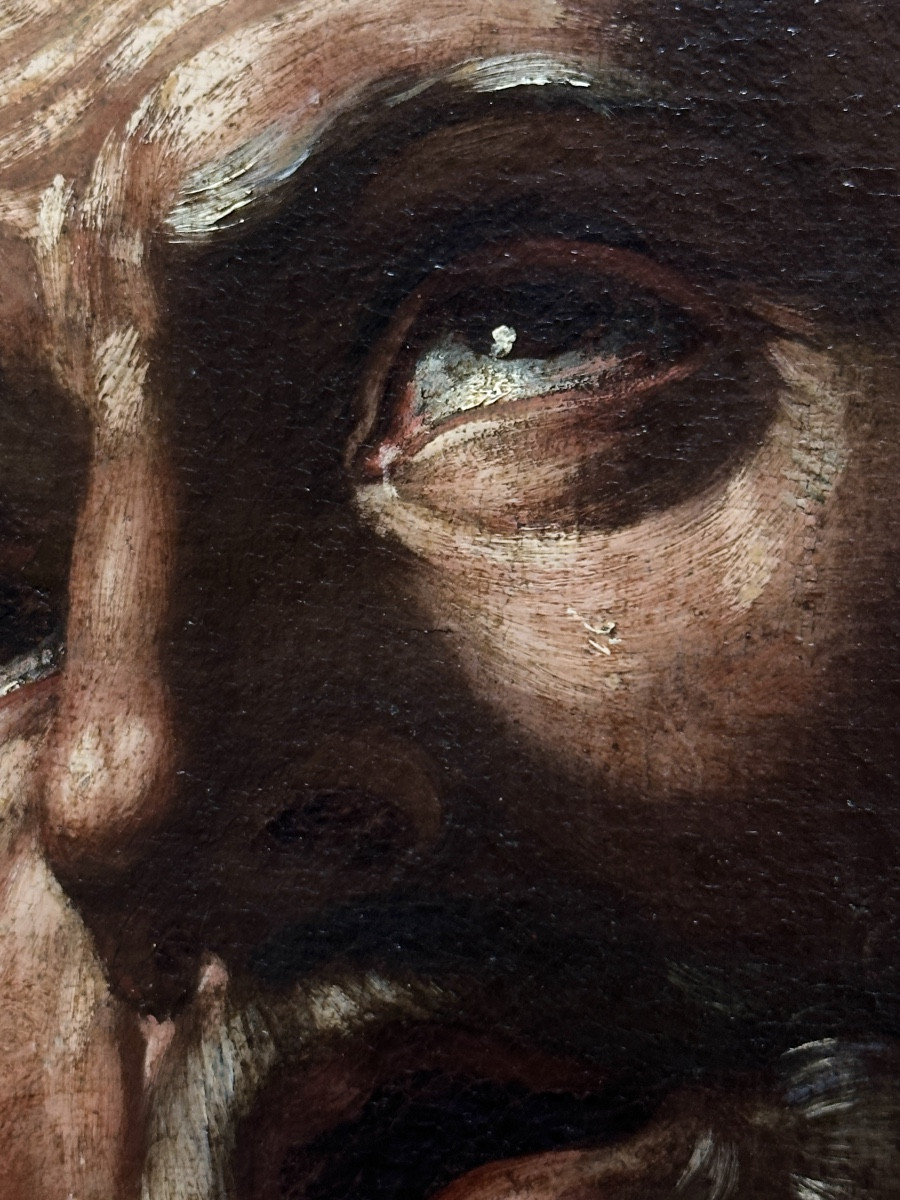
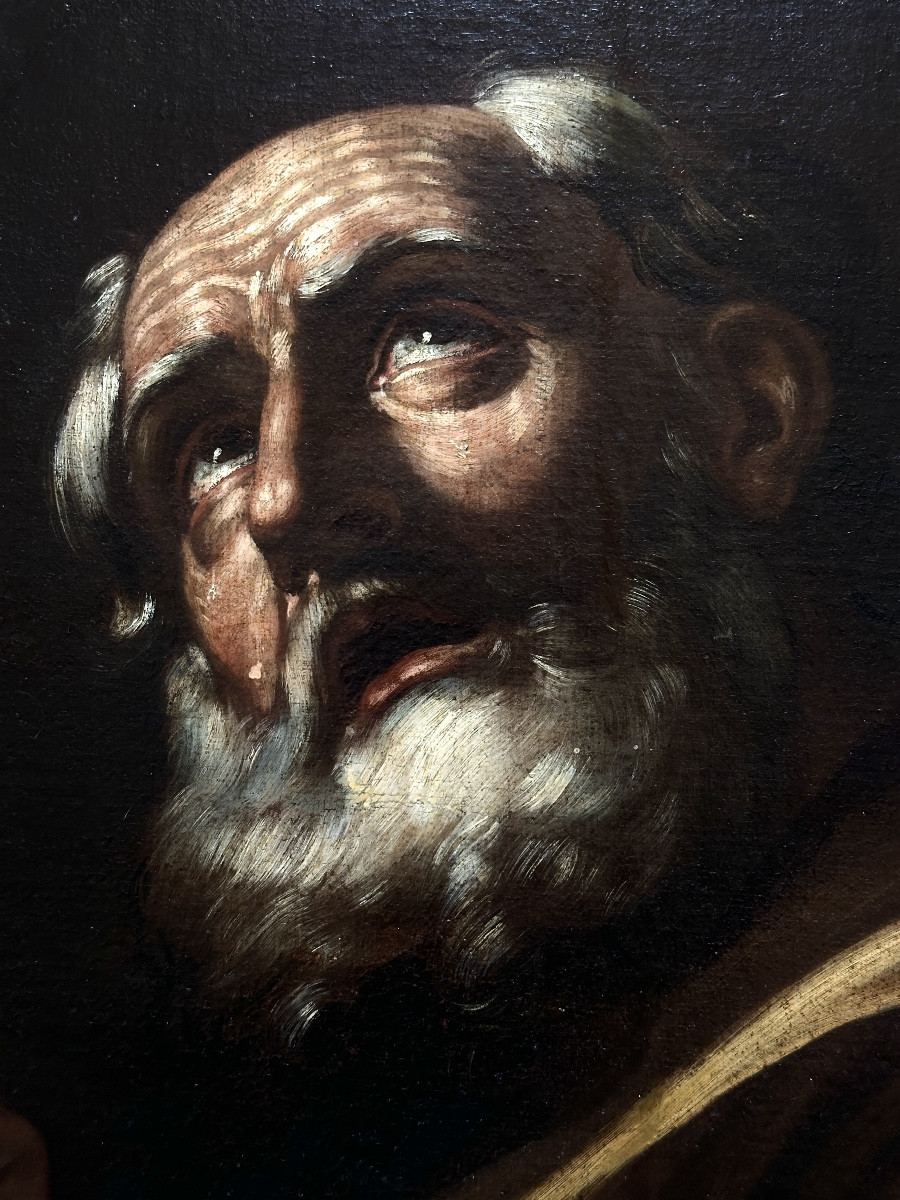
Penitent Saint Peter, 17th-century Spanish school, Caravaggesque style, in the manner of Ribera. Oil on canvas depicting a half-length portrait of Saint Peter in penitence, his hands clasped, his gaze raised, captured in a moment of supplication and inner turmoil. The saint appears against an almost neutral, dark background; no extraneous details distract the viewer. The entire composition converges on the head, the hands, and the large folds of the golden-brown cloak, which emerge intensely from the shadows. The saint is depicted at an advanced age, an old man with a receding hairline and a thick white beard, his hands clasped in prayer. The upward gaze and expression of repentance recall the iconography of Saint Peter after his denial. This is an image of contrition, not a formal portrait of an apostle with elaborate attributes. The painting relies on a distinctly Baroque formula of devotion: tight framing, close-up of the bust, a background absorbed by shadow, and light concentrated on the emotional aspects of the spiritual narrative. This constriction gives the work an immediate and condensed presence, capturing a state of mind. The emotion originates first in the head. The bald, slightly domed forehead is lined with soft wrinkles that accompany the upward gaze. The heavy, reddened eyelids and slightly open mouth create an expression of inner surrender. The face is neither emphatic nor sentimental; on the contrary, it maintains a restrained, profoundly human gravity. The eye is rendered with precision and accounts for a large part of the painting's success. The slightly moist eyeball is bordered by a pinkish line that lends a carnal truth to the gaze. The dark brown iris is half-submerged in the shadows, yet enlivened by a tiny touch of white in the upper part, like a glimmer of light caught at the edge of the eye. This minuscule accent of white is enough to convey the vibrancy of life, to transform the expression of a simple upward gaze into a visionary intensity. It is a discreet yet remarkably effective technique, with a profound spiritual impact. The clasped hands extend this emotional charge. They are deliberately understated, undramatic, almost absorbed by the shadows, but their unified mass and warm texture reinforce the idea of silent prayer. The golden-brown cloak, draped in broad, broken folds, lends the whole a restrained and noble structure. The warm highlights of the drapery, contrasted with the black background, lend the figure its monumentality without breaking the intimacy of the subject. The painting belongs to the vast Caravaggesque lineage through its chiaroscuro, its rejection of anecdotal detail, its expressive naturalism, and its focus on the spiritual moment. The most natural kinship lies with Ribera, not so much in a slavish imitation as in this way of giving the saint a carnal density, an almost popular truth, and an inner intensity conveyed by the light. However, the work can be placed within the broader context of the Penitent Saint Peter, a subject circulating within Ribera's sphere of influence: the Prado Museum notes the existence of a significant group of religious paintings by Ribera for Osuna between 1617 and 1619, including a Penitent Saint Peter, while the Museo Goya explicitly states that Alonso Cano drew inspiration from a Penitent Saint Peter painted by Ribera around 1621, as well as from his print on the same subject. Print on the same subject. Relined painting. Oil on canvas 64 cm x 74.5 cm.
4 500 €
Period: 17th century
Style: Renaissance, Louis 13th
Condition: Fully restored
Material: Oil painting
Width: 64
Height: 74,5
Reference (ID): 1729119
Availability: In stock
Print