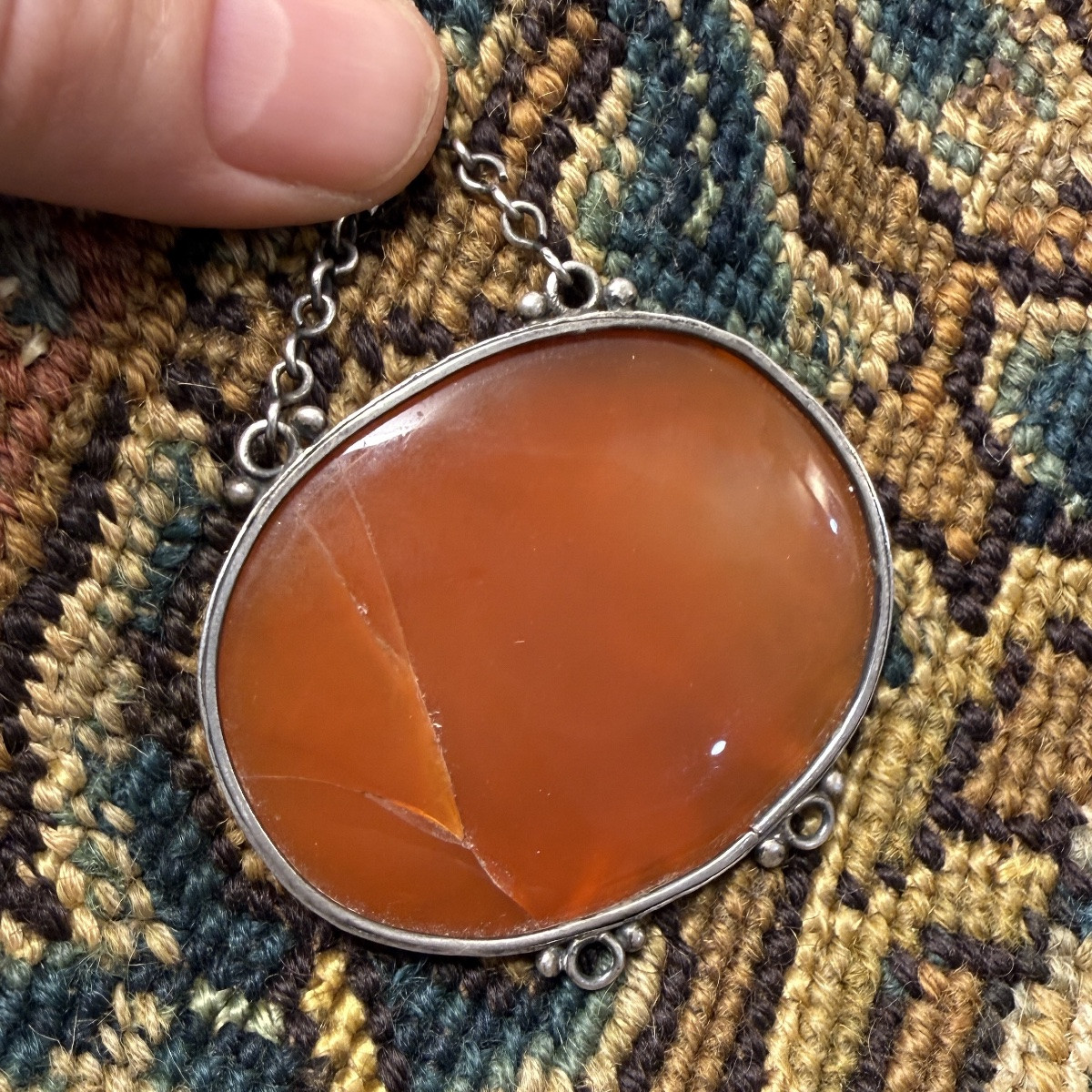


Hektor’s Departure; Silver Mounted Carnelian Intaglio. Italian, 18th Century.
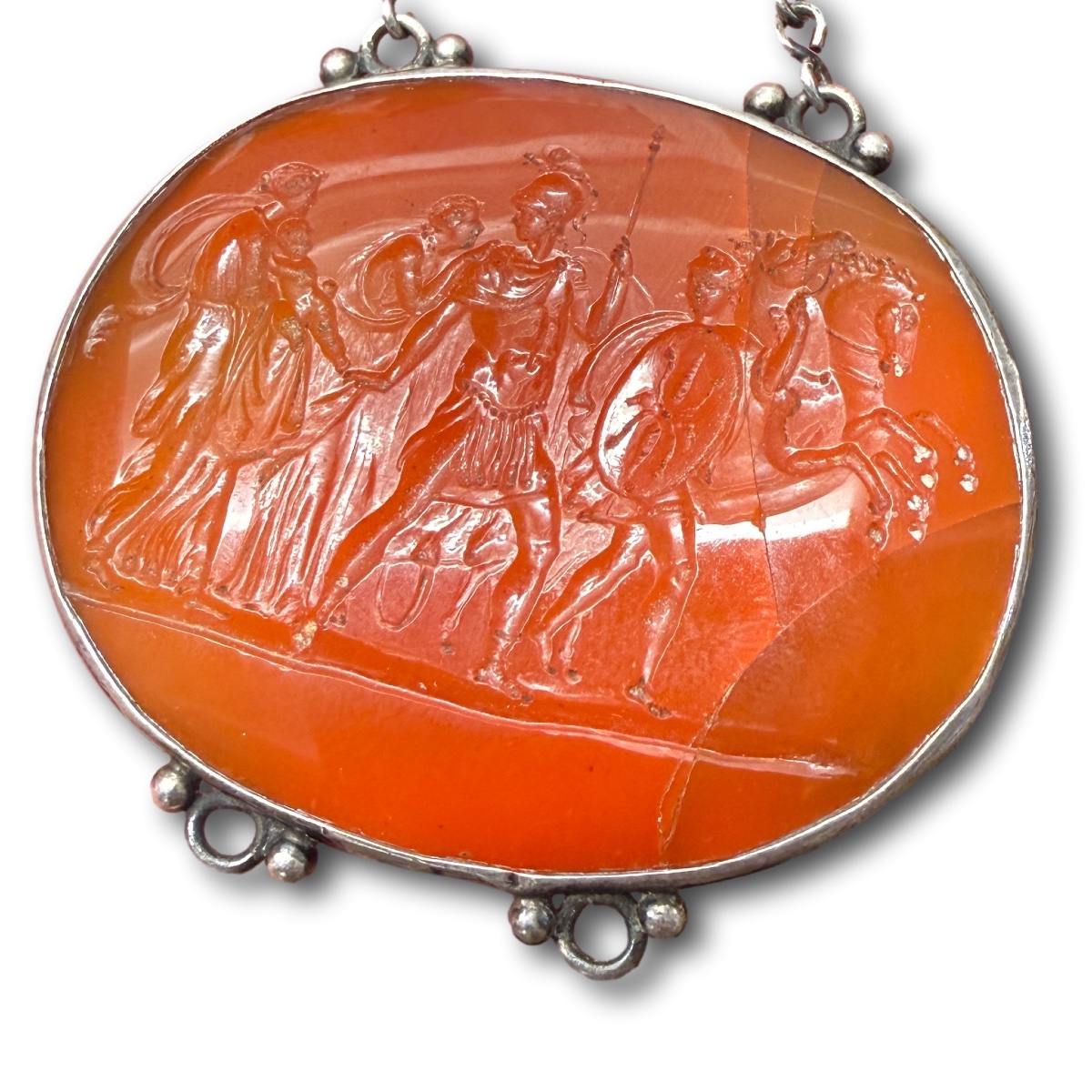
Hektor’s Departure — Silver Mounted Carnelian Intaglio.
Italian, after a model associated with Luigi Pichler, late 18th century.
Measurements
5.0 × 4.5 cm (silver mount), excluding chain. Weight: 17.5 g. Mounted in a later silver mount with suspension chain at the top.
Description
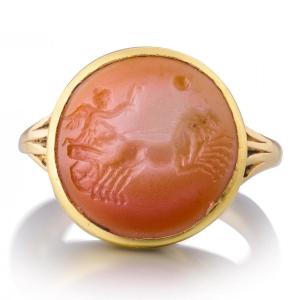
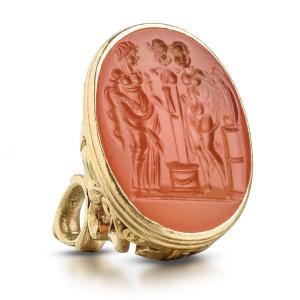
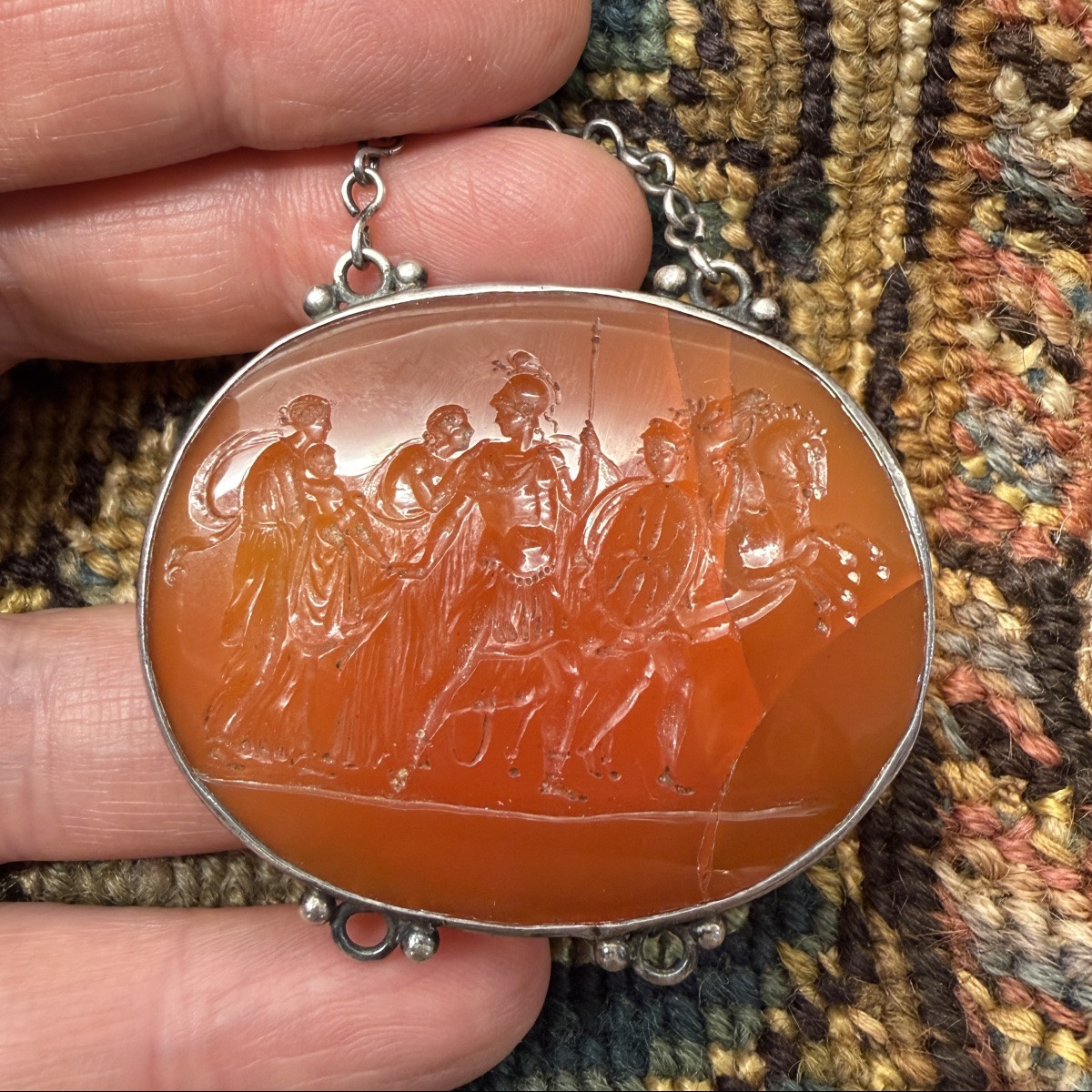
A large, finely executed carnelian intaglio depicting the poignant farewell of Hektor to his wife and child at the Scaean Gate. The composition shows the helmeted hero, armed with spear and shield, moving rightward toward an attendant holding two horses; to the left stand Andromache and the infant Astyanax, attended by a female figure. The iconography derives from the climactic episode in the Iliad by Homer and is rendered here with calm economy of line and confident, shallow cutting suited to gems of substantial scale.
The cutting is clearly executed in the refined neoclassical manner associated with late-18th/early-19th-century workshop models and is faithful to a well-known Pichler composition after a drawing by Vincenzo Camuccini (see references). The scale of the present gem—unusually large for the subject—allows a composed, almost sculptural arrangement of figures and a readable narrative in a single register; the workmanship of the figures’ drapery, the treatment of the shield and horses, and the measured use of incision point to a superior workshop execution “in the Pichler manner.”
Condition: a set of breaks to the right side of the gem (visible in the photographs). These fractures are consolidated and stable; there is no loss of material and they do not materially interrupt the readability or aesthetic presence of the engraving. The silver mount and suspension are later and in good condition.
Comparisons
Paoletti, Impronte o Numismatica?, vol. 2, no. 446 (Pichler impression after a drawing by Camuccini).
Cades, nos. 70, 667 — entry citing “da un disegno del Barone Camuccini.”
Comparable intaglio (granato) in the collection of the Staatliche Münzsammlung München (Mohl coll.), referenced as a direct formal parallel in scale and composition.
Italian, after a model associated with Luigi Pichler, late 18th century.
Measurements
5.0 × 4.5 cm (silver mount), excluding chain. Weight: 17.5 g. Mounted in a later silver mount with suspension chain at the top.
Description
A large, finely executed carnelian intaglio depicting the poignant farewell of Hektor to his wife and child at the Scaean Gate. The composition shows the helmeted hero, armed with spear and shield, moving rightward toward an attendant holding two horses; to the left stand Andromache and the infant Astyanax, attended by a female figure. The iconography derives from the climactic episode in the Iliad by Homer and is rendered here with calm economy of line and confident, shallow cutting suited to gems of substantial scale.
The cutting is clearly executed in the refined neoclassical manner associated with late-18th/early-19th-century workshop models and is faithful to a well-known Pichler composition after a drawing by Vincenzo Camuccini (see references). The scale of the present gem—unusually large for the subject—allows a composed, almost sculptural arrangement of figures and a readable narrative in a single register; the workmanship of the figures’ drapery, the treatment of the shield and horses, and the measured use of incision point to a superior workshop execution “in the Pichler manner.”
Condition: a set of breaks to the right side of the gem (visible in the photographs). These fractures are consolidated and stable; there is no loss of material and they do not materially interrupt the readability or aesthetic presence of the engraving. The silver mount and suspension are later and in good condition.
Comparisons
Paoletti, Impronte o Numismatica?, vol. 2, no. 446 (Pichler impression after a drawing by Camuccini).
Cades, nos. 70, 667 — entry citing “da un disegno del Barone Camuccini.”
Comparable intaglio (granato) in the collection of the Staatliche Münzsammlung München (Mohl coll.), referenced as a direct formal parallel in scale and composition.
1 850 €
Period: 18th century
Style: Rome and Antic Greece
Condition: Condition of use
Material: Semi precious stone
Reference (ID): 1721344
Availability: In stock
Print