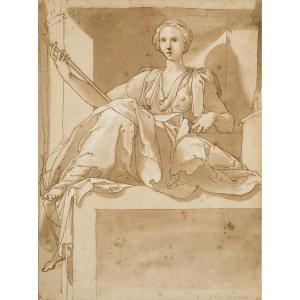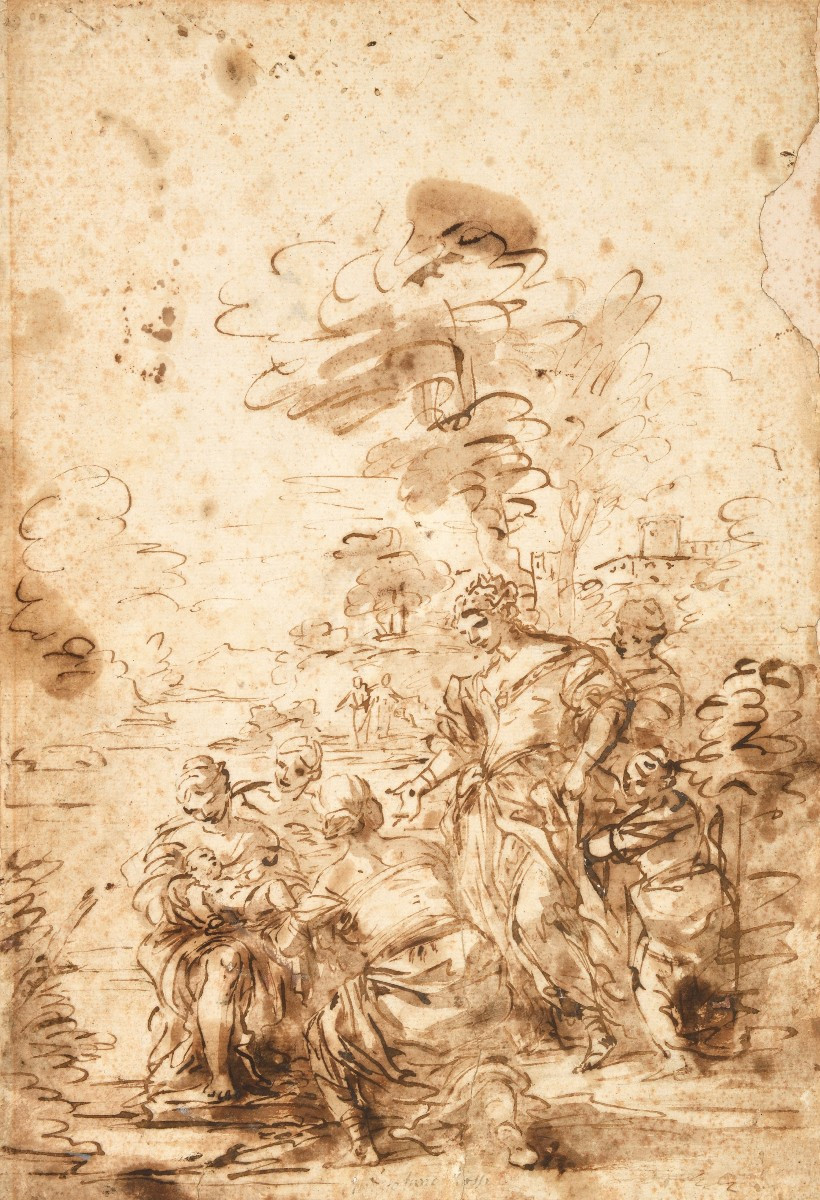

Giacinto Brandi (poli 1621 – 1691 Rome) - The Discovery Of Moses
GIACINTO BRANDI
(Poli 1621 – 1691 Rome)
The Discovery of Moses
Pen and brown ink, brown wash
43.2 x 29 cm
Bears an inscription at the lower edge “Agostino Tassi” and on the reverse “Brandi Gonzo?”
On the reverse: study of figures in red chalk
Provenance:
Private collection, France
This drawing depicts The Discovery of Moses, sometimes called Moses Saved from the Waters, an episode recounted in Chapter 2 of the Book of Exodus in the Hebrew Bible: the discovery of the infant Moses in the Nile by Pharaoh’s daughter. The subject became popular in painting, particularly from the Renaissance onward. Moses, a central figure in Jewish tradition, was given various interpretations in Christian thought, where he was regarded as a prefiguration of Christ. Independent depictions of the theme gained increasing popularity during the Renaissance and Baroque periods, as the combination of elegantly dressed women set within a waterside landscape appealed greatly to both artists and patrons.
The majority of painters active in Rome after 1650 were either “Cortonesque” or “Marattesque,” meaning they had trained in the workshops of Pietro da Cortona or Carlo Maratti. Giacinto Brandi chose instead to follow Giovanni Lanfranco (1582–1647), thus becoming one of the most original painters and draughtsmen of his generation. While Brandi’s paintings have been extensively studied by Antonella Pampalone, his drawings have received only sporadic scholarly attention. Establishing a coherent graphic corpus remains challenging, as few sheets directly connected to paintings have been published. The drawings also vary considerably in scale, and early attributions are rare.
The present drawing is therefore of particular importance. It can be compared with several firmly attributed works. The confident, vigorous penwork corresponds perfectly to Brandi’s hand, confirming the attribution. The figure of Pharaoh’s daughter shows clear affinities with other female figures in his drawings. See in particular:
Phryne before her Judges, pen and brown ink, brown wash heightened with white, squared in black chalk, 24 x 17.5 cm, inscription “del Brandi,” J. Petithory collection, bequeathed to the Louvre in 1992, on deposit at the Musée Bonnat, Bayonne (fig. 1).
Figures Seeking Refuge during the Flood, pen and brown ink with grey-brown wash over black chalk, 17.3 x 23.2 cm, inscription “hiacinto brandi,” British Museum, London (fig. 2).
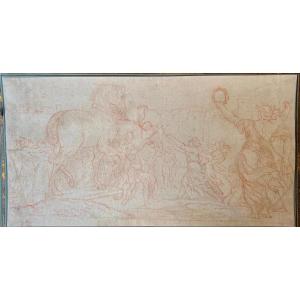
The Coronation of the Virgin, pen and brown ink, brown wash, 16.7 x 39.4 cm, Thierry de Maigret sale, March 31, 2016, lot 310 (fig. 3).
Young Woman Trampling a Demon, pen and brown ink, brown wash, black chalk and red chalk, 18 x 19 cm, Louvre, Paris (fig. 4).
Brandi developed a distinctly eclectic style: Lanfranco’s influence is evident in the delicacy of the line and the fluidity of the modelling, while the realism and dramatic chiaroscuro likely reflect the influence of Mattia Preti.
(Full description available upon request.)
Period: 17th century
Style: Louis 14th, Regency
Condition: Some repairs
Material: Paper
Width: 29
Height: 43.2
Reference (ID): 1712949
Availability: In stock