THIS OBJECT WAS SOLD
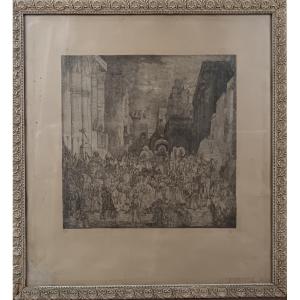
Satirical Scene, Attributed To Giuseppe Maria Mitelli (bologna, 1634–1718)


Italy, 17th century, etching.
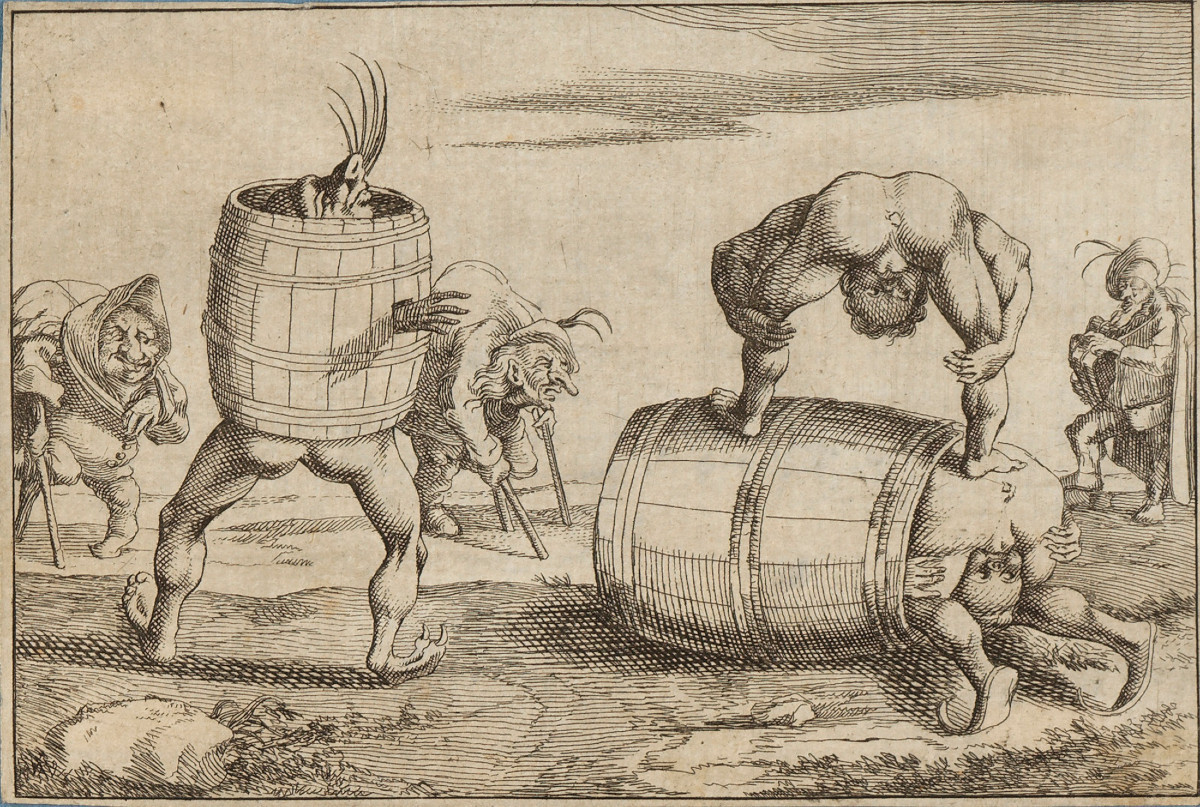
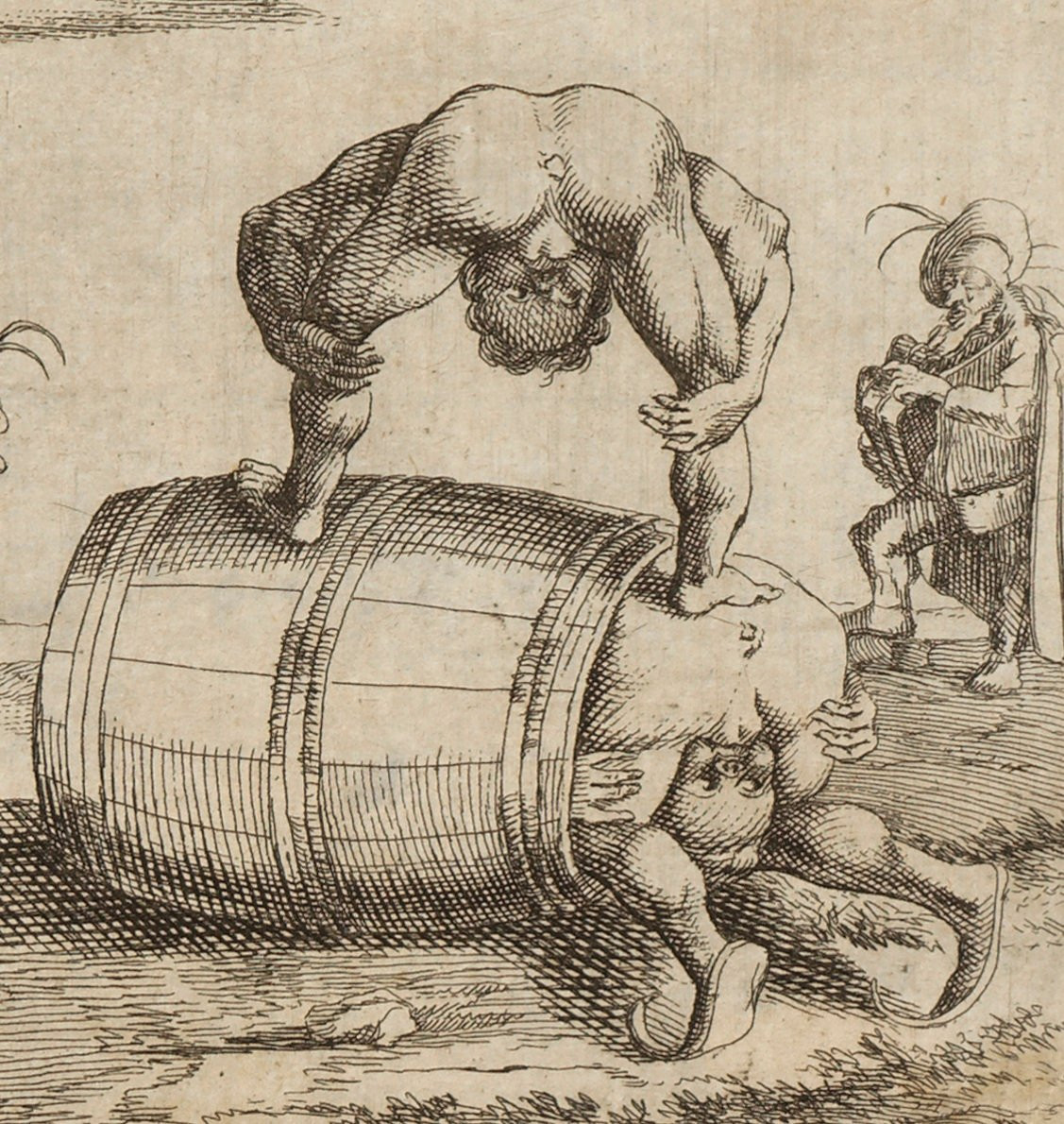
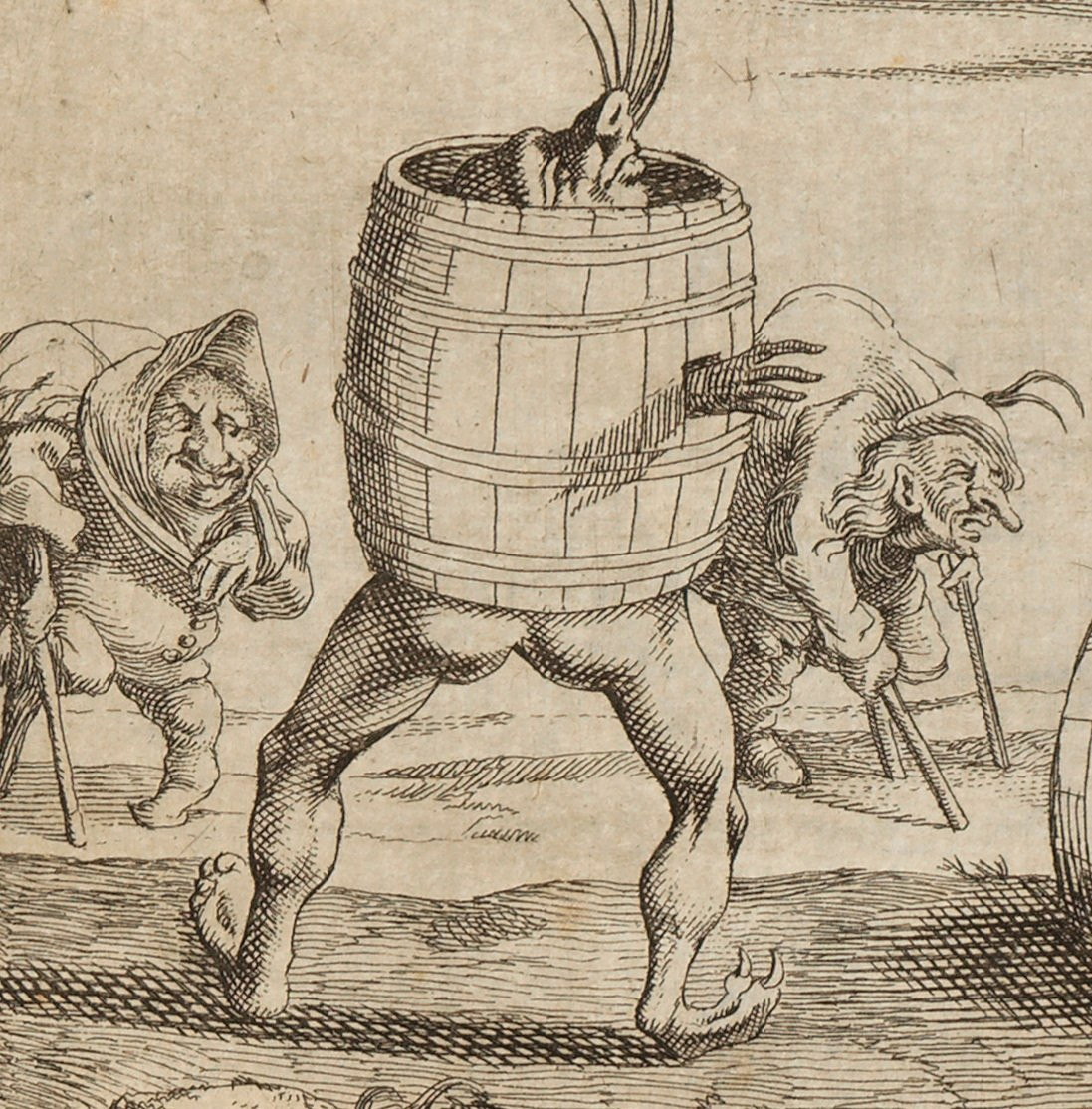
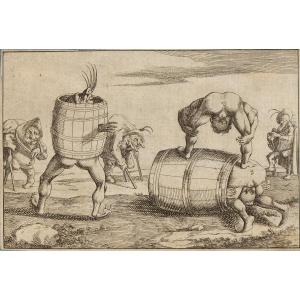
In this frieze where the world seems to teeter on its own foundations, bodies collide, overturn, and expose themselves with an almost insolent freedom. On the right, two intertwined figures compose a scene whose bawdy nature makes little attempt to conceal itself: one, leaning backward on the barrel, adopts such an open posture that it borders on provocation, while the other, half-buried in the barrel's opening, adds to the whole a bodily tension that verges on the pornographic, but treated with the ironic detachment characteristic of early burlesque. Nothing is shown, everything is suggested, and it is precisely in this ambiguous zone that Mitelli excels: a popular theater where desire, awkwardness, and ridicule become indistinguishable.
Further on, two old men on crutches advance like impassive witnesses to this joyful license, reminding us that, in Mitelli's work, the grotesque is never separate from the most fragile aspects of humanity. The line, lively, tight, almost impatient, cuts out the figures with a dry energy characteristic of the Bolognese engraver. The print oscillates between obscene farce, social satire, and a form of amused compassion—a typical Mitelli blend, where popular laughter becomes a mirror, unforgiving yet not without tenderness. Although the absence of a caption, common in Mitelli's work, prevents precise identification of our print, the stylistic coherence remains strong. And there are series of "grotesque capricci" attributed to Mitelli that lack captions. Our print would thus be classified as an early work or even as unpublished.
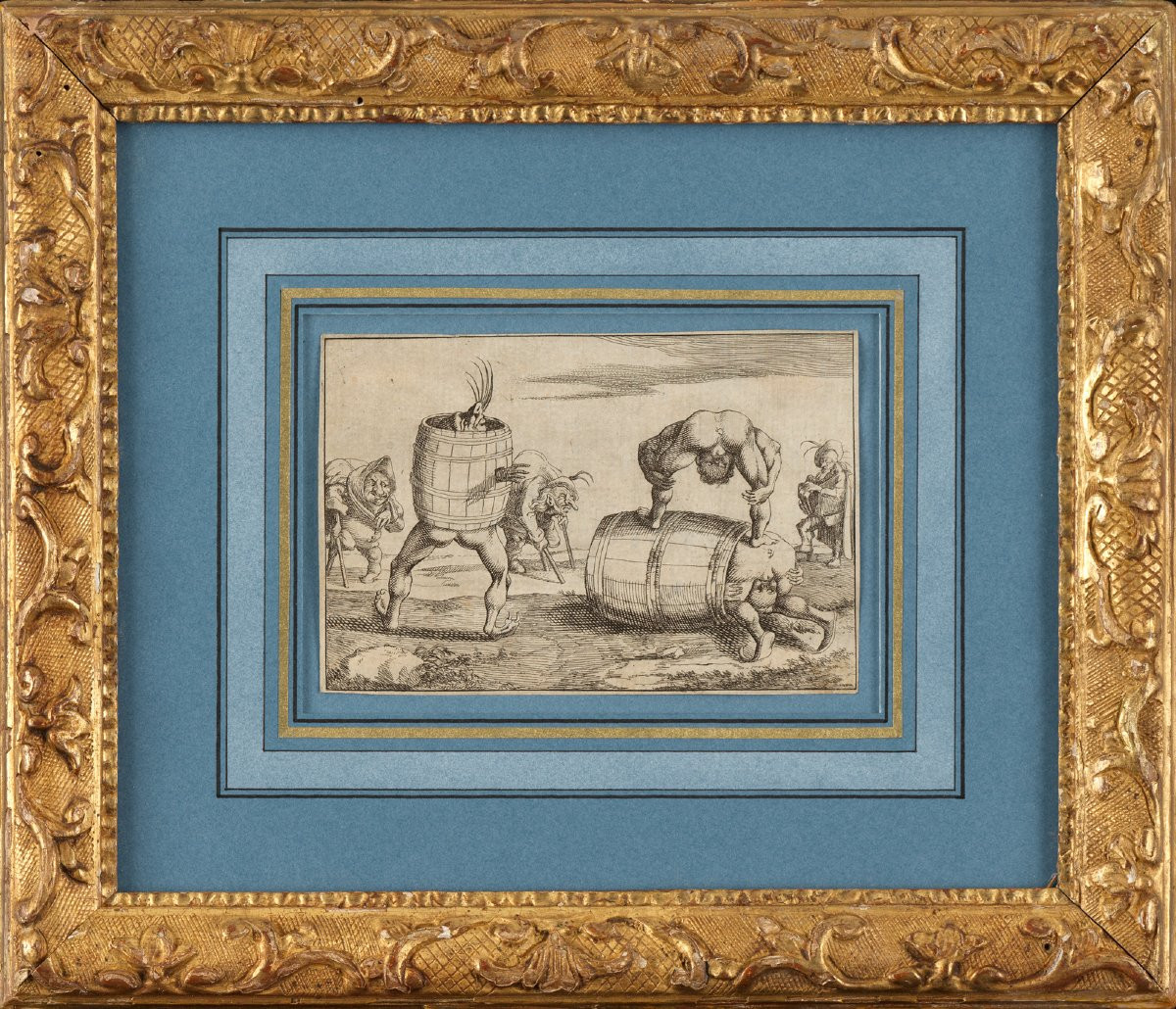
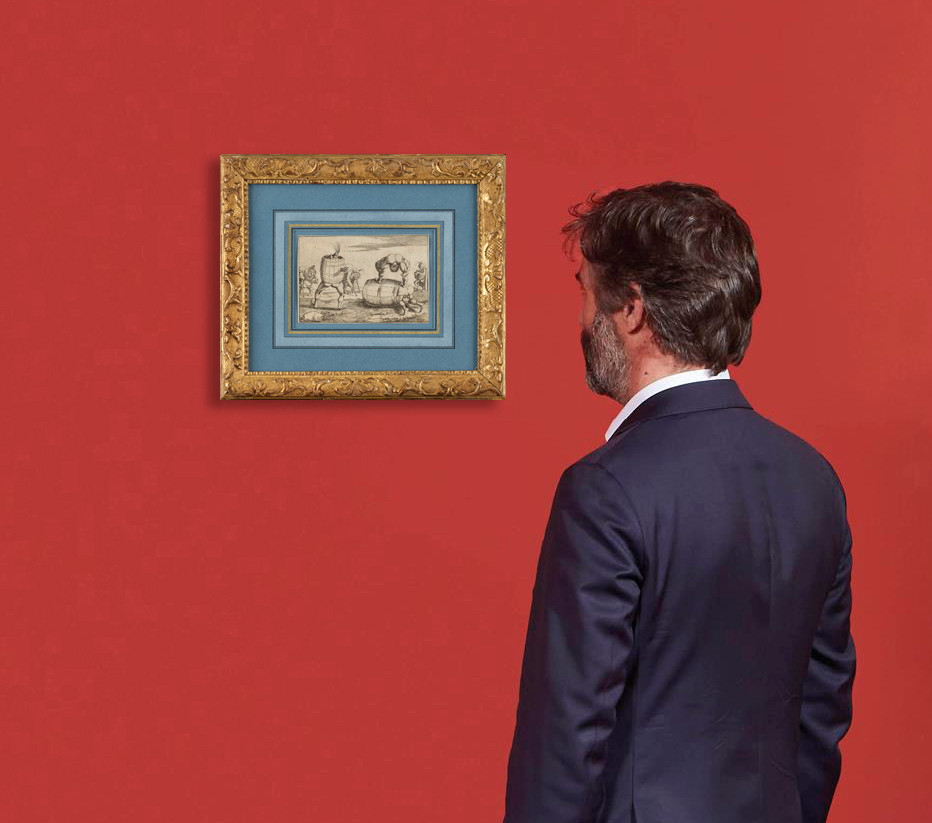
It is presented under a "Mariette blue" wash and under anti-reflective and anti-UV glass, and is set in a Louis XIV-era Bérain frame. Dimensions: 10 x 14.9 cm sheet – 28 x 33 cm with frame.
Biography: Giuseppe Maria Mitelli (Bologna 1634 – Bologna 1718) Mitelli was a 17th-century Bolognese engraver, known for his satirical and allegorical genre scenes. He made a name for himself by creating witty engravings depicting the daily life and customs of his time. Mitelli remained loyal to his native city throughout his life, where he died in 1718. His prints are highly sought after by enthusiasts and collectors of antique prints.
In this frieze where the world seems to teeter on its own foundations, bodies collide, overturn, and expose themselves with an almost insolent freedom. On the right, two intertwined figures compose a scene whose bawdy nature makes little attempt to conceal itself: one, leaning backward on the barrel, adopts such an open posture that it borders on provocation, while the other, half-buried in the barrel's opening, adds to the whole a bodily tension that verges on the pornographic, but treated with the ironic detachment characteristic of early burlesque. Nothing is shown, everything is suggested, and it is precisely in this ambiguous zone that Mitelli excels: a popular theater where desire, awkwardness, and ridicule become indistinguishable.
Further on, two old men on crutches advance like impassive witnesses to this joyful license, reminding us that, in Mitelli's work, the grotesque is never separate from the most fragile aspects of humanity. The line, lively, tight, almost impatient, cuts out the figures with a dry energy characteristic of the Bolognese engraver. The print oscillates between obscene farce, social satire, and a form of amused compassion—a typical Mitelli blend, where popular laughter becomes a mirror, unforgiving yet not without tenderness. Although the absence of a caption, common in Mitelli's work, prevents precise identification of our print, the stylistic coherence remains strong. And there are series of "grotesque capricci" attributed to Mitelli that lack captions. Our print would thus be classified as an early work or even as unpublished.
It is presented under a "Mariette blue" wash and under anti-reflective and anti-UV glass, and is set in a Louis XIV-era Bérain frame. Dimensions: 10 x 14.9 cm sheet – 28 x 33 cm with frame.
Biography: Giuseppe Maria Mitelli (Bologna 1634 – Bologna 1718) Mitelli was a 17th-century Bolognese engraver, known for his satirical and allegorical genre scenes. He made a name for himself by creating witty engravings depicting the daily life and customs of his time. Mitelli remained loyal to his native city throughout his life, where he died in 1718. His prints are highly sought after by enthusiasts and collectors of antique prints.
Explore similar pieces and discover your ideal find:
Prints (Relief, Intaglio)