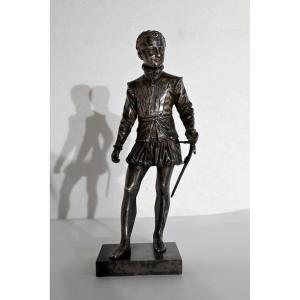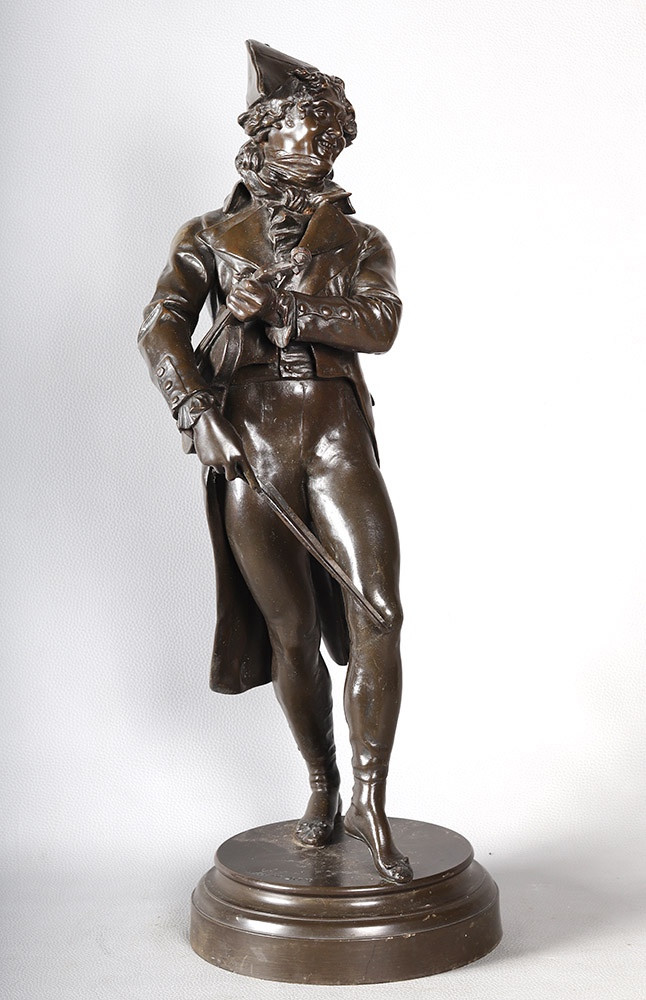
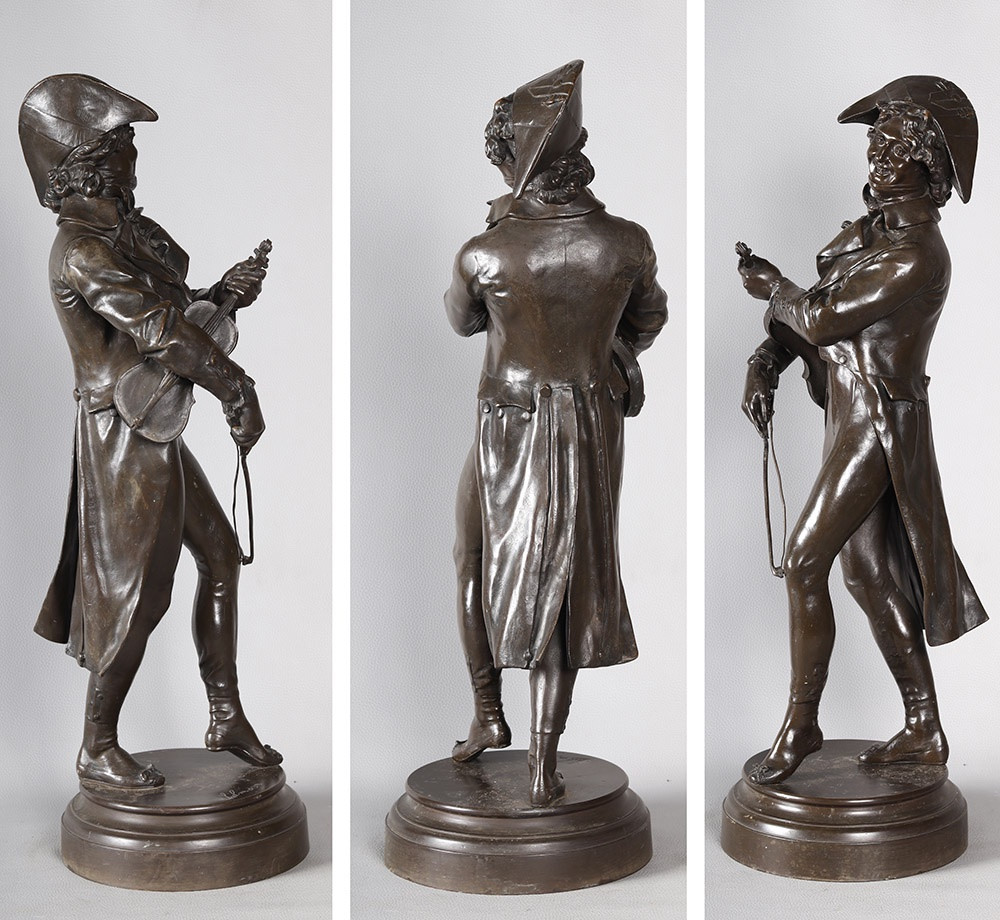
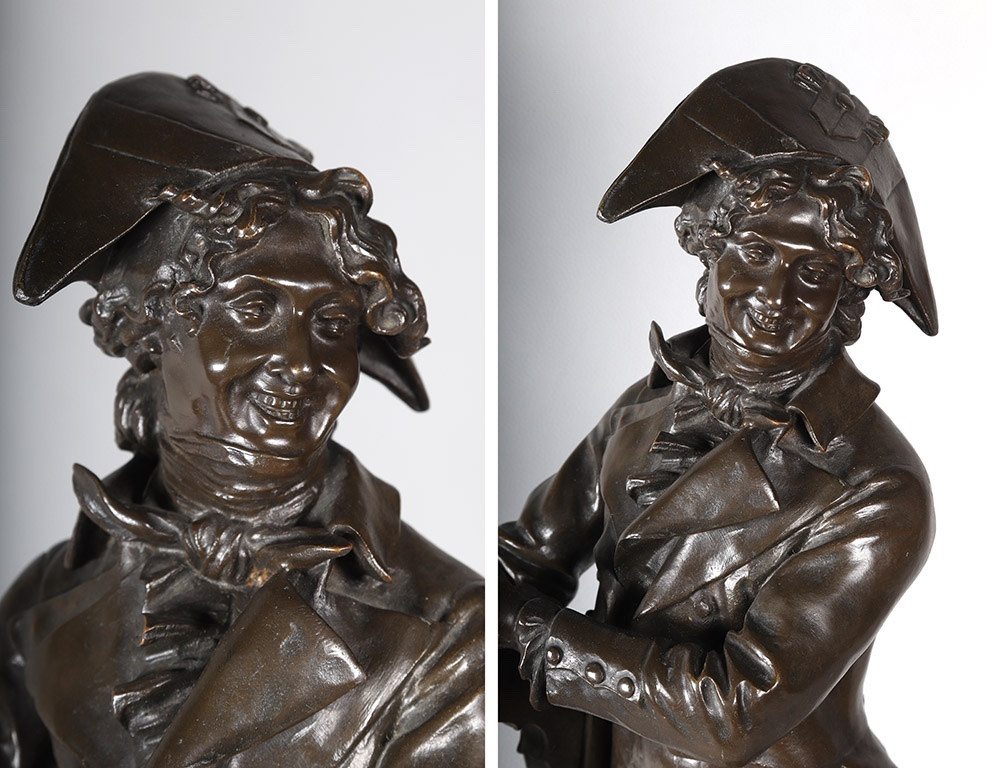
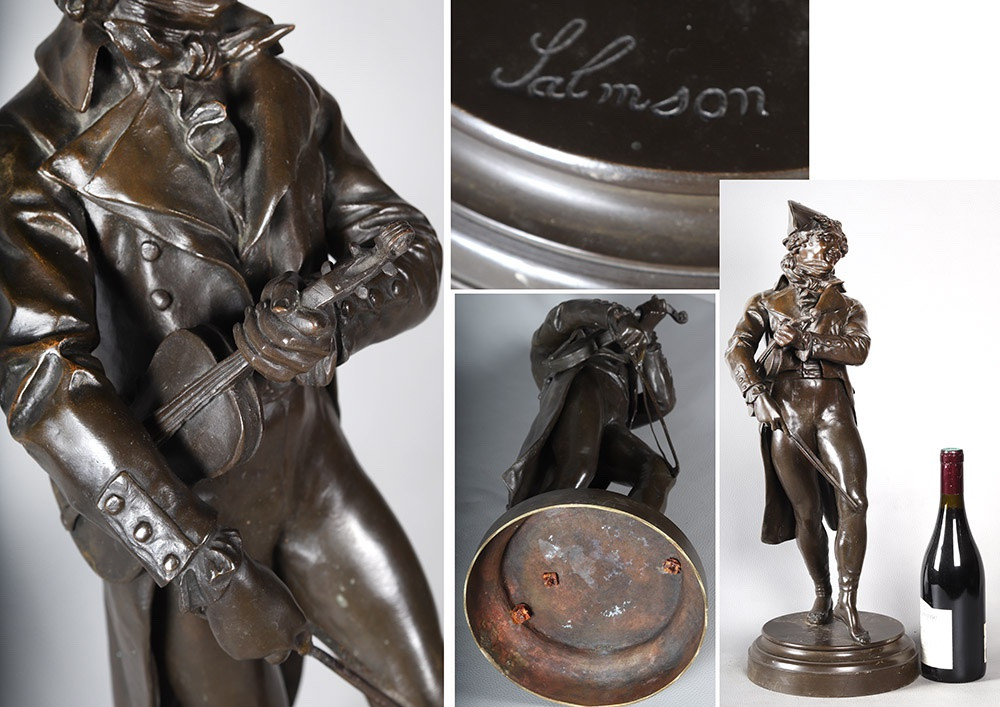


19th Century Bronze, 62 Cm, Jean Jules Salmson 1823/1902, The Violinist Under The Empire
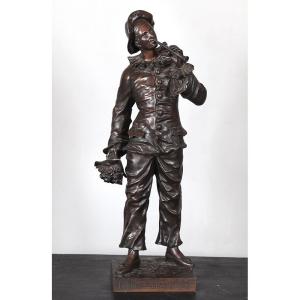
19th-century bronze, 62 cm, Jean Jules Salmson (1823-1902), The Violinist under the Empire, French School
Lost-wax bronze casting on a bronze base, in very good condition.
Signed: Salmson, a listed and valued artist.
Artprice estimate: up to €13,000
Jules Salmson is featured in the Bénézit dictionary and in P. Kjellberg's dictionary of 19th-century bronzes on pages 609 and 610.
Sold with invoice and certificate of authenticity.
Subject: The Violinist under the Empire…
Period: 20th Century
Dimensions: Height: 62 cm – Width: 20 cm – Weight: 12 kg
Biography:
Jean Jules Salmson (1823–1902)
Sculptor and medalist, born in Paris on July 18, 1823, died on May 7, 1902. French School;
Jules Salmson was the son of Jean-Baptiste Salmson (1807–1866), a Swedish-born engraver of medals and precious stones, who settled in Paris in 1822. His cousin was the painter Hugo Salmson (1843–1894).
He entered the École des Beaux-Arts in Paris, where he studied under Jules Ramey, Armand Toussaint, and Auguste Dumont. In 1845, he won the preliminary competition for sculpture, with the subject being "Terror." In 1846, he entered the second attempt at the Grand Prix de Rome but destroyed the work, as he was dissatisfied with it.
He made his debut at the Salon of 1859; he received a second-class medal in 1863 and 1867, and was made a Knight of the Legion of Honor that same year.
In 1876, he was appointed by the Geneva government to head the School of Industrial Fine Arts, where he demonstrated exceptional artistic and administrative skills and made a significant contribution to the institution's success.
In 1891, he was named a corresponding member of the Institut de France.
Among his works are *La Prudence*, a statue for the Paris Commercial Court (1865); *Henri IV*, a plaster bust for the La Rochelle Town Hall (1876); *Haendel*, a statue for the Paris Opera; the monument to H. B. de Saussure and de Balmat in Chamonix (1887); the caryatids for the Théâtre de Vaudeville in Paris (Folly, Comedy, Satire, Music); *Glory* for the new Louvre Palace; *The Spinner*, a bronze statue in the Luxembourg Gardens; and a model of a statue of Jean-Jacques Rousseau in the Geneva Municipal Museum. He also designed the fireplace in the foyer of the Geneva Theatre.
In 1892, he published an illustrated volume: *Entre deux coups de ciseaux, souvenirs d’un sculpteur* (Between Two Cuts of the Scissors, Memories of a Sculptor).
He was the teacher of numerous sculptors, including Émile-Coriolan Guillemin, André Paul Arthur Massoulle, Jean-Louis Grégoire, Henri Lebossé, and Vincent Désiré Faure de Broussé (1876-1908).
Source: Bénézit
Awards:
Medal, 2nd class, 1863.
Medal, 2nd class, 1865.
Medal, 2nd class, at the 1867 Universal Exhibition.
Knight of the Legion of Honor, 1867.
Silver medal, at the 1889 Paris Universal Exhibition.
Works in Museums and Public Spaces:
Angers, Museum of Fine Arts: The Titans, 1889, plaster, current location unknown.
The Titans, 1895, bronze bas-relief.
Chamonix: Monument to Saussure and Balmat, 1887, bronze group.
Clermont-Ferrand, Roger-Quilliot Art Museum: Hope, 1865, bronze.
Nérac, Castle Museum: Henry IV (plaster), exhibited at the Salon in 1876.
Paris, Musée d'Orsay: The Spinner, Salon of 1863, bronze statue.
Opéra Garnier: Handel, 1887-1888, marble statue.
Roubaix, La Piscine: Handel, 1874, plaster statue, model for the marble statue at the Opéra Garnier.
Sold with invoice and certificate.
Bronze can be viewed at our gallery in L’Isle-sur-la-Sorgue (France) on weekends.
Free shipping within France.
Shipping outside France available upon request.
Period: 19th century
Style: Other Style
Condition: Perfect condition
Material: Bronze
Width: 20 cm
Height: 62 cm
Reference (ID): 1709548
Availability: In stock