THIS OBJECT WAS SOLD
Wynford Dewhurst (1864-1941) Deep Valley, Creuse. Crozant, English Impressionist, Monet


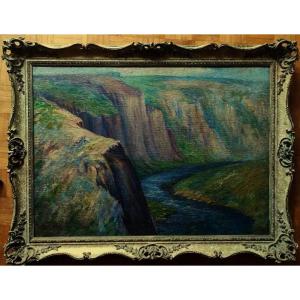


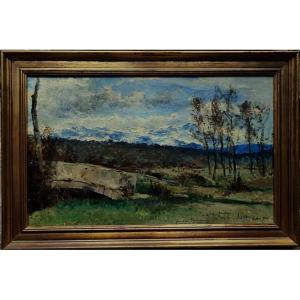
A rare new work by Wyndford Dewhurst, this time a large oil on canvas depicting a river in a steep-sided valley, likely the Creuse, signed in pink in the lower left corner. There are old labels on the back, but I haven't been able to decipher the writing. The canvas measures 73 x 100 cm (excluding the frame) and 89 x 117 cm (including the frame). This is therefore a magnificent impressionist composition by Wyndford Dewhurst, who paints this steep-sided valley, I think it is 90% the Creuse valley even though it appears very rugged, but the cliffs towards Crozant are rather steep, moreover, many painters have deliberately exaggerated this impression of steepness depending on where they placed themselves to give even more force to their work, as when we look at the view of Crozant by Othon-Friesz painted in 1901 (see last photo) or when we admire the views of Claude Monet made at Fresselines. His style is always very distinctive; he also plays with the support, which here is a very thick-weave canvas, and his palette is, as usual, very recognizable with its mauves, violets, blues, greens, yellows, etc. ...an emblematic work of the Crozant school, of which he is one of the most famous representatives as a foreign painter, along with Béla Erdelyi, the Hungarian. I have already introduced you to Wyndford Dewhurst, one of the greatest English Impressionist painters, a close friend of Monet, who regularly came to paint in the Creuse region; he even donated one of his paintings to the town hall of Gargilesse. But he also painted in Provence and on the French Riviera, in Normandy, and in the area around Paris. Wyndford Dewhurst RBA (January 26, 1864 – July 9, 1941) was an English Impressionist painter and renowned art theorist. He spent a great deal of time in France, and his work was profoundly influenced by Claude Monet. He received his artistic training in France, at the École des Beaux-Arts in Paris (where he unilaterally changed his name to Wynford Dewhurst), and was a pupil of the renowned French painter Jean-Léon Gérôme. Despite his teacher's rejection of the radical Impressionist movement in favor of a highly refined academic style (Gérôme continued the development and preservation of French Neoclassicism), Dewhurst was strongly influenced by the Impressionists. It is known that he discovered Impressionism, to which he was immediately captivated, through the work of Émile Claus in the Maddocks Collection in Bradford. However, his most important mentor would become Claude Monet. It was to Monet that Dewhurst dedicated his pioneering work on French Impressionism, *Impressionist Painting: Its Genesis and Development*, published in 1904. This was the first major study of French painters published in English. Besides helping to reintroduce this painting style to British artists, Dewhurst's book emphasized the debt French Impressionists owed to British artists John Constable and J.M.W. Turner, arguing that the Impressionists had merely developed their existing painting techniques. "At the turn of the century, British painters, if not the British public, had resigned themselves to Impressionism." According to Dewhurst, artists like himself who painted in the Impressionist style were often "ridiculed for imitating a foreign style," and he was keen to justify their position. “French artists simply developed a British-inspired style,” he wrote, an opinion rejected by French painters such as Pissarro, who revealed his national bias by acknowledging Constable and Turner, but instead identifying French influences such as Nicolas Poussin, Claude Lorrain, Jean-Baptiste-Siméon Chardin, and Jean-Baptiste-Camille Corot. However, Pissarro had previously told a journalist, “It seems to me that we are all descended from the Englishman Turner. He was the first to know how to make colors shine with a natural brilliance.” Dewhurst’s thesis in *Impressionist Painting* was controversial, as it addressed the debated question of Impressionism’s French or British origins. Nevertheless, the movement enjoyed considerable success in Britain: Kevin McConkey tells us that Dewhurst’s theme “was taken up by artists as diverse as Clausen, John Rothenstein, and Kenneth Clark.” Nevertheless, the detailed biographical sketches that Dewhurst devotes to the most important artists associated with the rise of Impressionism in France are, from a historical point of view, quite satisfactory. It is worth noting that *Impressionist Painting* also includes an entire chapter devoted to women artists, since “modernity is the hallmark of Impressionism, and this movement was the very first artistic revolt in which women participated.” Indeed, Dewhurst thanks the renowned painter Mary Cassatt (who worked within the Impressionist circle) for her contribution to the preface of his book. During his career, Dewhurst became known for his paintings of the countryside around Dieppe and the Seine Valley, where he painted regularly, and he confided that it was there that he had his most important artistic revelations. In particular, he discovered the violet light present in Monet's paintings of the South of France. Dewhurst's mature work demonstrates a more expressive mastery. This is especially evident in a series of paintings executed in the Creuse Valley, where the vivid, almost garish palette again recalls Monet, even if, in some cases, it achieves "an unintentional Fauvist intensity." Dewhurst died on July 9, 1941, in Burton upon Trent. His work is now internationally renowned, regularly fetching prices in the five figures, especially for his most impressionistic works painted with delicate, commas. This canvas is in very good condition, the original one. I would only point out a small restoration in the violet cliff in the center, but without any patching, that's all. Delivered in a lovely antique carved frame in the Montparnasse style. Guaranteed authentic.
Explore similar pieces and discover your ideal find:
Landscapes