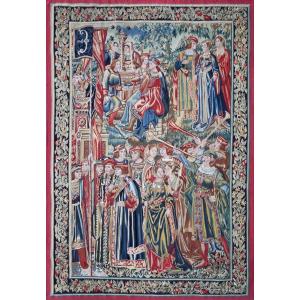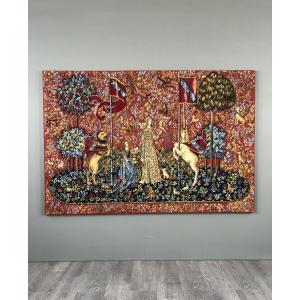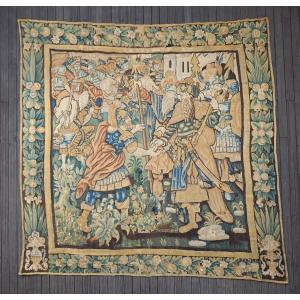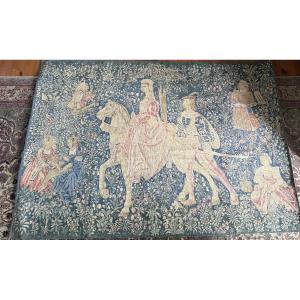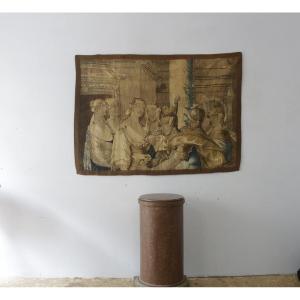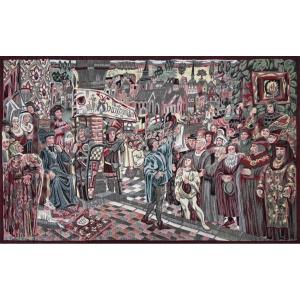


Tapestry "the Charter Of Burgundy 1469" – Jacquard Manufactory, La Filandière Paris - No. 1636
This tapestry is a fascinating piece that illustrates a key moment in European history, blending politics, trade, and medieval prestige. Here are the historical details and the scene depicted: The Scene: "The Charter of Burgundy" (1469) The scene takes place in 1469 (as indicated by the date inscribed on the floor near the throne). It likely depicts the confirmation of privileges or the granting of a charter by the Duke of Burgundy to a Flemish or Burgundian city. The Main Figure: On the left, seated on his throne, is almost certainly Charles the Bold (Duke of Burgundy from 1467 to 1477). He is recognizable by his authoritative posture and the style of his court, which at the time was the richest and most sophisticated in Europe. The Action: A messenger or representative of the city (in the center) presents a scroll (a charter). Around them, a crowd of dignitaries, soldiers, and burghers attends the event in a town with typical northern architecture (stepped gables). The setting: The text on the banner in the upper left appears to bear the inscription "Burgondia" (Burgundy). The coat of arms and symbols of ducal power are also visible. The tapestry was produced by the "La Filandière" workshop in Paris. This workshop is renowned for its reproductions of medieval and historical tapestries using the Jacquard loom (a high-precision mechanical weaving technique). Why is this scene important? In 1469, the Duchy of Burgundy was at its height. It controlled not only present-day Burgundy, but also the Netherlands, Belgium, and Luxembourg. This tapestry celebrates the alliance between feudal power and urban liberties (trade), which brought wealth to this region.
1 800 €
Period: 20th century
Style: Renaissance, Louis 13th
Condition: Perfect condition
Material: Wool
Width: 194 cm
Height: 130 cm
Depth: 1 cm
Reference (ID): 1702015
Availability: In stock
Print