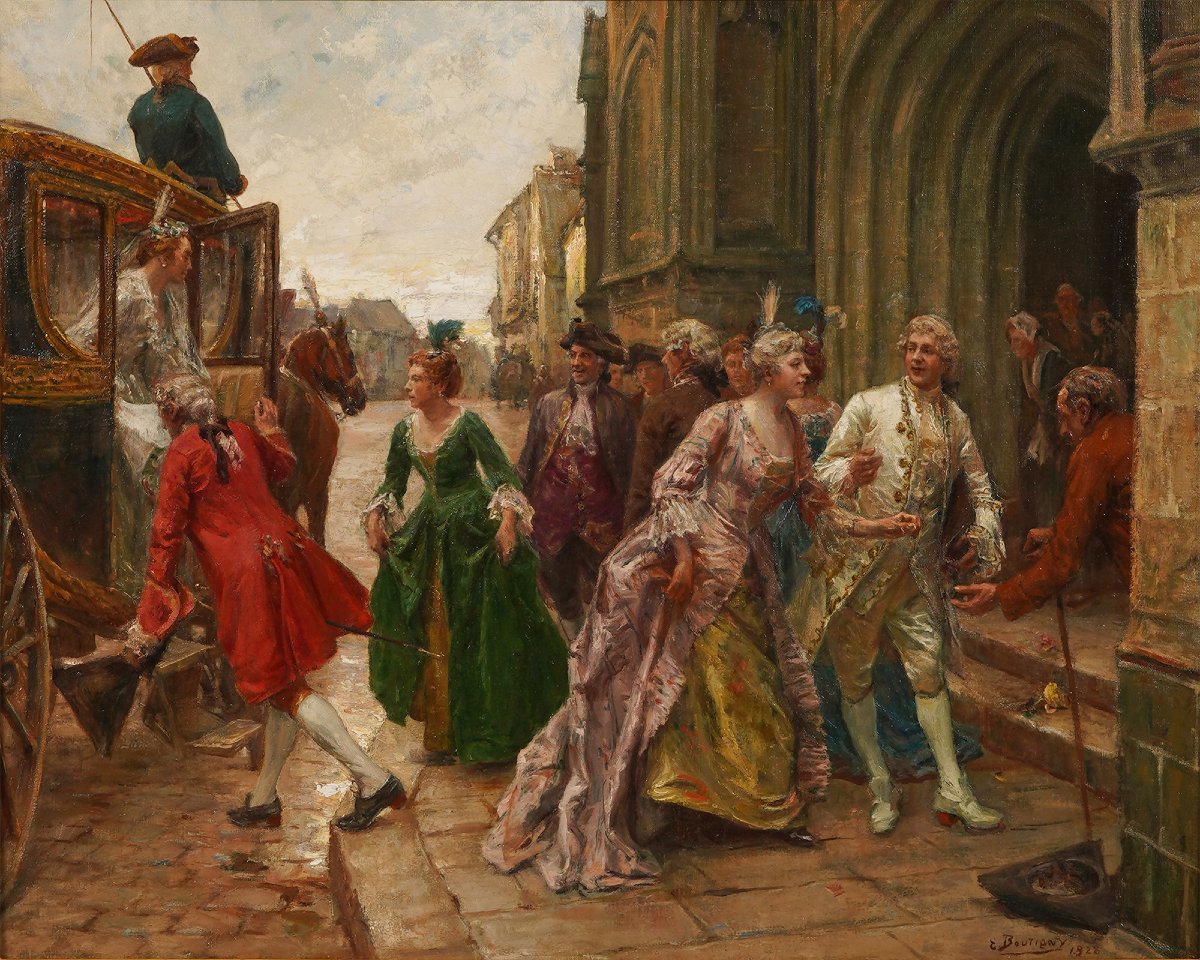
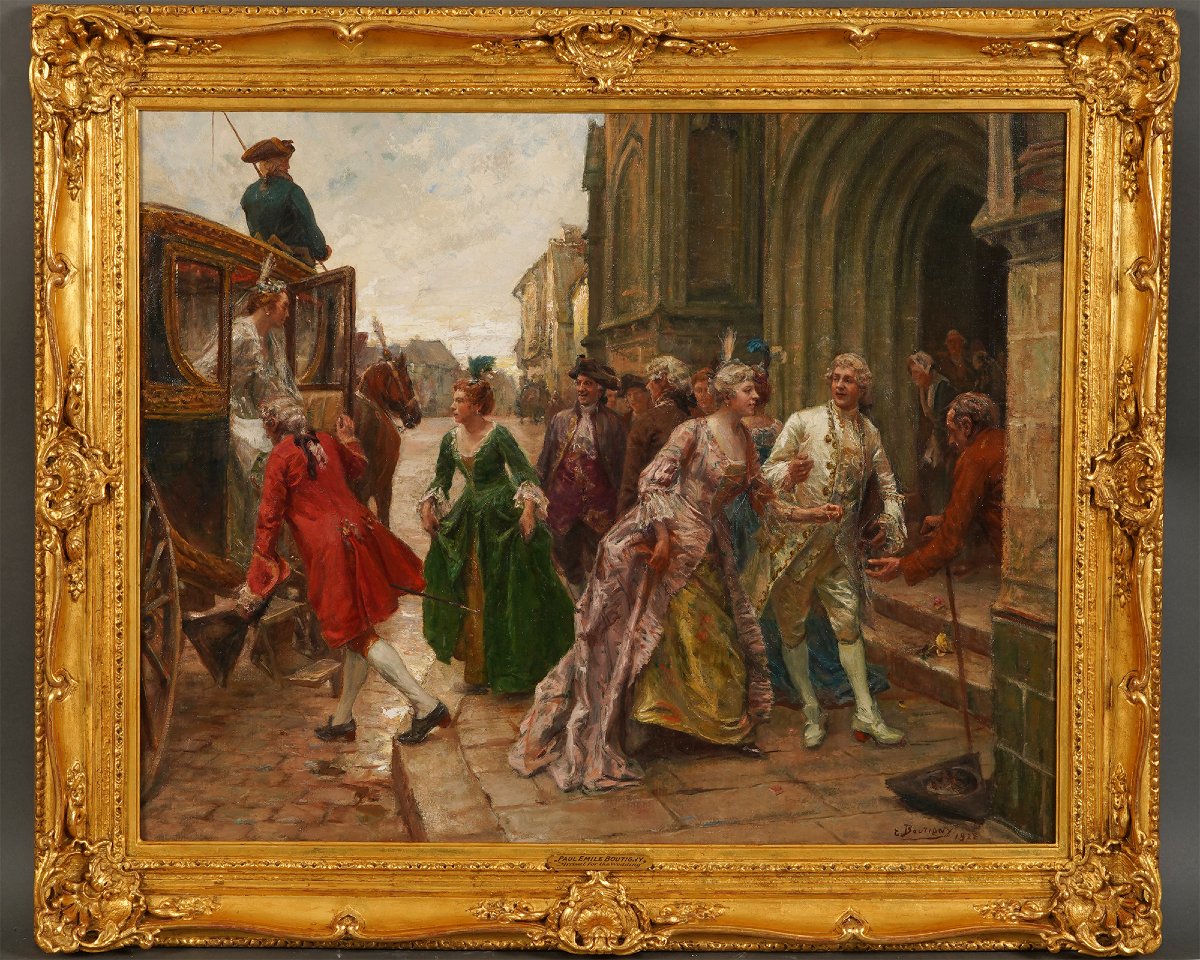




P.e. Boutigny, "the Arrival Of The Bride", France, 1928
Artist: E. Boutigny
Signed and dated E. Boutigny 1928
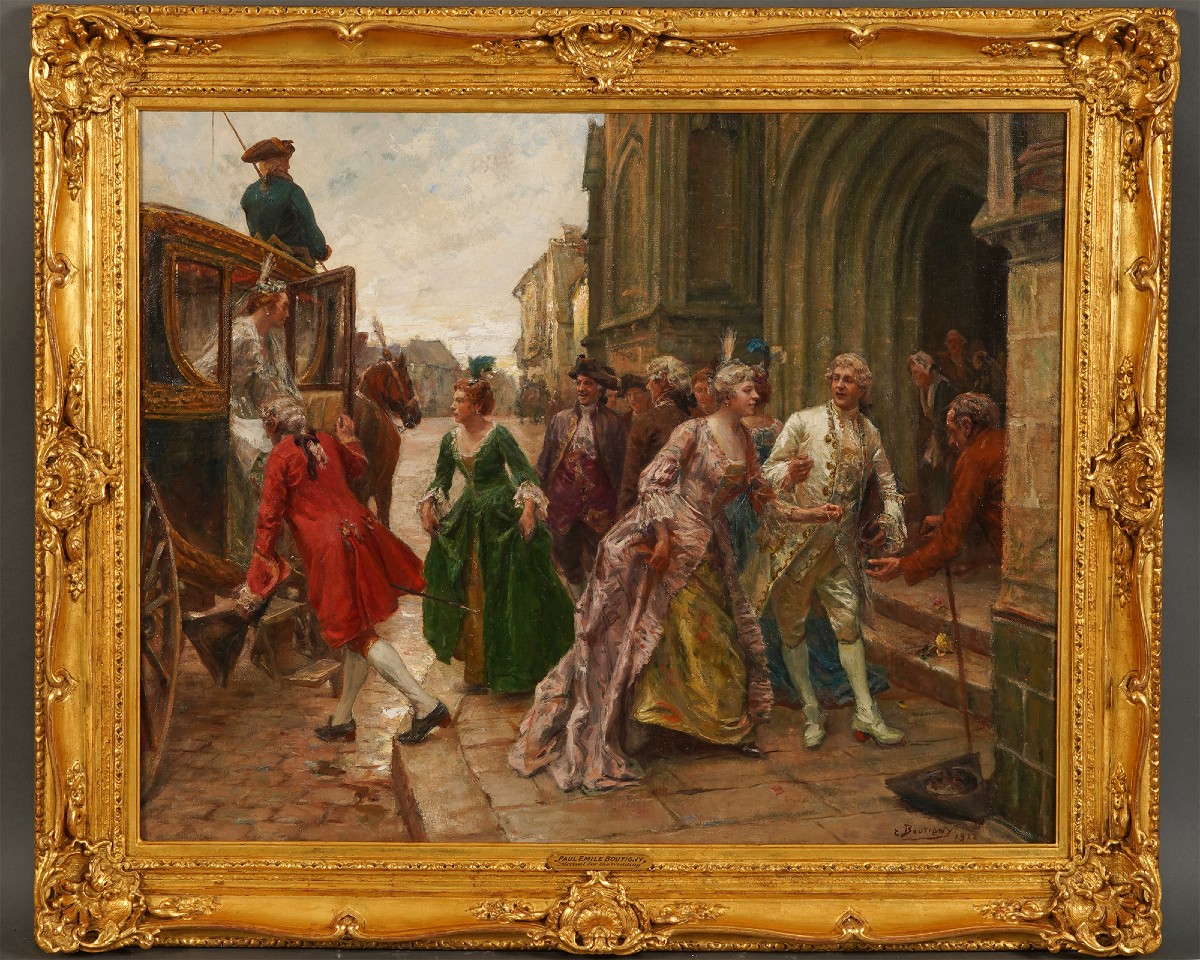
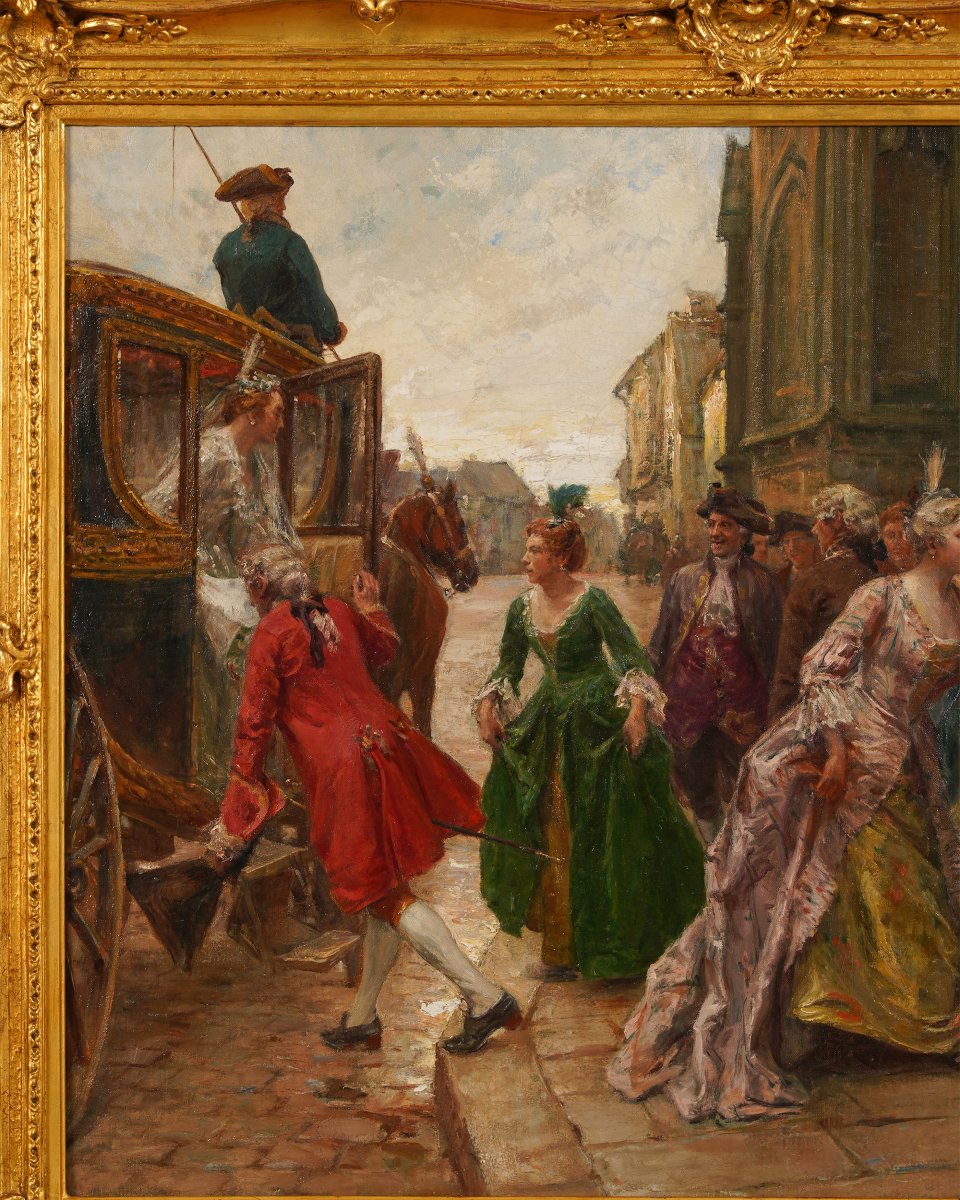
This elegant painting depicts the arrival of a carriage bringing the bride to a church. The moment captured is that of a worldly disembarkation, transformed into a social spectacle. The figures, richly dressed, fill the space in a dense and animated composition. The dresses, made of silky fabrics in shimmering colors, contrast with the men’s garments adorned with embroidery and gold buttons, highlighting the social hierarchy and refinement of the protagonists.
The light, diffuse and carefully controlled, emphasizes the central figures while leaving the peripheral areas in relative shadow. On the right, the presence of a beggar introduces a discreet note of social contrast, though without any real critical tension: it functions more as a picturesque motif inherited from the eighteenth-century tradition than as a form of denunciation. This restraint confirms the idealized dimension of the scene, in which the Ancien Régime is evoked as an age of elegance and harmonious sociability. Created at the end of Boutigny’s career, this work bears witness to a deliberate fidelity to a narrative and decorative aesthetic, running counter to contemporary avant-garde movements.
Biography :
Paul Émile Boutigny (1853–1929) was among the most highly regarded painters of historical and fashionable genre scenes during the Third Republic. A pupil of Alexandre Cabanel at the École des Beaux-Arts in Paris, he specialized at an early stage in genre scenes inspired by history, most often set in the eighteenth century. He thus aligned himself with the so-called “neo-gallant” tradition, inherited from Watteau, Fragonard, and Lancret, but reinterpreted through the sensibility and technique of the late nineteenth century. He made his debut at the Salon des Artistes Français in 1881 and exhibited there regularly, where his works met with a favorable reception. His success was based on a seductive, narrative, and decorative style of painting, perfectly suited to bourgeois and aristocratic interiors. At a time marked by the rise of Impressionism and later the avant-gardes, he deliberately chose to remain faithful to a classical aesthetic, embracing a certain stylistic conservatism. At the turn of the twentieth century and until the end of his life, Boutigny pursued this path with consistency. His later works, particularly those of the 1910s and 1920s, reveal a great freedom of brushwork while maintaining clarity of narrative and elegance of composition. The pictorial surface sometimes becomes more vibrant, reflecting a heightened sensitivity to light and movement.
Bibliography :
– Benezit, Dictionnaire des Peintres, Sculpteurs, Dessinateurs et Graveurs, Paris, Gründ.
– Catalogue du Salon des Artistes Français, années 1881–1895.
– Jean?Paul?Crespelle, La?Vie artistique à la?Belle?Époque, Paris, 1966.
– Musée?d’Art et?d’Histoire de?Saint?Denis?–?fonds Paul?Émile?Boutigny.
(References on the artist’s biography and exhibitions held during the 1880s and?1890s.)
This elegant painting depicts the arrival of a carriage bringing the bride to a church. The moment captured is that of a worldly disembarkation, transformed into a social spectacle. The figures, richly dressed, fill the space in a dense and animated composition. The dresses, made of silky fabrics in shimmering colors, contrast with the men’s garments adorned with embroidery and gold buttons, highlighting the social hierarchy and refinement of the protagonists.
The light, diffuse and carefully controlled, emphasizes the central figures while leaving the peripheral areas in relative shadow. On the right, the presence of a beggar introduces a discreet note of social contrast, though without any real critical tension: it functions more as a picturesque motif inherited from the eighteenth-century tradition than as a form of denunciation. This restraint confirms the idealized dimension of the scene, in which the Ancien Régime is evoked as an age of elegance and harmonious sociability. Created at the end of Boutigny’s career, this work bears witness to a deliberate fidelity to a narrative and decorative aesthetic, running counter to contemporary avant-garde movements.
Biography :
Paul Émile Boutigny (1853–1929) was among the most highly regarded painters of historical and fashionable genre scenes during the Third Republic. A pupil of Alexandre Cabanel at the École des Beaux-Arts in Paris, he specialized at an early stage in genre scenes inspired by history, most often set in the eighteenth century. He thus aligned himself with the so-called “neo-gallant” tradition, inherited from Watteau, Fragonard, and Lancret, but reinterpreted through the sensibility and technique of the late nineteenth century. He made his debut at the Salon des Artistes Français in 1881 and exhibited there regularly, where his works met with a favorable reception. His success was based on a seductive, narrative, and decorative style of painting, perfectly suited to bourgeois and aristocratic interiors. At a time marked by the rise of Impressionism and later the avant-gardes, he deliberately chose to remain faithful to a classical aesthetic, embracing a certain stylistic conservatism. At the turn of the twentieth century and until the end of his life, Boutigny pursued this path with consistency. His later works, particularly those of the 1910s and 1920s, reveal a great freedom of brushwork while maintaining clarity of narrative and elegance of composition. The pictorial surface sometimes becomes more vibrant, reflecting a heightened sensitivity to light and movement.
Bibliography :
– Benezit, Dictionnaire des Peintres, Sculpteurs, Dessinateurs et Graveurs, Paris, Gründ.
– Catalogue du Salon des Artistes Français, années 1881–1895.
– Jean?Paul?Crespelle, La?Vie artistique à la?Belle?Époque, Paris, 1966.
– Musée?d’Art et?d’Histoire de?Saint?Denis?–?fonds Paul?Émile?Boutigny.
(References on the artist’s biography and exhibitions held during the 1880s and?1890s.)
16 500 €
Period: 20th century
Style: Louis 15th - Transition
Condition: Good condition
Material: Oil painting
Width: 110
Height: 90
Depth: 7
Reference (ID): 1700595
Availability: In stock
Print