THIS OBJECT WAS SOLD
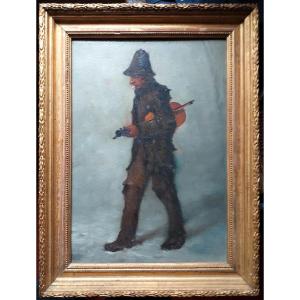
Musician Playing The Ophicleide


The Ophikleide Player, European School, 19th Century. Musician with an ophicleide. Oil on canvas, 50 x 40 cm, 19th century. This oil on canvas depicts a seated musician, absorbed in playing his instrument, an ophicleide, recognizable by its long body equipped with keys and its curved neck ending in a mouthpiece. The artist has chosen a close framing and a simple interior scene, emphasizing the figure and the musical gesture. The musician, dressed in a dark suit with metal buttons and wearing a hat, is shown in profile, in an attitude of silent concentration. The brushwork is precise yet lively, with a palette dominated by warm, earthy tones that lend the whole an intimate and realistic atmosphere. In both its subject matter and its execution, this work belongs to the tradition of realism and genre painting of the 19th century, illustrating the period's interest in scenes of everyday life and folk musicians. The depiction of the ophicleide, a rare instrument today, is of particular iconographic interest and reinforces the dating of the work to the first half of the 19th century. The ophicleide is a brass wind instrument... A metal instrument, it replaced the older serpent in the 19th century, used for both religious and military purposes. Very different from this instrument, which originated in the 15th century, the ophicleide was equipped with keys from the outset. In churches, it was used from approximately 1820 to 1880. It also had its place in the symphony orchestra, military bands, and concert bands. It held an important position among the brass instruments in Romantic operas. The instrument was produced in several sizes, covering various ranges, from alto (in E-flat and F) to contrabass (in E-flat), including bass (in B-flat and C). There were also keyed bugles (sopranos). The first score using this instrument is Gaspare Spontini's opera Olimpia in 1819. The ophicleide also appears in the instrumental nomenclature of other famous compositions such as the oratorio Elijah and the overture to A Midsummer Night's Dream by Felix Mendelssohn, as well as Berlioz's Symphonie fantastique. Verdi and Wagner also wrote for the ophicleide. Several variants of the ophicleide appeared from different makers under different names: Russian bassoon, serpent bassoon, ophibaryton, ophimonocleide, and serpent forveille. These instruments, similar to the ophicleide, were less widely used. The ophicleide has now fallen into disuse due to the unevenness of its tone across its entire range. It was quickly superseded by tubas, more powerful piston instruments, and with a more even timbre, at a time when most composers sought to develop the sonic breadth of orchestras. A few musicians today are working to perpetuate its use, in the context of so-called historical interpretations, such as those of the Orchestre Révolutionnaire et Romantique founded by Sir John Eliot Gardiner, or the ensemble "Les Cuivres Romantiques".
Explore similar pieces and discover your ideal find:
musical instruments