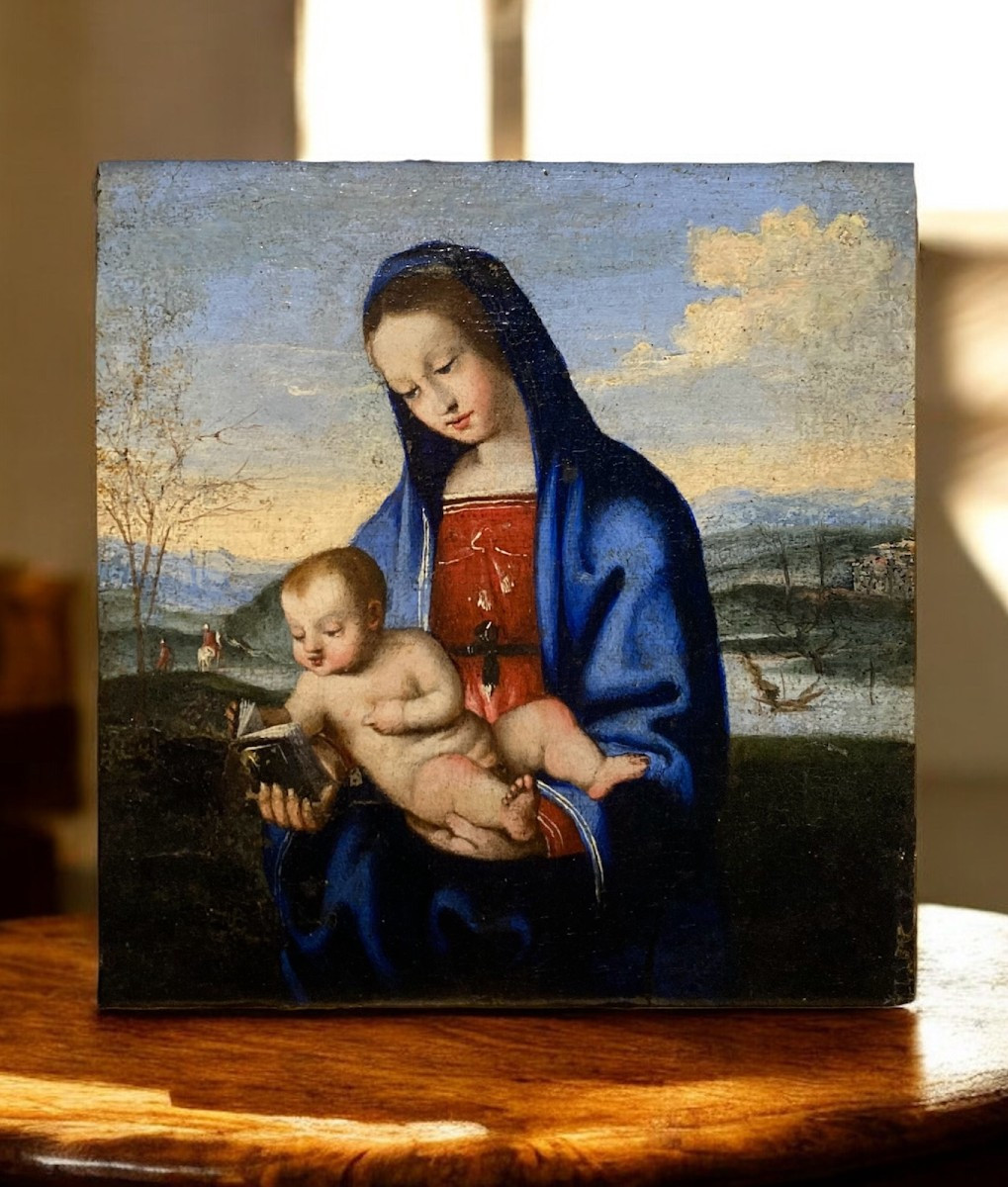




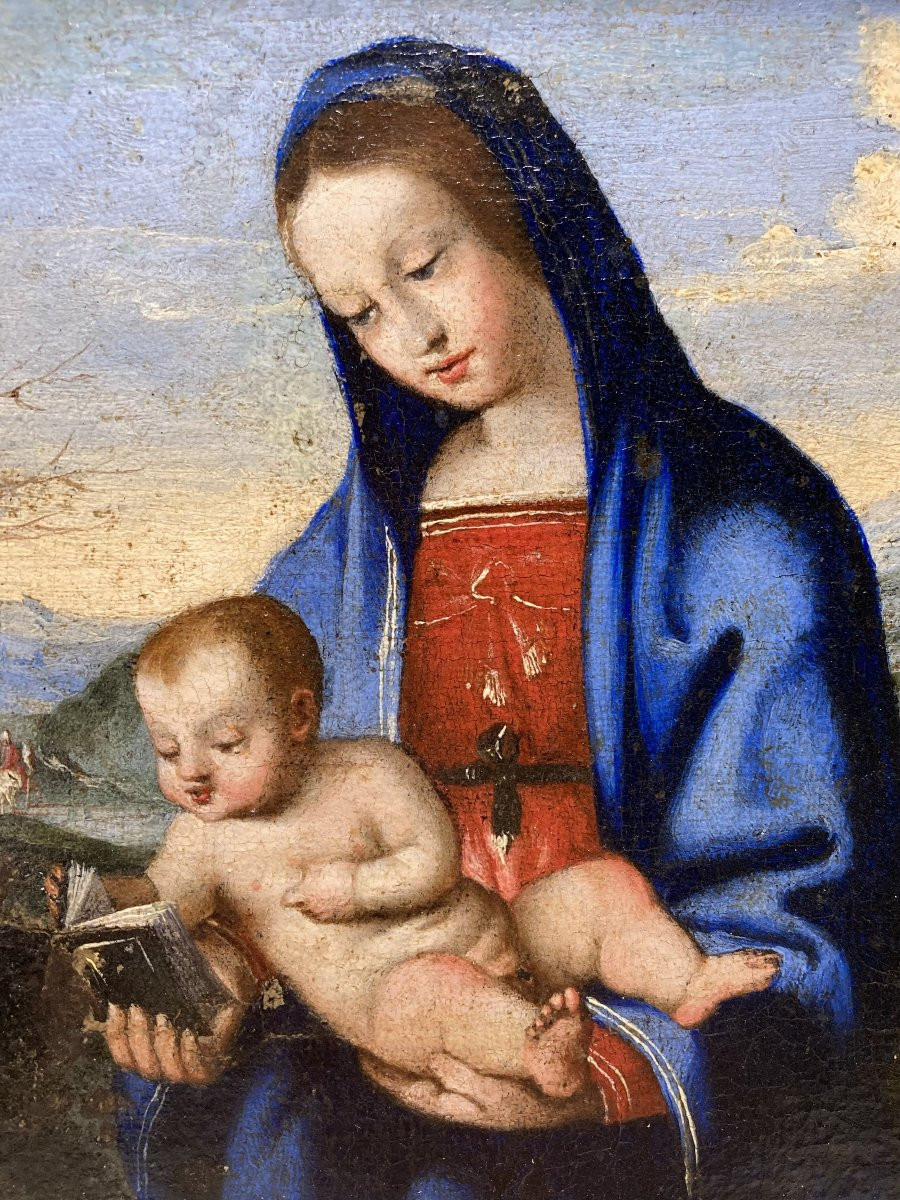
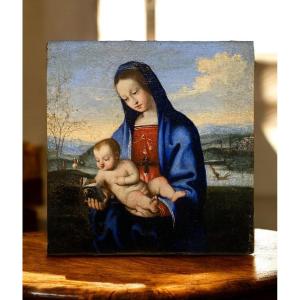


The work presented here is a small oil painting on canvas depicting the Madonna and Child holding a book. This iconography is known as the Madonna of the Book, but more precisely, our oil painting seems to reference Raphael's famous Madonna Conestabile, painted in 1504 and now in the Hermitage Museum in St. Petersburg.
Compositionally, the two works are similar, presenting the two subjects with the same attribute in similar poses. The landscape is also depicted quite similarly, as was common at the time. However, there are some variations.
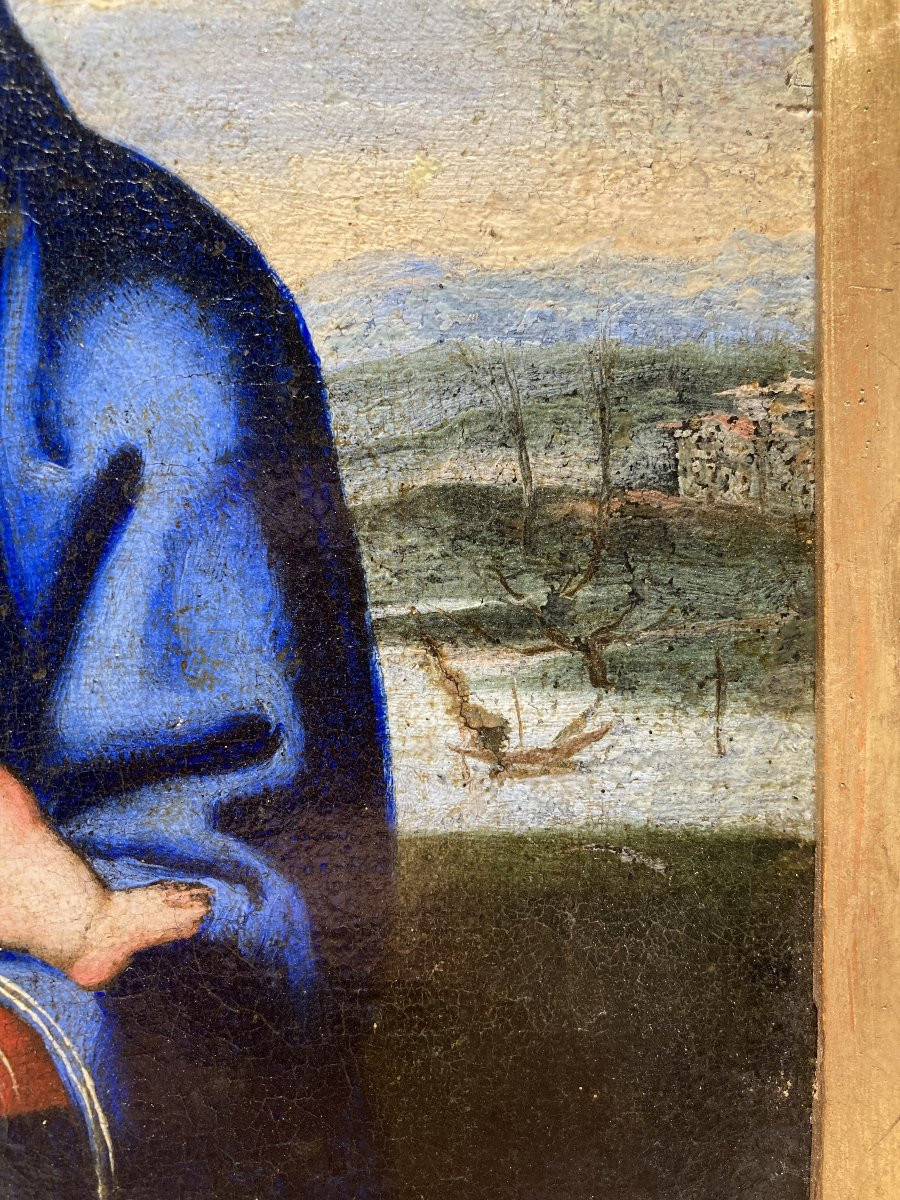
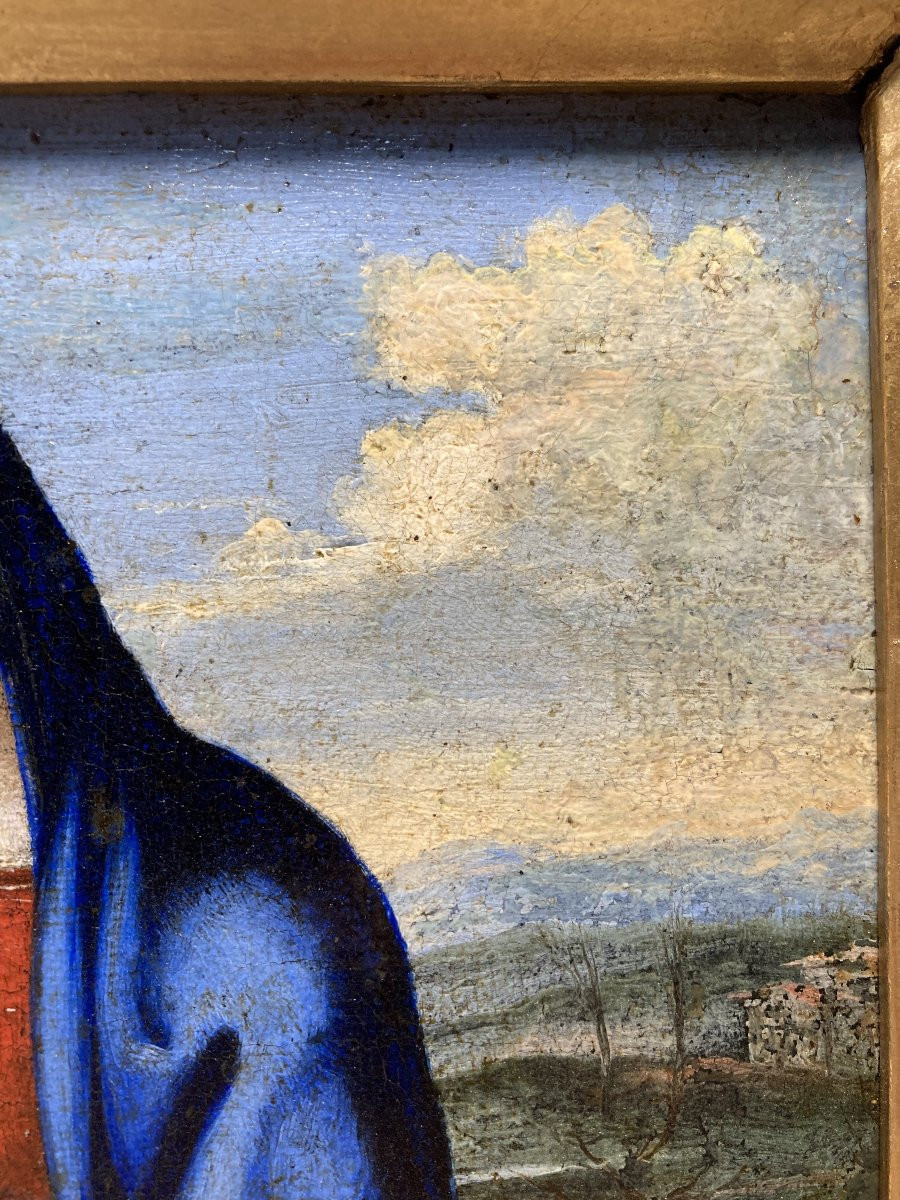
The stylistic signature, however, is substantially different: while Raphael's original version features colder tones and less accentuated three-dimensional volumes, our version features a more intense focus on naturalistic detail: in the more liquid and textured colors and in the nuanced tones. As a backdrop to a Madonna of rare and ineffable sweetness, the landscape seems to reclaim its liveliness: the movements of the sky and light are calibrated and animated, with the sunset illuminating the mountains, which stand out on the horizon.
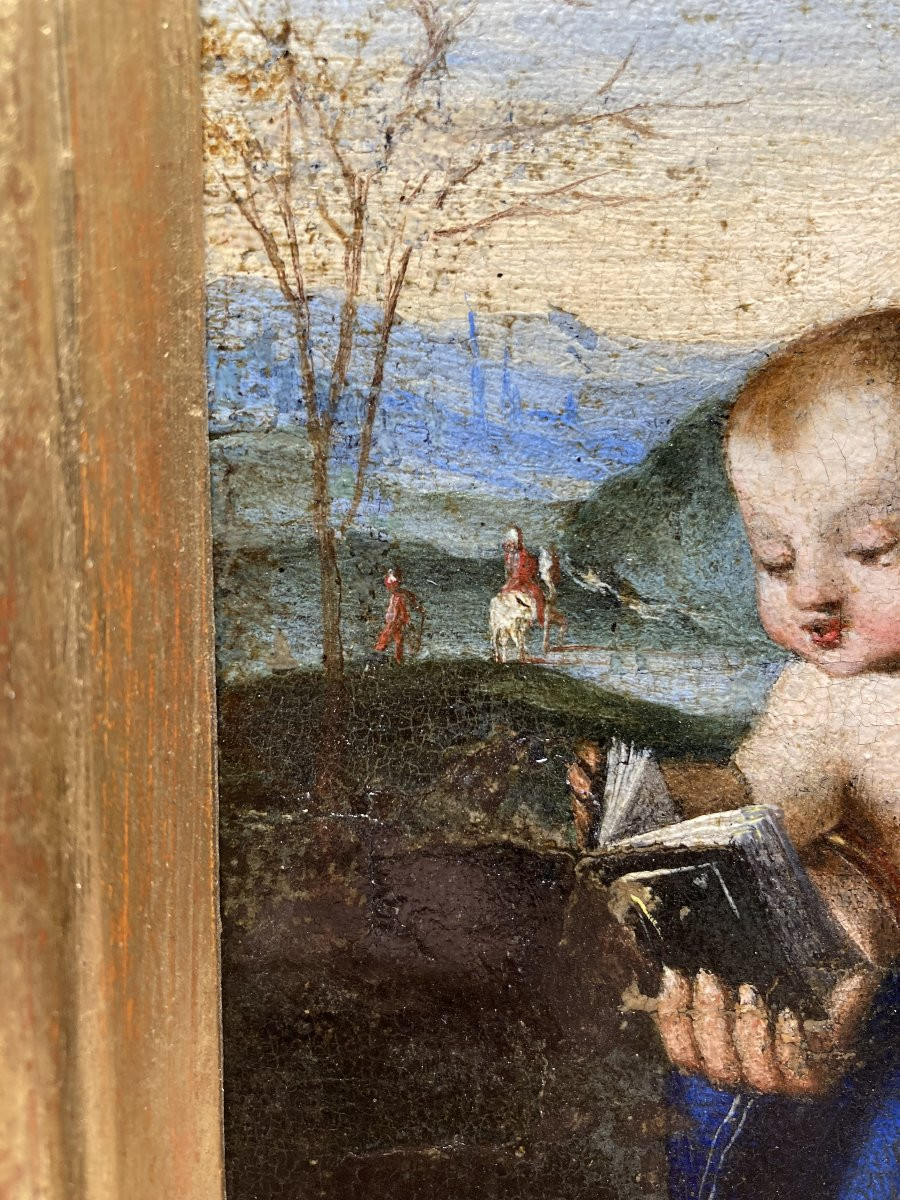
The landscape changes, blurs, and reveals itself through chiaroscuro and the skillful use of color. The clouds are no longer a shade of color, but an independent mass that claims its space in the composition. The attention to naturalistic detail is evident, even where the boat on the lake reflects its shadow, moved by the gentle waves.
The Madonna and Child appear more prominently in the foreground, strongly present in terms of color and volume.
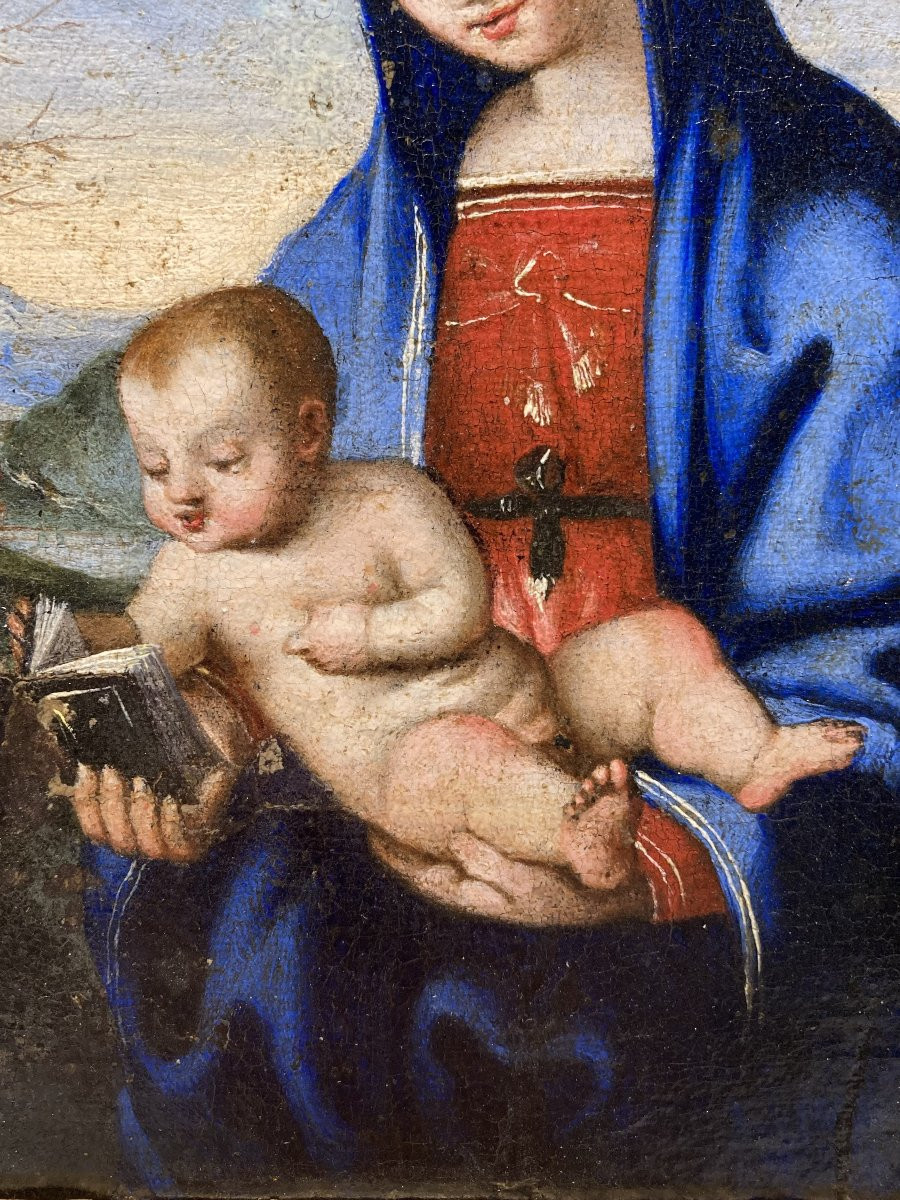
The color and sfumato in the faces of the two sacred subjects highlight the human and personal side behind the two figures: a sweetness rendered through color and sfumato, perfected in Mary's face with her half-closed eyes of rare expressiveness.
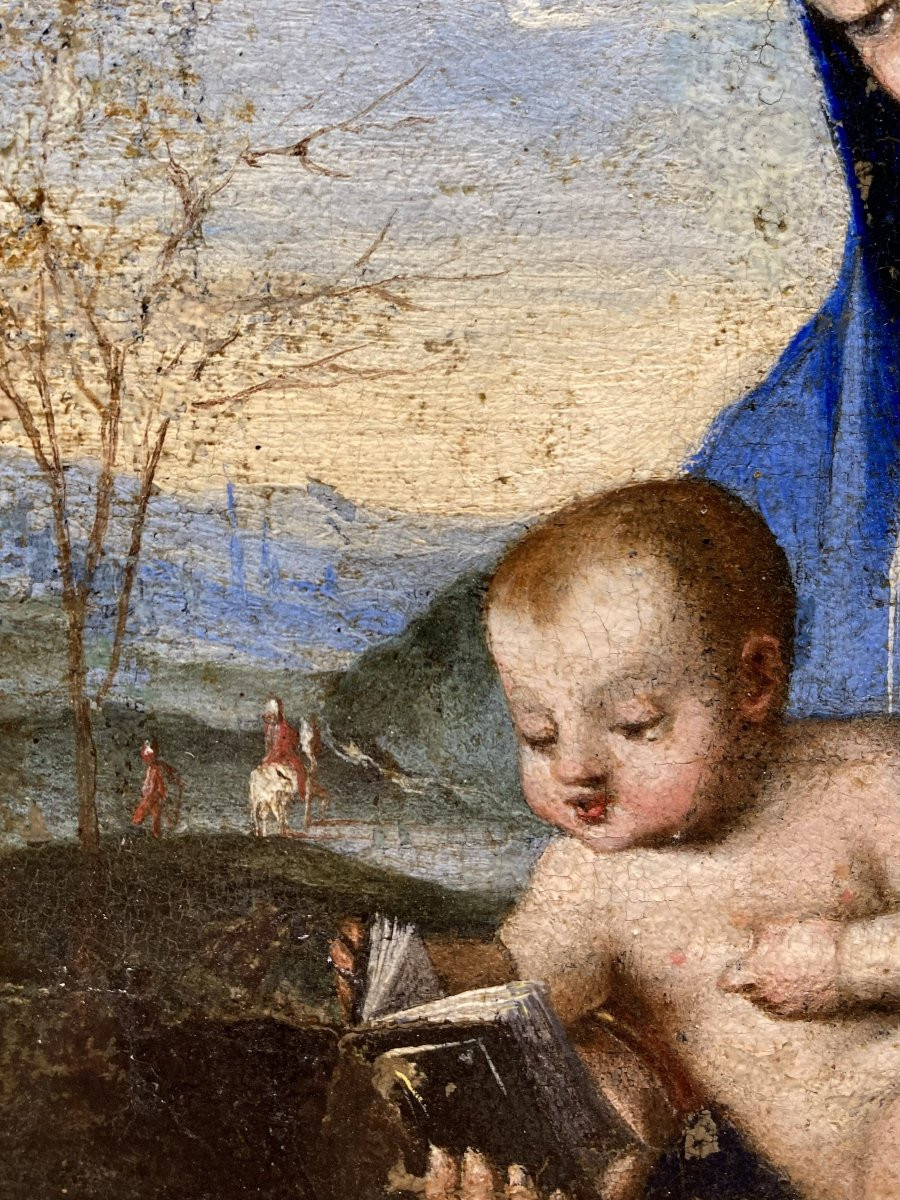
The Child appears lively, curious, yet simultaneously serious, before the Book, which likely contains his Word.
Every detail is rendered with extreme quality, which, given the small size of the canvas, can be described as lenticular.
The two figures in the background, one on foot and one on horseback, are rendered with exquisite brushstrokes and, when viewed under a magnifying glass, reveal the artist's refinement.
Analyzing the differences between the two works and in light of the above, we can confidently place the work in a northern Italian workshop, which closely matches that of Lorenzo Costa of Ferrara.
Furthermore, the Civic Museum of Montepulciano (inv. no. 14/1971) houses a work virtually identical to ours, with some variations on the original but characterized by the same stylistic signature.
Therefore, comparing the two works, we can confidently assert that, just as the Montepulciano canvas has been attributed to Lorenzo Costa's workshop by Dr. Laura Martini, so, in our opinion, ours has the same provenance, as strong similarities exist not only in the depiction but also in the stylistic approach and in comparison to the original work.
Observing the thickness of the canvas, one can see a meticulous preparation of the canvas throughout its stages. The primer on which the artist applied the paint is black, explaining how he managed to give a heavenly luminosity to Mary's face through the contrast between the background and the surface glazes.
The canvas is in very good condition, with some very small, old pictorial retouching.
18th-19th century relining, after which the work was mounted on wood.
The work is accompanied by a 19th-century gilded frame.
Canvas dimensions: 17.5 x 18.5 cm
Frame dimensions: 33.5 x 34 cm








 Le Magazine de PROANTIC
 TRÉSORS Magazine
 Rivista Artiquariato