

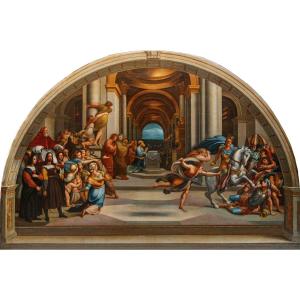


"17th Century, By Raffaello Sanzio, The Expulsion Of Heliodorus From The Temple"
17th century, by Raffaello SanzioThe Expulsion of Heliodorus from the Temple
Oil on canvas, 91 x 135 cm
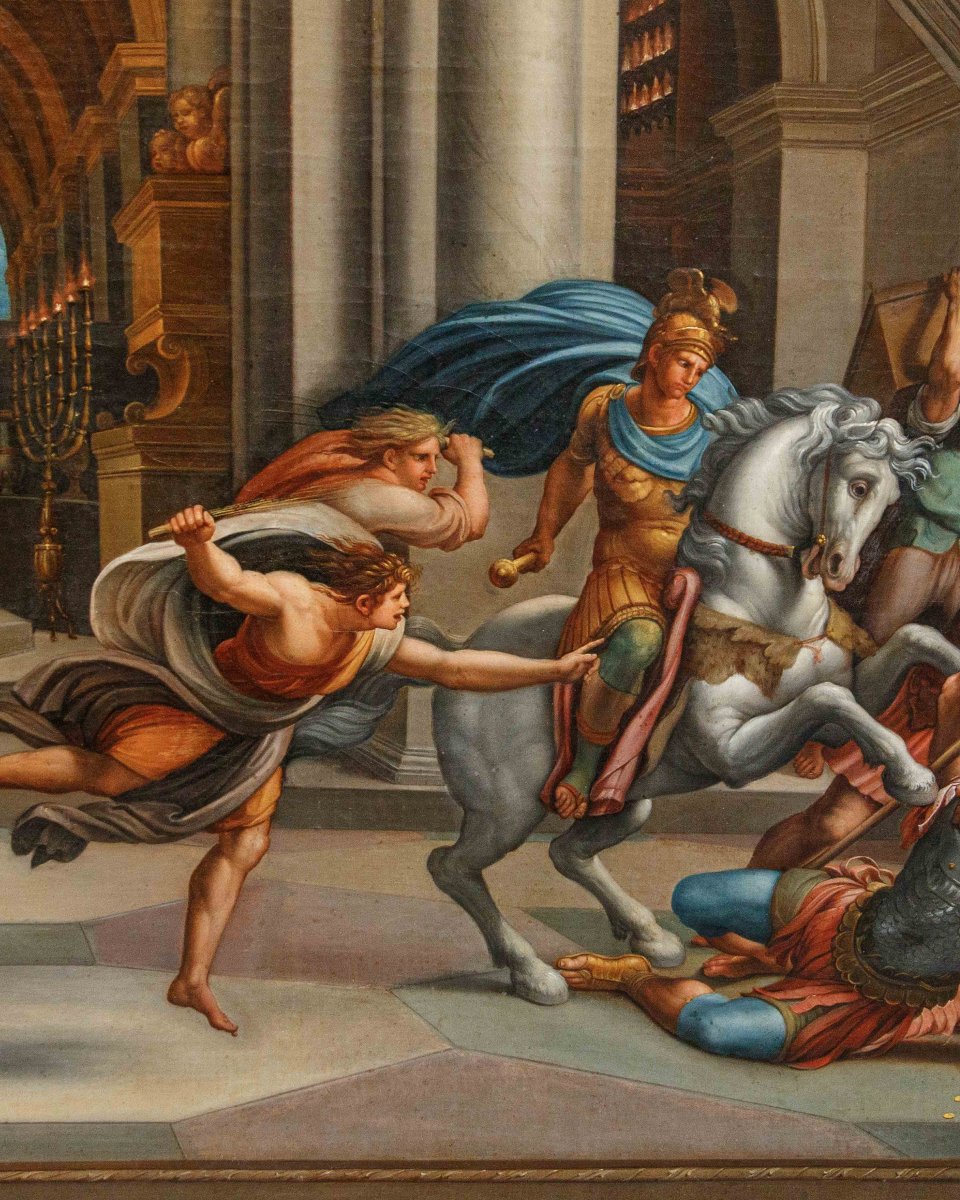
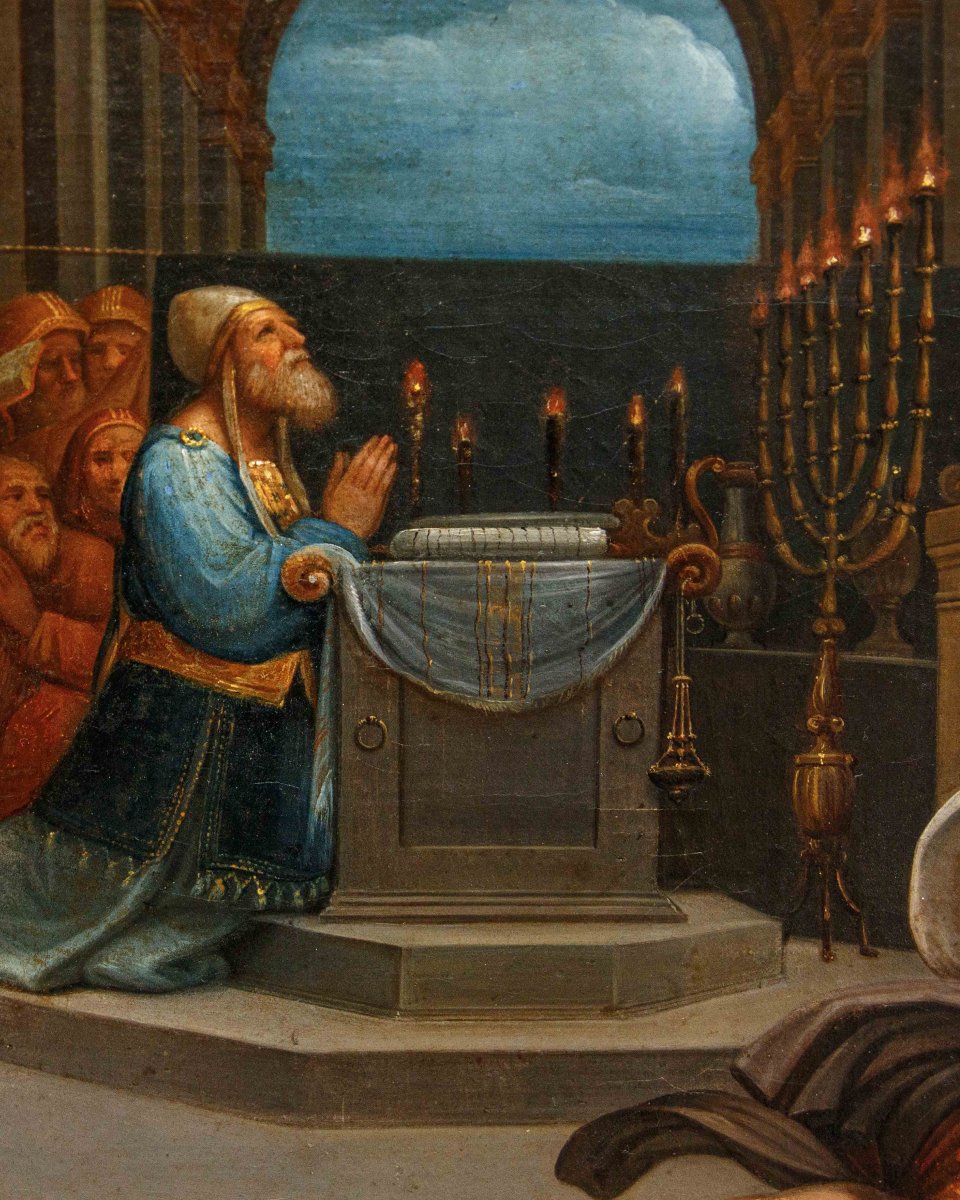
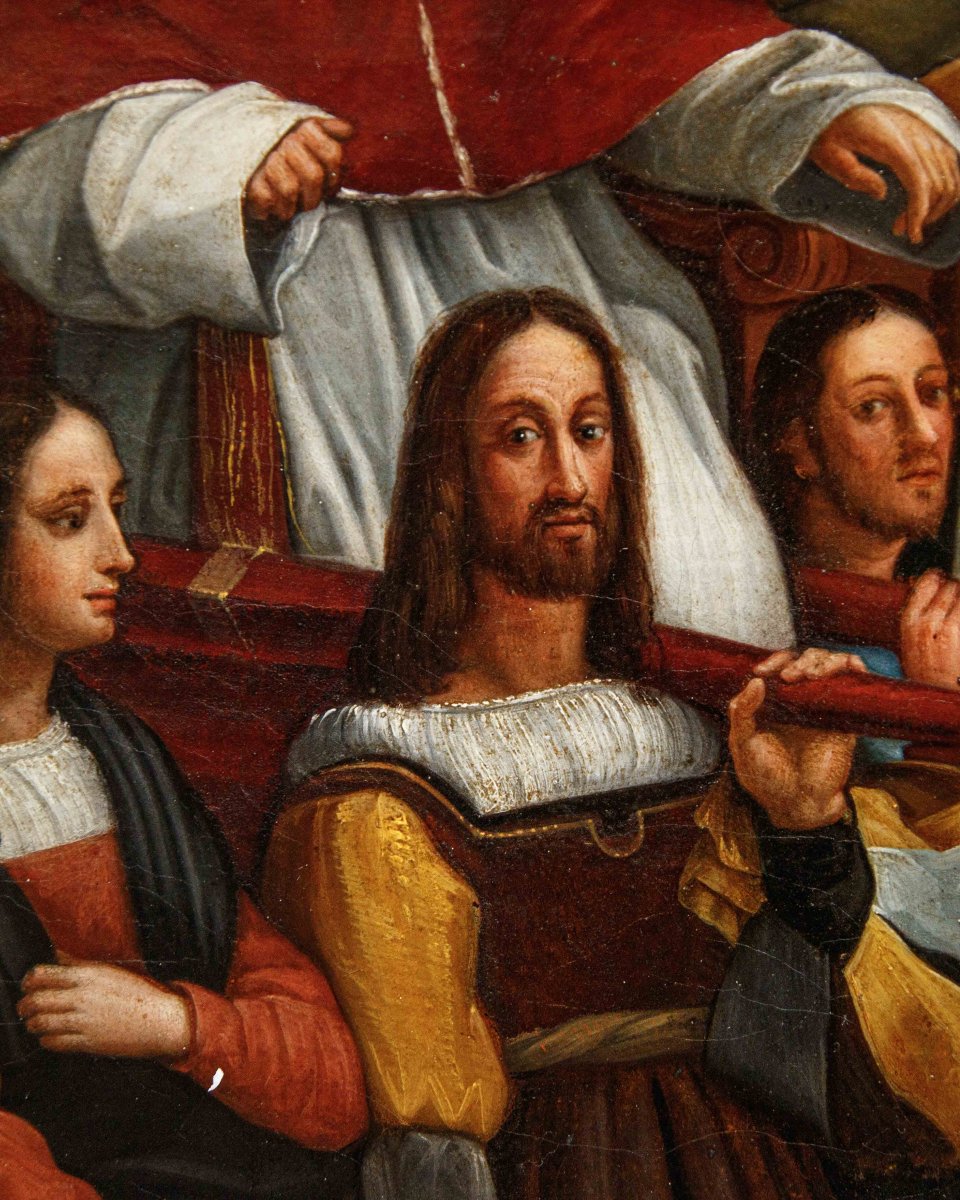
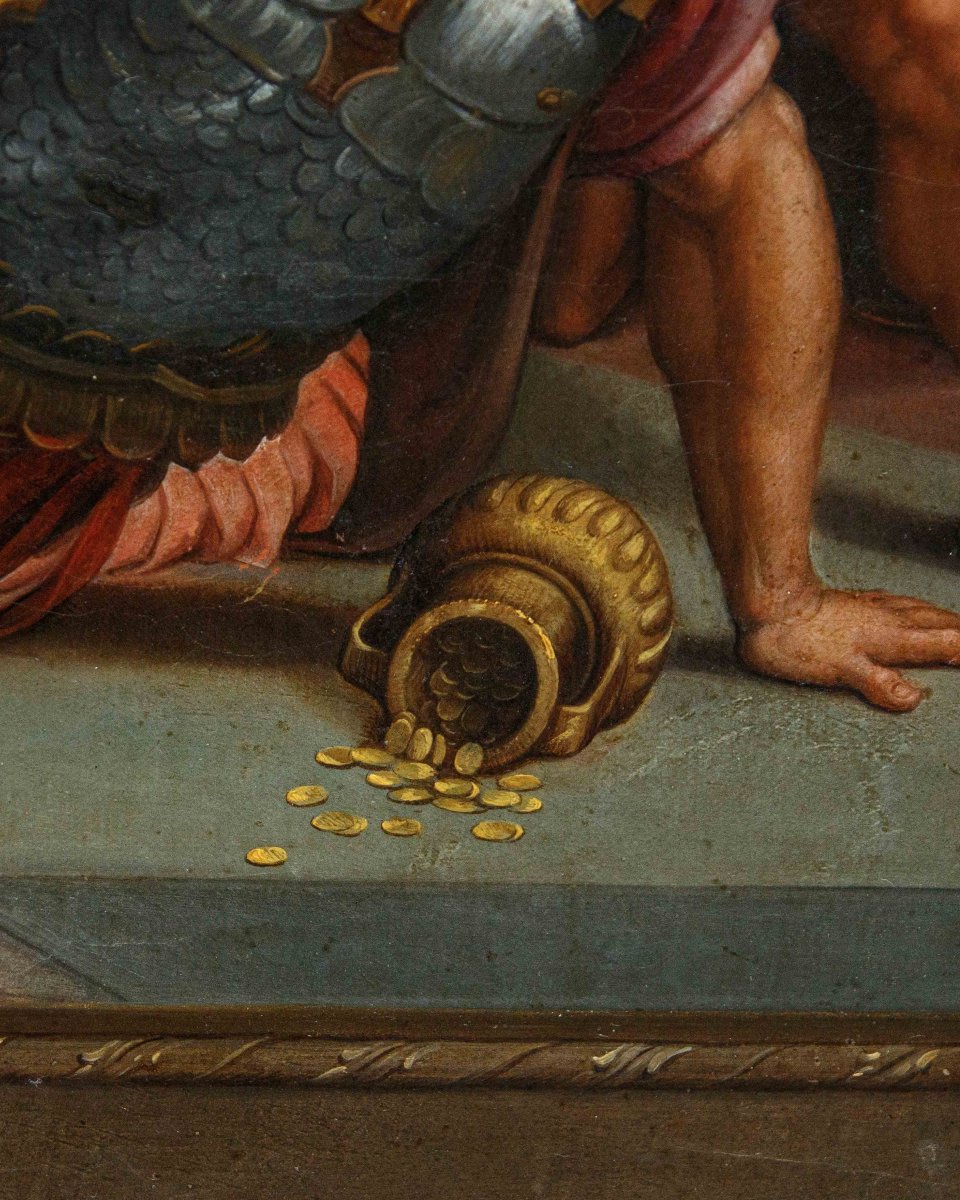
The work in question takes up the famous fresco The Expulsion of Heliodorus from the Temple, the eponymous work of the second of the Vatican Rooms frescoed by Raphael on commission from Pope Julius II (after the Stanza della Segnatura). The Room of Heliodorus was built in a historical period (1511-1514) in which the papacy was strongly threatened both militarily and politically, especially by foreign powers and the ambitions of the Council of Pisa-Milan. The iconographic program of the room, unlike the philosophical balance of the Signatura, was therefore intended to be of a political-celebratory nature: the aim was to illustrate the miraculous protection granted by God to the Church in times of crisis and danger. Specifically, the scene is taken from the Second Book of Maccabees (3, 21-28) and narrates the episode of Heliodorus of Antioch, minister of the king of Syria, sent to Jerusalem to steal the treasures of the Temple. While the High Priest Onias was busy praying, God sent a knight riding his white steed and two young celestial men to flog Heliodorus, putting him to flight and forcing him to return the stolen goods. Allegorically, the episode aimed to symbolize on the one hand the inviolability of ecclesiastical heritage, on the other the direct defense of the Church by God against his enemies (the enemies of Pope Julius II). Raffaello Sanzio made a clear departure from the unified approach and serene balance that had characterized the works of the Stanza della Segnatura. For this new commission, the artist adopts a more dramatic and dynamic register, fully representative of his mature phase. The composition is dominated in depth by the temple architecture, majestic and classicizing, whose imposing barrel vault ideally guides the eye towards the altar, placed in the center of the scene. It is significant, however, that the action does not take place in this geometric heart, but is relegated to the sides, leaving the spatial center empty and immobile, occupied solely by the praying High Priest Onia. The heart of the drama is concentrated on the right: the angel on horseback, symbol of divine justice, flanked by the two young floggers (sometimes interpreted as demonic figures), bursts in with extraordinary violence. The figures of Heliodorus and his accomplices are caught in a sudden and disorderly escape, depicted with a sense of whirling motion. The left side, however, is occupied by the contemporary presence of Pope Julius II, who, sitting in the gestatorial chair with the attitude of a Roman emperor, witnesses the biblical miracle. The bearded and imposing pontiff serves as a witness and guarantor of the truth of the event, explicitly connecting the sacred past to the present of the papacy. Around him, contemporary figures, such as the engraver Marcantonio Raimondi, observe or lean towards action, strengthening the fusion between biblical history and current political events. In terms of lighting, Raphael uses light to emphasize pathos and drama, making strong chiaroscuros pass through Heliodorus' area and underlining the miraculous and supernatural nature of the intervention. The palette is rich and vibrant, with the intense use of reds and golds in the robes contributing to the sumptuousness of the scene, contrasting with the dramatic shadows. The plasticism of the figures is accentuated, exhibiting vigorous bodies and agitated movements; the detail of the man climbing the column on the left to better observe is an example of the search for verisimilitude and the emotional reaction typical of this Raphaelesque phase. The Expulsion of Heliodorus thus marked a stylistic turning point for Raphael, who moved away from the serene and ideal "beautiful manner" of the School of Athens to embrace a more dynamic and monumental language, also stimulated by the vision of Michelangelo's painting on the Sistine Chapel vault, created in those same years. The fresco is a masterpiece of papal propaganda, where the power of the Church and its divine protection are forcefully represented in a time of great crisis. The inclusion of the Pope as a witness makes the work a powerful affirmation of temporal and spiritual power that transcends mere biblical illustration, paving the way for subsequent artistic evolutions of the sixteenth century.
The four walls of Heliodorus' room depict, in addition to the Expulsion of Heliodorus from the Temple, also The Meeting between Leo I and Attila, The Mass of Bolsena and The Liberation of St. Peter. The model painted by Raphael. The image conceived by Raphael enjoyed great success not only in brush tests, but also in engraved replicas, such as those created by Giovanni Volpato (1735-1803) in the 18th century.










 Le Magazine de PROANTIC
 TRÉSORS Magazine
 Rivista Artiquariato