





G. Simoni, Pair Of Paintings "les Fêtes Galantes", Paris, 1881
Artist: G. Simoni
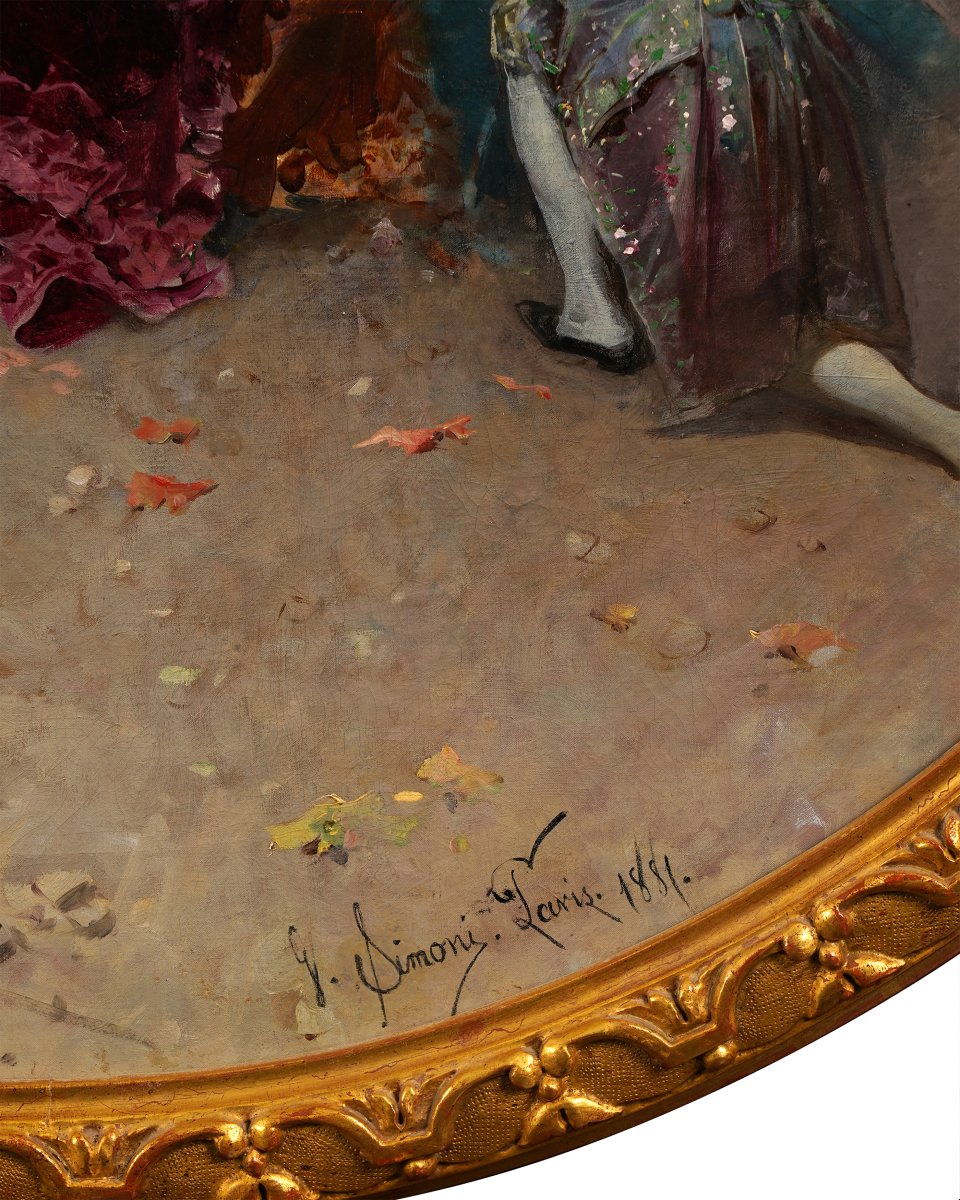
Signed, located and dated G. Simoni. Paris. 1881
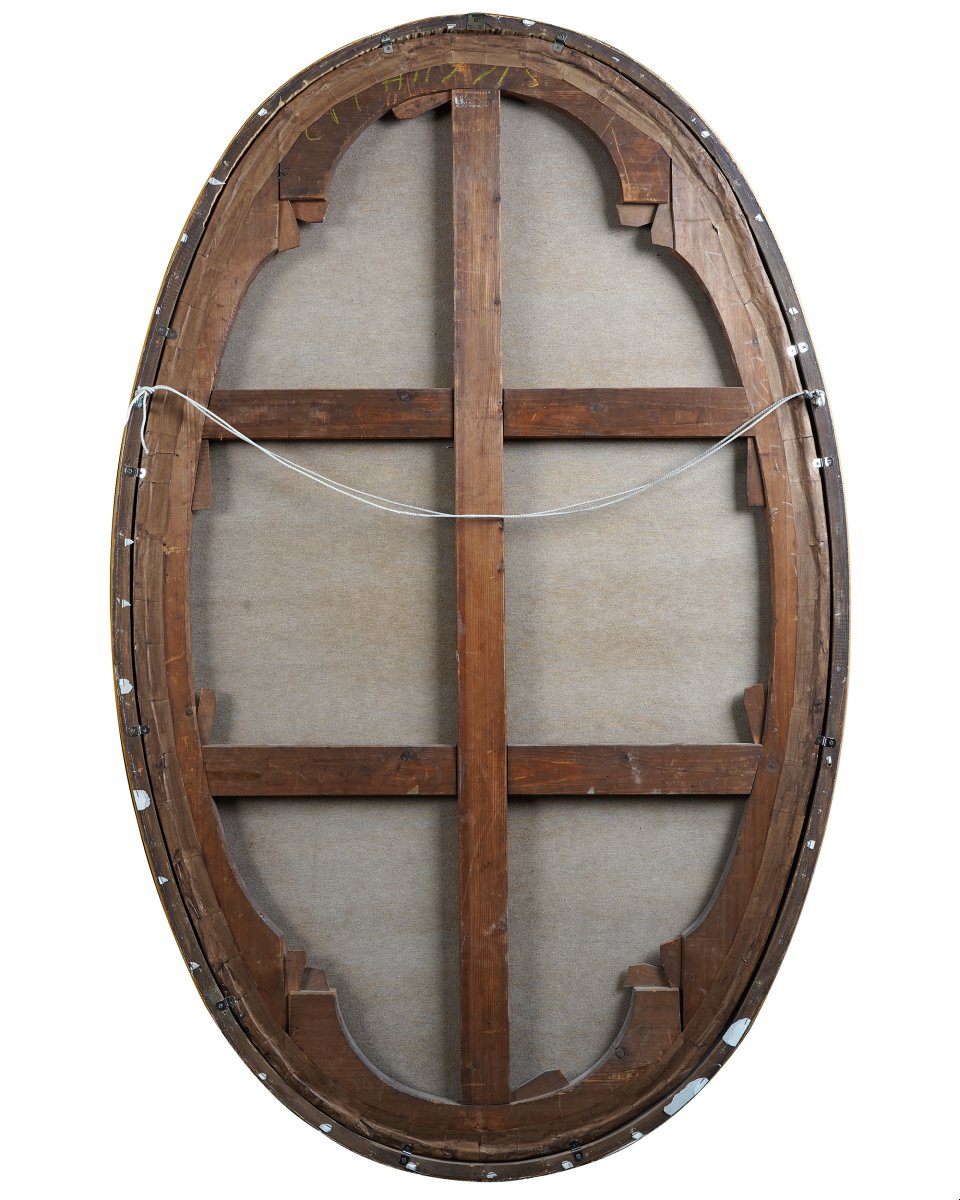
Dimensions with frame – Height : 165 cm (64,9 in.) ; Width : 105 cm (41,3 in.)
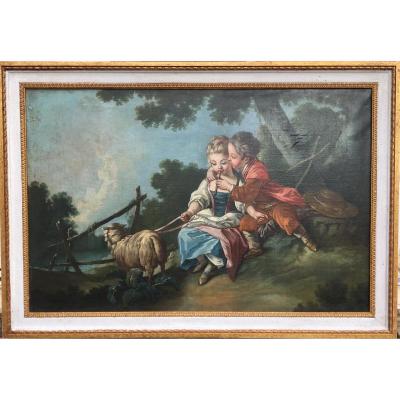
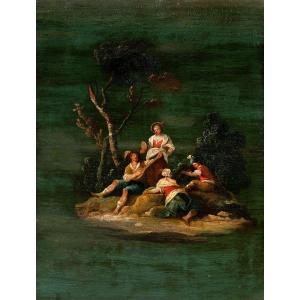
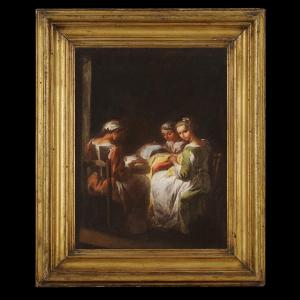
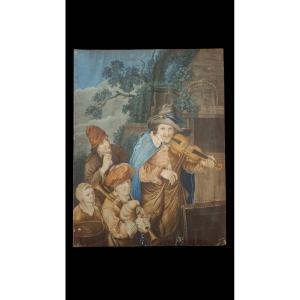
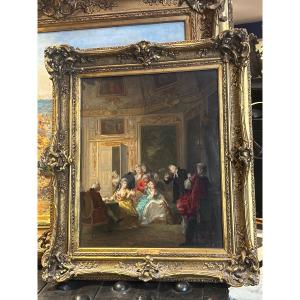
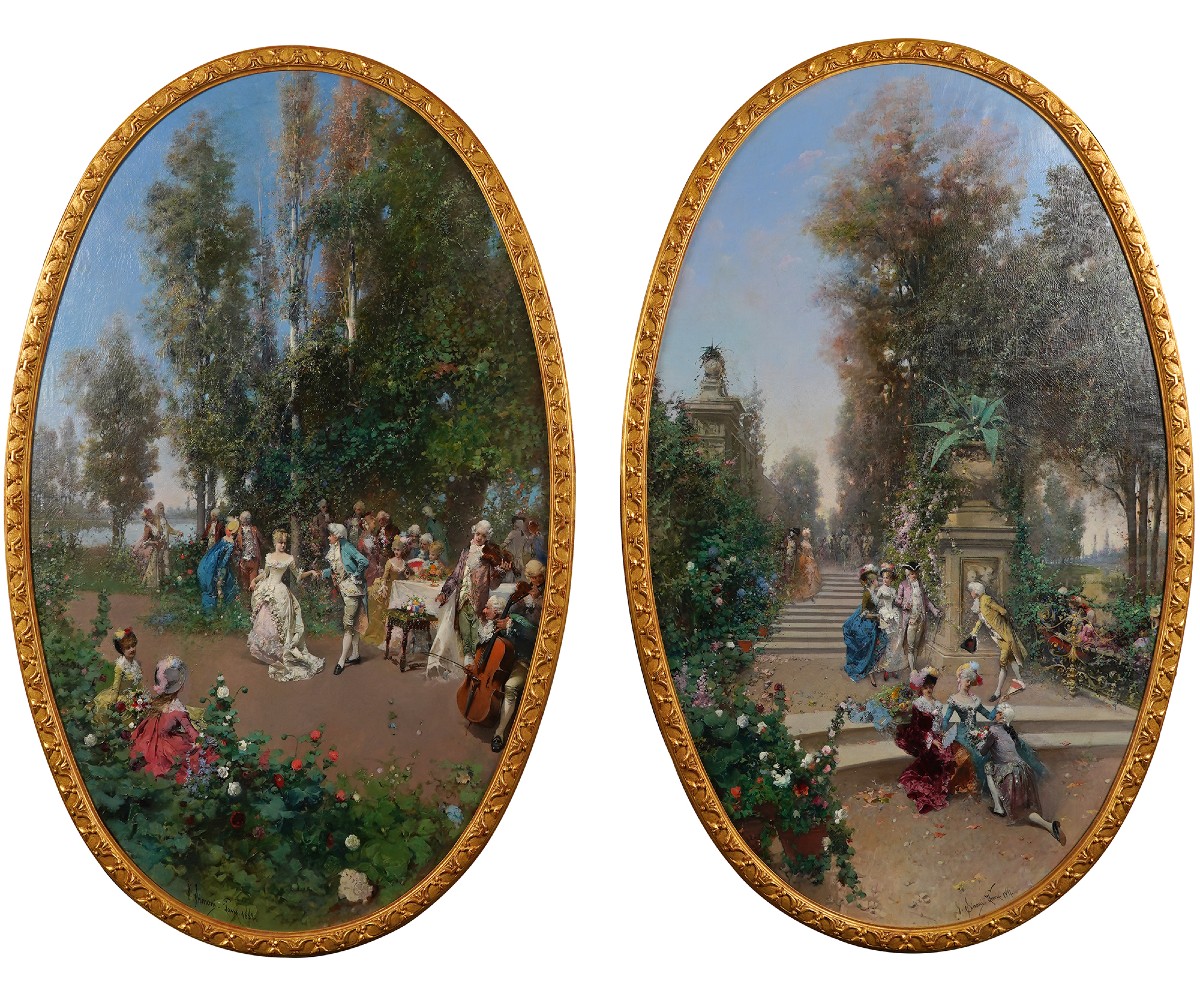
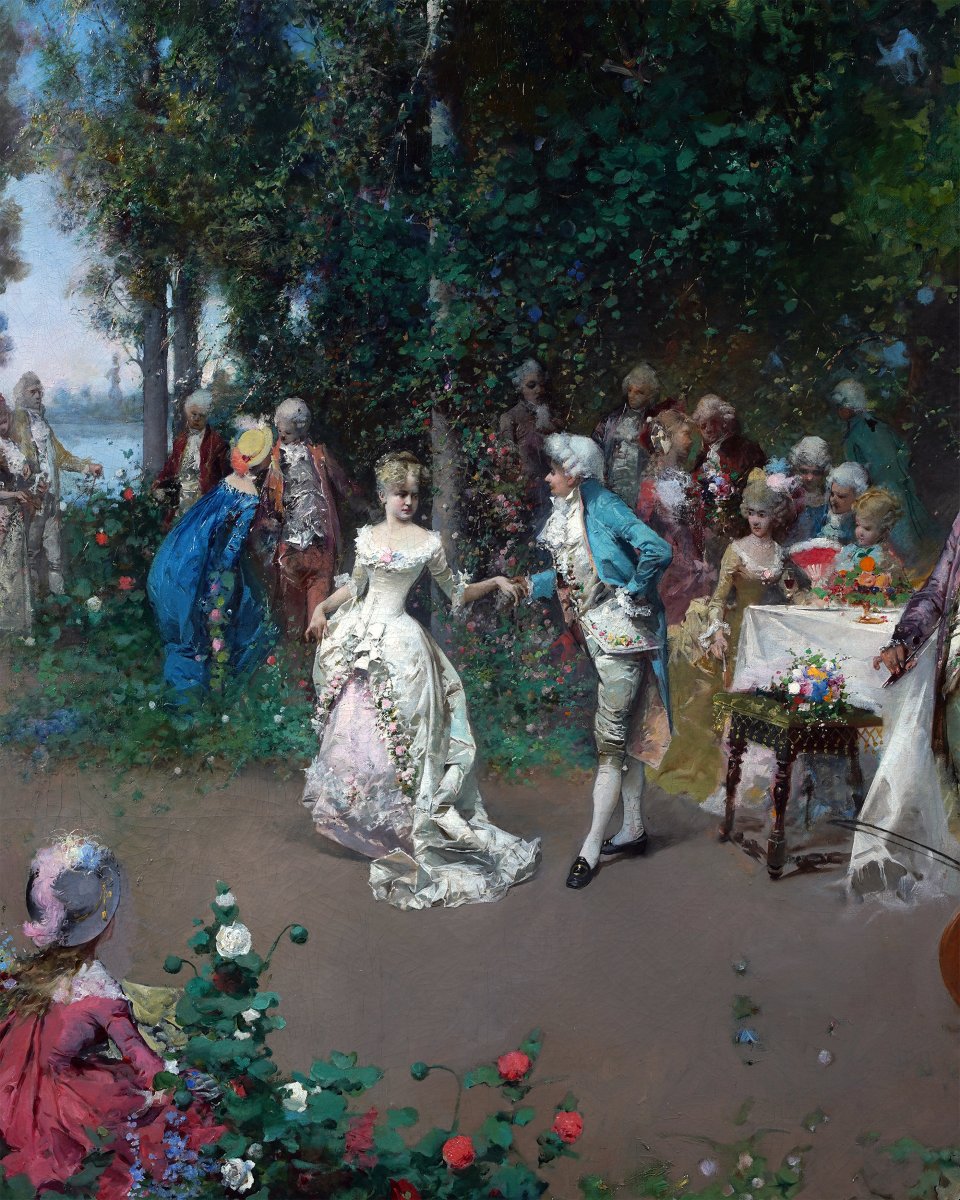
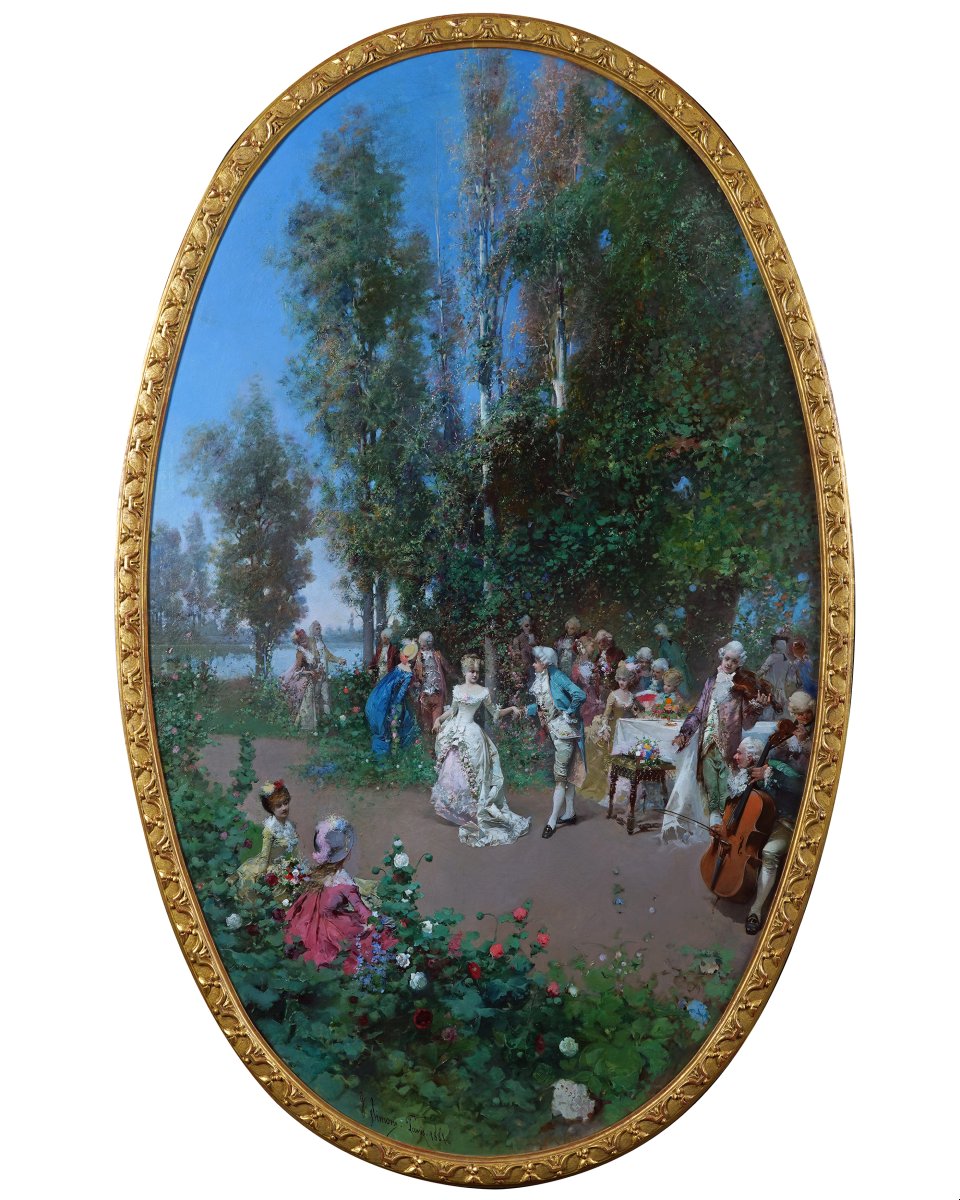
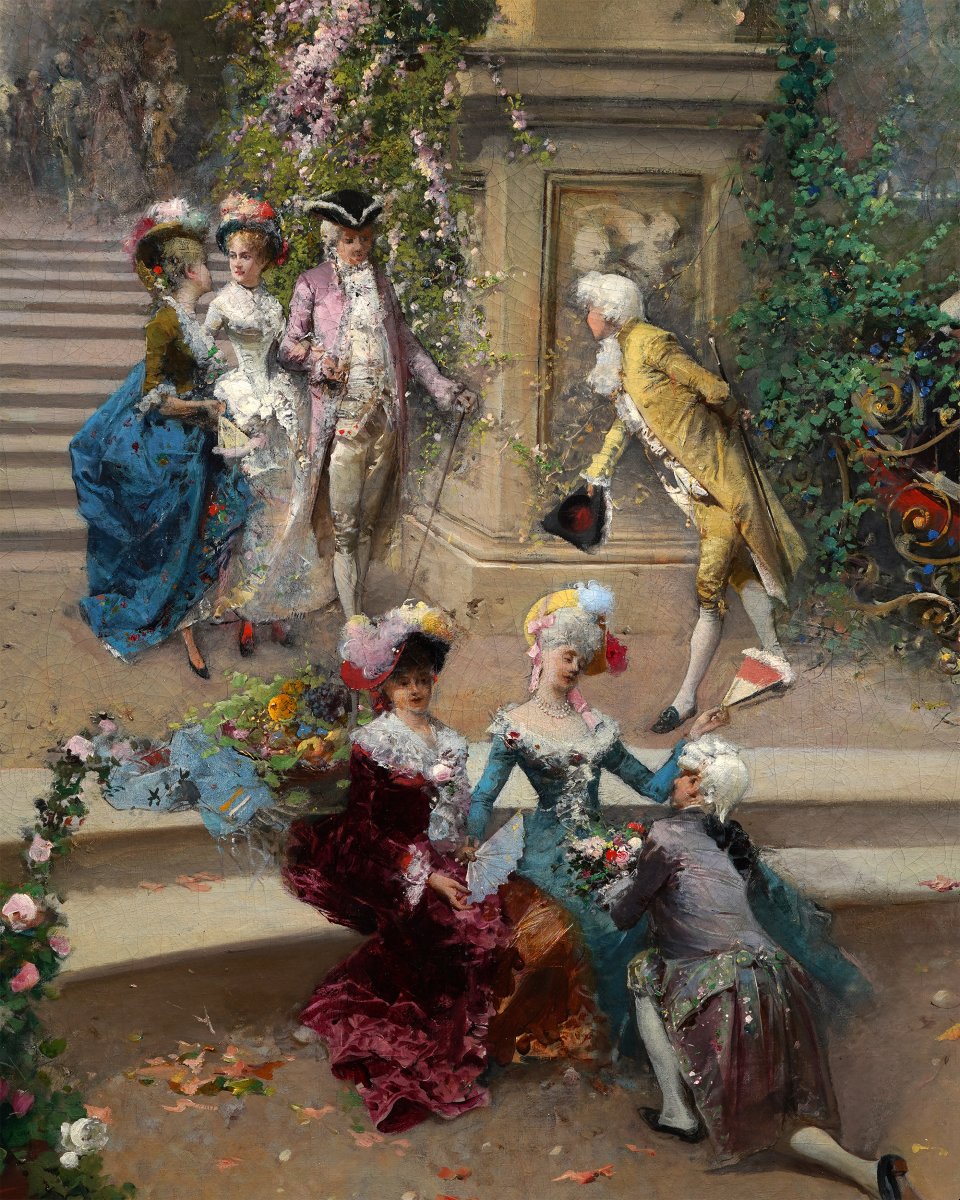
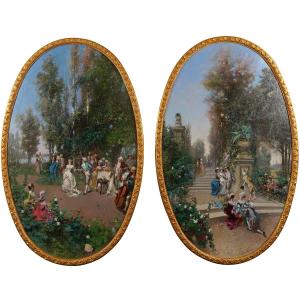
This large pair of oval paintings depicts elegant ladies and gentlemen dressed in eighteenth-century fashion, gathered in a vast formal French garden. The first painting shows an open-air concert: a group of musicians accompanies the stroll of refined couples moving along a path lined with flowering beds, beneath tall trees that filter a clear light. The second painting depicts a social rendezvous at the foot of a staircase adorned with statues and ornamental urns. Ladies in brightly colored silk gowns and cavaliers in pastel attire converse, while other figures recede into the depth of the park.
The palette is luminous, dominated by the greens of the foliage, the blues of the sky, and the pinks, blues, and whites of the fabrics. The brushwork, supple and vibrant, suggests the details of costumes and vegetation rather than describing them meticulously, creating an atmosphere of lighthearted and animated festivity.
These paintings belong to the Neo-Rococo revival that enjoyed great success in Paris during the Second Empire and then the Third Republic. Simoni draws inspiration from the tradition of the fêtes galantes of Watteau and Fragonard, reinterpreted by the painters of fashionable genre scenes of the Belle Époque.
The choice of the oval format, the staging of an idealized park, and the emphasis on polite conversation, music, and promenade all evoke a nostalgic and refined vision of the Ancien Régime, highly sought after by the Parisian bourgeois clientele of the late nineteenth century.
Through the liveliness of the brushwork, the care given to textiles, and the animation of the crowd, these paintings are close to the works of contemporaries such as Cesare Augusto Detti, Federico Andreotti, and Vittorio Reggianini, who were also active between Italy and Paris.
Biography :
Gustavo Simoni (1845–1926) was an Italian painter born in Rome who studied at the Accademia di San Luca in Rome. From 1877 onward, Simoni began traveling throughout Europe (France, Spain) and especially in North Africa (Tunisia, Morocco, and Algeria, where he settled for several years).
These travels nourished his inspiration and oriented him toward Orientalism, a nineteenth-century European artistic movement depicting life in the Maghreb and the Middle East, of which he became one of the leading Italian representatives. His works depict caravans, North African markets, street scenes, musicians, and Berber figures with realism and a keen sense of detail.
He won a gold medal at the Paris Salon of 1889 with his monumental scene The Burning of Persepolis. In the 1890s, he opened a studio in Paris and founded an Orientalist painting school in Rome to train young artists. He contributed to the Società degli Acquarellisti Romani (Association of Roman Watercolorists), and his works are now held in collections and museums around the world, notably in Glasgow, Leipzig, Melbourne, and New York.
Bibliography :
• Crespelle, Jean?Paul, La vie artistique au temps de la Belle Époque, Paris, 1966
• Conisbee, Philip, Painting in 19th?Century France, London, 1990
• Expositions de peintres de genre mondain à Paris (catalogues de salons, 1875–1900)
Dimensions with frame – Height : 165 cm (64,9 in.) ; Width : 105 cm (41,3 in.)
This large pair of oval paintings depicts elegant ladies and gentlemen dressed in eighteenth-century fashion, gathered in a vast formal French garden. The first painting shows an open-air concert: a group of musicians accompanies the stroll of refined couples moving along a path lined with flowering beds, beneath tall trees that filter a clear light. The second painting depicts a social rendezvous at the foot of a staircase adorned with statues and ornamental urns. Ladies in brightly colored silk gowns and cavaliers in pastel attire converse, while other figures recede into the depth of the park.
The palette is luminous, dominated by the greens of the foliage, the blues of the sky, and the pinks, blues, and whites of the fabrics. The brushwork, supple and vibrant, suggests the details of costumes and vegetation rather than describing them meticulously, creating an atmosphere of lighthearted and animated festivity.
These paintings belong to the Neo-Rococo revival that enjoyed great success in Paris during the Second Empire and then the Third Republic. Simoni draws inspiration from the tradition of the fêtes galantes of Watteau and Fragonard, reinterpreted by the painters of fashionable genre scenes of the Belle Époque.
The choice of the oval format, the staging of an idealized park, and the emphasis on polite conversation, music, and promenade all evoke a nostalgic and refined vision of the Ancien Régime, highly sought after by the Parisian bourgeois clientele of the late nineteenth century.
Through the liveliness of the brushwork, the care given to textiles, and the animation of the crowd, these paintings are close to the works of contemporaries such as Cesare Augusto Detti, Federico Andreotti, and Vittorio Reggianini, who were also active between Italy and Paris.
Biography :
Gustavo Simoni (1845–1926) was an Italian painter born in Rome who studied at the Accademia di San Luca in Rome. From 1877 onward, Simoni began traveling throughout Europe (France, Spain) and especially in North Africa (Tunisia, Morocco, and Algeria, where he settled for several years).
These travels nourished his inspiration and oriented him toward Orientalism, a nineteenth-century European artistic movement depicting life in the Maghreb and the Middle East, of which he became one of the leading Italian representatives. His works depict caravans, North African markets, street scenes, musicians, and Berber figures with realism and a keen sense of detail.
He won a gold medal at the Paris Salon of 1889 with his monumental scene The Burning of Persepolis. In the 1890s, he opened a studio in Paris and founded an Orientalist painting school in Rome to train young artists. He contributed to the Società degli Acquarellisti Romani (Association of Roman Watercolorists), and his works are now held in collections and museums around the world, notably in Glasgow, Leipzig, Melbourne, and New York.
Bibliography :
• Crespelle, Jean?Paul, La vie artistique au temps de la Belle Époque, Paris, 1966
• Conisbee, Philip, Painting in 19th?Century France, London, 1990
• Expositions de peintres de genre mondain à Paris (catalogues de salons, 1875–1900)
46 000 €
Period: 19th century
Style: Louis 15th - Transition
Condition: Good condition
Material: Oil painting
Width: 105
Height: 165
Depth: 5
Reference (ID): 1691623
Availability: In stock
Print