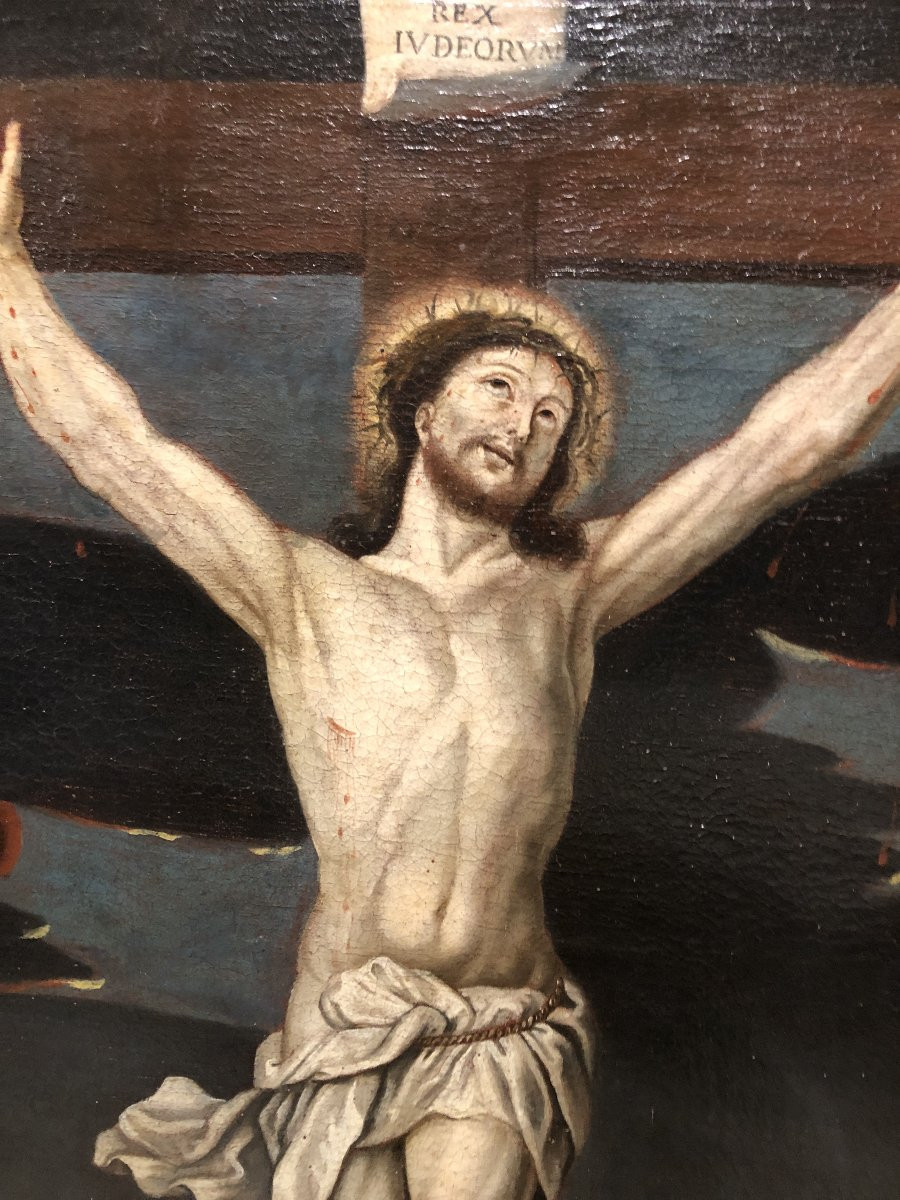


Adam Van Noort (1561-1641), Circle - Mary Of Austria, Empress, Before Christ
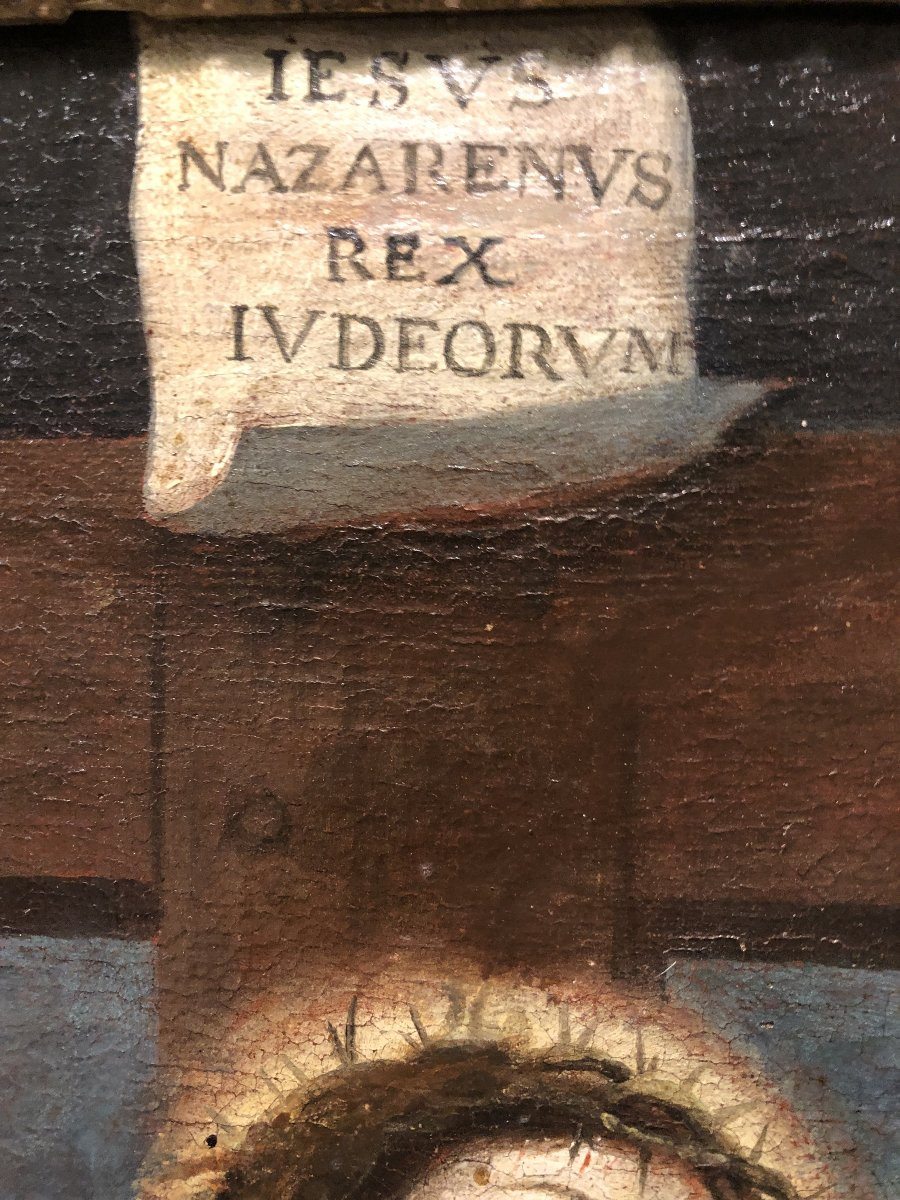
Oil on canvas. Original canvas. Examination of the painting under ultraviolet light reveals an exceptional state of preservation. In this monumental oil painting, attributed to the circle of the great Antwerp master Adam van Noort, unfolds a scene of striking epic and spiritual dimension: Mary of Austria, daughter of Emperor Charles V and Empress of the Holy Roman Empire, stripped of her earthly finery, bows with absolute devotion at the feet of Christ. The characteristic features of the Habsburgs blend with the solemnity of the religious habit and ermine mantle, while the crown, symbol of a power that dominated Europe, rests humbly before the cross, testifying to divine sovereignty over earthly power. This work is not merely a portrait, but a manifesto of the Counter-Reformation in a Netherlands ravaged by revolt. At the height of the challenge to Austrian hegemony by William of Orange, the Antwerp School immortalized the Empress as the unshakeable bulwark of the Catholic faith, reaffirming Habsburg piety in the face of the winds of heresy. After the death of Maximilian II, Maria's influence reached almost legendary proportions, firmly guiding the destinies of her sons, the future emperors Rudolf II and Matthias, before her triumphant return to Spain in 1582. Settled in the Discalced Monastery, she transformed this refuge into the epicenter of an unparalleled political and spiritual faction, where, alongside her daughter Margaret and Queen Margaret of Austria-Styria, she challenged the hegemony of the Duke of Lerma and financed campaigns that would defend the Catholic ideal in the heart of Europe. Her life, an epic of dynastic diplomacy and mystical fervor, ended in 1603 with the notes of the immortal Requiem by Tomás Luis de Victoria, composed especially to honor the woman who, from her cloister, ruled an empire and celebrated until her last breath a Spain she considered the last refuge of Orthodox Christendom. Antwerp religious painting from the transition between the 16th and 17th centuries constitutes a fundamental chapter in art history, establishing a crucial link between late Mannerism and the flourishing of Flemish Baroque. In this vibrant context of the Counter-Reformation, the city on the Scheldt River emerged as a cosmopolitan center of artistic production where sacred imagery regained its role as a tool of persuasion and devotion. At the heart of this artistic ferment was Adam van Noort, a master among masters, whose current renown as a mentor to figures such as Peter Paul Rubens and Jacob Jordaens should not overshadow his talent as a prolific creator of monumental altarpieces. His style is distinguished by a vigorous physical monumentality and an anatomical treatment that lends biblical scenes a dramatic tension foreshadowing the energy of the Baroque. Van Noort displayed a particular predilection for the iconography of the Crucifixion, which he used as a stage to explore the contrast between the suffering divinity and the humanity of those surrounding the cross, through stormy skies and dramatic lighting. Among his most remarkable works are the Crucifixion in the Church of St. Frutos, famous for its pyramidal pathos, and the Christ on the Cross in Antwerp Cathedral, where he fused the meticulous detail of Flemish art with Herculean proportions influenced by Italian art. Similarly, in his versions of the Crucifixion with donors, he included the nobility and clergy to link sacred history to the political reality of a city that, after the siege of Antwerp, was reasserting itself as the great Catholic stronghold of the Netherlands. These works, more than mere objects of worship, were powerful declarations of faith whose formal robustness and religious eloquence laid the essential foundations for the development of great 17th-century Flemish painting. - Dimensions of the image without frame: 87 x 114 cm / 99 x 125.5 cm with an interesting antique frame.
7 500 €
Period: 16th century
Style: Other Style
Condition: Excellent condition
Material: Oil painting
Reference (ID): 1689396
Availability: In stock
Print