


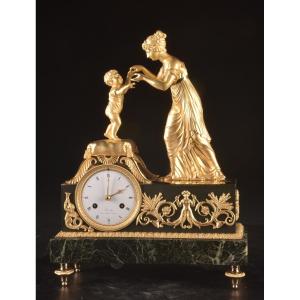


"Empire Period Clock Decorated With Diana And Venus, Gilt Bronze And Marble, Attributed To Thomire, "
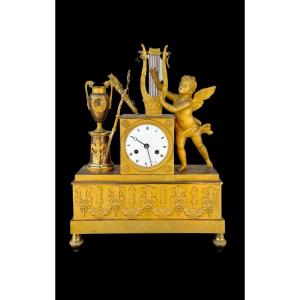
This elegant Empire period clock, attributed to Pierre-Philippe Thomire, dates from the early 19th century, around 1805–1815, and is a remarkable example of French Neoclassical decorative art during the First Empire. It is surmounted by a finely mercury-gilded bronze sculpture, traditionally identified as Diana and Venus, depicted in a graceful allegorical scene. The standing female figure, draped in antique fabric, delicately extends an object to a young child positioned above the dial. The modeling of the figures is distinguished by the finesse of their anatomy, the expressiveness of their gestures, and the exquisite rendering of the drapery. The whole reflects the Empire period's marked interest in classical mythology and moral themes. The architecturally structured case combines dark patinated bronze with a base of veined green marble. The façade is richly adorned with gilt-bronze appliqués depicting palmettes, foliate scrolls, and a central female figure, a symbol of harmony and abundance. The white enamel dial with Roman numerals is surrounded by a finely chased gilt-bronze bezel, lending balance and legibility to the composition. The quality of the casting, the precision of the chasing, and the harmonious proportions are characteristic of the work of Thomire and his workshop, among the most prestigious Parisian bronze casters of the Empire period. The clock is preserved in very fine original condition and displays a strong decorative and sculptural presence. Dimensions: 43 × 33 × 12.5 cm. 














 Le Magazine de PROANTIC
 TRÉSORS Magazine
 Rivista Artiquariato