THIS OBJECT WAS SOLD
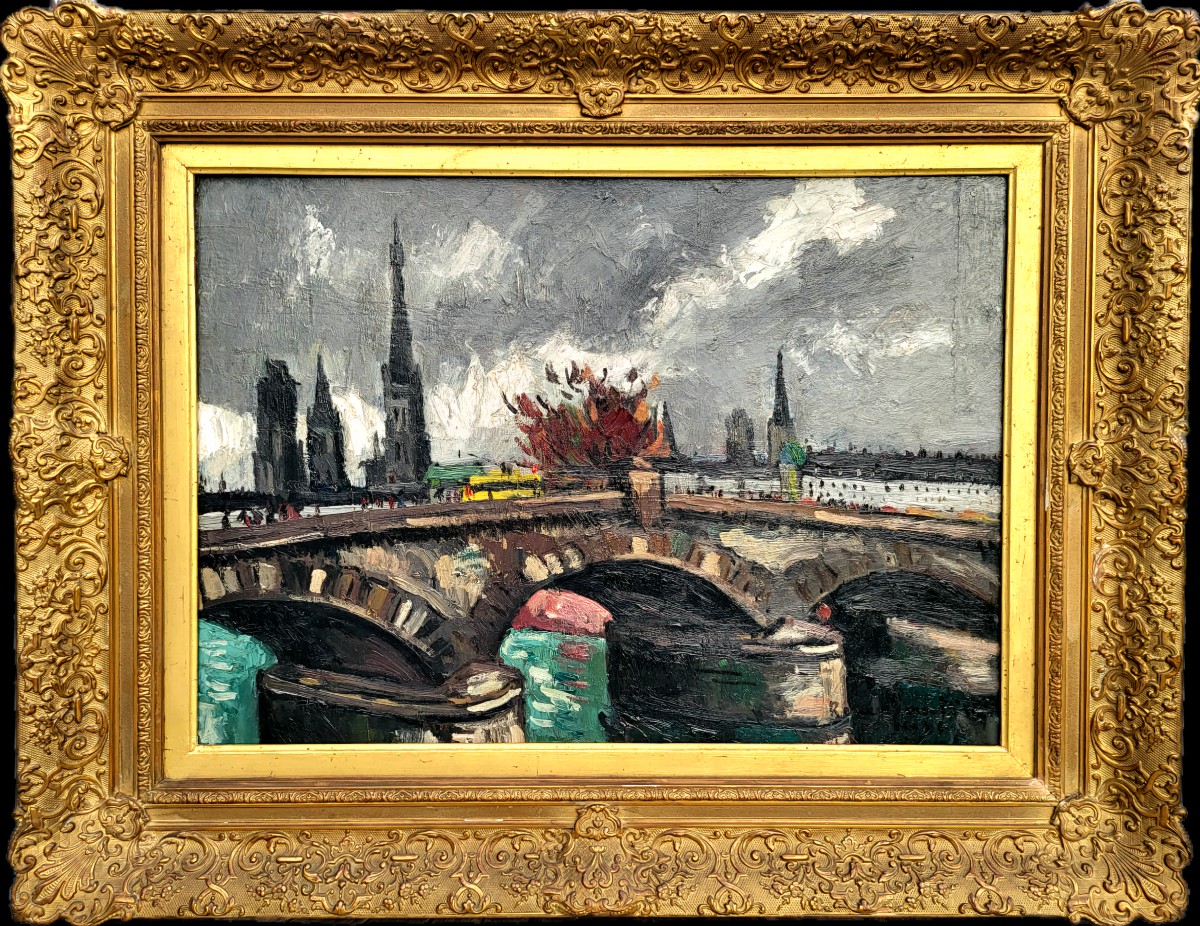
René Sautin (1881-1968) Rouen, The Pierre Corneille Bridge In Grey Weather, Dated 1931




The Work:
Rouen, the Corneille Bridge in Gray Weather. Signed and dated 1931. This oil on cardboard is a vibrant and powerful depiction of the city of Rouen, a rare subject for René Sautin. The artist presents us with a masterful view of the Corneille Bridge, with the iconic silhouette of Notre-Dame Cathedral and the spires of the city of a hundred bell towers in the background. Sautin, the "painter of strength," uses a broad and generous brushstroke. The paint is worked with a fervor that gives the gray Normandy sky a spectacular, almost tormented dynamism. Although the title evokes "gray weather," the work is punctuated by bold contrasts: the highlights of red and yellow in the center and the touches of emerald green on the bridge piers bring a striking modernity and luminosity to the whole. Historical and Local Subject: The Corneille Bridge and the quays of the Seine are major themes of the Rouen School. This work captures the industrial and port atmosphere of the city with a sensitivity characteristic of the great colorists of the 19th and 20th centuries. The painting is enhanced by a substantial gilded wooden frame. This imposing and richly sculpted frame offers a classical contrast that underscores the painting's modernity.
The Artist:
René Sautin (Montfort-sur-Risle 1881-Les Andelys 1968) A French painter of the Norman school, René Sautin was primarily a landscape painter, trained at the Rouen School of Fine Arts. After studying in Montfort-sur-Risle and Pont-Audemer, he entered the Rouen School of Fine Arts in the studio of the painter Philippe Zacharie. He returned to Paris where he spent a year in Ferrier's studio, after which he painted under the guidance of the painter Albert Lebourg. He settled in Les Andelys in 1911, deeply connected to his Norman homeland. The banks of the Seine at Les Andelys were his favorite subject, often painted by his fellow artists, including Manzanna Pissarro and Paul Signac, Maximilien Luce, André Derain, Armand Guillaumin, Henri Lebasque, and Paul-Elie Gernez. Around 1923, he abandoned Impressionist techniques for a calm and reasoned Fauvism. Having found balance in his means of expression from 1925 onward, he reached his peak in the 1950s. He is one of the few Norman painters to depict his landscapes in such a personal way, characterized by their power, a certain controlled violence, and a strong sensitivity. The Second World War profoundly affected the artist. He tirelessly painted the Seine, the quays of Petit-Andelys, and Château Gaillard, but each time it was a new work; his creative genius led him to produce a new composition each time. His technique evolved over time; the lines became more pronounced, the forms outlined in deep black. In the 1950s, René Sautin continued this tendency to emphasize his drawing. Unfortunately, he gradually lost his sight. The artist compensated for his vision loss with increasingly intense and vivid colors, which he reproduced on large canvases. He stopped painting permanently in 1964, four years before his death in 1968 at the age of 87. His works are exhibited in the museums of Pont-Audemer, Vernon, and Les Andelys. He also exhibited at the Salon des Indépendants.
Rouen, the Corneille Bridge in Gray Weather. Signed and dated 1931. This oil on cardboard is a vibrant and powerful depiction of the city of Rouen, a rare subject for René Sautin. The artist presents us with a masterful view of the Corneille Bridge, with the iconic silhouette of Notre-Dame Cathedral and the spires of the city of a hundred bell towers in the background. Sautin, the "painter of strength," uses a broad and generous brushstroke. The paint is worked with a fervor that gives the gray Normandy sky a spectacular, almost tormented dynamism. Although the title evokes "gray weather," the work is punctuated by bold contrasts: the highlights of red and yellow in the center and the touches of emerald green on the bridge piers bring a striking modernity and luminosity to the whole. Historical and Local Subject: The Corneille Bridge and the quays of the Seine are major themes of the Rouen School. This work captures the industrial and port atmosphere of the city with a sensitivity characteristic of the great colorists of the 19th and 20th centuries. The painting is enhanced by a substantial gilded wooden frame. This imposing and richly sculpted frame offers a classical contrast that underscores the painting's modernity.
The Artist:
René Sautin (Montfort-sur-Risle 1881-Les Andelys 1968) A French painter of the Norman school, René Sautin was primarily a landscape painter, trained at the Rouen School of Fine Arts. After studying in Montfort-sur-Risle and Pont-Audemer, he entered the Rouen School of Fine Arts in the studio of the painter Philippe Zacharie. He returned to Paris where he spent a year in Ferrier's studio, after which he painted under the guidance of the painter Albert Lebourg. He settled in Les Andelys in 1911, deeply connected to his Norman homeland. The banks of the Seine at Les Andelys were his favorite subject, often painted by his fellow artists, including Manzanna Pissarro and Paul Signac, Maximilien Luce, André Derain, Armand Guillaumin, Henri Lebasque, and Paul-Elie Gernez. Around 1923, he abandoned Impressionist techniques for a calm and reasoned Fauvism. Having found balance in his means of expression from 1925 onward, he reached his peak in the 1950s. He is one of the few Norman painters to depict his landscapes in such a personal way, characterized by their power, a certain controlled violence, and a strong sensitivity. The Second World War profoundly affected the artist. He tirelessly painted the Seine, the quays of Petit-Andelys, and Château Gaillard, but each time it was a new work; his creative genius led him to produce a new composition each time. His technique evolved over time; the lines became more pronounced, the forms outlined in deep black. In the 1950s, René Sautin continued this tendency to emphasize his drawing. Unfortunately, he gradually lost his sight. The artist compensated for his vision loss with increasingly intense and vivid colors, which he reproduced on large canvases. He stopped painting permanently in 1964, four years before his death in 1968 at the age of 87. His works are exhibited in the museums of Pont-Audemer, Vernon, and Les Andelys. He also exhibited at the Salon des Indépendants.
Explore similar pieces and discover your ideal find:
modern paintings