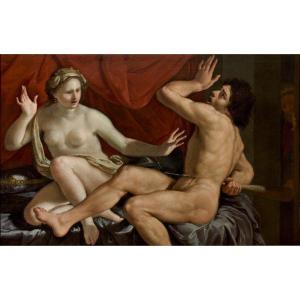
Hsp Italian School Guido Reni (1575–1642) Susanna And The Elders Wax Seal Cae25hsp001
Artist: Guido Reni
HSP religious art Italian School after Guido Reni (1575–1642) Susanna and the Elders wax seal on the back CAE25HSP001 Oil on panel, Italy, 17th century (19th-century frame) Oil on antique panel depicting Susanna and the two elders, an emblematic episode from the Old Testament (Book of Daniel), highly prized by 17th-century Italian and Northern painters for the dramatic tension it creates between nudity, morality, and the gaze. The scene illustrates the moment when Susanna, surprised at her bath, rejects the advances of two elders who are spying on her and trying to force her. A symbol of virtue and chastity, unjustly accused, Susanna will become, thanks to the prophet Daniel, the embodiment of innocence triumphing over slander. This theme was notably treated by Tintoretto, Veronese, Artemisia Gentileschi, Guido Reni, and Annibale Carracci. The composition is distinguished by a marked chiaroscuro, concentrating the light on Susanna's body, and a warm, muted palette dominated by browns and ochres. The wax seal, on the reverse of the panel, is an old wax seal, somewhat deteriorated but still legible in places. It clearly displays a coat of arms corresponding to the arms of the House of Savoy, and a partially legible inscription "R. Galleria **** Uffizi" for R[egia or Reale] Galleria degli Uffizi, Royal Uffizi Gallery. This name is historically attested in the 19th century, when the Florentine collections came under the administration of the States of the House of Savoy after Italian unification (from 1860). This type of seal was used to mark works belonging to public collections or upon loan. Inventories, relocations, or removals from collections (workshop copies, declassified works, or duplicates). In light of these elements, the stamp attests to a long-standing institutional link with the Italian collections of an early copy dating from before the 19th century. It is an early work, made after an original 17th-century Italian work, and which passed through an official or semi-official channel in the 19th century. The pictorial quality, the technique on panel, and the presence of the stamp rule out a late decorative or industrial production. Execution of the painting: circa 1650–1700 (or early 18th century at the latest). A museum-quality work, steeped in history, combining a major biblical subject with a rare institutional cachet. Ideal for a discerning art lover, a collector of Old Masters, or as a highly elegant decorative piece. This episode is taken from the apocryphal books of the Old Testament (Susanna 15–24). While the virtuous and beautiful Susanna is bathing in her garden, two old men approach her and, lusting after her, threaten to accuse her of adultery if she does not yield to their advances. She refuses and is falsely accused, but her innocence is proven, thus sparing her from stoning. Ludovico Carracci also painted a version of "Susanna and the Elders." This painting hung in the Palazzo Lancellotti, Rome, in 1640, alongside "Lot and His Daughters Leaving Sodom." Given their similar dimensions, it was long believed that they were complementary works. However, a restoration carried out in 1984 revealed brushstrokes suggesting different dates: "Susanna and the Elders" was painted after "Lot and His Daughters," and it is likely that the two paintings were not originally conceived as a diptych.
2 500 €
Period: 18th century
Style: Renaissance, Louis 13th
Condition: Condition of use
Material: Oil painting on wood
Length: 32,5 cm
Reference (ID): 1682008
Availability: In stock
Print