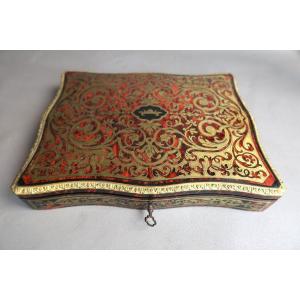
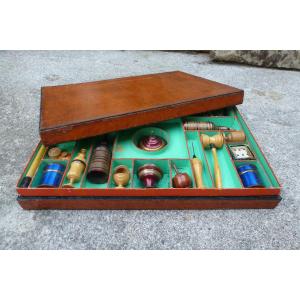
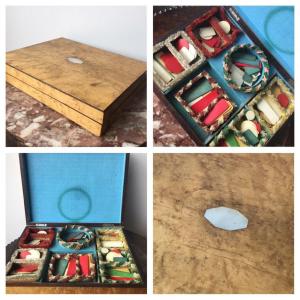
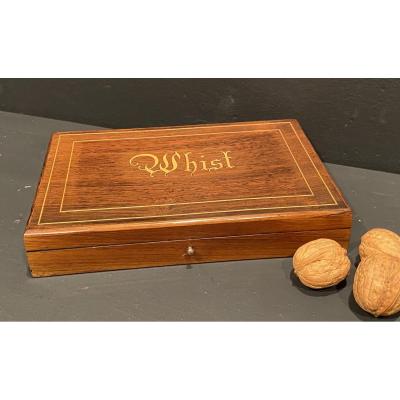
Box, Case, Boston Game, Late 19th Century
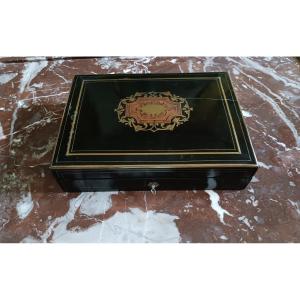
Rosewood and boxwood marquetry "Boston" box containing baskets with bone tokens, a score counter, and rules of the game (see description below). The box's closure mechanism is missing.
Late 19th century. Dimensions: H 5 x W 29.2 x D 22.5 cm.
The "Boston" Game: Why the name "Boston"? The game appeared around 1780. The name refers to the city of Boston in the United States, an emblematic location of the American Revolutionary War, very present in the European vision of America at that time. It spread throughout major European cities in the 19th century. It was played in salons and cafes and became an integral part of the culture of that era. The principle of the game? It is a game very similar to Whist, a trick-taking game for 4 players with a 52-card deck. The unique feature? It lies in the bids where a player commits to a certain number of tricks, and in the bonuses or penalties following the success of the contract. Thus foreshadowing the mechanisms of Bridge.
Late 19th century. Dimensions: H 5 x W 29.2 x D 22.5 cm.
The "Boston" Game: Why the name "Boston"? The game appeared around 1780. The name refers to the city of Boston in the United States, an emblematic location of the American Revolutionary War, very present in the European vision of America at that time. It spread throughout major European cities in the 19th century. It was played in salons and cafes and became an integral part of the culture of that era. The principle of the game? It is a game very similar to Whist, a trick-taking game for 4 players with a 52-card deck. The unique feature? It lies in the bids where a player commits to a certain number of tricks, and in the bonuses or penalties following the success of the contract. Thus foreshadowing the mechanisms of Bridge.
180 €
Period: 19th century
Style: Napoleon 3rd
Condition: Condition of use
Material: Rosewood
Length: 29.2
Width: 22,5
Height: 5
Reference (ID): 1679583
Availability: In stock
Print