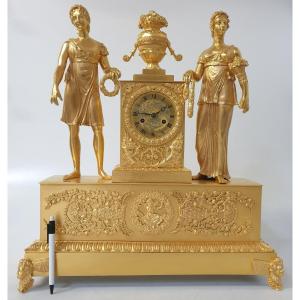
Monumental mantel clock executed in Paris during the second half of the 19th century, under the Second Empire or the early years of the Third Republic, a period distinguished by the flourishing of high-quality French decorative bronze.
The clock is signed “Henri Picard” on the rear of the base, attesting to its production by one of the most prestigious Parisian bronziers of the century.
The composition is built around a spherical clock case, symbolizing time and the universe.
Resting atop the sphere is a finely modeled putto (Cupid), leaning forward in a contemplative posture, suggesting the fleeting nature of time and its dominion over human emotion.
Flanking the central globe are two reclining female allegorical figures, sculpted in the round and integrated into a richly molded architectural base.
One figure, holding a torch, may be interpreted as an allegory of Light or Day, while the other, with a languid pose and lowered gaze, evokes Rest, Night, or Meditation.
Together, the figures form a poetic meditation on time, knowledge, and the cyclical rhythm of existence.
The sculptural execution is of exceptional quality, characteristic of the finest works produced by the Henri Picard workshop.
The faces display refined expressions, with delicately modeled features and subtle transitions of volume.
The hands and fingers are rendered with remarkable precision, demonstrating a level of chiseling associated only with master bronziers.
The drapery is deeply chased, creating fluid, naturalistic folds that enhance the play of light across the gilded surfaces.
Finely chased bronze
Original mercury gilding (ormolu), with a warm and well-preserved patina
Dial with applied Roman numerals
Period mechanical movement (to be serviced or checked according to use)
The quality and consistency of the gilding reflect the technical excellence of Parisian luxury workshops of the period.
About Henri PicardHenri Picard (active in Paris circa 1831–1864, with the firm continuing thereafter) was among the most celebrated bronziers-orfèvres of the 19th century.
Renowned for his high-end decorative objects—clocks, mantel garnitures, candelabra, and mounted works—he supplied an elite clientele and worked in Louis XVI, Empire, and Napoleon III styles, often inspired by 18th-century prototypes.
His works are today held in major public and private collections and are regularly featured in important international auctions.
This clock represents a fully realized example of monumental Parisian decorative art of the 19th century, combining sculpture, horology, and allegorical meaning into a single, commanding work.
Its signature, sculptural refinement, and balanced composition place it firmly among the most distinguished productions of the Second Empire period.
Height - 68 cm
Width - 75 cm
Depth - 21 cm













 Le Magazine de PROANTIC
 TRÉSORS Magazine
 Rivista Artiquariato