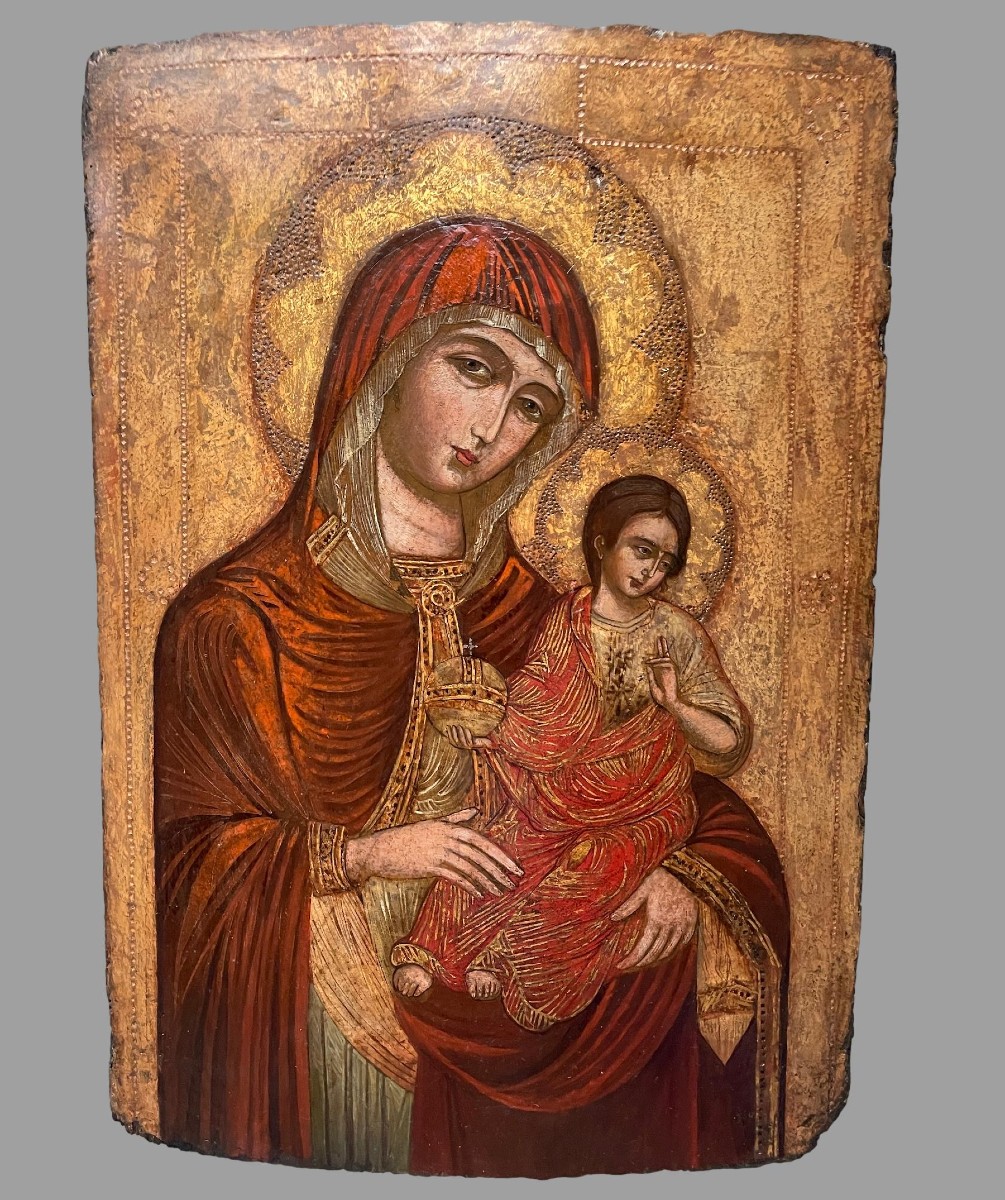
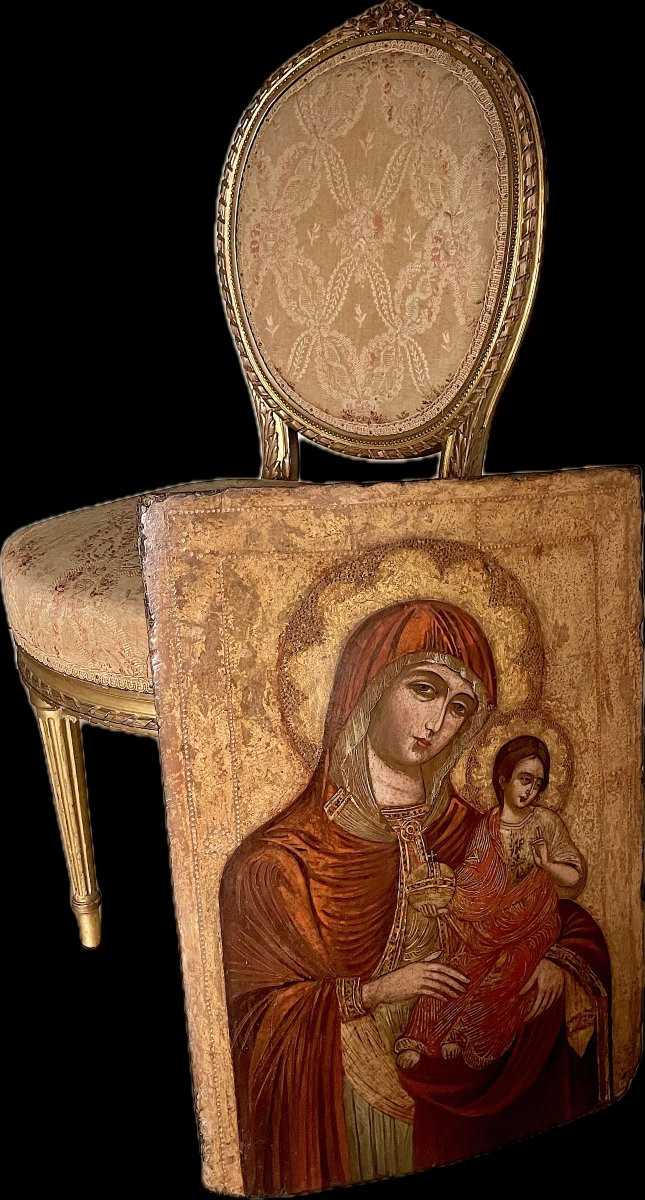
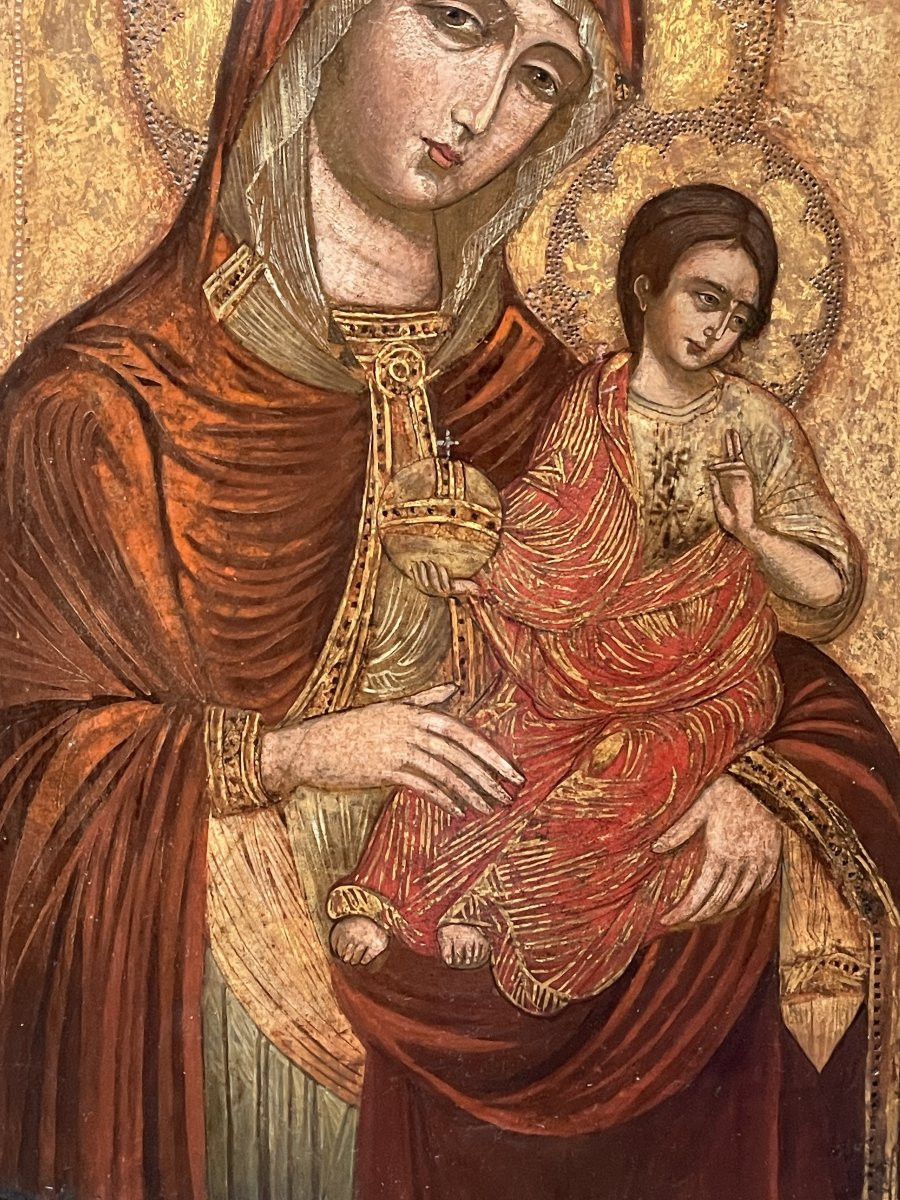
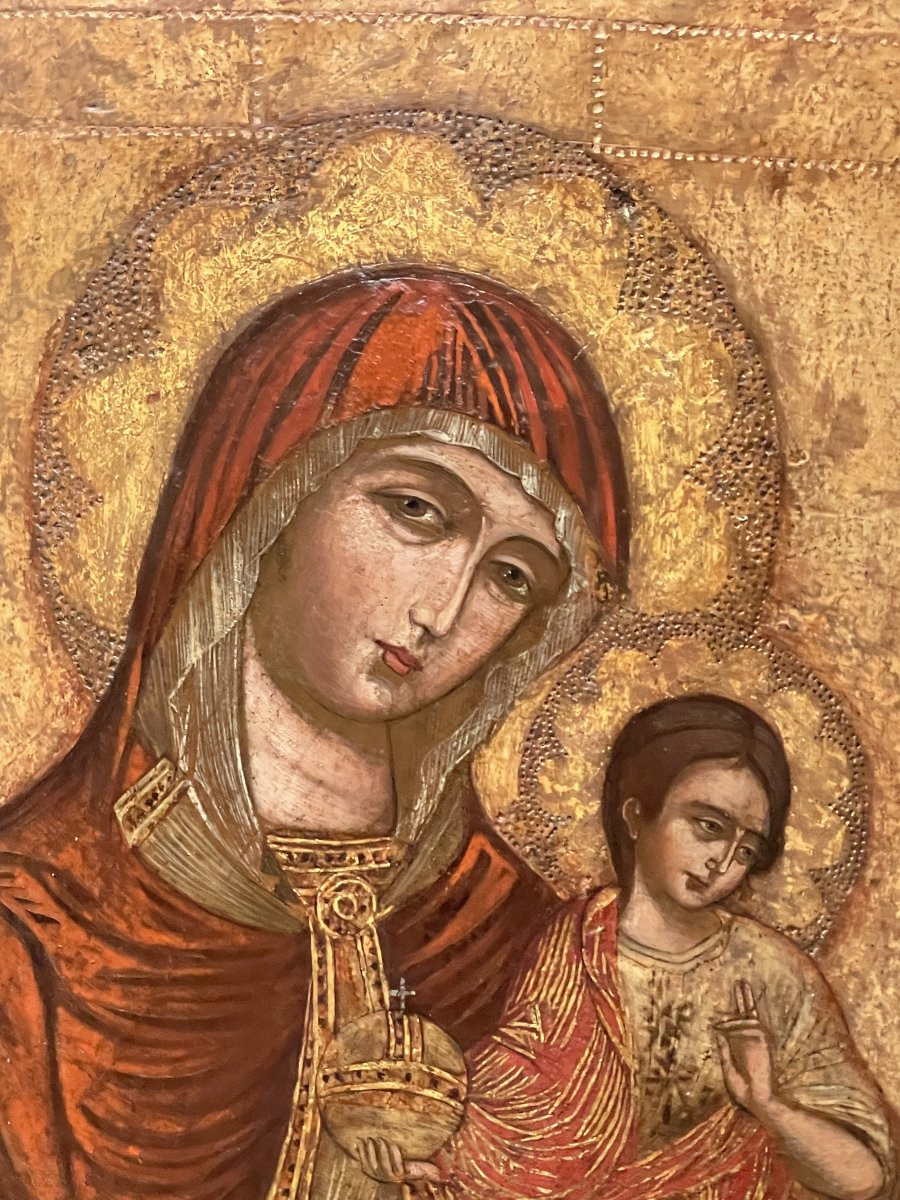
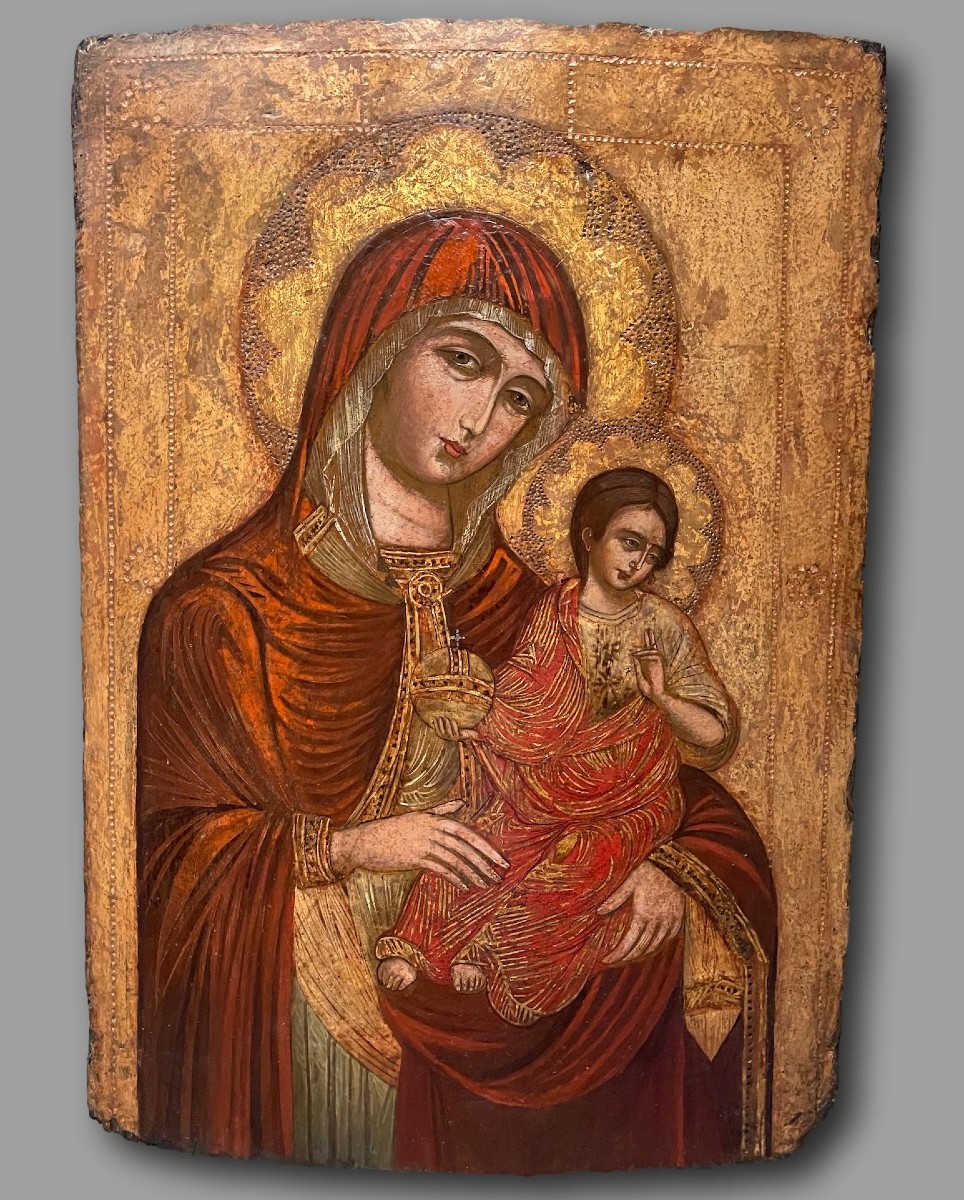
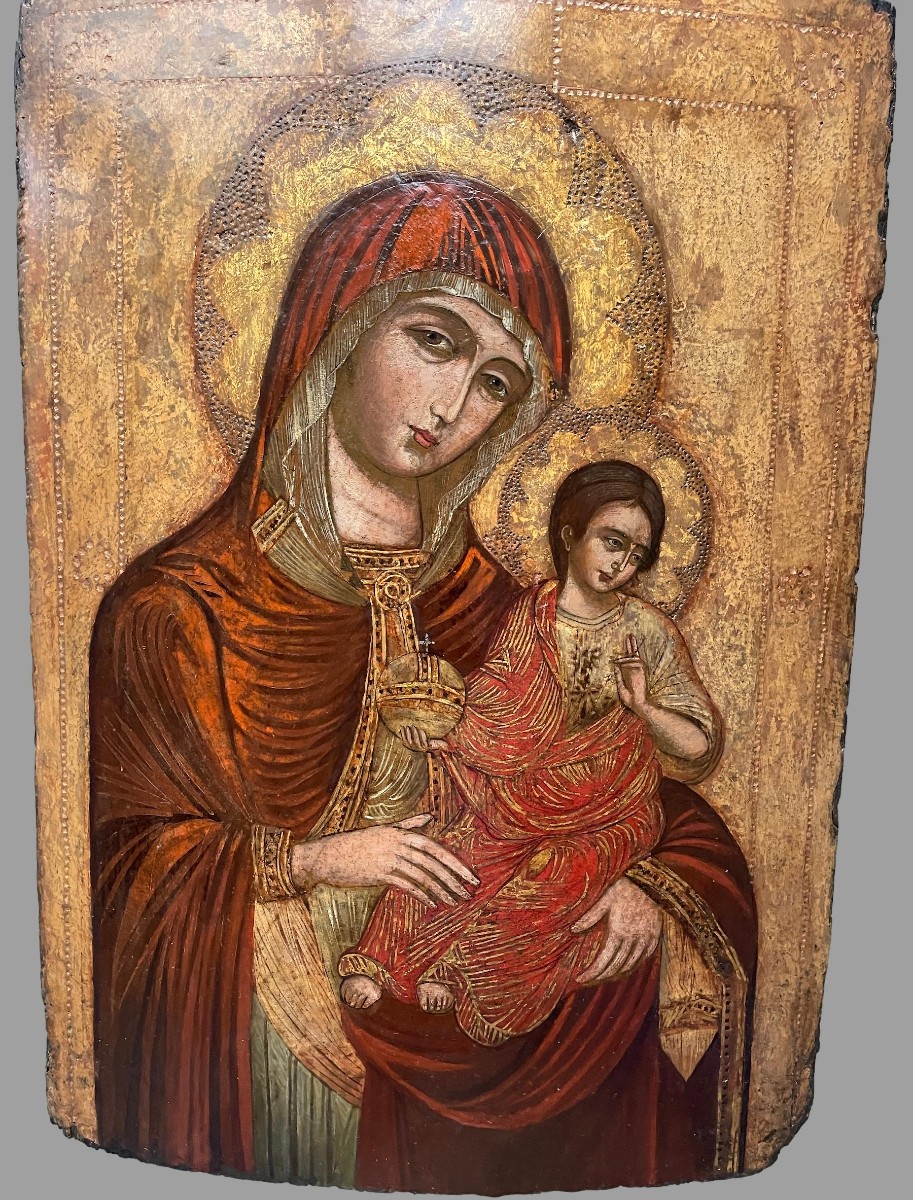
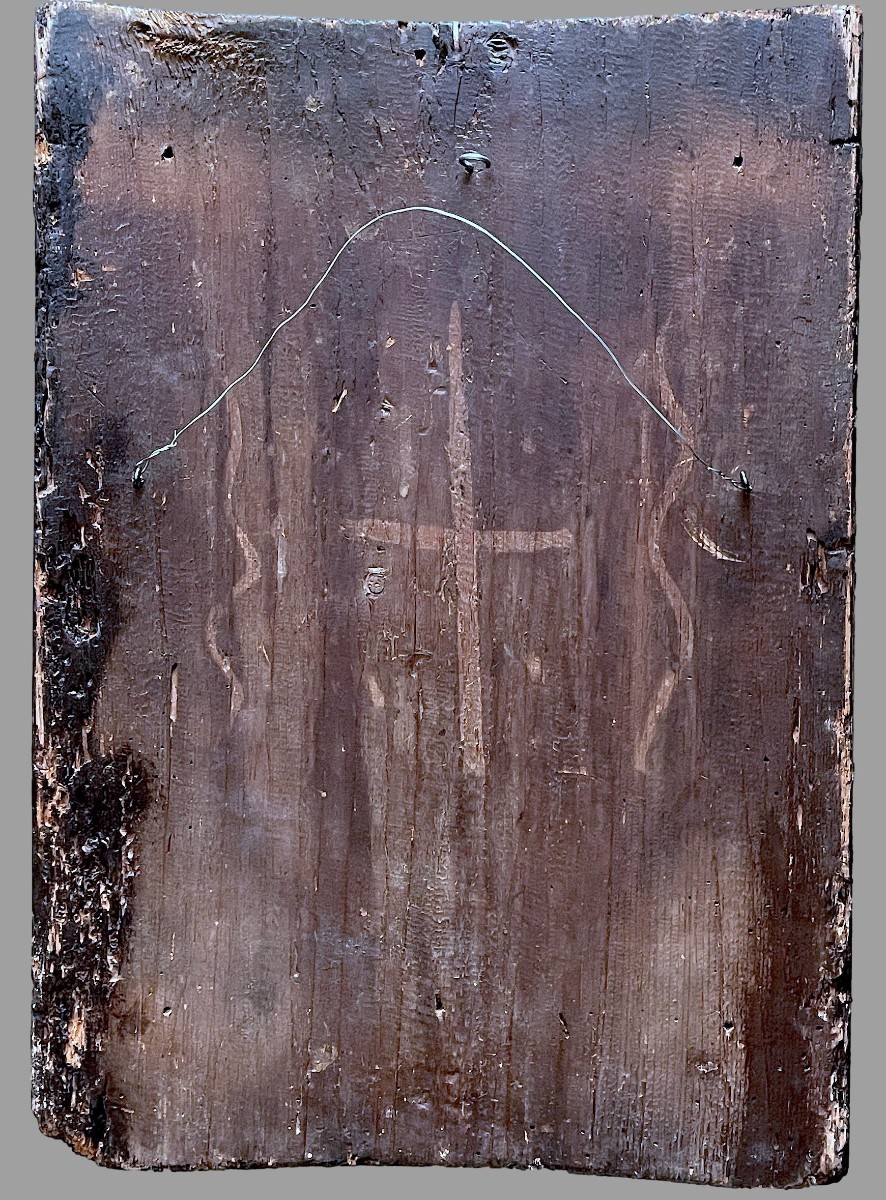


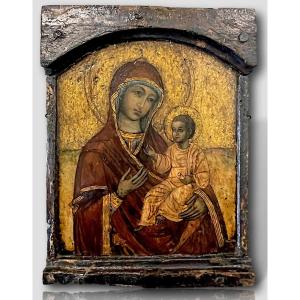
Important tempera on wooden panel with punched gold ground, depicting the Virgin and Child, presented half-length in a solemn and hieratic composition rooted in the Italo-Byzantine tradition.
Museum Quality, Comparable to Italian gold-ground Madonnas preserved in the Louvre, the Uffizi Gallery, the National Gallery (London) and The Metropolitan Museum of Art:
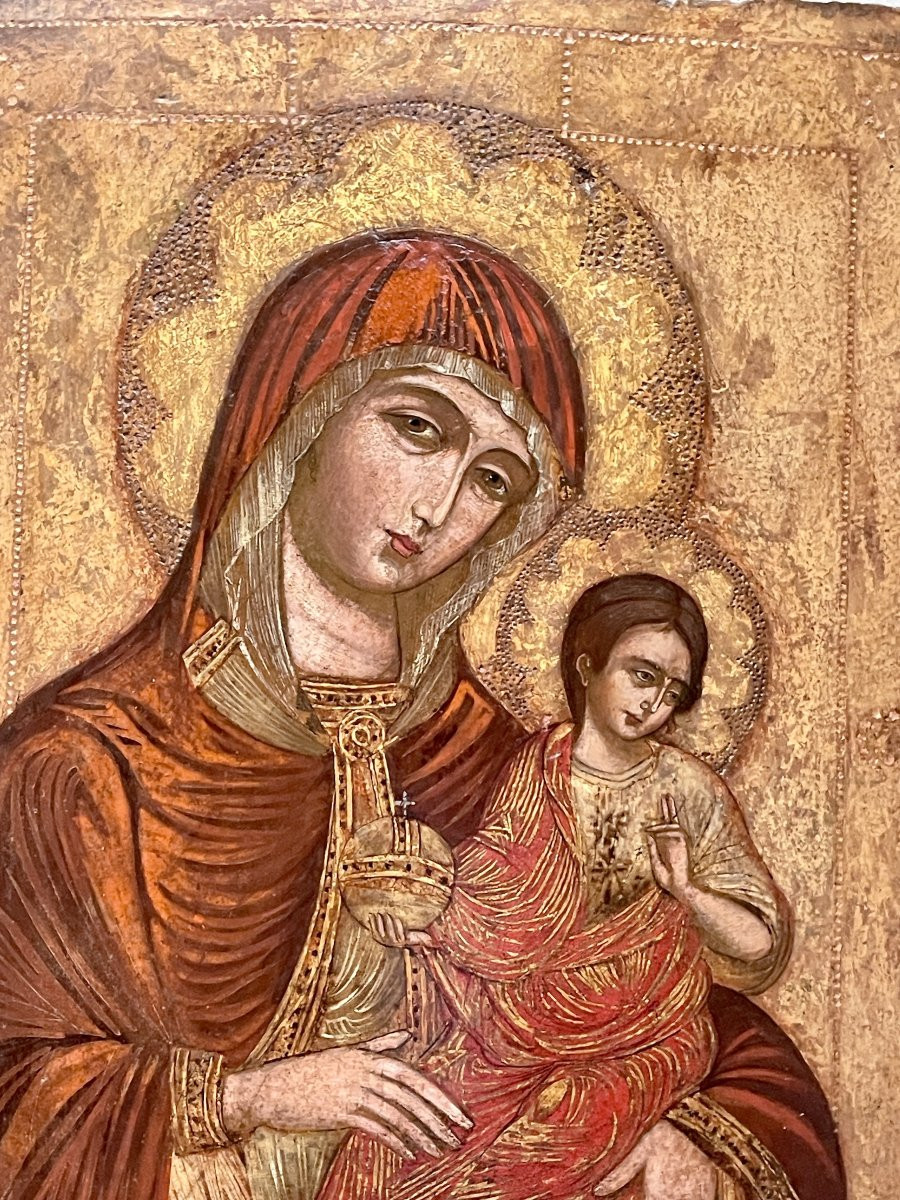
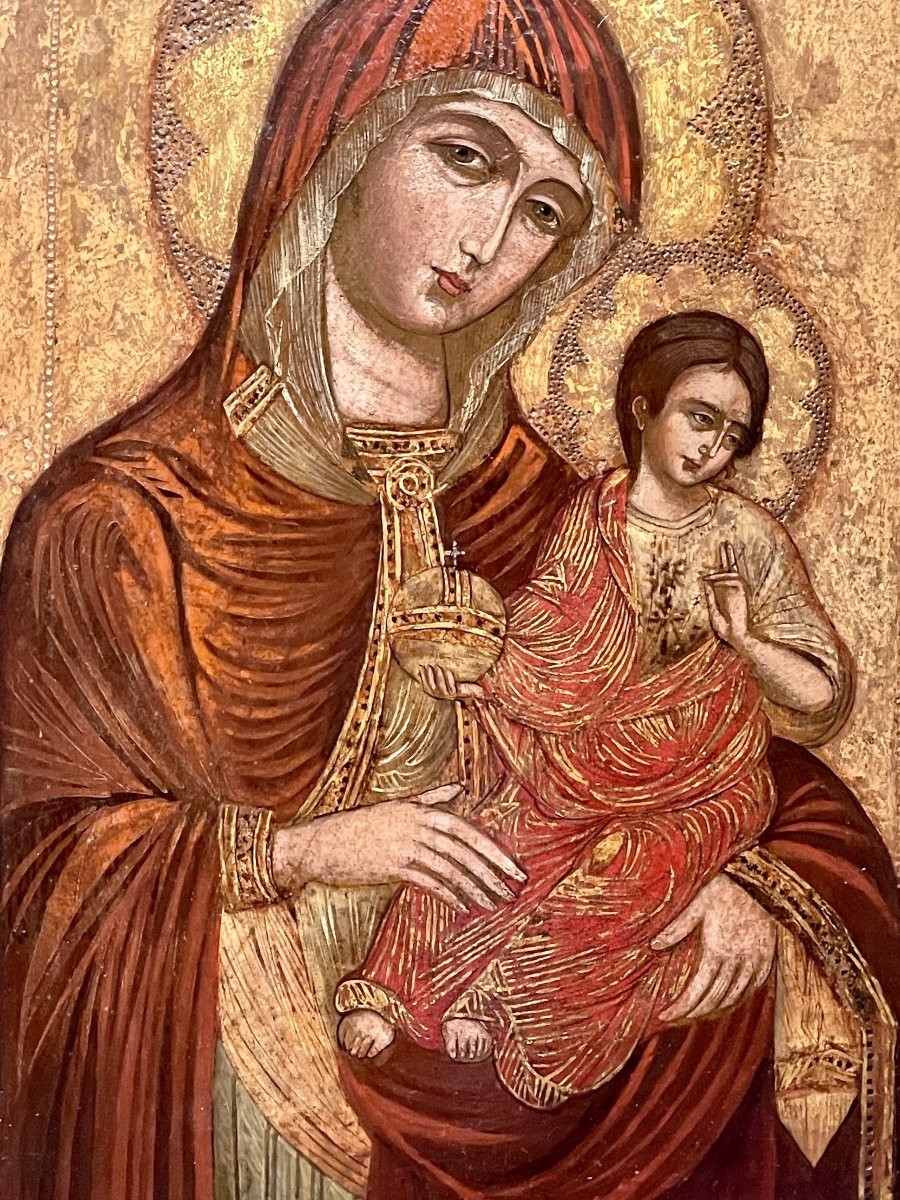
The Virgin is shown frontally, gently inclining her head in a gesture of quiet contemplation. Her elongated face, finely modelled and imbued with restrained melancholy, reflects the spiritual ideals of late medieval Marian iconography. The Christ Child, seated on her left arm, raises his right hand in blessing while holding a symbolic orb in his left hand, affirming his divine sovereignty.
The composition is set against a fully gilded background, richly worked and punched around the halos, emphasizing the sacred and timeless dimension of the scene.
Technique and PaletteEgg tempera on gesso-prepared wooden panel
Gold leaf applied over red bole
Dominant pigments: deep crimson, vermilion red, warm ochres, soft green and flesh tones
Draperies articulated through incised lines and linear highlights typical of medieval practice
The surface presents a coherent ancient patina, consistent with its age.
The pigment palette, based on lead white, ochres, green earth, vermilion, and red bole gilding, along with the panel's large size, confirms its Italian origins from the late 14th century, commissioned for a high-quality piece. The work is now positioned in the upper segment of the market for medieval gold-ground Madonnas.
The gold background, hand-punched using simple circular punches, displays a decorative hierarchy of halos, gold field, and periphery, consistent with the practices of workshops in central Italy at the end of the 14th century. This treatment, comparable to that observed on panels preserved in major European museum collections, constitutes a key chronological and stylistic indicator of the work's authenticity and quality.
This painting belongs to the late Italo-Byzantine tradition, transitioning toward early Gothic sensibilities. Stylistic parallels suggest a Central Italian workshop (Tuscany, Umbria or Marche), active circa 1380–1420.
The work reflects affinities with artists and workshops influenced by Cimabue, Coppo di Marcovaldo, and early Tuscan devotional painting, while maintaining strong Byzantine formal structures.
Historical ImportanceGold-ground Virgins played a fundamental role in medieval devotion, serving both private prayer and semi-liturgical contexts. This panel exemplifies the transmission of Byzantine iconography into Western Europe and the gradual humanisation of sacred figures prior to the Renaissance.
DimensionsHeight: 54.5 cm
Width: 39 cm
Thickness: 2.4 cm
Shipping and Insurance Information:
All our packages are packaged by MBE (Mail Boxes Etc.) in Narbonne, guaranteeing careful and perfectly secure packaging.
Shipping is then handled by UPS, FedEx, or GLS, ensuring reliable and tracked delivery worldwide.
For all purchases over €4,000, an ad valorem insurance policy is automatically taken out with Trans-Pass, providing optimal coverage for your purchase throughout its entire journey.











 Le Magazine de PROANTIC
 TRÉSORS Magazine
 Rivista Artiquariato