THIS OBJECT WAS SOLD
Virgin And Child, Italo-byzantine School, Circle Of The Cretan-venetian Workshops, Circa 1450–1480




Following further examination, the following description emerges:
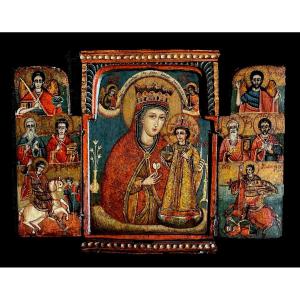
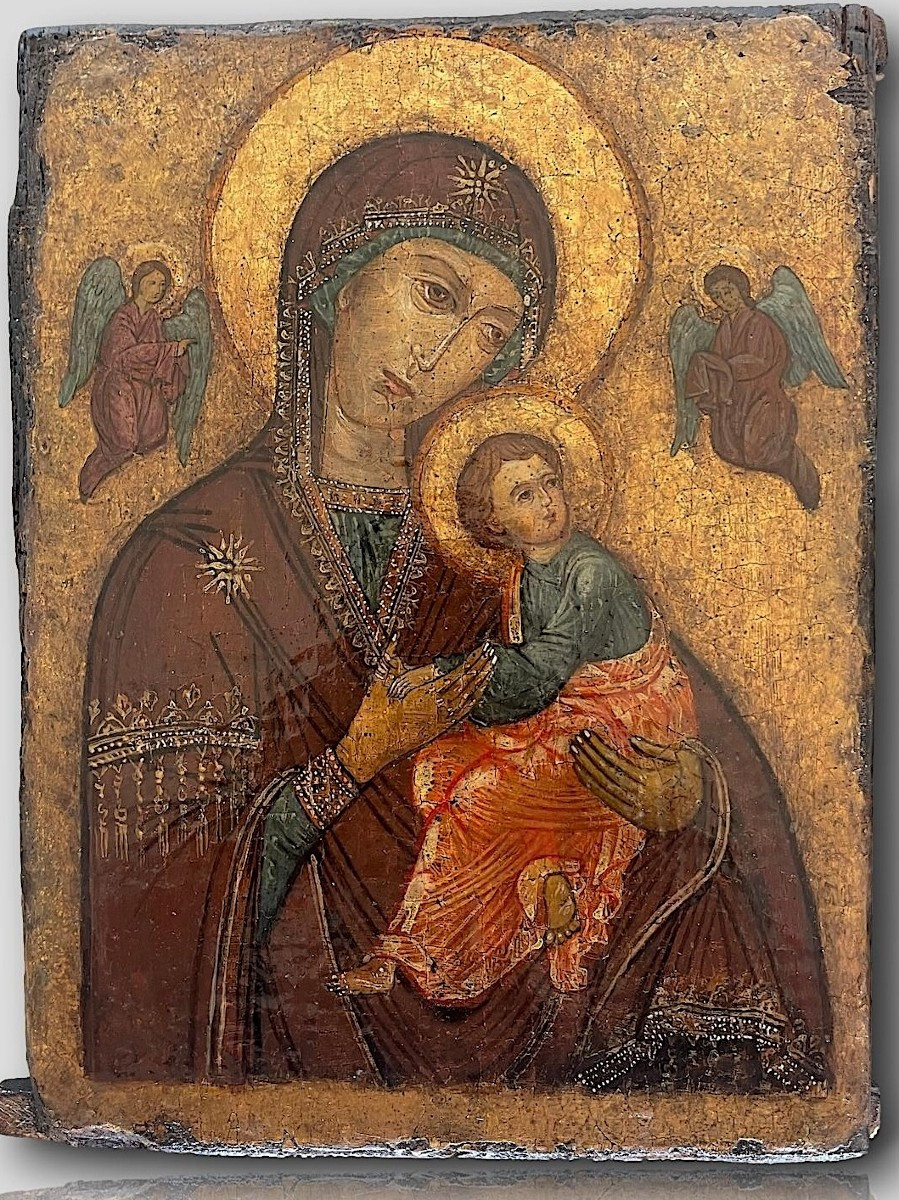
Beautiful antique icon depicting the Virgin and Child in the Hodigitria style, executed in tempera on a gold-ground panel.
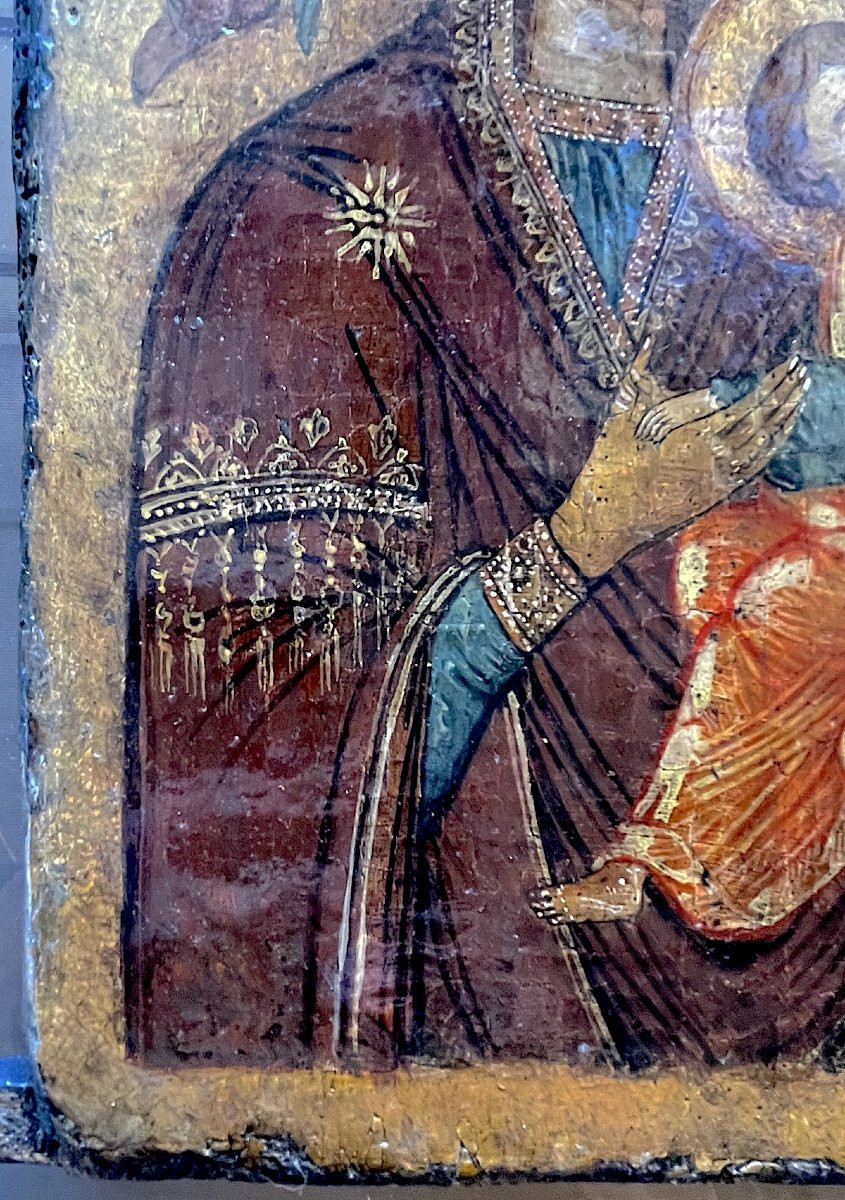
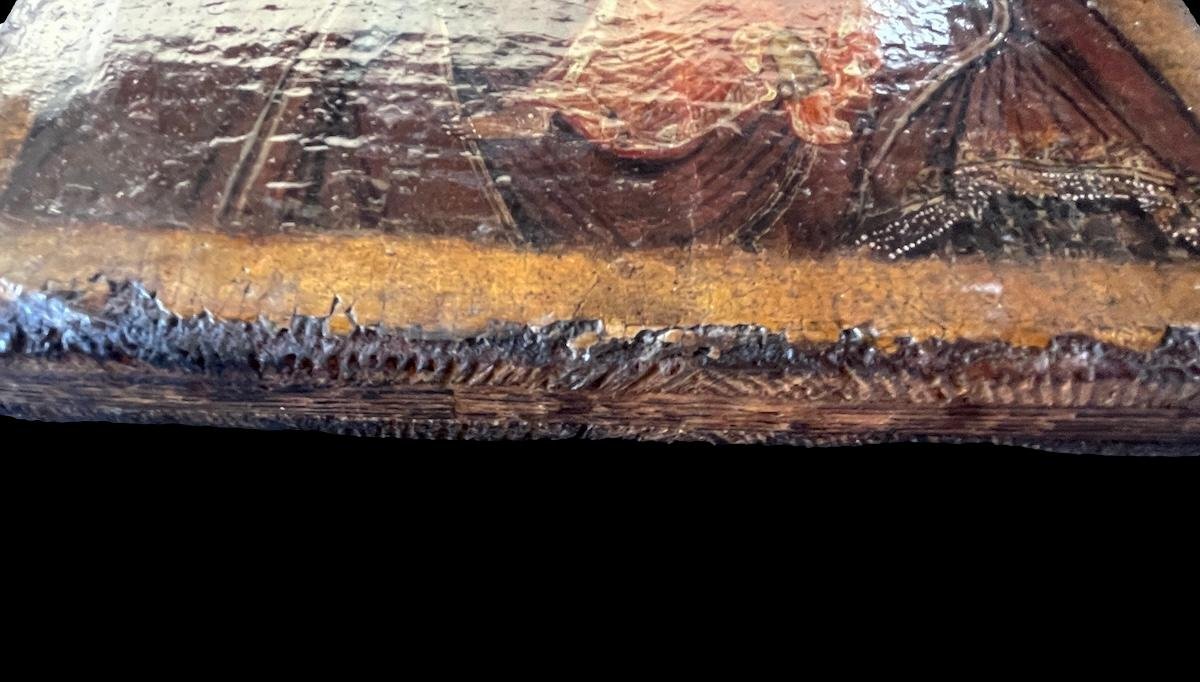
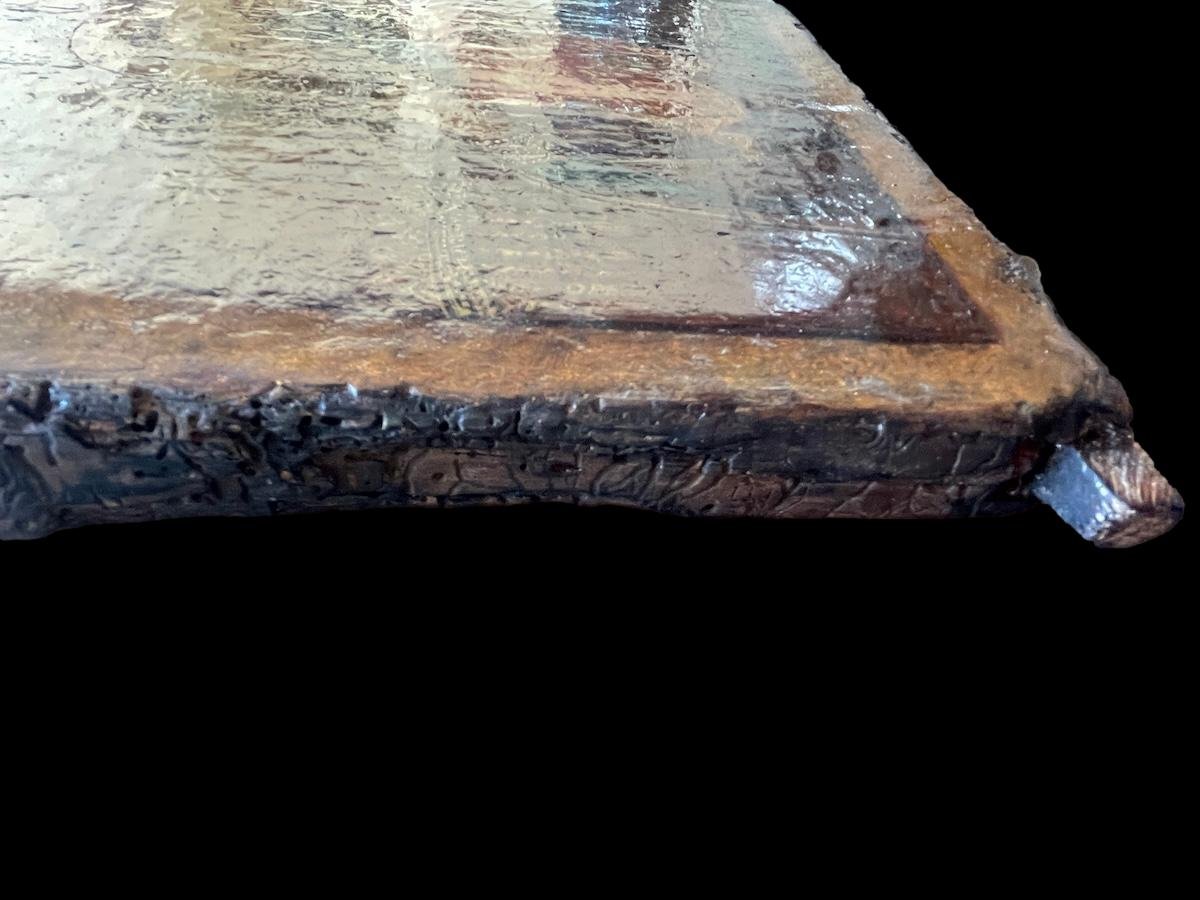
This magnificent Virgin and Child is an emblematic work of the Venetian or Veneto-Cretan school, dating from the 15th century. Painted on a wooden panel, in tempera on a ground chalk base and with a gold ground, this religious icon testifies to the artistic and spiritual richness of this pivotal period, where Byzantine and Venetian Renaissance influences converged. The work, in remarkable condition for its age, shows signs of natural wear (crazing and slight abrasions on the edges), which add to its authenticity and historical charm.
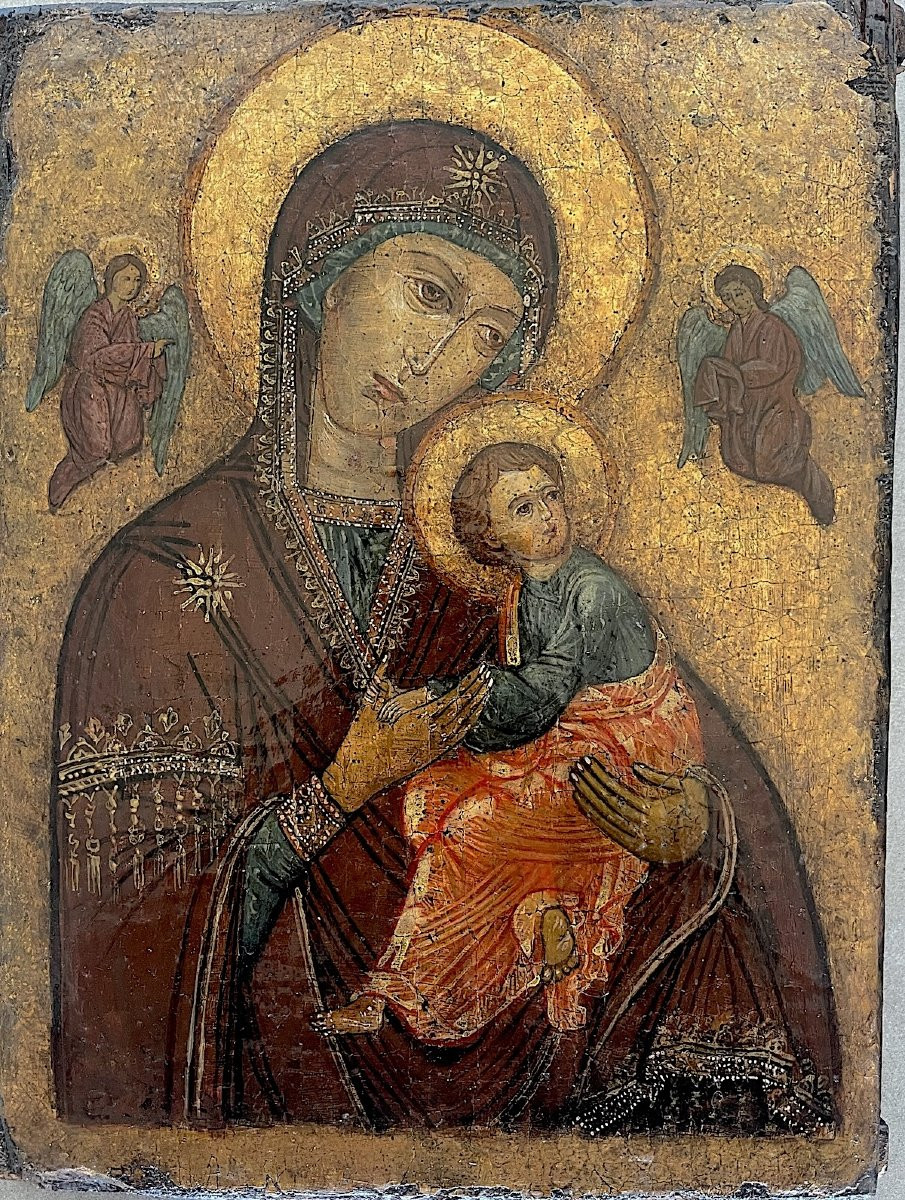
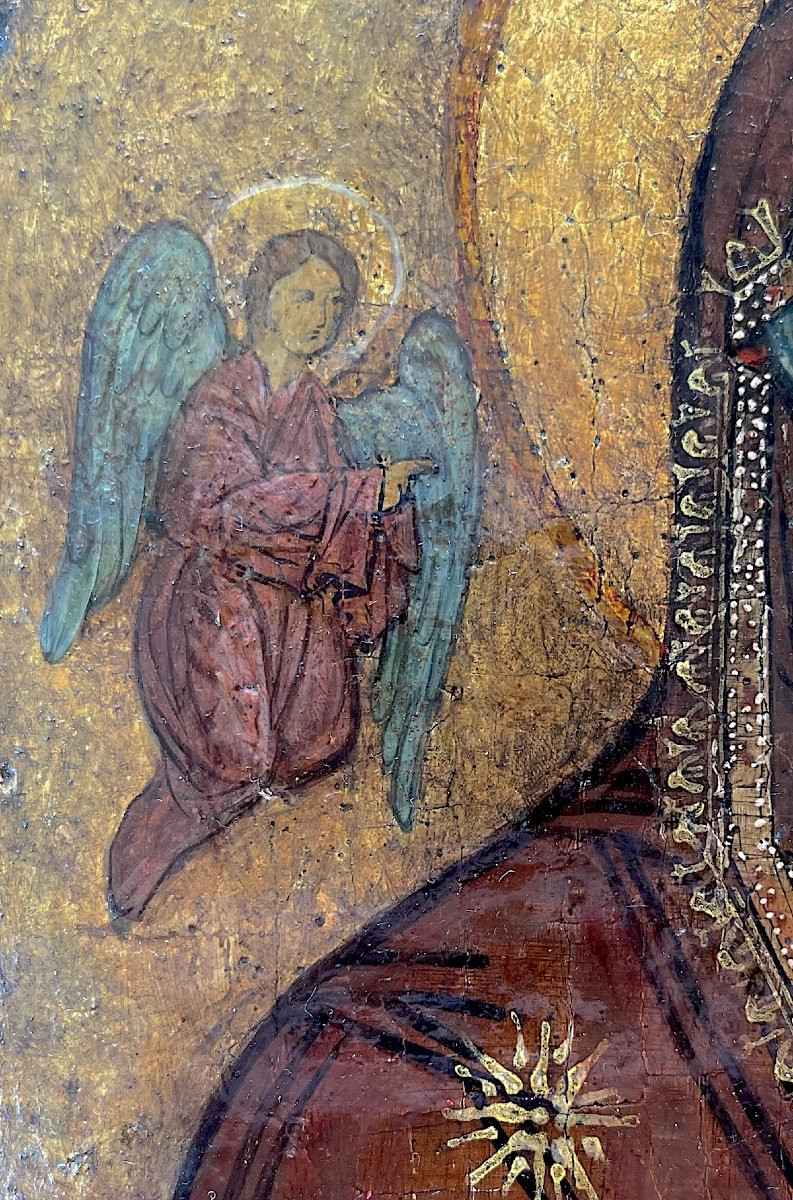
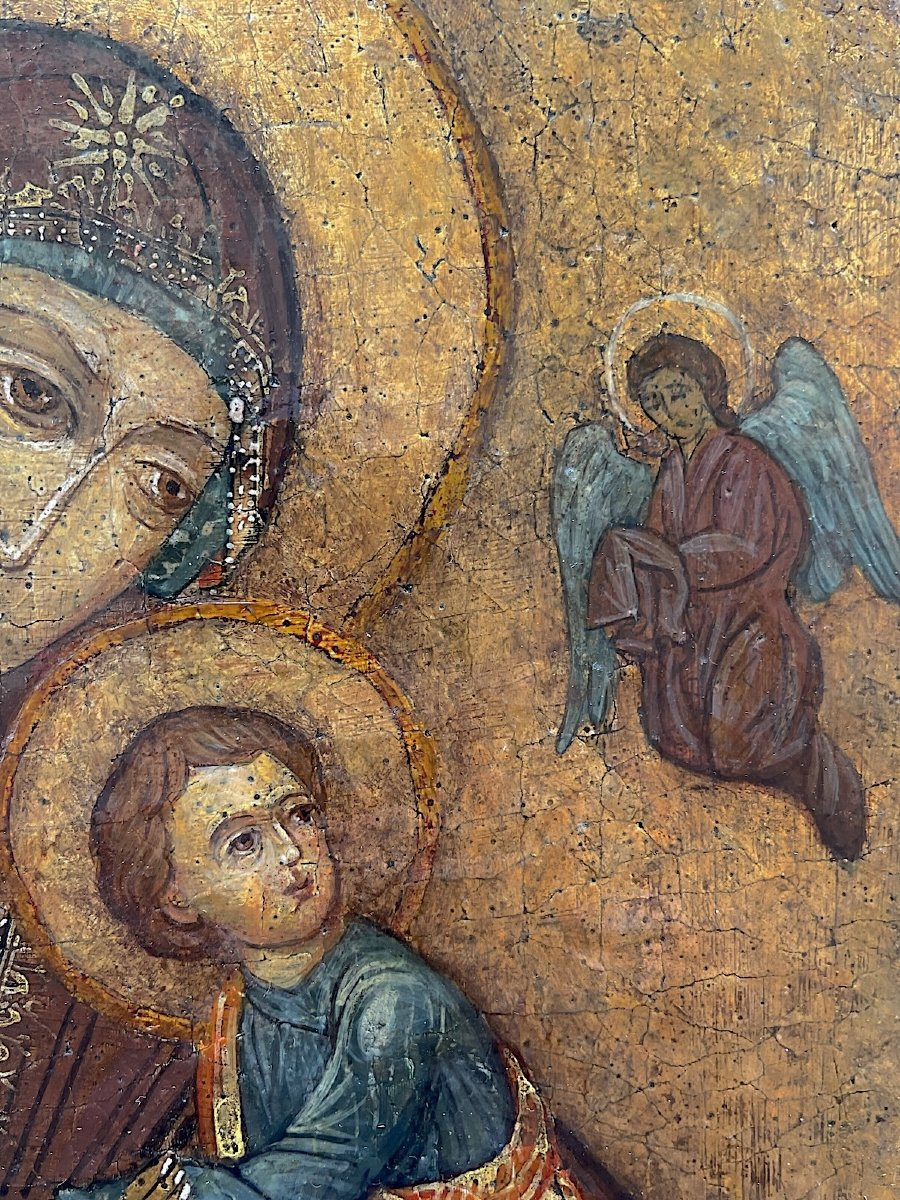
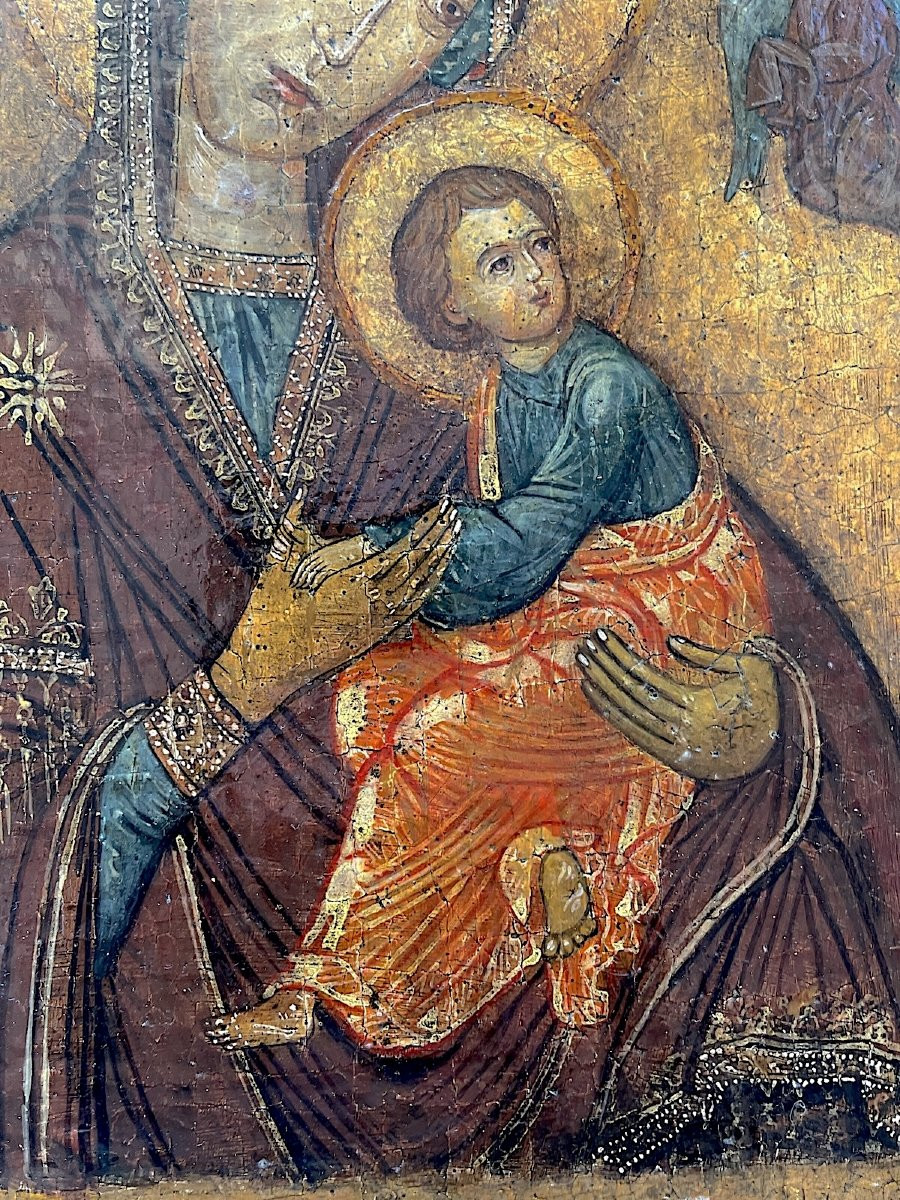
The composition is typical of icons of the Virgin and Child, or Theotokos, in the Byzantine tradition. The Virgin, depicted facing forward, holds the Infant Jesus in her arms, in a pose imbued with tenderness and solemnity. She is dressed in a dark brown mantle with golden highlights, adorned with star motifs symbolizing her purity and divinity. The Child, seated on her left arm, wears a green tunic and a red-orange drape, vibrant colors that contrast with the simplicity of the Virgin's robe. Two angels, placed in the upper corners of the composition, surround the scene and add a celestial dimension; their outstretched wings and gestures of adoration reinforce the sacred character of the whole. The gold background, typical of Byzantine icons, creates a luminous aura around the figures, isolating them in a divine and timeless space.
The colors used in this work are both rich and symbolic, in accordance with the conventions of religious art of the period. Here is an analysis of the main colors, with their approximate hexadecimal codes for better visualization:
Gold (#D4AF37): Used for the background and halos, it symbolizes divine light and eternity.
Dark brown (#3F2A1D): Present in the Virgin's mantle, it evokes humility and the earth, while contrasting with the gold background.
Deep green (#355E3B): The color of the Child's tunic, it represents hope and life.
Orange-red (#E74C3C): Used for the Child's drapery, it symbolizes divine love and sacrifice.
This type of Virgin and Child was intended for private devotion or to adorn small chapels, and its compact size (29.4 x 29.6 cm) makes it an intimate object, designed for close contemplation. The presence of angels and starry motifs on the Virgin's mantle is a recurring theme in Marian iconography, symbolizing her position as Queen of Heaven.
The work is remarkably refined for a piece from this period and school. The panel painting, although showing some craquelure and wear along the edges, remains in very good condition. The pigments have retained their brilliance, particularly the golds and reds, and the serene details of the faces attest to the artist's skill. The slightly irregular wooden panel adds to the overall sense of authenticity.
The panel measures 29.4 cm high by 22.6 cm wide, dimensions that lend the work a balanced harmony. The rectangular shape, slightly irregular due to age, is typical of portable icons of the period.
Comparative dating: circa 1450–1480 1. Comparison with the Cretan-Venetian school (mid-15th century)
Your icon shows strong similarities to the works produced by Cretan workshops active under Venetian rule:
Andreas Ritzos (active circa 1450–1490)
same type of Hodegetria Virgin with a reclining posture,
elongated faces, introspective gaze,
angular but already supple folds,
a simple, undecorative gold background.
Your work belongs to the stylistic circle of these workshops, without reaching the refinement of an identified master, which is consistent with workshop production from the third quarter of the 15th century.
2. Comparison with the Italo-Byzantine Virgins of Venice (circa 1450–1475)
Strong similarities with:
the Venetian Byzantine Madonnas in the Museo Correr,
the panels of private devotion produced for merchants and confraternities.
Common features:
absence of Renaissance perspective,
tempered hieratic style,
restricted and symbolic color palette.
➡ These works are dated between 1440 and 1480, a transitional period still very faithful to the Byzantine canon.
3. Comparison with late Palaiologan icons (late 14th – early 15th century)
Notable differences with earlier works:
less frontal rigidity,
less excessive linear graphic style,
a more human Mother-Child relationship.
➡ These elements rule out a date before 1420.
4. Comparison with early 16th-century Italian painting
Unlike works after 1500:
no chiaroscuro, No Renaissance volumetric modeling,
absence of spatial depth.
➡ This observation rules out a date after 1500.
By stylistic comparison with the works of the Cretan-Venetian and Italo-Byzantine workshops active between 1450 and 1480, this tempera on gold-ground panel fits squarely within the third quarter of the 15th century, a period of transition between Byzantine tradition and Western influences.
The composition, remarkably balanced, combines Byzantine hieraticism with expressive gentleness, characteristics of Italo-Byzantine workshops of the mid-15th century. The elongated faces, the introspective gaze, the graphic folds, and the warm palette lend this work a remarkable spiritual presence.
The burnished gold ground, the consistent signs of age and wear, and the pictorial quality attest to its authentic antiquity and its status as a work of private devotion, intended for prayer.
➡ Italo-Byzantine School, circa 1450–1480.
➡ A rare and sought-after work, ideal for a sacred art or oratory collection.
#ancienticon #virginandchild #hodigitria #tempera #fondor #byzantineart #italobyzantineschool #medievalart #sacredart #proantic #artcollection
Shipping and Insurance Information:
All our packages are handled by MBE (Mail Boxes Etc.) Narbonne, guaranteeing careful and perfectly secure packaging.
Shipping is then handled by UPS, FedEx, or GLS, ensuring reliable and tracked delivery worldwide.
For all purchases over €4,000, an ad valorem insurance policy is automatically taken out with Trans-Pass, providing optimal coverage for your purchase throughout its entire journey.
Beautiful antique icon depicting the Virgin and Child in the Hodigitria style, executed in tempera on a gold-ground panel.
This magnificent Virgin and Child is an emblematic work of the Venetian or Veneto-Cretan school, dating from the 15th century. Painted on a wooden panel, in tempera on a ground chalk base and with a gold ground, this religious icon testifies to the artistic and spiritual richness of this pivotal period, where Byzantine and Venetian Renaissance influences converged. The work, in remarkable condition for its age, shows signs of natural wear (crazing and slight abrasions on the edges), which add to its authenticity and historical charm.
The composition is typical of icons of the Virgin and Child, or Theotokos, in the Byzantine tradition. The Virgin, depicted facing forward, holds the Infant Jesus in her arms, in a pose imbued with tenderness and solemnity. She is dressed in a dark brown mantle with golden highlights, adorned with star motifs symbolizing her purity and divinity. The Child, seated on her left arm, wears a green tunic and a red-orange drape, vibrant colors that contrast with the simplicity of the Virgin's robe. Two angels, placed in the upper corners of the composition, surround the scene and add a celestial dimension; their outstretched wings and gestures of adoration reinforce the sacred character of the whole. The gold background, typical of Byzantine icons, creates a luminous aura around the figures, isolating them in a divine and timeless space.
The colors used in this work are both rich and symbolic, in accordance with the conventions of religious art of the period. Here is an analysis of the main colors, with their approximate hexadecimal codes for better visualization:
Gold (#D4AF37): Used for the background and halos, it symbolizes divine light and eternity.
Dark brown (#3F2A1D): Present in the Virgin's mantle, it evokes humility and the earth, while contrasting with the gold background.
Deep green (#355E3B): The color of the Child's tunic, it represents hope and life.
Orange-red (#E74C3C): Used for the Child's drapery, it symbolizes divine love and sacrifice.
This type of Virgin and Child was intended for private devotion or to adorn small chapels, and its compact size (29.4 x 29.6 cm) makes it an intimate object, designed for close contemplation. The presence of angels and starry motifs on the Virgin's mantle is a recurring theme in Marian iconography, symbolizing her position as Queen of Heaven.
The work is remarkably refined for a piece from this period and school. The panel painting, although showing some craquelure and wear along the edges, remains in very good condition. The pigments have retained their brilliance, particularly the golds and reds, and the serene details of the faces attest to the artist's skill. The slightly irregular wooden panel adds to the overall sense of authenticity.
The panel measures 29.4 cm high by 22.6 cm wide, dimensions that lend the work a balanced harmony. The rectangular shape, slightly irregular due to age, is typical of portable icons of the period.
Comparative dating: circa 1450–1480 1. Comparison with the Cretan-Venetian school (mid-15th century)
Your icon shows strong similarities to the works produced by Cretan workshops active under Venetian rule:
Andreas Ritzos (active circa 1450–1490)
same type of Hodegetria Virgin with a reclining posture,
elongated faces, introspective gaze,
angular but already supple folds,
a simple, undecorative gold background.
Your work belongs to the stylistic circle of these workshops, without reaching the refinement of an identified master, which is consistent with workshop production from the third quarter of the 15th century.
2. Comparison with the Italo-Byzantine Virgins of Venice (circa 1450–1475)
Strong similarities with:
the Venetian Byzantine Madonnas in the Museo Correr,
the panels of private devotion produced for merchants and confraternities.
Common features:
absence of Renaissance perspective,
tempered hieratic style,
restricted and symbolic color palette.
➡ These works are dated between 1440 and 1480, a transitional period still very faithful to the Byzantine canon.
3. Comparison with late Palaiologan icons (late 14th – early 15th century)
Notable differences with earlier works:
less frontal rigidity,
less excessive linear graphic style,
a more human Mother-Child relationship.
➡ These elements rule out a date before 1420.
4. Comparison with early 16th-century Italian painting
Unlike works after 1500:
no chiaroscuro, No Renaissance volumetric modeling,
absence of spatial depth.
➡ This observation rules out a date after 1500.
By stylistic comparison with the works of the Cretan-Venetian and Italo-Byzantine workshops active between 1450 and 1480, this tempera on gold-ground panel fits squarely within the third quarter of the 15th century, a period of transition between Byzantine tradition and Western influences.
The composition, remarkably balanced, combines Byzantine hieraticism with expressive gentleness, characteristics of Italo-Byzantine workshops of the mid-15th century. The elongated faces, the introspective gaze, the graphic folds, and the warm palette lend this work a remarkable spiritual presence.
The burnished gold ground, the consistent signs of age and wear, and the pictorial quality attest to its authentic antiquity and its status as a work of private devotion, intended for prayer.
➡ Italo-Byzantine School, circa 1450–1480.
➡ A rare and sought-after work, ideal for a sacred art or oratory collection.
#ancienticon #virginandchild #hodigitria #tempera #fondor #byzantineart #italobyzantineschool #medievalart #sacredart #proantic #artcollection
Shipping and Insurance Information:
All our packages are handled by MBE (Mail Boxes Etc.) Narbonne, guaranteeing careful and perfectly secure packaging.
Shipping is then handled by UPS, FedEx, or GLS, ensuring reliable and tracked delivery worldwide.
For all purchases over €4,000, an ad valorem insurance policy is automatically taken out with Trans-Pass, providing optimal coverage for your purchase throughout its entire journey.
Explore similar pieces and discover your ideal find:
religious paintings