






18th Century, Pair Of Italian Painting With Pastoral Scenes, Londonio School
Artist: Scuola Del Londonio
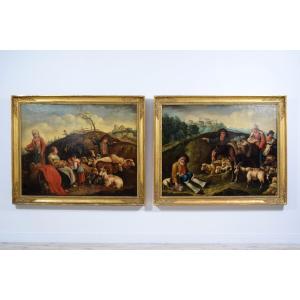
Pair oflarge paintings depicting pastoral scenes, Londonio school, second half of the18th century
Frame: W 157 x H 130 x D 9 cm; canvas: 139 x 110 cm
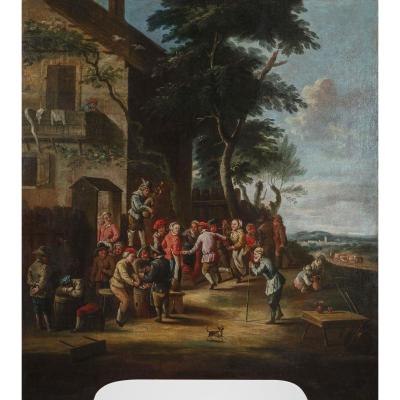
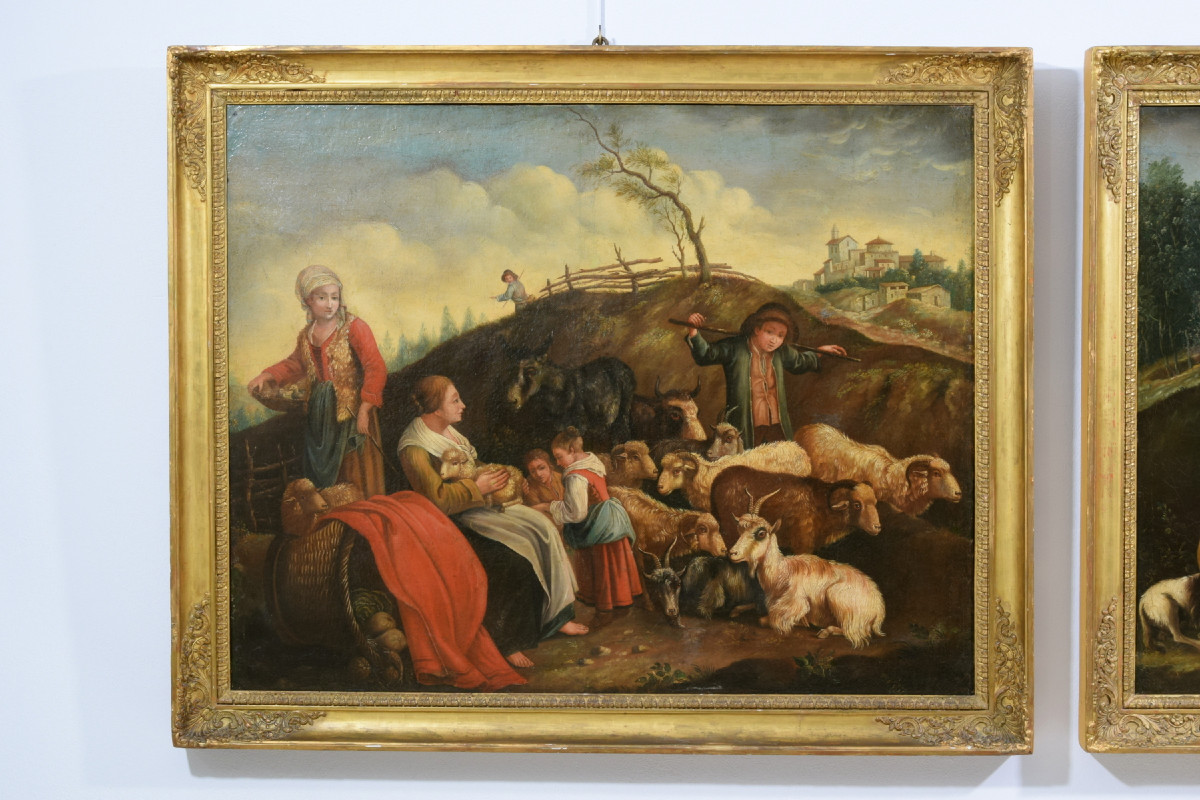
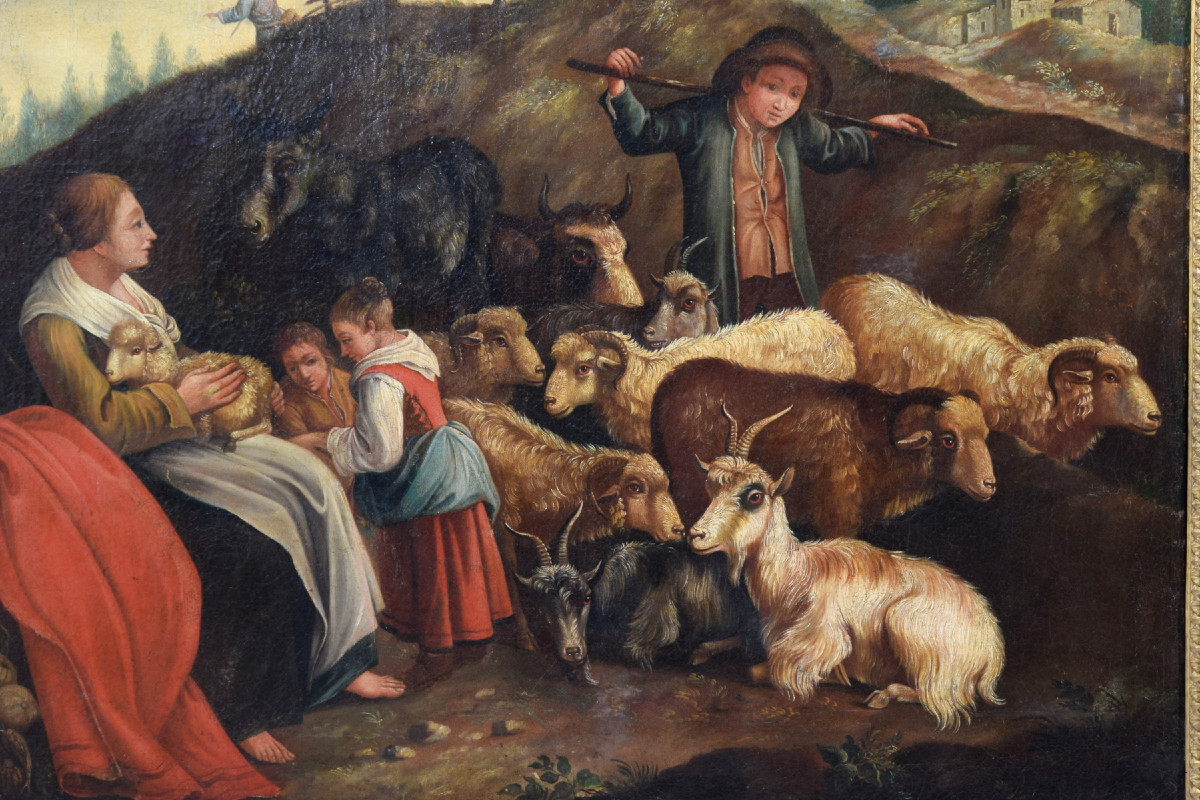
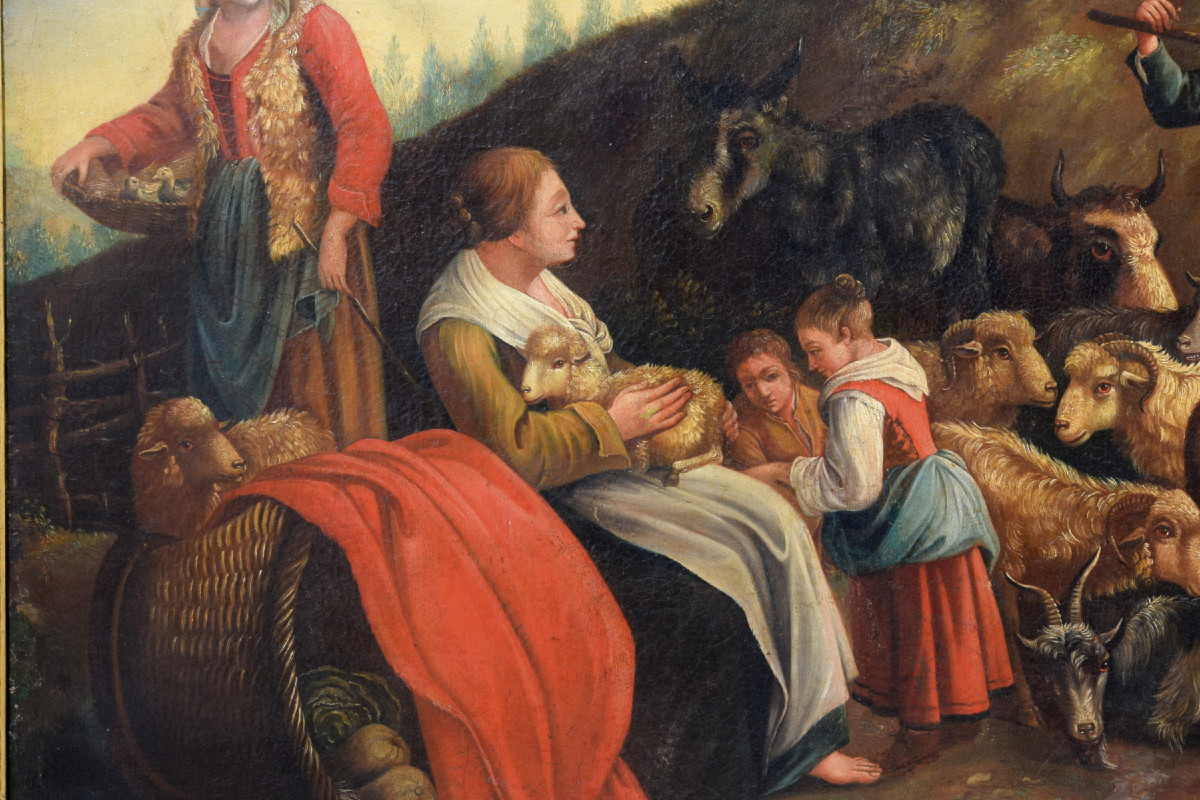
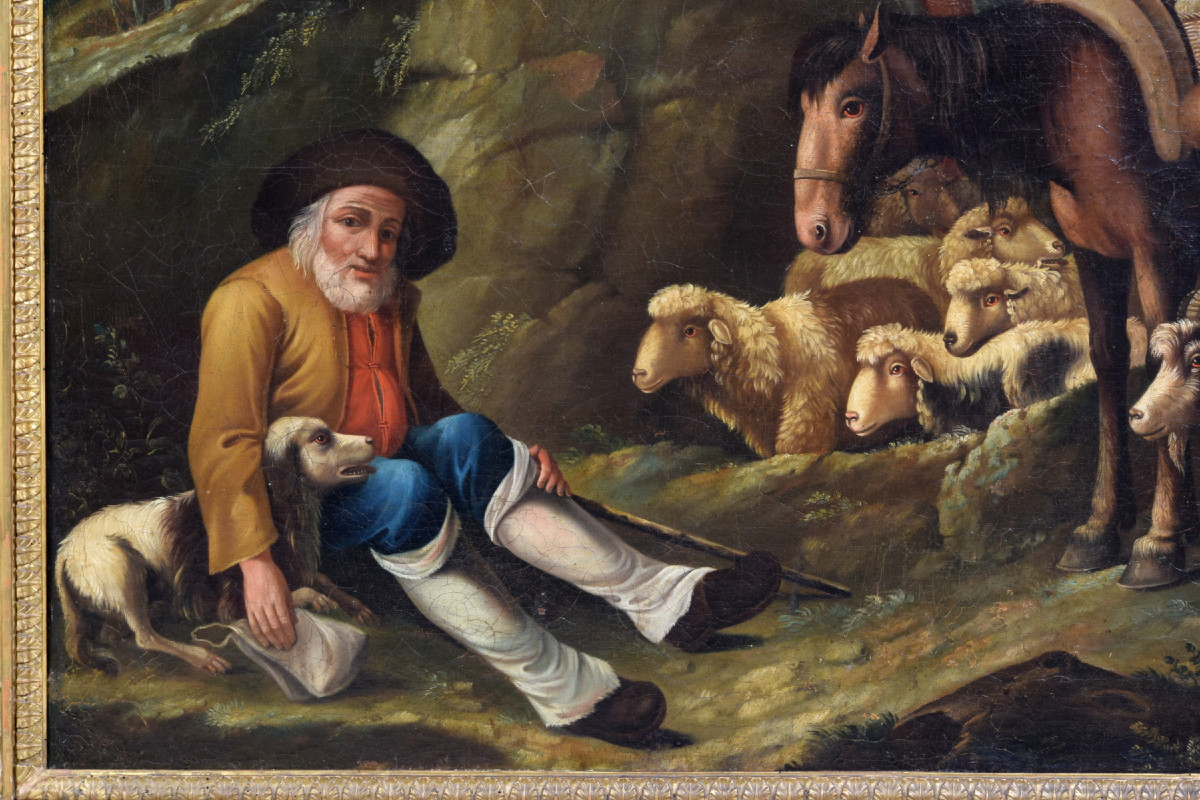
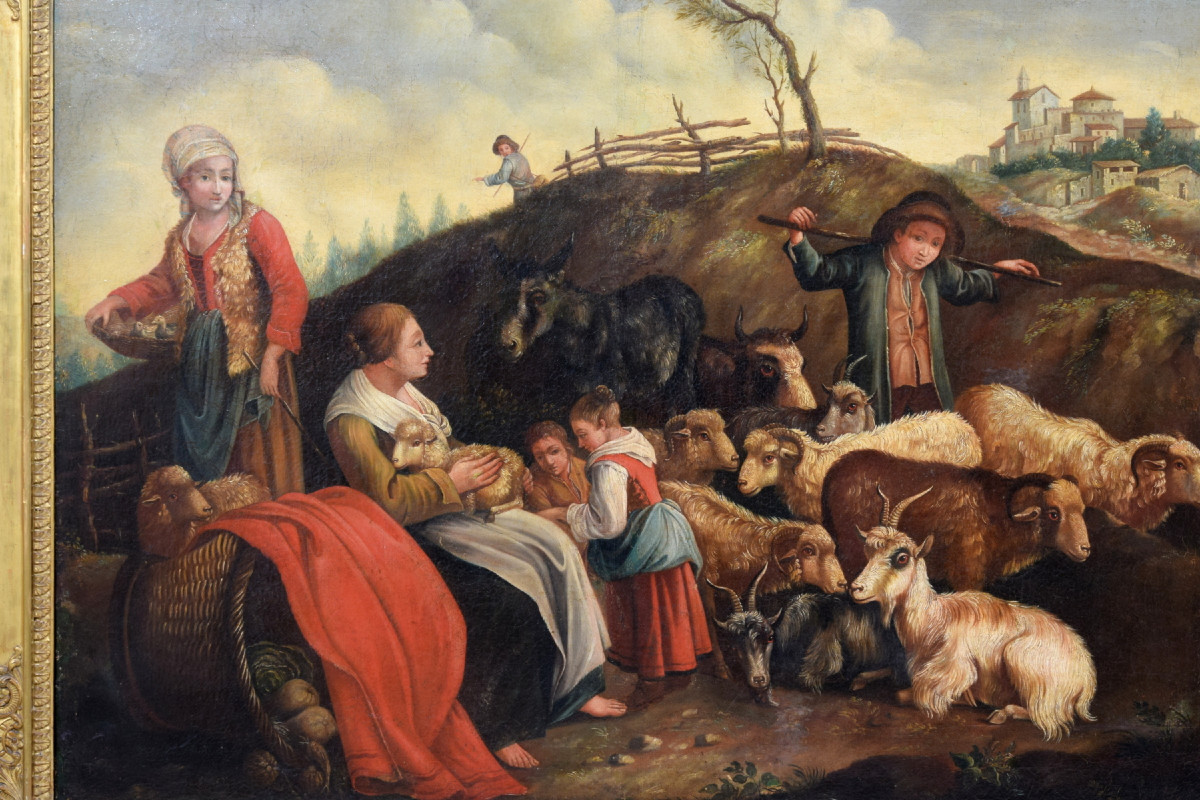
This pairof large-scale paintings, presented in antique gilded wooden frames withmouldings and corner carvings, depicts 18th-century pastoral scenes typical ofthe Lombard tradition (Italy) and close to the manner of the Londonio familyand their followers, recalling the Bergamo area. The compositions are lively,rich in figures, set outdoors and placed within rural landscapes.In thepainting on the left, the foreground features a group of shepherds and youngshepherdesses arranged in a way that guides the viewer’s gaze toward the centreof the scene. A seated woman holds a lamb on her lap and appears to beinteracting with two young girls who approach her affectionately. To the left,another young woman stands holding a wicker basket filled with straw and twochicks. Her balanced pose and simple yet well-kept attire contribute to theeveryday character of the scene.On the right, a young shepherd with a staff resting across his shouldersoversees a varied flock of sheep and goats. The animals, rendered withnaturalistic accuracy, are one of the most characteristic elements of theLondonio tradition: expressive, vivid, and carefully portrayed in theirpostures and in the depiction of their fur. Alongside the sheep appear a donkeyand other animals, further enriching the narrative. The background reveals asoft, rolling landscape crossed by a fence and dominated by a distant village,with houses and a church standing out against a cloudy sky. Warm tones anddiffused light create a serene, bucolic atmosphere suggestive of a peacefulworking day among fields and pastures.The secondpainting, presented here on the right, features an equally elaborate and livelyscene built through a collective narrative of human and animal figures. In theforeground on the left, an elderly shepherd sits on the ground, surrounded byhis sheep; his relaxed posture, serene face, and the presence of a small dog byhis side infuse the scene with a sense of domestic intimacy. At the centrestands a younger man beside a horse carrying a gourd water flask, a winebarrel, and—attached to the saddle—several baskets containing two small lambs.His gesture, with an outstretched arm pointing into the distance, introducesnarrative dynamism and leads the viewer’s eye toward the background. Next tohim, on the right, a woman adds a familiar and almost affectionate tone to thepastoral scene. Other figures appear behind her, forming a compact, industriousgroup. The horse and the various sheep and goats, painted with evidentnaturalistic attention, again confirm the stylistic influence of the Londonioschool, known for its detailed and lively depictions of farm animals. Thebackground presents a wide hilly landscape with a small village perched on arise. A woodland area with lush green trees adds depth, while the bright skystreaked with light clouds harmonizes the entire composition.Theatmosphere of these paintings reflects the simple everyday life of a ruralcommunity absorbed in its work, captured in moments of pause or transition. Theoverall effect conveys a sense of familial harmony, typical of Lombard rusticscenes, where the relationship between people, animals, and landscape isdepicted with tenderness and narrative engagement.The figures are reinterpreted in a personal way and gathered into an originalcomposition, drawing inspiration from various engravings by Francesco Londonio,to which they clearly relate through formal and thematic affinities.TheLondonio family holds a significant place in the artistic history of Lombardy,in the north of Italy, in the 18th century. Its most renowned member isFrancesco Londonio (1723–1783), a Milanese painter and engraver, though thefamily also included other artists who contributed to the creation of a trueschool devoted to pastoral painting. The Londonio workshop in Milan became atraining ground for several artists: not an institutional school, but acreative environment where style, subjects, and ways of depicting the ruralworld were handed down.The term Londonio school refers to a group of painters, mostly Lombard,active between the second half of the 18th century and the early 19th century,who drew inspiration from Francesco Londonio’s pastoral scenes, hisaffectionate naturalism in the depiction of animals, the intimate, everydaycompositions, warm colours and soft light, and above all his celebratedengravings, true iconographic matrices used as models.Many ofthese artists cannot always be precisely identified, but belong to a broadproductive stream: works destined for villas, country houses, and bourgeoisresidences seeking elegant, reassuring rural subjects.FrancescoLondonio was born in Milan in 1723. Tradition cites an early training withFerdinando Porta, a late-Baroque Milanese painter, and later with BenignoBossi, whose influence brought him closer to engraving. Painting andprintmaking remained central throughout his production. Londonio became famousfor a genre highly prized at the time: rustic painting. His works portrayscenes of shepherds, farmers, flocks of sheep and goats, domestic animals,rustic interiors, and rural landscapes.His style combines elements of Lombard naturalism with influences from AntonioAllegri known as Correggio, Ceruti, Philip Peter Roos, Van Laer and DomenicoBrandi, whom he encountered during his travels to Cremona, Rome, and Naples;all fused with a sentimental and idyllic tone that made his works popular amongthe nobility, the bourgeoisie, and the ecclesiastical world. Admirers includedArchbishop Pozzobelli, Cardinal Vitaliano Borromeo, and Cardinal Angelo MariaDurini.In addition to his paintings, Londonio produced numerous etchings—often on thesame pastoral subjects—which helped spread his fame beyond Lombardy and aretoday considered central to the 18th-century Italian engraving tradition. Hespent most of his life in Milan, where he continued to paint, engrave, andteach. He died in 1783, leaving a vast corpus of paintings and prints.Londonio is regarded as one of the foremost interpreters of Lombard pastoralpainting in the 18th century.The authorof this pair of works belongs to this tradition, drawing upon Londonio’siconographic models and reinterpreting them freely. The ability to rework theseschemes without losing their original matrix reveals not only a thoroughunderstanding of Londonio’s pictorial language but also a desire to update itthrough freer and more personal solutions.In this sense, the two paintings under examination stand as significanttestimony to the success of the Londonio school in the late 18th century andbeyond, showing how his legacy continued to influence artists and patronssensitive to rural atmospheres, the gentle naturalism of the figures, and thecarefully constructed spatial arrangements.The lively colour palette and balanced composition make these large-formatworks highly decorative and particularly pleasant. They may be displayed aboveconsoles or chests of drawers, or hung side by side on the wall of a livingroom, study, entrance hall, or corridor, enhancing the charm and dynamism ofthe décor.
Weapologize for any translation errors from Italian. Please click here to viewthe expertise in Italian.
Frame: W 157 x H 130 x D 9 cm; canvas: 139 x 110 cm
This pairof large-scale paintings, presented in antique gilded wooden frames withmouldings and corner carvings, depicts 18th-century pastoral scenes typical ofthe Lombard tradition (Italy) and close to the manner of the Londonio familyand their followers, recalling the Bergamo area. The compositions are lively,rich in figures, set outdoors and placed within rural landscapes.In thepainting on the left, the foreground features a group of shepherds and youngshepherdesses arranged in a way that guides the viewer’s gaze toward the centreof the scene. A seated woman holds a lamb on her lap and appears to beinteracting with two young girls who approach her affectionately. To the left,another young woman stands holding a wicker basket filled with straw and twochicks. Her balanced pose and simple yet well-kept attire contribute to theeveryday character of the scene.On the right, a young shepherd with a staff resting across his shouldersoversees a varied flock of sheep and goats. The animals, rendered withnaturalistic accuracy, are one of the most characteristic elements of theLondonio tradition: expressive, vivid, and carefully portrayed in theirpostures and in the depiction of their fur. Alongside the sheep appear a donkeyand other animals, further enriching the narrative. The background reveals asoft, rolling landscape crossed by a fence and dominated by a distant village,with houses and a church standing out against a cloudy sky. Warm tones anddiffused light create a serene, bucolic atmosphere suggestive of a peacefulworking day among fields and pastures.The secondpainting, presented here on the right, features an equally elaborate and livelyscene built through a collective narrative of human and animal figures. In theforeground on the left, an elderly shepherd sits on the ground, surrounded byhis sheep; his relaxed posture, serene face, and the presence of a small dog byhis side infuse the scene with a sense of domestic intimacy. At the centrestands a younger man beside a horse carrying a gourd water flask, a winebarrel, and—attached to the saddle—several baskets containing two small lambs.His gesture, with an outstretched arm pointing into the distance, introducesnarrative dynamism and leads the viewer’s eye toward the background. Next tohim, on the right, a woman adds a familiar and almost affectionate tone to thepastoral scene. Other figures appear behind her, forming a compact, industriousgroup. The horse and the various sheep and goats, painted with evidentnaturalistic attention, again confirm the stylistic influence of the Londonioschool, known for its detailed and lively depictions of farm animals. Thebackground presents a wide hilly landscape with a small village perched on arise. A woodland area with lush green trees adds depth, while the bright skystreaked with light clouds harmonizes the entire composition.Theatmosphere of these paintings reflects the simple everyday life of a ruralcommunity absorbed in its work, captured in moments of pause or transition. Theoverall effect conveys a sense of familial harmony, typical of Lombard rusticscenes, where the relationship between people, animals, and landscape isdepicted with tenderness and narrative engagement.The figures are reinterpreted in a personal way and gathered into an originalcomposition, drawing inspiration from various engravings by Francesco Londonio,to which they clearly relate through formal and thematic affinities.TheLondonio family holds a significant place in the artistic history of Lombardy,in the north of Italy, in the 18th century. Its most renowned member isFrancesco Londonio (1723–1783), a Milanese painter and engraver, though thefamily also included other artists who contributed to the creation of a trueschool devoted to pastoral painting. The Londonio workshop in Milan became atraining ground for several artists: not an institutional school, but acreative environment where style, subjects, and ways of depicting the ruralworld were handed down.The term Londonio school refers to a group of painters, mostly Lombard,active between the second half of the 18th century and the early 19th century,who drew inspiration from Francesco Londonio’s pastoral scenes, hisaffectionate naturalism in the depiction of animals, the intimate, everydaycompositions, warm colours and soft light, and above all his celebratedengravings, true iconographic matrices used as models.Many ofthese artists cannot always be precisely identified, but belong to a broadproductive stream: works destined for villas, country houses, and bourgeoisresidences seeking elegant, reassuring rural subjects.FrancescoLondonio was born in Milan in 1723. Tradition cites an early training withFerdinando Porta, a late-Baroque Milanese painter, and later with BenignoBossi, whose influence brought him closer to engraving. Painting andprintmaking remained central throughout his production. Londonio became famousfor a genre highly prized at the time: rustic painting. His works portrayscenes of shepherds, farmers, flocks of sheep and goats, domestic animals,rustic interiors, and rural landscapes.His style combines elements of Lombard naturalism with influences from AntonioAllegri known as Correggio, Ceruti, Philip Peter Roos, Van Laer and DomenicoBrandi, whom he encountered during his travels to Cremona, Rome, and Naples;all fused with a sentimental and idyllic tone that made his works popular amongthe nobility, the bourgeoisie, and the ecclesiastical world. Admirers includedArchbishop Pozzobelli, Cardinal Vitaliano Borromeo, and Cardinal Angelo MariaDurini.In addition to his paintings, Londonio produced numerous etchings—often on thesame pastoral subjects—which helped spread his fame beyond Lombardy and aretoday considered central to the 18th-century Italian engraving tradition. Hespent most of his life in Milan, where he continued to paint, engrave, andteach. He died in 1783, leaving a vast corpus of paintings and prints.Londonio is regarded as one of the foremost interpreters of Lombard pastoralpainting in the 18th century.The authorof this pair of works belongs to this tradition, drawing upon Londonio’siconographic models and reinterpreting them freely. The ability to rework theseschemes without losing their original matrix reveals not only a thoroughunderstanding of Londonio’s pictorial language but also a desire to update itthrough freer and more personal solutions.In this sense, the two paintings under examination stand as significanttestimony to the success of the Londonio school in the late 18th century andbeyond, showing how his legacy continued to influence artists and patronssensitive to rural atmospheres, the gentle naturalism of the figures, and thecarefully constructed spatial arrangements.The lively colour palette and balanced composition make these large-formatworks highly decorative and particularly pleasant. They may be displayed aboveconsoles or chests of drawers, or hung side by side on the wall of a livingroom, study, entrance hall, or corridor, enhancing the charm and dynamism ofthe décor.
Weapologize for any translation errors from Italian. Please click here to viewthe expertise in Italian.
24 500 €
Period: 18th century
Style: Louis 14th, Regency
Condition: Good condition
Material: Oil painting
Length: 157
Height: 130
Depth: 9
Reference (ID): 1673389
Availability: In stock
Print